It’s possible that I shall make an ass of myself. But in that case one can always get out of it with a little dialectic. I have, of course, so worded my proposition as to be right either way (K.Marx, Letter to F.Engels on the Indian Mutiny)
Thursday, August 28, 2025
QUANTUM
Penn engineers send quantum signals with standard internet protocol
New integrated chip shows how quantum networks could “speak” today’s internet language on existing commercial fiber-optic cables
University of Pennsylvania School of Engineering and Applied Science
Yichi Zhang, a doctoral student in Materials Science and Engineering, with the equipment used to generate and send the quantum signal over Verizon fiber optic cables. (Credit: Sylvia Zhang)
In a first-of-its-kind experiment, engineers at the University of Pennsylvania brought quantum networking out of the lab and onto commercial fiber-optic cables using the same Internet Protocol (IP) that powers today’s web. Reported in Science, the work shows that fragile quantum signals can run on the same infrastructure that carries everyday online traffic. The team tested their approach on Verizon’s campus fiber-optic network.
The Penn team’s tiny “Q-chip” coordinates quantum and classical data and, crucially, speaks the same language as the modern web. That approach could pave the way for a future “quantum internet,” which scientists believe may one day be as transformative as the dawn of the online era.
Quantum signals rely on pairs of “entangled” particles, so closely linked that changing one instantly affects the other. Harnessing that property could allow quantum computers to link up and pool their processing power, enabling advances like faster, more energy-efficient AI or designing new drugs and materials beyond the reach of today’s supercomputers.
Penn’s work shows, for the first time on live commercial fiber, that a chip can not only send quantum signals but also automatically correct for noise, bundle quantum and classical data into standard internet-style packets, and route them using the same addressing system and management tools that connect everyday devices online.
“By showing an integrated chip can manage quantum signals on a live commercial network like Verizon’s, and do so using the same protocols that run the classical internet, we’ve taken a key step toward larger-scale experiments and a practical quantum internet,” says Liang Feng, Professor in Materials Science and Engineering (MSE) and in Electrical and Systems Engineering (ESE), and the Science paper’s senior author.
The Challenges of Scaling the Quantum Internet
Erwin Schrodinger, who coined the term “quantum entanglement,” famously related the concept to a cat hidden in a box. If the lid is closed, and the box also contains radioactive material, the cat could be alive or dead. One way to interpret the situation is that the cat is both alive and dead. Only opening the box confirms the cat’s state.
That paradox is roughly analogous to the unique nature of quantum particles. Once measured, they lose their unusual properties, which makes scaling a quantum network extremely difficult.
“Normal networks measure data to guide it towards the ultimate destination,” says Robert Broberg, a doctoral student in ESE and coauthor of the paper. “With purely quantum networks, you can’t do that, because measuring the particles destroys the quantum state.”
Coordinating Classical and Quantum Signals
To get around this obstacle, the team developed the “Q-Chip” (short for “Quantum-Classical Hybrid Internet by Photonics”) to coordinate “classical” signals, made of regular streams of light, and quantum particles. “The classical signal travels just ahead of the quantum signal,” says Yichi Zhang, a doctoral student in MSE and the paper’s first author. “That allows us to measure the classical signal for routing, while leaving the quantum signal intact.”
In essence, the new system works like a railway, pairing regular light locomotives with quantum cargo. “The classical ‘header’ acts like the train’s engine, while the quantum information rides behind in sealed containers,” says Zhang. “You can’t open the containers without destroying what’s inside, but the engine ensures the whole train gets where it needs to go.”
Because the classical header can be measured, the entire system can follow the same “IP” or “Internet Protocol” that governs today’s internet traffic. “By embedding quantum information in the familiar IP framework, we showed that a quantum internet could literally speak the same language as the classical one,” says Zhang. “That compatibility is key to scaling using existing infrastructure.”
Adapting Quantum Technology to the Real World
One of the greatest challenges to transmitting quantum particles on commercial infrastructure is the variability of real-world transmission lines. Unlike laboratory environments, which can maintain ideal conditions, commercial networks frequently encounter changes in temperature, thanks to weather, as well as vibrations from human activities like construction and transportation, not to mention seismic activity.
To counteract this, the researchers developed an error-correction method that takes advantage of the fact that interference to the classical header will affect the quantum signal in a similar fashion. “Because we can measure the classical signal without damaging the quantum one,” says Feng, “we can infer what corrections need to be made to the quantum signal without ever measuring it, preserving the quantum state.”
In testing, the system maintained transmission fidelities above 97%, showing that it could overcome the noise and instability that usually destroy quantum signals outside the lab. And because the chip is made of silicon and fabricated using established techniques, it could be mass produced, making the new approach easy to scale.
“Our network has just one server and one node, connecting two buildings, with about a kilometer of fiber-optic cable installed by Verizon between them,” says Feng. “But all you need to do to expand the network is fabricate more chips and connect them to Philadelphia’s existing fiber-optic cables.”
The Future of the Quantum Internet
The main barrier to scaling quantum networks beyond a metro area is that quantum signals cannot yet be amplified without destroying their entanglement.
While some teams have shown that “quantum keys,” special codes for ultra-secure communication, can travel long distances over ordinary fiber, those systems use weak coherent light to generate random numbers that cannot be copied, a technique that is highly effective for security applications but not sufficient to link actual quantum processors.
Overcoming this challenge will require new devices, but the Penn study provides an important early step: showing how a chip can run quantum signals over existing commercial fiber using internet-style packet routing, dynamic switching and on-chip error mitigation that work with the same protocols that manage today’s networks.
“This feels like the early days of the classical internet in the 1990s, when universities first connected their networks,” says Broberg. “That opened the door to transformations no one could have predicted. A quantum internet has the same potential.”
This study was conducted at the University of Pennsylvania School of Engineering and Applied Science and was supported by the Gordon and Betty Moore Foundation (GBMF12960 and DOI 10.37807), Office of Naval Research (N00014-23-1-2882), National Science Foundation (DMR-2323468), Olga and Alberico Pompa endowed professorship, and PSC-CUNY award (ENHC-54-93).
Additional co-authors include Alan Zhu, Gushi Li and Jonathan Smith of the University of Pennsylvania, and Li Ge of the City University of New York.
Classical-decisive quantum internet by integrated photonics
Article Publication Date
28-Aug-2025
Part of the equipment used to create a node of the quantum network, roughly one kilometer’s worth of Verizon commercial fiber optic cable away from its source. (Credit: Sylvia Zhang)
A node of the quantum network, roughly one kilometer’s worth of Verizon fiber optic cable away from the quantum signal’s source. (Credit: Sylvia Zhang)
Yichi Zhang, a doctoral student in Materials Science and Engineering, inspects the source of the quantum signal. (Credit: Sylvia Zhang)
From left: Liang Feng, Professor in Materials Science and Engineering, and Robert Broberg, a doctoral student in Electrical and Systems Engineering. The wires behind them include a Verizon fiber optic cable that carried the quantum signal. (Credit: Sylvia Zhang)
Quantum Research Sciences developing AI
platform to help Air Force more efficiently
connect with industry
QRS partnering with Purdue’s Rosen Center for Advanced Computing to create the Automated Commercial Industry Data-Repository platform
WEST LAFAYETTE, Ind. — Quantum Research Sciences (QRS), a leading Indiana-based software company, has been awarded a U.S. Air Force contract to develop an artificial intelligence-driven platform called ACID-R, or Automated Commercial Industry Data-Repository.
The platform is designed to help the Air Force efficiently identify and leverage needed technologies from the private sector. It harnesses AI without the risk of hallucination, or AI-fabricated false information, to quickly deliver details on commercial, military-focused products and services.
Streamlining reviews, improving effectiveness
QRS CEO Ethan Krimins said the Air Force currently receives new technology proposals through antiquated channels like email where relevant information is buried within PDFs that are up to 20 pages long.
“ACID-R is designed to streamline access to commercial capabilities, accelerating defense modernization with sustainment and logistics,” he said.
ACID-R allows vendors to upload their capability statements, and the AI-powered software will extract the relevant information from each proposal.
“The Air Force will then be able to view, search and filter through thousands of proposals rather than manually reviewing each statement,” Krimins said. “ACID-R will also automatically inform vendors of missing information that the Air Force needs, enabling them to create more effective proposals.”
QRS and Purdue connections
QRS is a Purdue Innovates client company. It is partnering with Purdue’s Rosen Center for Advanced Computing to develop the ACID-R platform. RCAC is a national leader in high-performance computing and AI innovation.
Laura Theademan, director of RCAC Center Operations and Visualization, said, “We have been collaborating with Ethan on federal contracts for nearly a decade. This USAF project is the largest and most significant yet.”
Program leader Daniel Madren, the senior research development administrator at RCAC, has been handling the near-daily tech innovation with Air Force counterparts.
“I am thrilled with the progress that our team has made,” he said. “This has been a multipronged effort with our AI scientists, research software engineers and visualization experts all working collaboratively alongside QRS to develop this cutting-edge platform.”
QRS and the DOD
QRS also is the creator of the Department of Defense’s first operational quantum software. It collaborates on the quantum computer software with Andreas Jung, professor of physics and astronomy in Purdue University’s College of Science, and the Jung Research Group, where AJ Wildridge carries out his doctoral research.
Krimins said the company brings its deep expertise at the intersection of quantum computing and national security to this effort.
“Our company’s mission-driven approach emphasizes thorough discovery and coordinated deployment of software solutions that can solve real-world defense challenges,” he said. “With this new initiative, QRS and RCAC will integrate advanced AI techniques to help the Air Force harness the power of private sector innovation.”
About Quantum Research Sciences
Quantum Research Sciences (QRS) is an American technology company focused on the discovery, development and delivery of quantum software. QRS created the DOD’s first operational quantum software and is working toward new quantum software applications every day. For more information on QRS, visit https://quantumresearchsciences.com/.
About Purdue Innovates
Purdue Innovates is a unified network at Purdue Research Foundation to assist Purdue faculty, staff, students and alumni in either IP commercialization or startup creation. As a conduit to technology commercialization, intellectual property protection and licensing, startup creation, and venture capital, Purdue Innovates serves as the front door to translate new ideas into world-changing impact.
For more information on licensing a Purdue innovation, contact the Office of Technology Commercialization at otcip@prf.org. For more information about involvement and investment opportunities in startups based on a Purdue innovation, contact Purdue Innovates at purdueinnovates@prf.org.
About Purdue University
Purdue University is a public research university leading with excellence at scale. Ranked among top 10 public universities in the United States, Purdue discovers, disseminates and deploys knowledge with a quality and at a scale second to none. More than 107,000 students study at Purdue across multiple campuses, locations and modalities, including more than 58,000 at our main campus in West Lafayette and Indianapolis. Committed to affordability and accessibility, Purdue’s main campus has frozen tuition 14 years in a row. See how Purdue never stops in the persistent pursuit of the next giant leap — including its comprehensive urban expansion, the Mitch Daniels School of Business, Purdue Computes and the One Health initiative — at https://www.purdue.edu/president/strategic-initiatives.
How an in-between quantum state could boost future technologies
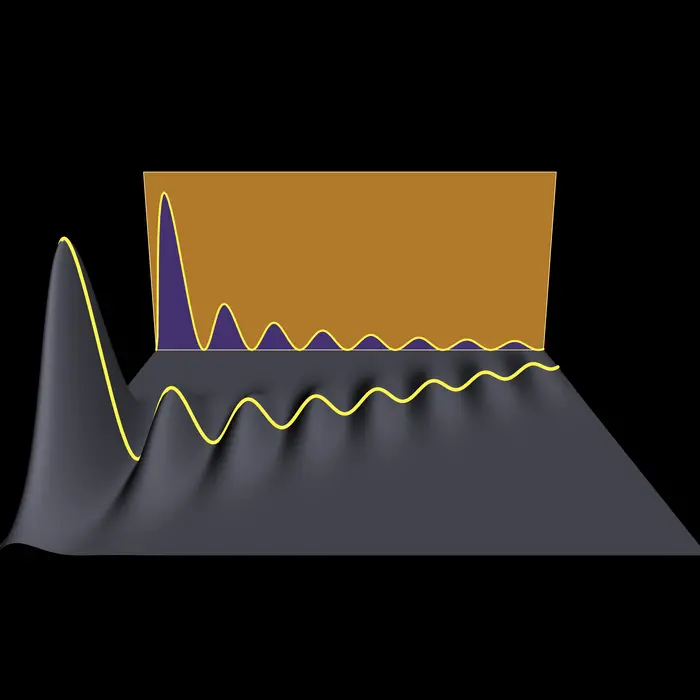
By working in two or more dimensions—as opposed to one dimension, shown in the orange box—researchers have more opportunities to access semi-localized quantum states, according to new research from the University of Michigan. These modes could prove useful in emerging technologies, such as quantum computers.
Credit: K. Zhang et al. Phys. Rev. X. 2025 (DOI: 10.1103/cwwd-bclc) Used under a CC-BY license.
Kai Sun of the University of Michigan is a humble physics professor with ambitious goals.
"I'm mainly a paper-and-pencil type of theorist, doing analytical calculations mostly," Sun said. "My interests are pretty broad, but basically searching for new fundamental principles and new phenomena, especially new phenomena and new physics previously believed to be impossible."
While his newest study doesn't quite hit that impossible threshold, it does still update our conception of physical possibilities. A quantum behavior that was thought to be possible only sometimes can actually be readily realized, according to new work from Sun and his colleagues published in the journal Physical Review X.
Taking advantage of this behavior could help manipulate light and other quantum particles in new ways, which could find applications in emerging fields like quantum computing.
The study was funded, in part, by the Office of Naval Research. U-M research fellow Kai Zhang and graduate student Chang Shu also contributed to the work.
Stay weird, quantum mechanics
While classical physics—the set of natural laws governing the majority of what we see and feel in our everyday lives—tends to be black and white, quantum mechanics is famous for being mushier.
For example, in classical physics, waves and particles are different things. But in the ultratiny quantum realm, things like light and electrons act as both waves and particles. In conventional computers, a bit has a value of either zero or one. In quantum computers, quantum bits act as combinations of ones and zeros.
Sun and his colleagues' new study keeps with quantum's penchant for finding a blurrier middle ground between either-or binaries.
Previously, scientists had thought there were two typical ways an energetic wave or particle—remember, they aren't exactly distinct in quantum mechanics—exist inside materials. To envision these states or modes, think about holding a long rubber band that's been snipped, so it's a straight line instead of a loop.
If you pinched the band at two points near the center and pulled it taut, then had someone pluck it like a guitar string, that gives you one of the states. The energy is contained in the string moving up and down between your fingers, forming a standing wave that doesn't travel along the string.
That's compared with a traveling wave, which would be more like flicking the band like a whip to send a ripple traveling along the length of the band.
"If we use quantum terminology, one is confined or localized. The other is a propagating wave," Sun said.
Researchers had known there was a third, in-between state that's partially, but not completely localized. The problem, or so they thought, was that these states were very persnickety.
I have the power (law)
In the rubber band example of a localized wave, your pinching fingers act as barriers preventing energy from traveling. In real materials, such barriers can be presented by edges or irregularities in their microscopic structures. Confined states or modes can wiggle within those boundaries, but their energy vanishes very quickly outside. To be mathematically precise, that fast decay is exponential.
For propagating waves, there are no such obstacles and no fast decays. But in the in-between, partially confined state, there is a decay that isn't as severe as exponential. That decay is described mathematically by what's called a power law.
"A power law is a much slower decay than exponential, but it's much faster than no decay," Sun said.
Researchers have observed situations with power law decays in real world experiments before, but these situations were thought to be tricky to establish and maintain.
"It was possible, but it needed some kind of fine-tuning," Sun said. "In this work, the fun part is we find a family of systems where all the modes are power law and they're extremely robust. They don't need any fine-tuning."
The paper points to new design considerations that could make accessing these states easier and more reliable moving forward. One of the keys to making this discovery is that, previously, most researchers had focused on one dimensional problems, like the rubber band.
Sun and colleagues considered what happens in two or more dimensions and found cases where power-law decays are the norm near the boundaries or the "skin" of materials. They also found that the behavior of these skin modes was very sensitive to a material's shape, specifically its aspect ratio, which had not been shown before.
Sun said it's exciting both to uncover new physics and to begin imagining applications in areas such as quantum computing. For example, bits might host confined modes for calculations while still allowing power-law modes to transmit information between them.
"This work reveals novel concepts on the fundamental side, while also opening new opportunities for future applications," Sun said.
In everyday life, all matter exists as either a gas, liquid, or solid. In quantum mechanics, however, it is possible for two distinct states to exist simultaneously. An ultracold quantum system, for instance, can exhibit the properties of both a fluid and a solid at the same time. The Synthetic Quantum Systems research group at Heidelberg University has now demonstrated this phenomenon using a new experimental approach, by feeding a small amount of energy into a superfluid. They showed that, in a driven quantum system of this kind, sound waves propagate at two different speeds, which points towards coexisting liquid and solid states, a hallmark of supersolidity.
This surprising and seemingly contradictory behavior of two states of matter existing at the same time does not occur at room temperature. But at ultralow temperatures, quantum mechanics takes over, and matter can exhibit fundamentally different properties. When atoms are cooled to such low temperatures, their wave-like nature is dominant. If brought close enough together, many particles merge into one large wave, known as a Bose-Einstein condensate. This state is a superfluid, a fluid that flows without friction.
In rare cases, superfluids can also exhibit periodic density modulations. Driven by external forces, these modulations cause the superfluid to effectively “crystallize” and take on solid-like properties. Despite this crystallization, the atoms in the system continue to behave as one collective wave, retaining their superfluid characteristics. In quantum mechanics, this coexistence of fluid and solid states is known as supersolidity.
Periodic density modulations in superfluids can, for example, be generated by shaking the system. Much like ripples forming on the surface of water when a bucket is shaken, energy is introduced into the superfluid by “shaking” the interaction between atoms. It becomes a dynamic, externally driven quantum system and is no longer in a state of equilibrium. Previous studies have demonstrated that crystalline order can nevertheless arise in such systems. However, as Prof. Dr Markus Oberthaler, head of the Synthetic Quantum Systems group, explains, the connection between these crystallization patterns and supersolidity had not yet been investigated through experiments.
A defining feature of supersolids is the presence of two types of sound waves: one that perturbs the superfluid, and another that perturbs the crystalline order. Using advanced experimental techniques, the Heidelberg physicists have now successfully triggered each of these perturbations separately. As part of this, they examined how the sound waves moved through the driven quantum system. They found that the resulting defects travelled at different speeds, indicating that the system exhibits both liquid and solid characteristics, making it supersolid.
“It is fascinating to see that simply by adding a little bit of energy to a superfluid, we can give it the properties of a solid,” says Prof. Oberthaler. “The excited superfluid supports oscillations like a solid does, with atoms vibrating in sync around their equilibrium positions as a sound wave passes,” explains the researcher, who works with his group at Heidelberg University’s Kirchhoff Institute for Physics.
According to Nikolas Liebster, this work represents the first observation of supersolid sound waves in a system far from equilibrium. “Typically, supersolids are discussed in terms of equilibrium physics, meaning everything is static in time,” says the physicist and member of Prof. Oberthaler’s research group. “Now we are shaking the superfluid, thereby injecting energy into it, and we’ve discovered that the concept of supersolidity remains valid even well outside equilibrium conditions.”
This research is part of the work carried out within the Collaborative Research Centre “Isolated Quantum Systems and Universality in Extreme Conditions” (ISOQUANT) and the STRUCTURES Cluster of Excellence at Heidelberg University. It was funded by the German Research Foundation. The results have been published in “Nature Physics”.
No comments:
Post a Comment