It’s possible that I shall make an ass of myself. But in that case one can always get out of it with a little dialectic. I have, of course, so worded my proposition as to be right either way (K.Marx, Letter to F.Engels on the Indian Mutiny)
Tuesday, August 19, 2025
Report: Methanol and Ammonia Fuel Are Quickly Moving from Theory to Reality
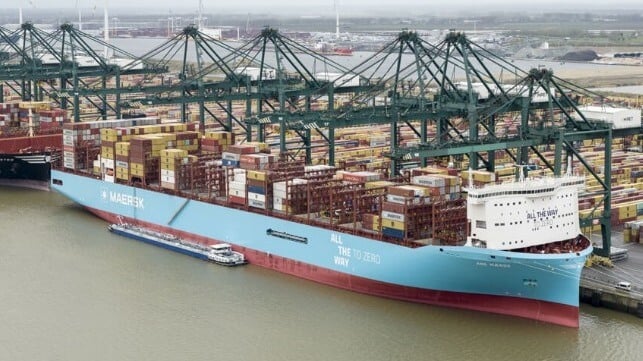
Methanol and ammonia as marine fuels are making quick progress and are now ready for the industry (Maersk)
The age of methanol and ammonia-powered vessels is quickly emerging, finds a new report from the Global Maritime Forum’s Getting to Zero Coalition. Based on interviews from across the industry, the report finds that both alternative fuels have made significant progress and have “arrived” as shipping fuels.
The Coalition highlights that it has been tracking the process since 2020 and, based on its findings, says it believes both fuels are now ready. This is a significant increase in maturity since the first report in 2020, but they also highlight the need for significant support to get the fuels from the pilot stage to maturity. The report warns that the fuels require a concerted push if they are to be mature enough to rapidly scale from around 2030, in line with the industry’s targets.
Based on the progress, the report this year focuses specifically on methanol and ammonia as marine fuels. It notes that they are relatively early in their adoption, yet have significant potential in the long term. They also shifted the analysis to three stages, starting with proof of concept, then initial scale, and finally maturity.
Methanol, the report notes, is rapidly moving from proof of concept to early scale (more than 60 methanol-capable vessels in operation, 300 more on order, and bunkering available at around 42 ports). Early adopters are finding it relatively safe and straightforward to integrate. Its lower energy density, however, presents operational trade-offs but has not proven a barrier, and new retrofit kits and the relative ease of converting tanks are making retrofitting conventional vessels feasible. They note that methanol is relatively easy to bunker as it can use existing vessels with limited modifications and faces limited concerns from port workers.
The key challenge for methanol to achieve broader scale-up is the availability of green methanol, which makes up only a small share of the total supply and remains challenging for shipping companies to access. Most methanol used on ships to date they note has been grey methanol, with only small volumes of bio-methanol being bunkered since 2023 and the first volumes of e-methanol being bunkered in May 2025. China, they note, is at the forefront of supplies of green methanol, but it is costly and must be accessed through long-term offtake agreements.
Ammonia is acknowledged as less mature, while the report concludes it is rapidly approaching proof of concept as a marine fuel, with engine tests suggesting it can cut tank-to-wake emissions by up to 95 percent. The first ammonia-powered vessels have been successfully piloted, engine testing is near completion, and bunkering trials are underway – none of which have revealed any fundamental barriers to adoption. Operators report confidence in safely operating ammonia-powered vessels and will likely phase the fuel in over time to build operational experience.
One of the big challenges they note for ammonia is mixed reactions from seafarers about the prospects of working on ammonia-fueled ships and hesitations. The Coalition notes that training of crews to operate the first wave of ammonia-powered vessels is underway.
The testing they report, however, is very positive for ammonia. They note the concerns, including nitrous oxide emissions and ammonia slip, saying either could represent showstoppers for the fuel. Early engine tests, the report highlights suggest that operating on ammonia could reduce a ship’s tank-to-wake emissions by between 90 and 95 percent. They said this addresses earlier uncertainty for ammonia-fueled engines.
“We are only at the start of our journey, and technology readiness is not enough by itself. To scale zero-emission fuels at the pace required, we need action from the International Maritime Organization, national policymakers, and the industry to create the right enabling conditions; this will be just as vital as the development of the technology itself."
The key area the report concludes that must be addressed is the fuel supply chain. In the case of methanol, they highlight the need for enhancing the availability of green molecules. The key points for ammonia are validating and rolling out commercial ammonia bunkering at key ports.
To achieve the concerted push required to meet the industry’s decarbonization goals, the Getting to Zero Coalition says targeted policy incentives still need to be provided along with funding to close the cost gap and support early adopters. They also call for establishing robust, harmonized fuel certification systems and aggregating fuel demand to create the investment case for developing the bunkering infrastructure. They also believe that CAPEX grants will be necessary for the investment in bunkering infrastructure, and especially for bunkering vessels.
MOL and ITOCHU Plan Ammonia Bunkering Demonstrations in Singapore
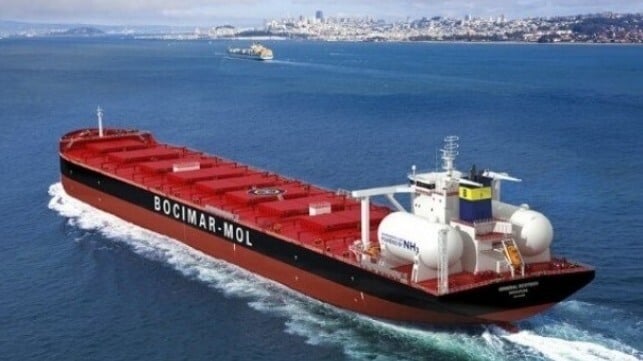
MOL will use its ammonia-powered bulkers along with ITOCHU for the first STS ammonia bunkering demonstrations (MOL)
Mitsui O.S.K. Lines, which has announced its plans to operate some of the first ammonia-powered vessels, is joining with ITOCHU Corporation to advance plans for pioneering ammonia bunkering demonstrations. The announcement comes as the Global Maritime Forum’s Getting to Zero Coalition released its annual report highlighting that one of the largest challenges remaining for ammonia as a marine fuel is bunkering.
The first ammonia bunkering of a vessel took place in Singapore at the beginning of 2024 on a demonstration basis. Since then, Japan and China have also conducted ammonia bunkering, but it is still very much on a trial basis. The Getting to Zero Coalition highlights that so far, there have not been any ship-to-ship ammonia bunkering, although a test to simulate the transfer of ammonia was undertaken off Australia nearly a year ago.
Singapore has been at the forefront of mapping the safety and management requirements to develop this new field of bunkering. Norway has also issued the first safety permits, while Rotterdam is also preparing for ammonia bunkering.
Under the new joint development agreement, MOL and ITOCHU will collaborate on initiatives with the aim of carrying out the demonstration of ship-to-ship ammonia bunkering in Singapore. They look to position as first movers in the field of ammonia bunkering vessels and ammonia-fueled vessels. Through the demonstrations which are planned to be carried out in the second half of 2027, MOL and ITOCHU aim to promote the early implementation of ammonia bunkering vessels and ammonia-fueled vessels.
ITOCHU ordered the world's first newbuilding 5,000 cbm ammonia bunkering vessel in June 2025. The vessel will be built by Sasaki Shipbuilding Co. in Japan and is to be flagged under the Singapore Registry. It is scheduled to be delivered in 2027.
Through conducting ammonia bunkering demonstrations, ITOCHU says it aims to establish safe offshore bunkering operations of ammonia as a marine fuel. Furthermore, it aims to commercialize the ammonia bunkering business at key maritime traffic locations in Singapore and other countries worldwide. ITOCHU has launched a specific-purpose company, Clean Ammonia Bunkering Shipping Pte, to proceed with the development of the ammonia bunkering business and to lead the demonstrations in Singapore.
MOL has already announced that it will jointly own three ammonia dual-fuel Capesize bulkers with Belgium-based CMB.TECH. The vessels will be built by China State Shipbuilding Corporation's Qingdao Beihai Shipbuilding Co. and are expected to be delivered between 2026 and 2027. These vessels, chartered by MOL, will be the world's first ammonia dual-fuel Capesize bulkers, and they will participate in the bunkering demonstration with ITOCHU’s bunker vessel.
Developing the protocols and demonstrating the safety and efficacy of ammonia bunkering is seen as a key step toward developing the commercial market.
Coal made up 54% of Asia’s power mix in 2024, driving countries to explore ammonia co-firing as a decarbonization strategy.
Rystad Energy projects a ninefold increase in ammonia demand by 2030, but warns of an 8.8 Mtpa supply gap and high production costs.
China, Japan, South Korea, and Indonesia are leading efforts, though success depends on foreign partnerships, infrastructure, and supportive policies.
With coal accounting for 54% of Asia’s power mix last year, the region faces a significant challenge in meeting its net-zero ambitions. In a bid to cut emissions, several Asian countries are turning to ammonia for power generation, particularly through co-firing, blending low-carbon ammonia with coal or natural gas. Rystad Energy expects China, Indonesia, Japan and South Korea to emerge as key hubs for this transition. However, a sizeable supply gap remains, with about 8.8 million tonnes per annum (Mtpa) of ammonia needed to meet 2030 targets.
Having relied on coal for decades, Asia lacks both the policy frameworks and the market demand needed to justify investment in infrastructure for ammonia as an energy source. Countries such as Japan and South Korea also face resource constraints, whether limited natural gas or insufficient renewable capacity, that hinder domestic production of clean ammonia. To meet net-zero goals, they will need to import clean ammonia from overseas, enabling coal replacement as a baseload power source while safeguarding energy security and affordability.
Ammonia co-firing is currently expensive, mainly due to the high costs associated with low-carbon hydrogen production, ammonia conversion and transportation. However, countries in Asia appear willing to tackle this challenge and advance their co-firing plans. Assuming a low-carbon hydrogen price of $5 per kilogram, which corresponds to an ammonia price of $1,000 per tonne, Rystad Energy estimates that the levelized cost of electricity for a 10% ammonia blend will be about 50% higher than coal-only generation. This indicates that costs must be tackled through innovation, economies of scale, or the implementation of a meaningful carbon price to make ammonia co-firing competitive.
While hydrogen and ammonia are set to play a growing role in decarbonizing Asia's power sector, much of the progress hinges on foreign partnerships and long-term offtake agreements. Even with high costs associated with hydrogen, our data shows that ammonia demand from power generation is expected to grow ninefold by 2030. However, without firm offtake commitments and accelerated development of critical import infrastructure, this growth could stall. While several key Asian players are already in discussions with international partners to secure ammonia supply, progress on import terminals and co-firing capabilities must speed up,
Minh Khoi Le, Head of Hydrogen Research, Rystad Energy
No comments:
Post a Comment