Requests for EU solidarity to battle wildfires at same level already as entire 2024 fire season
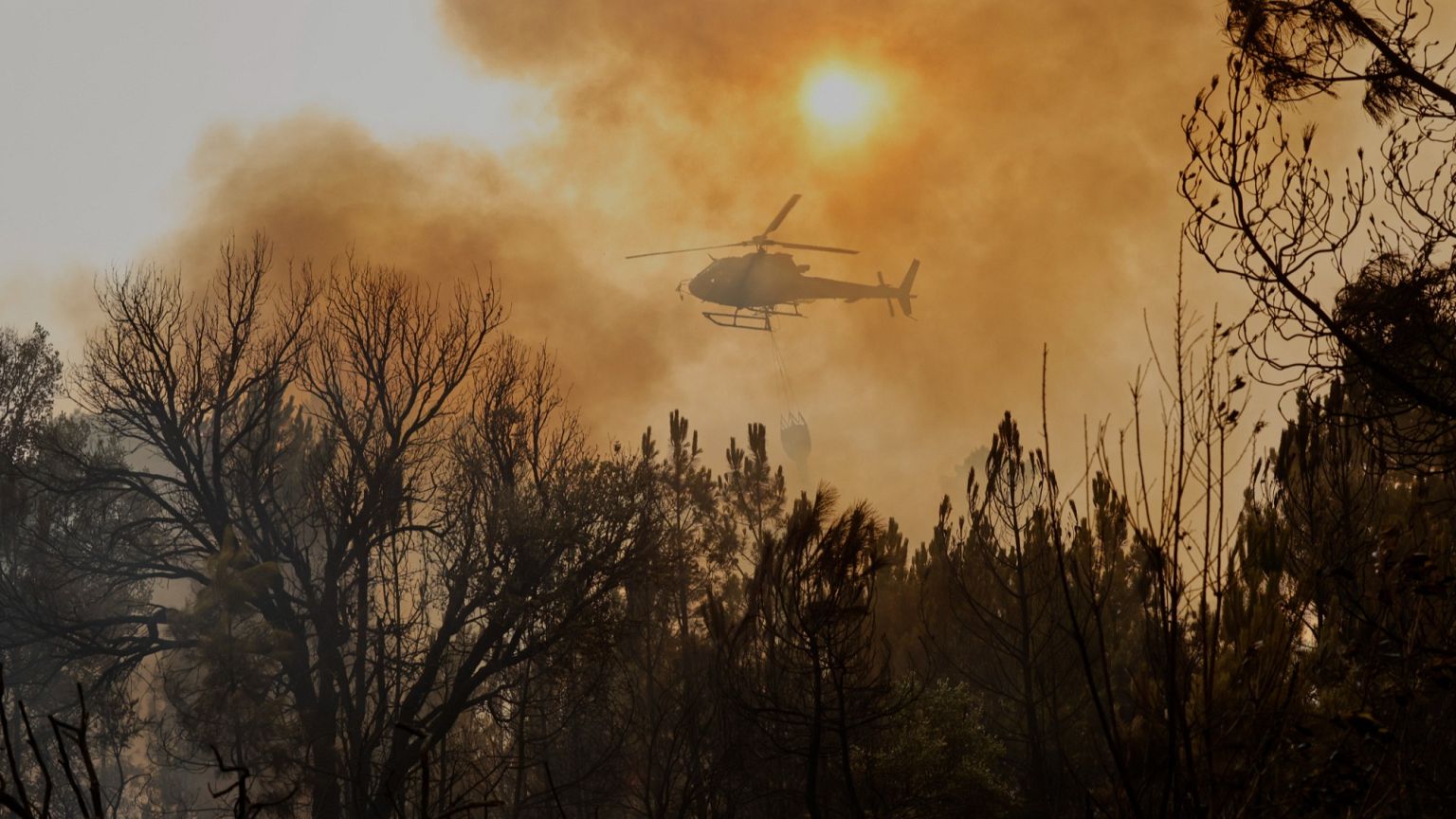
Spain made its first-ever request for European assistance to tackle wildfires on Wednesday.
The number of requests for European solidarity to help tackle wildfires this week reached the same tally as for the entire 2024 fire season, the European Commission announced on Thursday.
"Overall, the mechanism has been activated 16 times during the current season and we are in mid-August," European Commission spokesperson Eva Hrncirova told reporters on Thursday. "This is already equal to the total amount of activations during the whole summer season last year."
Spain became the latest country on Wednesday to turn to the mechanism, making its first-ever request for European solidarity against wildfires.
At least three people have died in Spain, including a volunteer firefighter, as wildfires sweep through the north-western Léon province.
Two planes from the rescEU strategic reserve, currently stationed in France, were expected to be deployed to Spain on Thursday
Bulgaria, Montenegro, Albania and Greece also asked for assistance this week.
Spain and Greece, which are traditionally heavily affected by wildfires, are among the EU member states that have had foreign firefighters pre-positioned on their soil since July.
A total of 650 firefighters from 14 European countries were pre-deployed in high-risk areas - the highest number since the scheme was launched in 2022 - with France and Portugal also welcoming foreign teams.
Among the other European countries that have activated the mechanism specifically for wildfires this year are Cyprus, Bosnia and Herzegovina, and North Macedonia. Israel and Syria have also requested assistance.
The way it works is that a country needing assistance tells the EU's Emergency Response Coordination Centre (ERCC) what they need and other states that are part of the mechanism can then individually contribute by volunteering equipment and manpower. The EU's Civil Protection mechanism then coordinates the deployment of the various contributions and foots the bill.
France, which battled its largest wildires in decade earlier this month in the southern coastal département of Aude, did not ask for further European assistance.
"It's a decision of the member state to ask for assistance or not. Big countries usually have big capacities and they have increased their capacities in the past due to the effect of the global warming and more often wildfires," European Commission spokesperson Hrncirova explained on Thursday.
"You can see that very often it's useful for smaller countries. We often have requests from Western Balkans, Albania, Montenegro. Macedonia. So for these countries, the assistance can be really crucial," she added.
More than 511,000 hectares had been turned to ashes across the EU by 12 August according to the European Forest Fire Information System (EFFIS), more than double the average tallied at the same time over the 2006-2024 period.
The number of fires observed since the beginning of the year has reached over 1,600, a jump from the average of 717 seen by the same date over the past 20 years.
Spain seeks EU help as wildfires kill three
and force thousands to flee
Spain has asked for European Union help to fight forest fires in the northwest that have killed three people and forced more than 8,000 to flee their homes.
Issued on: 14/08/2025 - RFI

Interior Minister Fernando Grande-Marlaska said on Wednesday that Spain has called on the EU’s assistance mechanism to help battle at least 14 fires across the country.
Spain has requested two Canadair firefighting aircraft and is ready to seek more help, including extra firefighters, if needed.
The EU assistance system, set up in 2001, allows the 27 member states and 10 other countries to support each other during emergencies.
Fires, fuelled by extreme temperatures and strong winds, have destroyed thousands of hectares in several regions of Spain, as they have elsewhere in Europe, notably in France and Portugal.
A person fighting the fire in Castile and León was killed on Thursday, bringing the death toll to three. Seven people were taken to hospital on Wednesday.
More than 8,000 people have been evacuated from their homes in Spain's León and Zamora provinces.
Galicia’s regional president Alfonso Rueda said 30 fires are being extinguished every day.
In Ourense province, firefighters have been unable to contain a large blaze in Chandrexa de Queixa. About 11,500 hectares have been burned there.
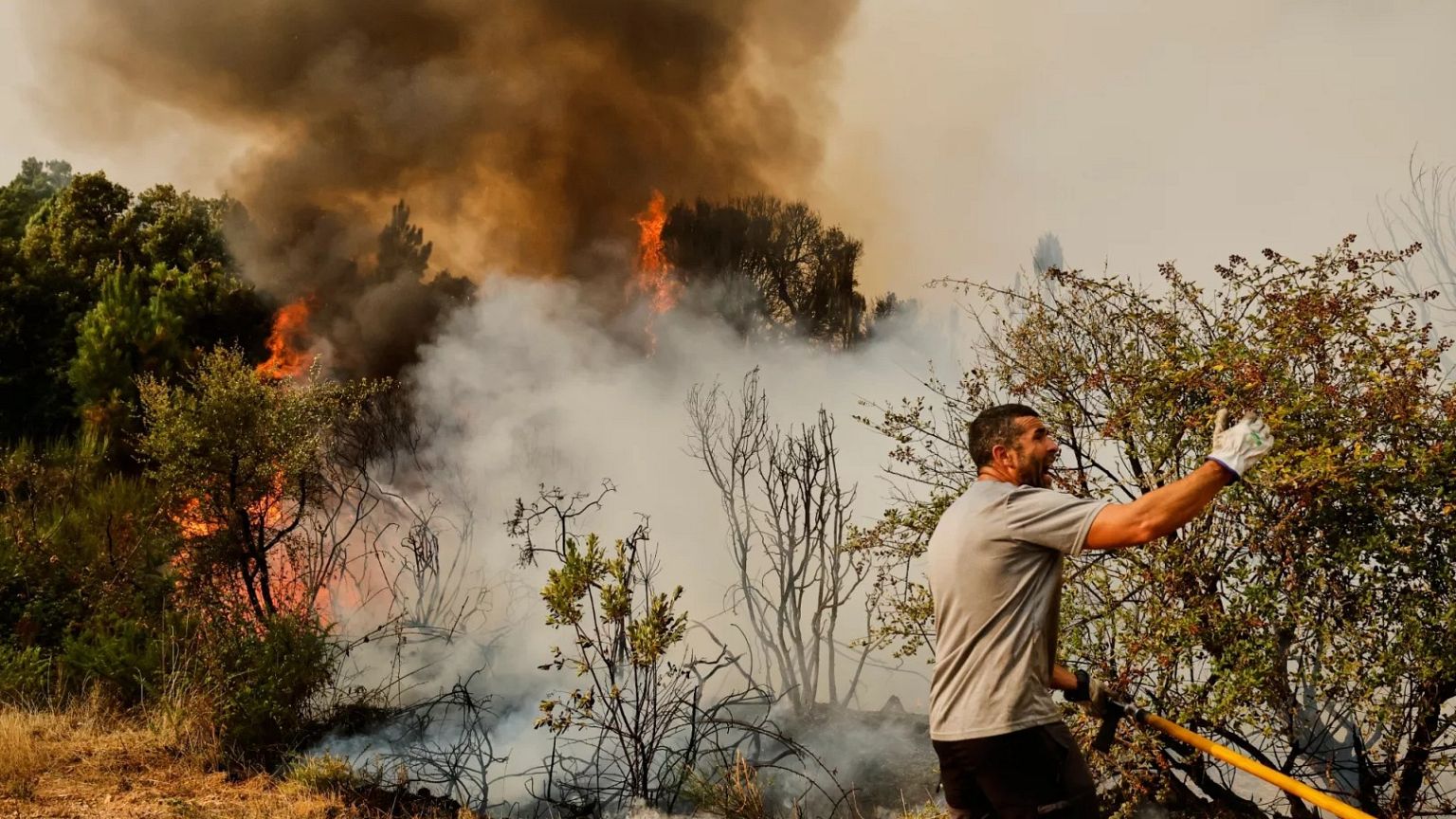
Copyright Thanassis Stavrakis/Copyright 2025 The AP. All rights reserved
By Euronews
Published on 14/08/2025 -
At least three have been killed as the European Commission said requests to help tackle wildfires this week reached the same count as for the entirety of 2024.
Thousands have been displaced after record temperatures sparked wildfires across southern Europe and triggered an unprecedented level of assistance from the European Commission.
Greece, Spain and Portugal have ordered mass evacuations after fires threatened to scorch towns and villages across all three countries.
In the Greek port city of Patras, firefighters struggled to protect homes and farms from flames that tore through pine forests and olive groves.
"Today is another very difficult day with the level of fire risk remaining very high across many parts of the country," fire fervice spokesperson Vassilis Vathrakoyiannis said.
At least 15 firefighters have been hospitalised or received medical attention for burns, smoke inhalation or exhaustion, he added.
Local media reported that two young men were arrested for arson late Wednesday evening on charges of setting the fire that first broke out on Tuesday in the Syhena district of Patras.
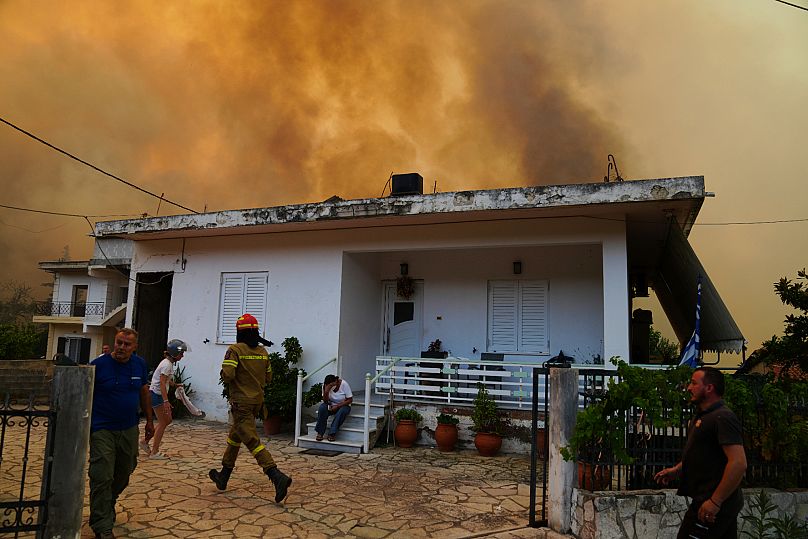
The flames, fuelled by strong winds, have damaged an unknown number of homes, businesses and two monasteries.
Firefighting resources in multiple countries have been stretched thin as they battle simultaneous fire outbreaks in scorching temperatures.
Aircraft forces in Greece rotated between blazes on the western mainland, the Patras area and the island of Zakynthos.
Athens has also sent reinforcements to neighbouring Albania, which is struggling to contain dozens of wildfires. An elderly man has died in one fire south of Tirana, officials said on Wednesday.
Spain reports catastrophic wildfire season
In Spain, Prime Minister Pedro Sánchez expressed condolences after the death of a volunteer firefighter in the Castile and León region north of the capital, Madrid, where more than 8,000 residents have been ordered to evacuate from at least thirty towns.
Authorities said that fires in León have burned through around 38,000 hectares of land. They confirmed the death of a 37-year-old man and at least 12 injuries between the municipalities of Zamora and León.
"The wildfire situation remains serious, and taking extra precautions is essential," Sánchez wrote in an online post.
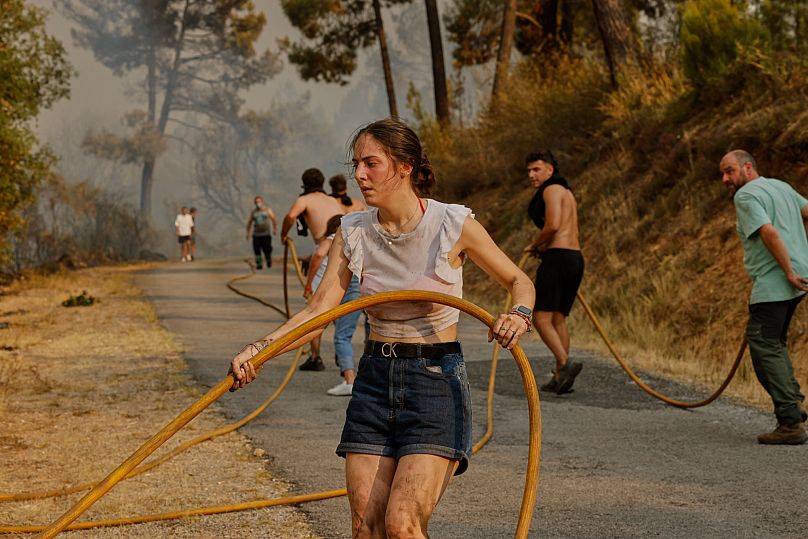
Evacuation centres in central Spain were filled to capacity, with some spending the night outdoors on folding beds. The most severe fires in the country pushed northward into rural areas.
Officials in Valencia declared a level two emergency after a fire reportedly triggered by a bout of lightening forced the preventative evacuation of several districts, whilst in seven fires remain active in the north-western city of Ourense.
Thousands of firefighters deployed in Portugal
In Portugal, authorities have deployed thousands of firefighting crews to combat fires that have been ongoing for several weeks.
Wildfires are particularly intense in the town of Arganil, where more than 900 firefighters combat a "very unfavourable" situation, authorities said on Thursday. At least three other fires are burning in Sátão and Cinfães, Cinfães and Trancoso.
Portuguese President Marcelo Rebelo de Sousa said weather conditions looked "particularly worrying" and could lead to the "worsening" of the flames.
Despite ongoing fires that have led to a record amount of burned land compared to last year, Portuguese Prime Minister Luís Montenegro said he has not yet activated international aid mechanisms, but did not rule out doing so in the future.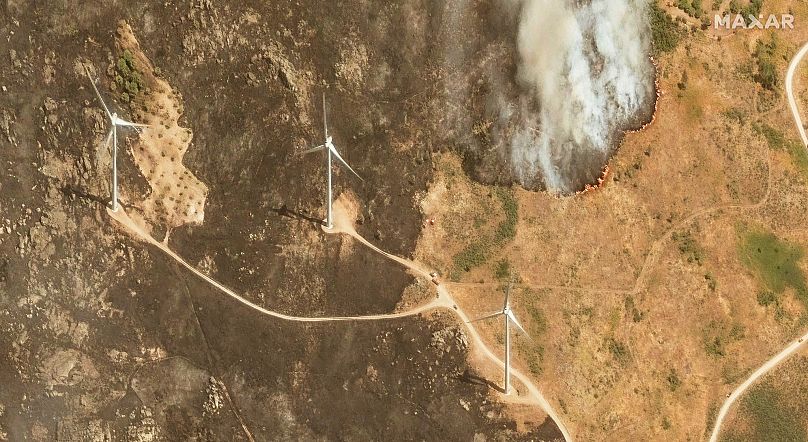
Satellite image by Maxar Technologies shows active fire line for a wildfire in Trancoso, Portugal, Aug. 12, 2025. AP/Satellite image ©2025 Maxar Technologies
"When necessary, when circumstances motivate it, we will do it. This obeys criteria that are of a technical and operational nature, which will have to be met," Montenegro told CNN Portugal.
The European Union has rushed aid to countries hit hard by the fires, including non-member states. European Commission President Ursula von der Leyen said that much efforts were focused on Montenegro where fires burned near the capital of Podgorica.
In a post on X, von der Leyen wrote: "We're mobilising support for Greece following their request for assistance. And prepositioned firefighters are already helping in Spain."
"This is European solidarity in action," she added.
Interview
Researchers race to predict wildfire behaviour as France battles biggest blaze in decades
A fire that raged through France’s southern Aude region and devastated an area larger than Paris had been brought under control late Thursday, authorities said. As large-scale wildfires become a bigger threat due to climate change, researchers in France are now working to model their behaviour in order to more effectively combat them.
Issued on: 07/08/2025 -
By: Cyrielle CABOT

Firefighters on Thursday battled for a third day to contain the biggest wildfire in France since 1949 raging in the southern Aude region, where more than 17,000 hectares (42,000 acres) have been blackened by flames. A 65-year-old woman was found dead in her scorched house and more than a dozen other people have been injured, two of them seriously.
The authorities mobilised 2,500 firefighters and significant air support to combat the flames.
Prime Minister François Bayrou, who visited the area on Wednesday, called the blaze “a catastrophe on an unprecedented scale” and warned that there could be more such disasters in the coming decades as a result of global warming.
Researchers are trying to better understand wildfires to learn how to prepare for them more effectively. Mélanie Rochoux, a researcher at the European Centre for Research and Advanced Training in Scientific Computing (Cerfacs) in Toulouse, has spent years studying the behaviour of forest fires and how weather and vegetation impact them. She provided some insights into the research currently under way.
FRANCE 24: The rapid spread of flames in the Aude region seems to have taken authorities by surprise. Are we able to predict how a fire will evolve once it starts?
Mélanie Rochoux: That is precisely the subject of my work with colleagues from Météo-France (France's national weather monitor) and the University of Corsica. At present, there is no operational tool deployed across France that can predict the behaviour of a fire in advance and determine precisely how it will spread, at what speed and in what direction.
The answer will depend on meteorological factors – temperature, wind, humidity – and environmental factors, such as the topography of the area and the vegetation.
Vegetation arranges itself into vertical strata, with a lower layer consisting of ground cover, a middle layer consisting of shrubs and an upper layer at the treetops.
Anything close to the ground – mainly dead vegetation such as twigs, leaves or pine needles – is particularly sensitive to changes in weather conditions. When the air humidity is low, this vegetation dries out quickly and becomes highly flammable. When a fire starts, it is this vegetation that will help it spread, depending on the wind.
But in some cases, trees can catch fire and burn all the way to the top, like torches. This is called a "crown fire", which greatly accelerates the spread of the flames.
In a given geographical area, the specifics of a fire will depend on a combination of these factors. Currently, all our work consists of carrying out simulations to better understand the role of these different factors and modelling scenarios based on data from previous fires.
However, we are still at the research stage, and we need more data to strengthen our models. In recent weeks, a fire observation campaign has been conducted in the south of France using an aircraft from the CNRS (France's National Centre for Scientific Research) and Météo-France. The aim was to fly over the forest fires, taking multiple readings on their nature, their spread across the ground and the components of the smoke in affected areas. Over the next two years, this aircraft will fly to Spain and Portugal to gather more data on fires in southern Europe as part of the EUBURN research programme (on wildfire risks).
Read moreAs France battles wildfires, experts call for a rethink of forest management
Is the scale of the fire in the Aude region something that was foreseeable?
In the Aude region, all the conditions were in place for a large-scale fire: strong winds with gusts of over 50 km/h, high temperatures of over 30°C and very low humidity in a heavily wooded area.
However, the situation was also exacerbated by a wet spring, which promotes the growth of vegetation. This was followed by a very hot and dry June, resulting in severe drought. We therefore ended up with abundant but very dry vegetation – the perfect fuel.
This explosive combination of heat and drought is what we call “concurrent extreme weather events”. And it's a recipe for large fires.
Météo France had accurately predicted this in its forest weather forecast. On Tuesday, the Aude department was placed on red alert, meaning a very high fire risk. But it is important to remember that there can be no fire without a spark. In France, nine out of 10 fires are caused by humans.

04:13
Given the scale of the disaster, can we see this as a sign of climate change?
An attribution study will determine the extent to which climate change made this fire more likely. But what is certain is that with global warming, fires like this are likely to become more frequent.
As we know, climate change is making extreme events such as heatwaves and droughts more frequent and more intense. The combination of heat and drought that we are seeing in the Aude region is therefore more likely to occur in the future.
But climate change is also altering the geography of fires. For a long time, fires in France were confined to the Mediterranean region. But increasingly, they can affect any part of the country, as long as the weather conditions are right. We saw this in 2022 with fires in Gironde (in the southwest) but also in Finistère (on the northwestern Atlantic coast)
When a wildfire occurs, the current strategy is to act quickly to bring it under control. Does the new reality, with more intense and frequent fires, undermine this policy?
Firefighters in France try to get to a fire as quickly as possible to bring it under control. So far, this strategy has proven successful.
But the new reality increases the risk of multiple large fires occurring at once in several places across France, making that strategy difficult. This was one of the things firefighters feared in 2022 during the major fires in the Gironde region. If fires had broken out at the same time across the Mediterranean region, the situation would have been very difficult to manage.
Technical and logistical resources remain limited and cannot be expanded indefinitely. In the long term, this early-attack strategy could be difficult to apply systematically, especially since fires are not just an issue for France but for Europe.
There is a united European mechanism for fighting fires, but if a major fire breaks out in France at the same time as in Greece or Portugal, we would not be able to benefit as much from European reinforcements.
Would better anticipating fires allow for a better use of resources?
Better anticipation enables us to better identify which fires to tackle as a priority, for example, by identifying those that are most likely to reach populated areas or escalate into mega-fires. We could then pre-position aerial and human resources according to priority.
That is why we are seeking to map areas where large fires could develop and plan for how they might evolve during the summer season. Ultimately, we want to be able to say, "If a fire starts here, it will spread there, at this speed, and reach this size." A better understanding of wildfires will enable us to better prepare for them.
This article has been translated from the original in French.
No comments:
Post a Comment