UK
‘You’re competing with cats’: Gordon McKee on TikTok, authenticity and why Labour must catch up online
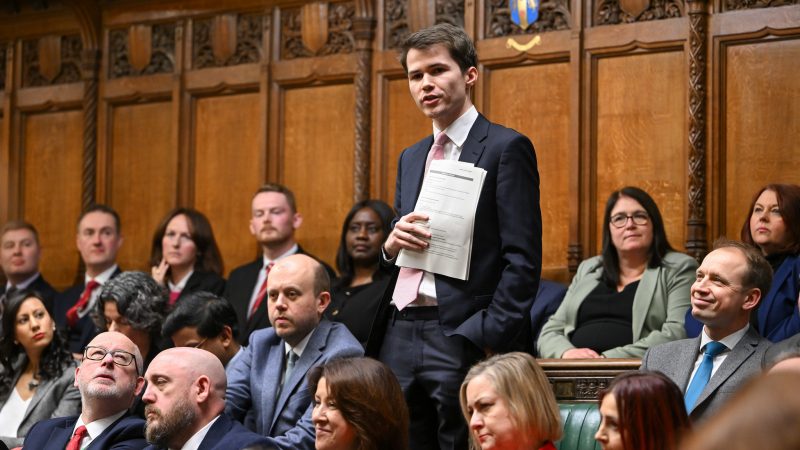
Few MPs have mastered the art of TikTok, but Gordon McKee is determined to try. The 30-year-old Labour MP for Glasgow South has seen several of his short videos on the platform go viral, from assembling flatpack furniture to explain why Britain hasn’t built big things recently, to being stuck at an airport to reveal how Labour is working to cut delays to flights – drawing more viewers than most Westminster speeches or TV appearances could dream of.
McKee is clear about why he first logged on as a politician: because he already used the platform himself. “I think the key thing is that I actually do watch TikTok,” he said. “I spend about an hour a day watching this content, and I was seeing no Labour politicians. Nigel Farage, unfortunately, does it extremely well [so] we should try and be on the platform.”
For McKee, whose constituency is younger and more diverse, the appeal is obvious. “I’m very lucky to represent a very young diverse constituency, where probably more of my constituents use it than many of my colleagues, so it’s just a good way of reaching a young demographic.”
‘You can’t boringly sit in front of a camera and talk about policy’
Being on the app is not the same as being good at it, however. TikTok, like many other social media platforms, is a crowded place – where attention is scarce. “Twenty or thirty years ago, politicians were competing with The Weakest Link or Who Wants to Be a Millionaire,” McKee reflects. “They had their slot on TV [and] you either watched it or you didn’t. Now, on Instagram, YouTube and TikTok, you’re competing with videos of cats on the internet. That’s much more difficult. That is much more difficult. You can’t boringly sit in front of a camera and spend four minutes talking about policy – it won’t work. You have to make it engaging and entertaining.”
For help, McKee received advice from people who already know how to thrive in that environment. Earlier this year, he did a collaboration in Parliament with Ukrainian content creator Max Klymenko, who has more than seven million followers on TikTok. “I tried to learn from him about what works. Making good, engaging videos is a real skill – I definitely haven’t mastered that yet. One of the bits of advice that Max gave was that you really want to minimise the effort each video takes. You’re not making a feature film, you’re just making a 30 second video – so you don’t want to spend hours of time thinking through that.”
McKee’s best performing clip, with close to a million views on TikTok, was on the government’s Employment Rights Bill, which has sought to expand protections for workers. “Had we, as a party, done enough back then to sell the bill to the generation of people that it was really going to impact? Probably not,” he admits. “So the idea was: how we can we make this legislation really meaningful and really impactful and digestible in a 30 second video? We picked out the clauses that we thought would be most relevant to an audience on TikTok – zero-hours and flexible contracts, protections for young workers – and just ahead and made it.”
Since he started posting after the start of the general election campaign, McKee has noticed that certain content works better with his colleagues in “the bubble” around SW1, while others will perform best among the general public. While Employment Rights Bill video is McKee’s most viewed video, it did not get the same traction as another video of him touting the benefits of improved animal welfare rules for zoos, which saw him ‘interview’ a llama named Leo – which received around 14,000 views. “You realise how much cut-through you get with these videos. There are some things that do really well in ‘the bubble’ but don’t do really well in real life, and vice versa. I feel like your job as a politician is to try and communicate with actual people, not Westminster insiders.”
‘People can smell inauthenticity immediately’
If there is a golden rule, McKee believes it is authenticity. “Your content has to be authentic. People can smell inauthenticity immediately,” he said. That can mean sometimes leaning into humour and comedy to sell a message, while other times being serious. After Reform UK narrowly won the Runcorn and Helsby by-election left his team and the wider party downbeat, McKee recorded a short reflection of his thoughts.
“Everybody was a bit down about it and I was like ‘why don’t we just do a video where I just say what I think and just talk – not some manufactured thing’ – and we edited together a 45 second video of thoughts.” The clip is one of his best performing videos with more than 25 thousands views. “The key thing is to be yourself,” McKee said.
Subscribe here to our daily newsletter roundup of Labour news, analysis and comment– and follow us on Bluesky, WhatsApp, X and Facebook.
‘Viewing habits are only going in one direction’
McKee is not the only MP investing in social media. He name-checks his Labour colleague Mike Tapp, whose videos take a different approach. “I’m not planning to go and sail a boat around Dover, but he clearly thinks about it, which is good.”
He also cites Zohran Mamdani, the Democratic candidate for Mayor of New York City in November’s election – whose online videos captivated younger voters and helped him secure a convincing win in his party’s primary. “I’m not saying it’s just because of those great videos he made, but it’s probably quite a big part of the reason that he got the momentum to get the position he’s in.”
The broader trend is undeniable, McKee argues. “Viewing habits are only going in one direction – they’re moving away from terrestrial TV and towards people sitting on their phones. Whether that’s good or bad for society, it’s definitely happening – and if you as a politician want to reach people, you’ve got to be where they are – and that’s increasingly on social media.”
That, for McKee, comes with an urgency. “We’ve got to be honest with ourselves: Nigel Farage has more followers than every other MP combined. He does well on that platform because he makes videos people engage with. I disagree with the content of them all, but you’ve got to recognise that he’s doing it. We’ve got to try and counter that.”
McKee insists much of the credit should go to his team, who help with filming and editing. He sees his approach as part of a wider shift Labour has to embrace if it wants to connect with voters outside the Westminster bubble.
‘From passports to policymaking: where AI can boost the public sector’
The public sector in the UK employs almost six million people and is responsible for 20% of the country’s economic output. The sheer size means that, in theory, the scope for benefits from AI-driven innovation is huge.
So what might that look like in practice? This is a big question, and one way to simplify it is to think about what government does – and where AI can really help.
We look at three massive government tasks that constitute the bulk of public sector work: communicating with the public, conferring rights to individual citizens, and making policy decisions.
Communicating with the public
Government needs to exchange information with the public. Indeed, it has an obligation to do so. People need official, reliable information about public services, benefits, subsidies, rules, regulations, policies and so on.
And government needs to get information from citizens. Observing how people encounter public services provides insight into public sector performance and can help to identify emerging problems. Understanding how people experience policy change, can provide evidence of public acceptance and legitimacy (or otherwise) of policy decisions.
AI can help with these tasks. LLM-based chatbots can respond to citizens’ queries and help them to find the information they need. LLMs can be used to automate public consultations, so that they can reach far more widely across the general public than they have before.
A key question is how we can encourage public organisations to think beyond what they currently do? For the first time ever, we can use generative AI to create feedback loops between the public and government, at scale.
Conferring rights
Another massive chunk of government work involves conferring rights to individual citizens, such as a license or passport, entitlement to a benefit or service, or rights to residency or citizenship.
The dream for large parts of the public sector is to automate entire processes. In general, we see a lot of public backlash and poor design, development, and deployment practices in precisely these types of projects, where the aim is to automate everything.
What we advise government to do is to think of any administrative process as a string of micro-transactions. If you apply for a passport, for example, there is a string of micro-transactions that need to be made to get one. These are small things like validating a photo or cross-checking text data from the application.
Our study found that central government alone completes about one billion of these micro-transactions per year, of which 120 million micro-transactions have very high automation potential with AI. These are complex repetitive tasks like checking photos, extracting salient text, triaging documents. There lies a lot of the potential for AI in government.
The key question is how to get officials excited about automating the minutiae of government’s bureaucratic practices? It does not sound like the stuff of which dreams are made. It won’t make front page news – but this is where AI – at the moment – can lead to substantial efficiency gains.
AI for public policymaking
The third area of government work where AI can be a game-changer is improving policy decisions.
In the UK, more than 52,000 policy decisions underpin how over a trillion pounds of public money gets allocated each year. Improving the way in which policy decisions are made can lead to substantial benefits. Data science and AI can do that in ways in which traditional statistical techniques cannot.
We have a tremendous opportunity to adapt our economic models for an age when every individual and company generate massive amounts of data on a daily basis, where the technologies that we have allow us to develop better answers to the questions that policy-makers have been asking for years. What happens if a big company closes? Can the excess capacity be absorbed by the local economy? Where are the skill shortages and who are the workers that can most easily be retrained to fill them?
How to make it happen? Adoption is key.
These three areas of AI opportunity correspond to massive government tasks: communicating with the public, conferring rights to individual citizens, and making policy decisions. These are ripe with potential to achieve efficiency and productivity gains.
But they won’t happen by magic. The government have bold aspirations for AI, detailed in the AI opportunities action plan and other policy documents. Adoption is crucial to achieving their aims. But the question of how to drive adoption receives less attention.
AI will only lead to better public services if citizens adopt them in a widespread way. If productivity is the most hoped-for benefit of AI, inequity is the most feared harm. So it is crucial to avoid AI exacerbating existing inequalities. There is mounting survey evidence to suggest that those with low incomes perceive less benefits and hold more concerns about AI applications. So do those with low levels of digital access and skills. The government needs to ensure that their digital inclusion plan is integrated with AI plans.
AI adoption must be stimulated right across the public sector in a comprehensive way. That means integrating AI tools into public services and bureaucratic processes. Economic modelling for policy requires the generation of good local data. Public service professionals are already using AI but in a disorganized fashion without clear guidelines. Governmentwide deals with AI giants will not resolve problems caused by legacy systems that lock departments in the past.
That will mean AI capability and expertise being distributed across government. There is now a strong digital centre for government – the remodeled Government Digital Service. They will need to work in concert with departments and agencies at all tiers of government to reassure citizens that AI-powered public services are progressive, easy-to-use and trustworthy. And to help and inspire public servants to make the most of AI.


No comments:
Post a Comment