It’s possible that I shall make an ass of myself. But in that case one can always get out of it with a little dialectic. I have, of course, so worded my proposition as to be right either way (K.Marx, Letter to F.Engels on the Indian Mutiny)
Tuesday, August 26, 2025
WAR IS ECOCIDE
Ukrainian Drones Damage Russia’s Ust-Luga Oil and Gas Terminal
Russian officials are saying debris caused a fire at the Ust-Luga energy terminal
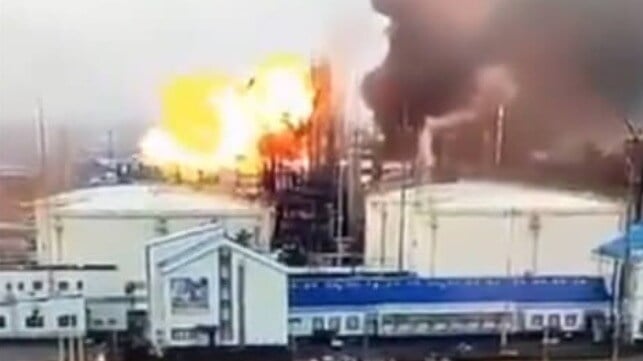
Ust-Luga, one of the main terminals in Russia’s oil and gas industry, was damaged by a long-range attack from Ukraine. It is the second time since the war began that Ukraine has been successful in attacking the facility, and it comes as both sides have increased their attacks against the energy infrastructure.
The Governor of the Leningrad Region, Alexander Drozdenko, started posting alerts about UAV attacks on Saturday, August 23, which continued into Sunday. The reports initially placed the drones at various points around the region, with Drozdenko reporting that at least 10 drones were destroyed on Saturday, prompting him to issue a warning for citizens to “refrain from being near industrial zones and enterprises, as well as visiting public places.”
On Sunday, August 24, Drozdenko acknowledged that at least 10 drones had attacked the port of Ust-Luga, although he said they were all destroyed. Debris from a drone was, however, reported to have caused a fire at the Novatek terminal. The reports said there were no casualties.
The extent of the damage is unclear, and many of the photos being posted online are from a 2024 fire at the plant. Drozdenko said the fire had been “localized” and that the fuel tanks were not damaged. By Sunday afternoon, the report was that the fire at Ust-Luga had been extinguished and Novatek was starting repairs and restoration work.
It is believed the gas processing equipment was struck, taking the plant offline. Some reports are suggesting it could take months to repair, which would be a major blow to Russia’s oil and gas industry.
Novatek has been operating the facility, which is located about 70 miles west of St. Petersburg, since 2013. Reports are that it handles more than seven million tons of gas condensate as well as more than four million tons of heavy and light oil. It is also a supplier of marine and jet fuel, kerosene, and diesel fuel.
The daring attack was staged more than 600 miles from Ukraine and was part of a larger assault on the energy system. Russia’s defense ministry is saying 95 drones were launched across 14 regions and all were downed with minor damage. It acknowledged 13 drones destroyed over Ust-Luga, as well as some damage to a nuclear power plant.
Russia has been striking Ukraine’s fuel import and distribution network and facilities. Last week, a tanker was reportedly damaged while unloading at the port of Izmail on the Danube.
Red Cat Plans to Start Marketing Ukraine's Drone Boats to the U.S. Navy
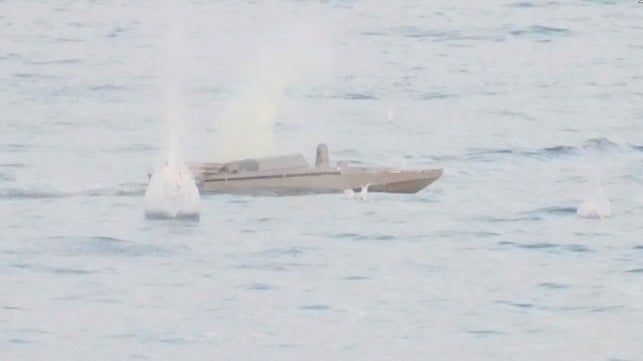
Ukrainian drone boat under fire in the Black Sea (Russian MoD)
An American military drone developer has set up a new division to sell Ukrainian-tested drone boat technology to the U.S. Navy, closing the loop on the cycle of innovation that has defined the Black Sea theater of the conflict.
As soon as the Russian full-scale invasion began in 2022, the Russian Navy's Black Sea Fleet imposed a naval blockade on Ukraine's seaports, repeatedly striking foreign-flag merchant ships off the coast. With American and European assistance, Ukraine countered with strikes of its own. Its forces sank the Black Sea Fleet flagship Moskva with antiship missiles, and followed up with strikes on Russian warships in Crimea using British/French Storm Shadow cruise missiles.
But Ukraine's real innovation was an exploding one-way drone boat, remotely controlled and cheap enough to be expendable. It was based on an American prototype that had been designed to counter a Chinese invasion fleet in the Taiwan Strait, according to the New York Times. Using this American-origin design, American Starlink connectivity, and American targeting support, Ukraine's defense intelligence agency (GUR) began regularly damaging or destroying Russian vessels in and around Crimea using swarm tactics.
After several design iterations, Ukraine's drone boats have also been up-gunned to carry strike UAVs and anti-aircraft missiles to counter Russian air patrols. Using a mix of short range missiles, these drone boats have become the first unmanned vessels in history to shoot down helicopters and fighter aircraft.
Using drones alone, the GUR's Group 13 helped Ukraine attain sea control of the western Black Sea, driving the Black Sea Fleet into the relative safety of the Novorossiysk area - without the benefit of a conventional navy. Its success made the Magura design instantly recognizable in defense circles.
The U.S. Navy has been investing in its own drone prototypes, reportedly with mixed results - but to date it has not publicly included the Magura series in its test and evaluation program. The defense robotics company Red Cat, a supplier of drones to Ukraine and to the U.S. Army, has offered a way to change that. It announced in May that it would begin marketing proven drone boats with "10,000+ hours of operating time in live combat missions" and "dozens of successful kinetic engagements against enemy assets," a description that only matches Ukraine's Magura series. Red Cat has now announced a new division to carry this product line forward in the U.S. market.
The new division - Blue Ops - will offer a seven-meter "Expeditionary Multi-Role Craft" matching the appearance and dimensions of the Magura V7, but built in the United States. It is intended for deep strike, interdiction and anti-ship warfare - like the V7 - and has autonomous capability, increased range and payload capacity. A spokesman confirmed that it is "based on technology already being built in various European countries and is being used in the Ukraine war." Red Cat plans to start production in the third quarter of 2025, in partnership with an existing manufacturer of USVs.
To head up the Blue Ops team, Red Cat has hired Barry Hinckley, a member of the Hinckley boatbuilding family, former tech executive, and former candidate for U.S. Senate. Hinckley has experience as a yacht broker, a startup founder and an offshore racing yachtsman. The division's co-leader will be Alexander "Sandy" Spaulding, the former president of Hinckley Yachts.
"The future of maritime defense depends on a fast, modular weapons system built in the U.S. That’s exactly what we’re delivering," said Barry Hinckley in a statement. "We’re not replacing large naval vessels—we’re building smaller, smarter, uncrewed platforms that extend their reach, provide forward protection, and can operate in places traditional ships can’t."
Ukraine Protests as Russia Opens Mariupol and Berdyansk to Foreign Ships
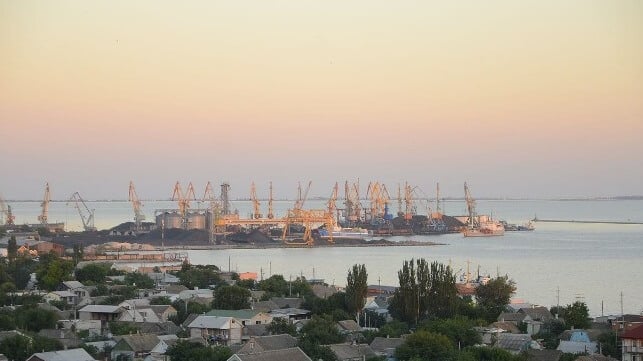
Berdiansk was a thriving seaport before the war (Andrew Butko / CC BY SA 3.0)
Ukrainian officials are protesting the release of a new list of ports open for foreign vessels, on which Russia is including the Sea of Azov ports of Mariupol and Berdyansk. Both ports have been occupied by Russian forces since 2022.
Before the Russian invasion, Mariupol was the tenth largest city in Ukraine and the second largest in the eastern region. It was a vital seaport handling metals, coal, and grain, and when the war began, multiple foreign ships were trapped in the port. The facilities are said to include 22 deep-water berths.
Mariupol was the scene of heavy fighting in the first part of 2022 and a siege that ended up focusing on the seaport, an asset which Russia considers a vital prize in its occupation. The city and seaport finally fell into Russian hands in May 2022, and after many months, the foreign ships were able to escape. Russia was reported to be using it as a supply port, but commercial port operations, however, have remained mostly suspended, other than the accusations by Ukraine that Russia is stealing minerals and grains and shipping them from the port.
Berdiansk was an equally important seaport, and it fell into Russia's hands in the first month of the war. It is located just 50 road miles west of Mariupol and was under Russian control by March 2022. Reports said Russia had reopened the seaport and was using it to transport military supplies.
The listing of seaports released by the Russian Federation on August 22 includes both Berdiansk and Mariupol as open ports able to handle foreign ships.
“We consider such actions as another attempt by Russia to legalize its occupation and consolidate illegal control over Ukrainian territories,” the Ministry of Foreign Affairs of Ukraine said in a statement issued yesterday, August 25. It “strongly condemns” the Russian actions and says it considers the order “null and void.”
Ukraine is calling for Western sanctions on any company or ship that uses either port to support commercial activities. In the past, it has also taken action against ships using the occupied seaports of Crimea. The courts have permitted it to seize and auction ships that carried commercial cargoes from Crimean seaports, and it has jailed and fined crewmembers on those ships.
Ukrainian media is reporting that Russia has been using both seaports to export grains grown in the east in the occupied areas of Ukraine. They contend that almost 212,000 tonnes of grain were shipped from Zaporizhia Oblast in 2023 to places including Turkey, Libya, Syria, and the Houthis in Yemen. Over 300,000 tonnes of grain, they report, have been moved through Berdiansk, while as much as 40,000 to 60,000 tonnes a month of minerals are being exported through the Port of Mariupol.
The move comes as Russia seeks to further consolidate its gains and exert control in advance of any potential peace talks. Reports said President Vladimir Putin told Donald Trump during their meeting in Alaska that Russia would keep the occupied territories, including the Sea of Azov ports and the regions of Zaporizhzhia, as part of a peace deal. Trump has suggested there would be some “swapping” of land in the peace agreement.

No comments:
Post a Comment