WOTD WORD OF THE DAY
Alkali waste dumped in the Pacific Ocean created alkalophilic ecosystems
PNAS Nexus
image:
Pushcore sampling from the white halo close to a barrel using the ROV manipulator arm.
view moreCredit: Schmidt Ocean Institute
Barrels filled with industrial waste that were dumped in the sea near Los Angeles more than 50 years ago are creating new microbial ecosystems adapted to highly alkaline conditions. It has been estimated that hundreds of thousands of barrels of waste were dumped off the coast of California in the mid 20th century. Previous investigations suggested that the barrels once contained dichlorodiphenyltrichloroethane (DDT)—an insecticide known for its broad toxicity that was banned for agricultural use in 1972.
Another study suggested the barrels once contained low-level radioactive waste. In addition, some barrels were noted to have concrete-like encrustations around their bases or to have been encircled by white “halos” on the sea floor. Paul R. Jensen and colleagues used a remotely operated vehicle to dive around 900 meters and collect cores of sediment around corroding steel barrels on the San Pedro Basin seafloor. The concentration of DDT and its breakdown products was elevated in the area, but there was no gradient with increasing concentrations as the cores approached the barrels, so the DDT likely came from a different source—possibly bulk liquid dumping. The authors found the concretions to be magnesium hydroxide precipitation and the white haloes to be calcium carbonate. Both mineral artifacts were likely caused by leakage of alkaline waste. Microbial communities around these barrels were low diversity and dominated by alkalophilic bacteria, not unlike those observed at hydrothermal vents. According to the authors, it will likely take thousands years for the ecological effects of caustic alkaline waste dumping in the San Pedro Basin to cease.
An alkalophilic organism, or alkaliphile, is a microorganism that thrives in extremely alkaline environments, typically with a pH above 8.5 or 9, and often cannot grow well in neutral conditions. These organisms use specialized biological mechanisms, like proton transfer strategies and sodium-hydrogen exchangers, to maintain a functional internal pH despite the harsh external conditions.
Journal
PNAS Nexus
Article Title
Extremophile hotspots linked to containerized industrial waste dumping in a deep-sea basin
Article Publication Date
9-Sep-2025
Barrel with exposed crust.
Half buried barrel with clearly visible white halo
Upright barrel with surrounding white halo. Study finds this white halo is indicative of the barrel once containing alkaline waste.
Credit
Schmidt Ocean Institute
Schmidt Ocean Institute
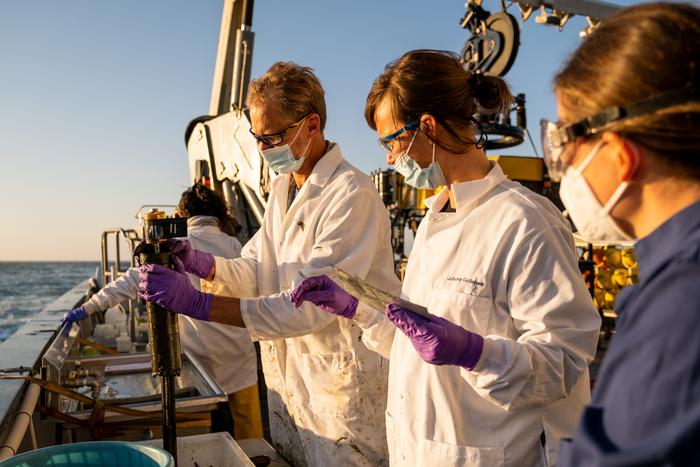
Paul Jensen and Johanna Gutleben of UC San Diego's Scripps Institution of Oceanography unload and sort sediment cores after the samples were brought to the surface from known dumping sites by Remotely Operated Vehicle (ROV) SuBastian during a July 2021 expedition aboard Research Vessel Falkor. Credit: Schmidt Ocean Institute.
Footage of Discarded Barrels off the Coast of Los Angeles [VIDEO]
Video footage from ROV SuBastian's exploration around the DDT Barrel Site 1 in the Southern California Borderland off the coast of Los Angeles. Credit: Schmidt Ocean Institute.
Footage of Discarded Barrels off the Coast of Los Angeles [VIDEO]
Video footage from ROV SuBastian's exploration around the DDT Barrel Site 1 in the Southern California Borderland off the coast of Los Angeles. Credit: Schmidt Ocean Institute.
Decades-old barrels of industrial waste still impacting ocean floor off Los Angeles
Initially thought to contain the pesticide DDT, study reveals some barrels contained caustic alkaline waste
image:
A discarded barrel on the seafloor off the coast of Los Angeles. The image was taken during a survey in July 2021 by remotely operated vehicle SuBastian. Credit: Schmidt Ocean Institute.
view moreCredit: Credit: Schmidt Ocean Institute.
In 2020, haunting images of corroded metal barrels in the deep ocean off Los Angeles leapt into the public consciousness. Initially linked to the toxic pesticide DDT, some barrels were encircled by ghostly halos in the sediment. It was unclear whether the barrels contained DDT waste, leaving the barrels’ contents and the eerie halos unexplained.
Now, new research from UC San Diego's Scripps Institution of Oceanography reveals that the barrels with halos contained caustic alkaline waste, which created the halos as it leaked out. Though the study’s findings can’t identify which specific chemicals were present in the barrels, DDT manufacturing did produce alkaline as well as acidic waste. Other major industries in the region such as oil refining also generated significant alkaline waste.
“One of the main waste streams from DDT production was acid and they didn’t put that into barrels,” said Johanna Gutleben, a Scripps postdoctoral scholar and the study’s first author. “It makes you wonder: What was worse than DDT acid waste to deserve being put into barrels?”
The study also found that the caustic waste from these barrels transformed portions of the seafloor into extreme environments mirroring natural hydrothermal vents — complete with specialized bacteria that thrive where most life cannot survive. The study authors said the severity and extent of this alkaline waste’s impacts on the marine environment depend on how many of these barrels are sitting on the seafloor and the specific chemicals they contained.
Despite these unknowns, Paul Jensen, emeritus marine microbiologist at Scripps and senior author of the study, said that he would have expected the alkaline waste to quickly dissipate in seawater. Instead, it has persisted for more than half a century, suggesting this alkaline waste “can now join the ranks of DDT as a persistent pollutant with long-term environmental impacts.”
The study, published today in the Proceedings of the National Academy of Sciences Nexus and supported by NOAA and the University of Southern California’s Sea Grant program, continues Scripps’ leadership role in unspooling the toxic legacy of once-legal ocean dumping off the coast of Southern California. The findings also provide a way of visually identifying barrels that formerly contained this caustic alkaline waste.
“DDT was not the only thing that was dumped in this part of the ocean and we have only a very fragmented idea of what else was dumped there,” said Gutleben. “We only find what we are looking for and up to this point we have mostly been looking for DDT. Nobody was thinking about alkaline waste before this and we may have to start looking for other things as well.”
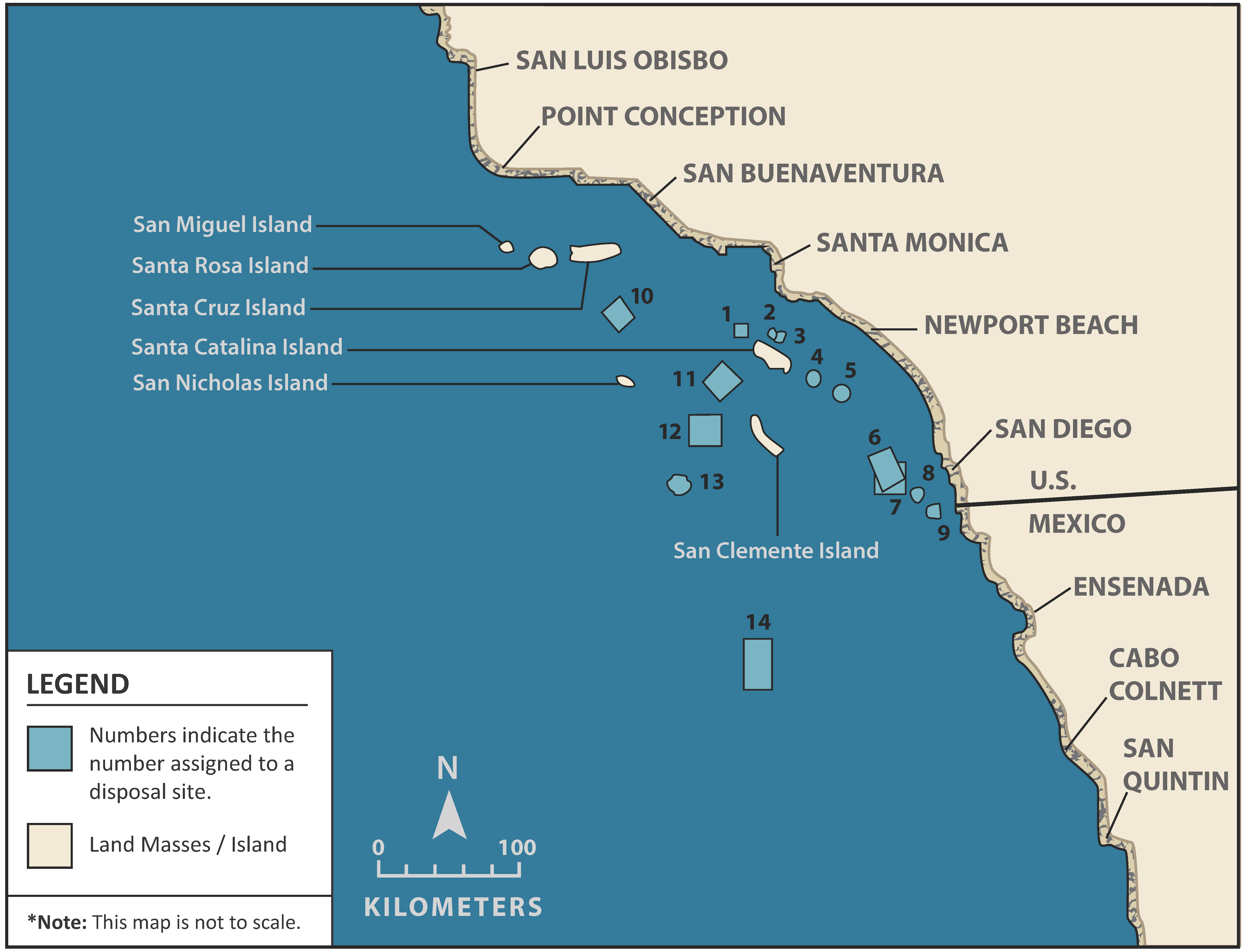
From the 1930s until the early 1970s, 14 deep-water dump sites off the coast of Southern California received “refinery wastes, filter cakes and oil drilling wastes, chemical wastes, refuse and garbage, military explosives and radioactive wastes,” according to the EPA. A pair of Scripps-led seafloor surveys in 2021 and 2023 identified thousands of objects, including hundreds of discarded military munitions. The number of barrels on the seafloor remains unknown. Sediments in the area are heavily contaminated with the pesticide DDT, a chemical banned in 1972 now known to harm humans and wildlife. Scant records from this time period suggest DDT waste was largely pumped directly into the ocean.
Gutleben said she and her co-authors didn’t initially set out to solve the halo mystery. In 2021, aboard the Schmidt Ocean Institute’s Research Vessel Falkor, she and other researchers collected sediment samples to better understand the contamination near Catalina. Using the remotely operated vehicle (ROV) SuBastian, the team collected sediment samples at precise distances from five barrels, three of which had white halos.
The barrels featuring white halos presented an unexpected challenge: Inside the white halos the sea floor suddenly became like concrete, preventing the researchers from collecting samples with their coring devices. Using the ROV’s robotic arm, the researchers collected a piece of the hardened sediment from one of the halo barrels.
The team analyzed the sediment samples and the hardened piece of halo barrel crust for DDT concentrations, mineral content and microbial DNA. The sediment samples showed that DDT contamination did not increase closer to the barrels, deepening the mystery of what they contained.
During the analysis, Gutleben struggled to extract microbial DNA from the samples taken through the halos. After some unsuccessful troubleshooting in the lab, Gutleben tested one of these samples’ pH. She was shocked to find that the sample’s pH was extremely high — around 12. All the samples from near the barrels with halos turned out to be similarly alkaline. (An alkaline mixture is also known as a base, meaning it has a pH higher than 7 — as opposed to an acid which has a pH less than 7).
This explained the limited amount of microbial DNA she and her colleagues had been able to extract from the halo samples. The samples turned out to have low bacterial diversity compared to other surrounding sediments and the bacteria came from families adapted to alkaline environments, like deep-sea hydrothermal vents and alkaline hot springs.
Analysis of the hard crust showed that it was mostly made of a mineral called brucite. When the alkaline waste leaked from the barrels, it reacted with magnesium in the seawater to create brucite, which cemented the sediment into a concrete-like crust. The brucite is also slowly dissolving, which maintains the high pH in the sediment around the barrels, and creates a place only few extremophilic microbes can survive. Where this high pH meets the surrounding seawater, it forms calcium carbonate that deposits as a white dust, creating the halos.
“This adds to our understanding of the consequences of the dumping of these barrels,” said Jensen. “It’s shocking that 50-plus years later you’re still seeing these effects. We can’t quantify the environmental impact without knowing how many of these barrels with white halos are out there, but it’s clearly having a localized impact on microbes.”
Prior research led by Lisa Levin, study co-author and emeritus biological oceanographer at Scripps, showed that small animal biodiversity around the barrels with halos was also reduced. Jensen said that roughly a third of the barrels that have been visually observed had halos, but it’s unclear if this ratio holds true for the entire area and it remains unknown just how many barrels are sitting on the seafloor.
The researchers suggest using white halos as indicators of alkaline waste could help rapidly assess the extent of alkaline waste contamination near Catalina. Next, Gutleben and Jensen said they are experimenting with DDT contaminated sediments collected from the dump site to search for microbes capable of breaking down DDT.
The slow microbial breakdown the researchers are now studying may be the only feasible hope for eliminating the DDT dumped decades ago. Jensen said that trying to physically remove the contaminated sediments would, in addition to being a huge logistical challenge, likely do more harm than good.
“The highest concentrations of DDT are buried around 4 or 5 centimeters below the surface — so it’s kind of contained,” said Jensen. “If you tried to suction that up you would create a huge sediment plume and stir that contamination into the water column.”
In addition to Gutleben, Jensen and Levin, Sheila Podell, Douglas Sweeney and Carlos Neira of Scripps Oceanography co-authored the study, alongside Kira Mizell of the U.S. Geological Survey.
Journal
PNAS Nexus
Article Title
Extremophile hotspots linked to containerized industrial waste dumping in a deep-sea basin

No comments:
Post a Comment