
China’s sudden pivot to Argentine soybeans this week is the latest manoeuvre in a quietly escalating battle for agricultural influence, and a clear example of how Beijing can use market muscle and timing to put Washington on the back foot.
In the space of just a few days, Chinese buyers have reportedly snapped up as many as 20 Panamax cargoes of Argentine soybeans after Buenos Aires temporarily suspended its 26% grain export tax according to Reuters and other agencies. It was a policy shift that immediately made Argentine soybean supplies cheaper and more attractive on world markets.
Traders have said the purchases, believed to amount to roughly 1.3m tonnes according to Reuters, and set for November shipment, came within just a few hours of the tax announcement, underlining how nimble purchases can be when policy windows open.
For US farmers and policymakers, the timing is bitter. Washington has for months sought to cultivate closer ties with Buenos Aires, even extending assurances of substantial financial support as Argentina works to stabilise its battered economy.
Yet the quick sequence - US assistance followed almost immediately by Argentina offering cheaper soy to global markets, most prominently China - highlights a geopolitical reality: money alone cannot bind trade loyalties.
The broader economic effect was immediate with analysts overnight September 24/25 flagging the move as another blow to an already bruised US export season in which China has bought little or no US soy.
That absence is not solely about price and lost revenue, however. It is the residue of a punitive tariff imposed by the US earlier in the summer, and a wider, long-term game by Beijing to diversify suppliers and reduce dependence on US agricultural exports.
In short, China is using Argentina as a pawn in a chess game with the US, to lower the cost of access to global soy supplies while simultaneously weakening a key US export sector.
That dynamic is not novel, but the ferocity of the latest episode is telling. Argentina’s tax suspension, painted out in local Spanish language media as a temporary measure to stimulate shipments and relieve storage pressures, was instantly met with a flurry of orders from half a world away.
Behind this was a slew of Chinese buyers, with an appetite for Q4 restocking, and, behind the buyers, although as of yet unconfirmed, more than likely an order from Beijing to buy, buy, buy - in the process once again bloodying Washington’s nose. From Beijing’s perspective this reads as smart, unromantic state backed manoeuvring: exploit a rival’s policy window, buy cheap, and inflict political pain in rural America.
This also plays into a long-standing US narrative in which America’s political economy is highly vulnerable to concentrated, visible shocks that affect congressional districts and swing voters nationwide.
China’s procurement decisions are opaque and centralised. They always have been. Beijing can quietly reroute demand elsewhere without having to answer to farmers at home – unlike a great many congressmen in Republican farming areas across the US.
Argentine policymakers meanwhile continue to exercise discretion. If waiving an export tax brings in foreign currency and placates domestic producers, it is a logical short-term choice in an economy that is teetering on the edge and any day may topple over.
Several thousand kilometres north of Argentina, American soybean growers for now see the result in starkly personal terms. Industry groups have already responded with alarm, urging negotiators in Washington to secure a deal with Beijing swiftly or risk further erosion of market share. These are calls for help that even President Donald Trump cannot ignore.
The political calculus is simple: lost sales translate into lost incomes – and in time, lost votes.
For Beijing, there is further benefit beyond immediate bargain hunting. Filling tanks with Argentine soy serves several purposes, notably reducing China’s exposure to a single supplier during an era of tense US-China relations. It also signals to global markets that China can pivot when geopolitics tighten. Most crucially perhaps in the eyes of Beijing, it also exerts pressure on US negotiators by weaponising commodity markets in a way that is hard to counter without conceding on tariffs or other political terrain.
That tactic alone forces a choice on Trump and Washington: either accept the pain and pursue a longer game of strategic decoupling, or respond with trade concessions that could be politically costly at home.
Either way, Beijing has used a third party – Argentina - as a bit-player of sorts with which to score points.
Whether Buenos Aires regards itself as a pawn or an opportunistic actor is moot; the bigger picture is being seen globally as Trump having been trumped over soy – by China.
'No sign of Chinese buying': Trump credited for 'devastating' US farmers' soybeans market
September 24, 2025
RAW STORY
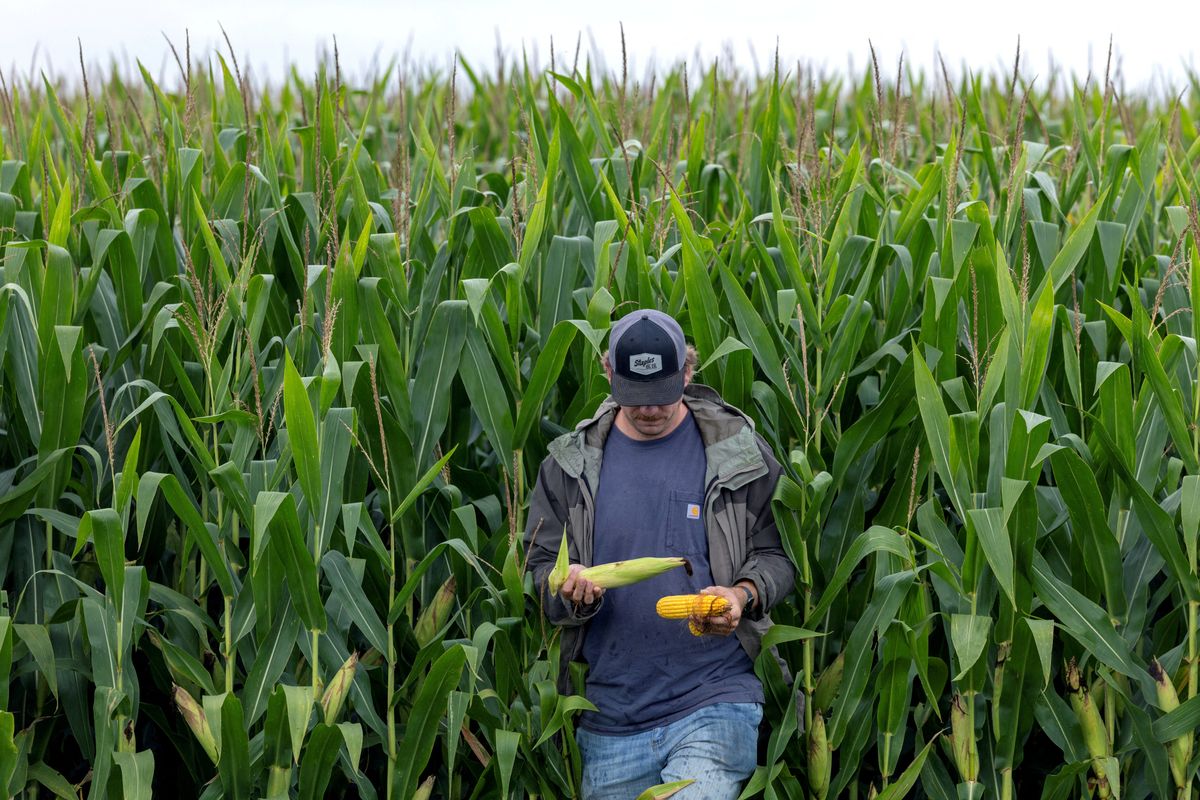
Jake Guse, a crop scout on the Pro Farmer Crop Tour, collects corn samples from a corn field as scouts travel across the midwest trying to gauge the size of the corn and soybean crop that farmers will harvest in the fall, in northwest Indiana on Aug. 19, 2025. REUTERS/Evelyn Hockstein
President Donald Trump's tariffs have decimated U.S. farmers' soybean market and there is "no sign of Chinese buying."
The fall harvest has started without any orders from China, the world's biggest buyer, according to a new report published on agriculture.com's Successful Farming.
American farmers are reporting record yields for crops this fall but it's unclear who will buy them. The USDA estimates that American farmers are harvesting 4.3 billion bushels, however there is no indication if or when shipments to China will continue. Most years, China buys more than half of U.S. soybean exports — but not this year.
Brazil, however, has had record demand from China from January to August 2025 for Brazilian soybeans. And in the new report, experts "consider the possible consequences if a trade deal is not reached this fall."
"From the 2017/18 to the 2024/25 crop season, Brazil jumped its soybean production from 4.5 billion bushels to 6.3 billion bushels, according to the National Supply Company (Conab) – Brazil’s food supply and statistics agency."
There is speculation that Chinese buyers importing soybeans could be "accelerating shipments to avoid sourcing from the United States."
The ongoing trade war between China and the U.S. is testing farmers' faith in the Trump administration. During the first trade war in 2018 during Trump's first term, farmers took a hit and during President Joe Biden's term had begun to recover.
Now under Trump's second term, farmers have called for more assistance during the prolonged economic uncertainty.
"Some relief might come from federal government payments to producers, as happened during the first round of trade war, but in many cases, that assistance may not be enough to prevent an uptick in financial stress," according to the report.
Chinese buyers are expected to continue shifting soybean purchases to other South American countries, including Argentina, Paraguay and Bolivia. These countries are planning to expand planting acreage for their crops and focusing on planting soon for the 2025 and 2026 crop in the Southern Hemisphere.
Critics are pointing to Trump's trade policies as a major disruption to the U.S. agriculture industry.
"Until Trump's first term, the US was by far the world's largest exporter of soybeans. Now Brazil dominates," David Frum, writer at The Atlantic, wrote via X.
"Has Iowa thanked Trump/Vance for devastating their soybeans market?" Former U.S. Representative Barbara Comstock (R-VA) wrote on X.
No comments:
Post a Comment