European carmakers clash over emission targets ahead of Brussels meeting
Over 150 executives from Europe's electric car (EV) sector have urged the EU to maintain its 2035 zero-emission target for cars and vans, countering earlier claims by traditional car manufacturers that the target was "unfeasible". European Commission President Ursula von der Leyen is due to hold talks with automotive industry leaders on Friday.
Issued on: 08/09/2025 - RFI

In a letter sent to Brussels on Monday, 150 EV executives, including bosses from Volvo Cars and Polestar, warned that any delay to the 2035 target would hand a competitive advantage to global rivals – particularly Chinese manufacturers – and undermine investor confidence in Europe's green transition.
"Weakening targets now would send a signal that Europe can be talked out of its own commitments," said Michael Lohscheller, Polestar's chief executive, in a statement. "That would not only harm the climate. It would harm Europe's ability to compete."
As part of its fight against climate change, the EU requires carmakers to progressively cut carbon emissions produced by new vehicles sold in the bloc, or face steep fines.
In March, the European Commission yielded to pressure from European automakers to give them three years, rather than one, to meet the carbon emission targets.
Two weeks ago, the heads of the European automobile manufacturers' and automotive suppliers' associations sent a letter to Commission President Ursula von der Leyen stressing that a 100 percent reduction in emissions for cars by 2035 was "no longer feasible".
That letter was signed by Mercedes-Benz CEO Ola Kaellenius – a significant endorsement from one of Europe's automotive giants.
EU car industry must speed up electric sales or face billions in fines
Emissions targets on track
On 12 September, Von der Leyen is set to discuss the future of the automative sector with industry players as they face increased competition from Chinese rivals and US tariffs.
A study by transport research and campaign group T&E, published Monday, showed that all European carmakers, except for Mercedes-Benz, are on track to meet the emission targets for 2025-2027. The German luxury manufacturer would need to pool its emissions with Volvo Cars and Polestar to avoid fines, the report said.
It forecast battery electric vehicle sales would surpass a 30 percent share of the EU car market in 2027 from 18 percent this year.
Demand for EVs across Europe has slowed, with consumers increasingly opting for cheaper Chinese-made imports.
Meanwhile, Stellantis CEO Antonio Filosa has called for greater flexibility in the transition to electric vehicles, urging the EU to support hybrid technologies as an interim solution.
"A European policy that encourages the replacement of older cars with new cars and a wider choice of powertrains would have a greater impact on global CO₂ emissions," he argued.
Crash or rescue: European carmakers look to EU for salvation
The current crisis affecting the European automotive industry is an acute threat to Europe’s economic future. Will a summit between the auto sector and Ursula von der Leyen on Friday provide a life-line?
Europe's car industry is “in mortal danger”, EU industry chief Stéphane Séjourné said a few months back, not mincing his words.
Stuttering sales, high energy prices, growing global competition and an uncertain regulatory and trade environment have plunged the sector into a spiralling crisis.
“There is a risk that the future map of the global car industry will be drawn without Europe,” Séjourné said back in April.
To tackle the sector’s most pressing challenges, EU Commission President Ursula von der Leyen will host the top car executives in Brussels on Friday.
It’s the third and last crisis meeting of its kind this year, part of what the Commission has billed the “Strategic Dialogue on the Future of the Automotive Industry”.
The meeting is scheduled for three hours – but will it create new momentum for the industry?
Last spring, the EU launched an Industrial Action Plan which includes funds for battery producers, most notably through the €1.8 billion Battery Booster and an additional billion euros allocated for battery research and development under the Horizon Europe programme.
But such initiatives have failed to change the overall gloomy outlook.
“The sense of urgency has not gone away,” Sigrid de Vries, director general of the European Automobile Manufacturers’ Association (ACEA) told Euronews. “We need more actio
The carmakers are particularly frustrated over a lack of a pragmatic policy plan for the industry’s transformation, as expressed in a recent open letter to Ursula von der Leyen by the presidents of ACEA and the European Association of Automotive Suppliers (CLEPA), Ola Källenius and Matthias Zink.
Europe’s transformation plan “must move beyond idealism to acknowledge current industrial and geopolitical realities”, they wrote.
According to the industry representatives, lower energy costs for charging, more purchase subsidies and tax reductions and especially a more even distribution of charging infrastructure are needed to make switching to electric vehicles an obvious choice for a critical mass of European consumers and businesses.
EV market in Europe stagnating
Right now, the market share of battery-electric vehicles in Europe stagnates at around 15% - not enough for a breakthrough of a technology considered all-decisive for the future.
There is a considerable hesitation of many European consumers to buy an electric vehicle because there are still not enough charging stations in Europe, 75% of which are located in only three countries: the Netherlands, France and Germany.
Across the EU, only about 880,000 public charging points are currently available.
But according to estimates from ACEA, 8.8 million charging points will be needed by 2030 – that’s just five years from now.
To achieve this, 1.5 million chargers would have to be installed every year, almost ten times the current rate of growth.
Seeing more economic and legal trouble on the horizon, the car industry wants a review of current CO2 regulations.
“Meeting the rigid car and van CO2 targets for 2030 and 2035 is, in today’s world, no longer feasible,” as the presidents of ACEA and CLEPA wrote to Ursula von der Leyen.
Instead, they demand flexibility and pragmatism regarding drivetrain technologies (aka: the ban of combustion engines) as a crucial rescue rope for the embattled industry.
After all, “you cannot force people into a particular kind of car”, Sigrid de Vries said.
For years, electrification has been the key strategy deployed globally by the industry to produce zero emission vehicles, responding to a key quest of policymakers.
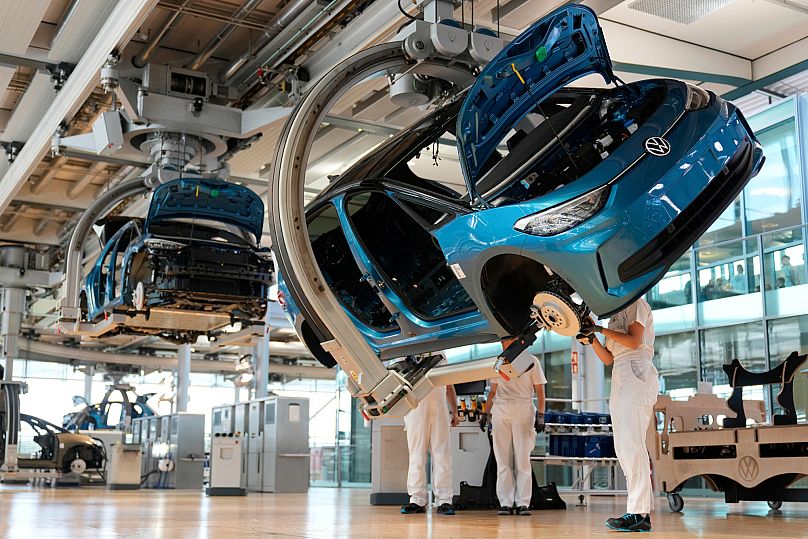
These vehicles are also becoming ever more connected and able to exchange information with other cars and roadside infrastructure, tending to become high-performance “computers on wheels”, increasingly dependent on chips and software.
As a consequence, new companies from the battery and tech sectors have entered the automotive market and leapfrogged traditional carmakers.
And here is where most European companies are still lagging behind their Asian rivals in electric car innovation. In 2024, only one electric car made in the EU was among the world’s Top Ten, the Volkswagen ID.3.
In this context, due to its quasi-control of the global battery production and low labour costs, China has risen as the electric vehicle manufacturing hub with Chinese cars becoming increasingly competitive.
And the People’s Republic remains by far the biggest global market.
Last year, according to Germany Trade & Invest, more than 32 million vehicles were sold in China, half of them electric (11 million in the European Union and 15 million in the United States).
At the IAA Mobility industry show in Munich this week, the largest in the world, the number of participating Chinese companies has increased by 40% to the highest level ever.
China's dominance and US tariffs
The growing Chinese dominance together with Donald Trump’s tariffs on European cars put Europe’s automotive industry under heavy pressure to adapt quickly to the new environment and develop industrial resilience to counter China, as the Report on EU competitiveness by the former Italian PM and ECB president Draghi pointed out.
Other experts advocate more cooperation with the Chinese.
“We need closer ties with China, not distancing ourselves. It would be stupid not to cooperate with the Chinese, as they hold all the cards,” Ferdinand Dudenhöffer, an economist and director of the Center Automotive Research (CAR) in Germany told Euronews.
“For this we need political support. What we don’t need is China-bashing.”
What is at stake is nothing less than the survival of the European car industry, widely regarded as the industrial backbone of the European economy, supporting more than 13 million direct and indirect jobs (more than 6% of total EU employment) and contributing roughly one trillion euro to the EU’s gross domestic product.
In Germany, Sweden and some eastern European countries, the car industry accounts for more than 10% of the manufacturing workforce.
So, when Germany, Europe’s biggest economy, lost 50,000 jobs in the car sector last year alone, the shockwaves were felt everywhere.
The country is home to some of the most famous carmakers in history, yet their survival is not guaranteed forever.
Just look at the United Kingdom whose car industry was once dominant, but today only has one 100% British brand left, the family-owned Morgan that makes hand-built sport cars.
“Every job lost, every factory shut down will not come back,” Dudenhöffer said.
“So, if the car industry struggles and declines, the general economic perspectives in Europe could be devastating for years to come.”

No comments:
Post a Comment