“If this is true, this is the largest public corruption scandal in the history of the United States and it’s not even close,” said one critic.
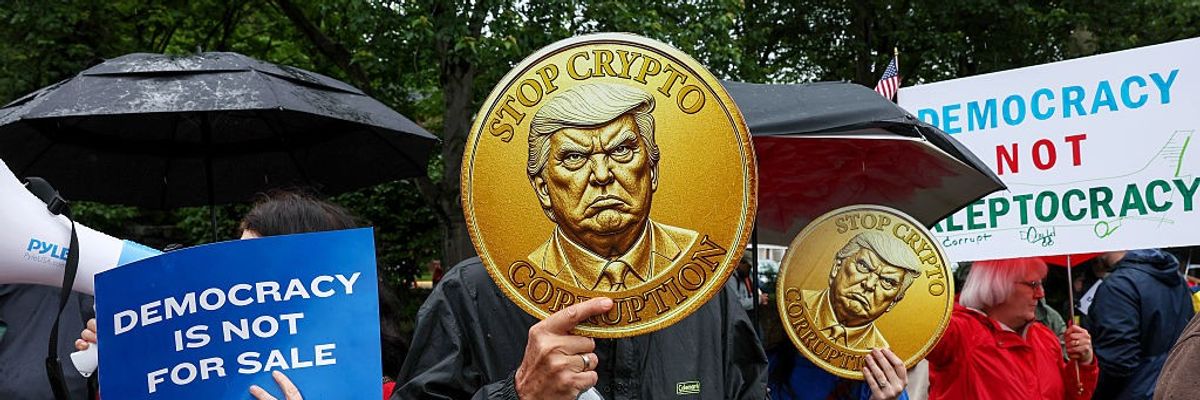
Demonstrators hold up mock cryptocurrency during the “America is Not for Sale” rally at the Trump National Golf Club on May 22, 2025 in Washington, DC.
(Photo by Jemal Countess/Getty Images for Public Citizen)
Brad Reed
Sep 15, 2025
COMMON DREAMS
The New York Times on Monday published a blockbuster report detailing how US President Donald Trump’s administration gave the United Arab Emirates access to high-powered artificial intelligence chips just days after receiving a massive investment in Trump’s cryptocurrency startup.
As the Times report documented, Sheikh Tahnoon bin Zayed Al Nahyan, a member of the United Arab Emirates’ (UAE) ruling family, had one of his investment firms deposit $2 billion into World Liberty Financial, the startup founded by members of the Trump family and the family of Trump Middle East envoy Steve Witkoff.
RECOMMENDED...
‘Greatest Corruption in Presidential History’: Trump Family Reaps $5 Billion More in Crypto Profits
Just two weeks later, wrote the Times, “the White House agreed to allow the UAE access to hundreds of thousands of the world’s most advanced and scarce computer chips, a crucial tool in the high-stakes race to dominate artificial intelligence,” despite national security concerns about these chips being shared with China.
The Times, which interviewed more than 75 people in its investigation of the deals, did not present direct evidence that the two deals were explicitly linked, and the White House denied any connection between the massive investment in the Trump family’s crypto firm and the decision to grant UAE access to the chips.
However, the paper interviewed three ethics lawyers who said that “the back-to-back deals violate longstanding norms in the United States for political, diplomatic, and private dealmaking among senior officials and their children.”
Other political observers were stunned by the Times’ report.
“If this is true, this is the largest public corruption scandal in the history of the United States and it’s not even close,” commented Ryan Cummings, chief of staff at the Stanford Institute for Economic Policy Research.
US foreign policy journalist Laura Rozen questioned whether Witkoff’s dealings with the UAE and other countries were impacting his ability to do his job in other areas.
“Maybe Witkoff is too busy pushing deals to enrich his and Trump’s families to focus on getting an Israel-Gaza hostage deal over the line, recognizing the Russians are not interested in ending the war on Ukraine, etc.,” she speculated.
Alasdair Phillips-Robins, a fellow in the Technology and International Affairs Program at the Carnegie Endowment for International Peace, marveled at the reporting that Trump’s negotiation team appeared to be willing to grant UAE access to the chips without forcing any major geopolitical tradeoffs.
“This sounds like the world’s weakest negotiation: telling the UAE they’ll get unlimited chips before they’ve agreed to a single concession in return,” he wrote.
Independent journalist Jacob Silverman, who has written extensively on the politics of the US tech industry, remarked that the Trump administration’s actions exposed in the Times report were “impeachable” and smacked of “incredible corruption.”
In addition to his cryptocurrency-related dealings with UAE, Trump has also come under scrutiny for accepting a luxury jet from the government of Qatar that he plans to use for the remainder of his term in office and that will be given to his official presidential library after he leaves the White House.
Exposed: How Trump family raked in billions in secret deals brokered by top advisor
Sarah K. Burris
September 15, 2025
RAW STORY
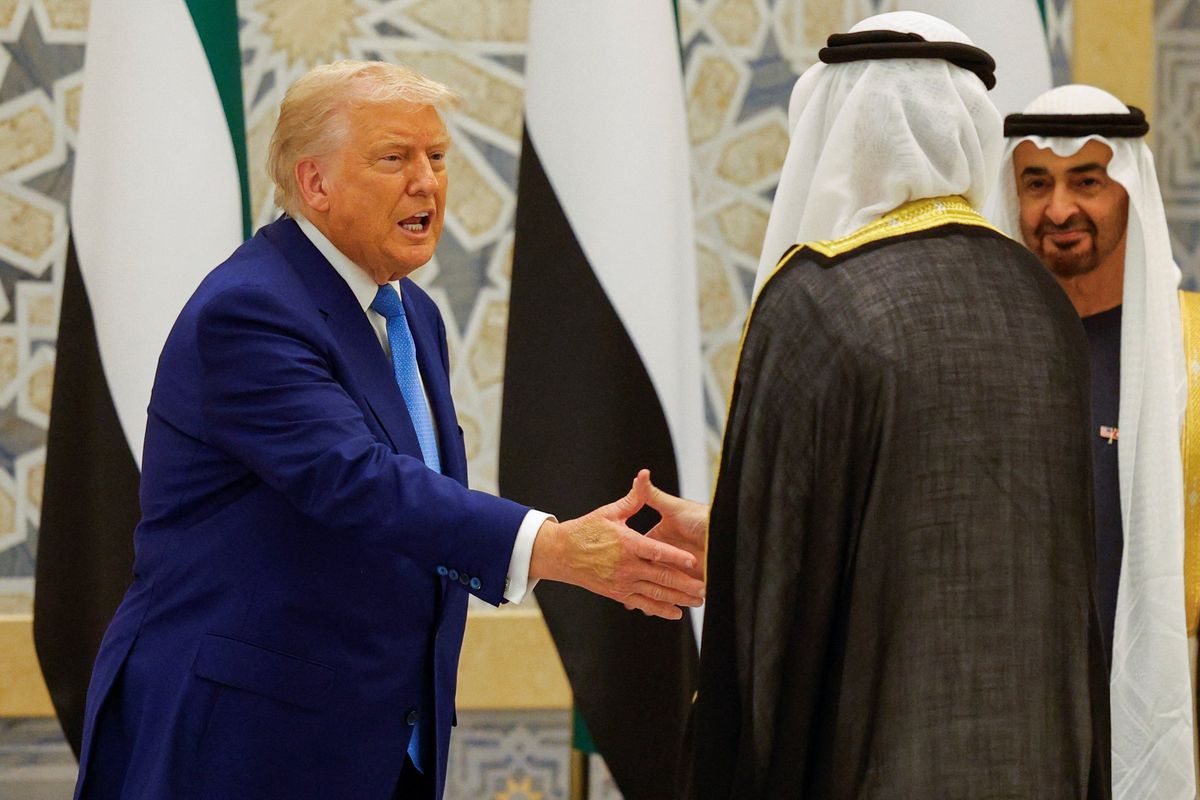
U.S. President Donald Trump greets a member of the United Arab Emirates' delegation, as he stands next to UAE President Sheikh Mohamed bin Zayed Al Nahyan, at Qasr Al Watan, in Abu Dhabi, United Arab Emirates, May 15, 2025. REUTERS/Brian Snyder
In a newly detailed report, The New York Times alleges that President Donald Trump's family secured billions of dollars through a deal orchestrated by his Middle East envoy, Steve Witkoff, and his son Zach Witkoff.
An extensive article by Eric Lipton, David Yaffe-Bellany, Bradley Hope, Tripp Mickle, and Paul Mozur describes how Witkoff and Sheikh Tahnoon bin Zayed Al Nahyan have "become both diplomatic allies and business partners, testing the limits of ethics rules while enriching the president, his family and his inner circle."
According to the report, a series of multi-billion-dollar arrangements involved Witkoff and Trump’s joint crypto company and the sale of computer chips to the UAE, generating significant financial benefits for them.
While administration officials objected to these deals, National Security Council senior director for technology David Feith was notably the main obstacle. The Times notes that far-right activist and Trump confidant Laura Loomer intervened in Feith’s firing, maintaining that it was for a separate issue. Loomer reportedly told Trump that Feith’s father’s political views were problematic, as Feith’s father previously served in George W. Bush’s administration.
After Feith was ousted, UAE negotiations proceeded under the leadership of David Sacks, Trump’s advisor on AI and cryptocurrency. At one point, the White House counsel acknowledged potential ethical concerns.
"Early investors in Craft Ventures, the firm Mr. Sacks helped start in 2017, included the Abu Dhabi Investment Authority, which is now overseen by Sheikh Tahnoon," the report notes. "Until at least March, Mr. Sacks, who is still working at Craft, was also invested in a stock fund that included the Taiwan Semiconductor Manufacturing Co., which builds Nvidia’s chips, and other A.I.-related companies such as Amazon and Meta."
The White House counsel signed a letter granting Sacks a special waiver to make formal decisions for the government—even on matters that affected his own investments. "Without the waiver, those kinds of actions could violate conflict-of-interest law," the Times wrote. Sacks and Craft Ventures then sold off their remaining stake in the AI firm.
As these deals unfolded in the background, Witkoff was simultaneously negotiating with the UAE over a U.S.-backed chip factory. The Times points out that a competing chip factory is also being built in the United States, adding further complexity. Both Witkoff and Sacks pressed to build the factory, with negotiations covering chip shipments to the UAE, expanding from 100,000 chips annually to 500,000.
The benefit would ensure billions in "U.S. industrial growth" and AI deployment. Top officials raised concerns, questioning whether the U.S. was demanding enough from Sheikh Tahnoon for chip sales, suggesting Trump should push the UAE to cancel military exercises with China and halt certain technology transfers.
Meanwhile, Zach Witkoff emerged as "the face of World Liberty," announcing in a post on X that his stablecoin would not fluctuate like Bitcoin, mirroring the steadiness of U.S. currency. In search of investors and expertise, Zach Witkoff traveled to the UAE, hiring one of the Sheikh’s top aides.
While his father handled diplomatic negotiations, Zach arranged for World Liberty to partner with MGX, a company chaired by Sheikh Tahnoon.
"MGX would use World Liberty’s USD1 stablecoin to complete a $2 billion investment in Binance, a giant crypto exchange," the Times reported. "It was the single largest investment in a crypto company ever, according to Binance. The transaction effectively handed World Liberty a $2 billion bank deposit, funds that the company could invest for annual returns in the tens of millions."
The Times describes these events as "the start of a succession of wins for the Witkoffs, the Trumps and the Emiratis."
Read the full report here.
.jpg)
No comments:
Post a Comment