From soft power to digital firepower: France steps up fight against disinformation
France is ramping up its fight against online disinformation with a new digital tool, known as French Response, aimed at countering hostile allegations from abroad. FRANCE 24 spoke with Dr Maxime Audinet, an influence strategies researcher at the Institute for Strategic Research (IRSEM), about how the account signals a shift toward proactive, strategic messaging.
Issued on: 08/09/2025 -
By: Anaelle JONAH
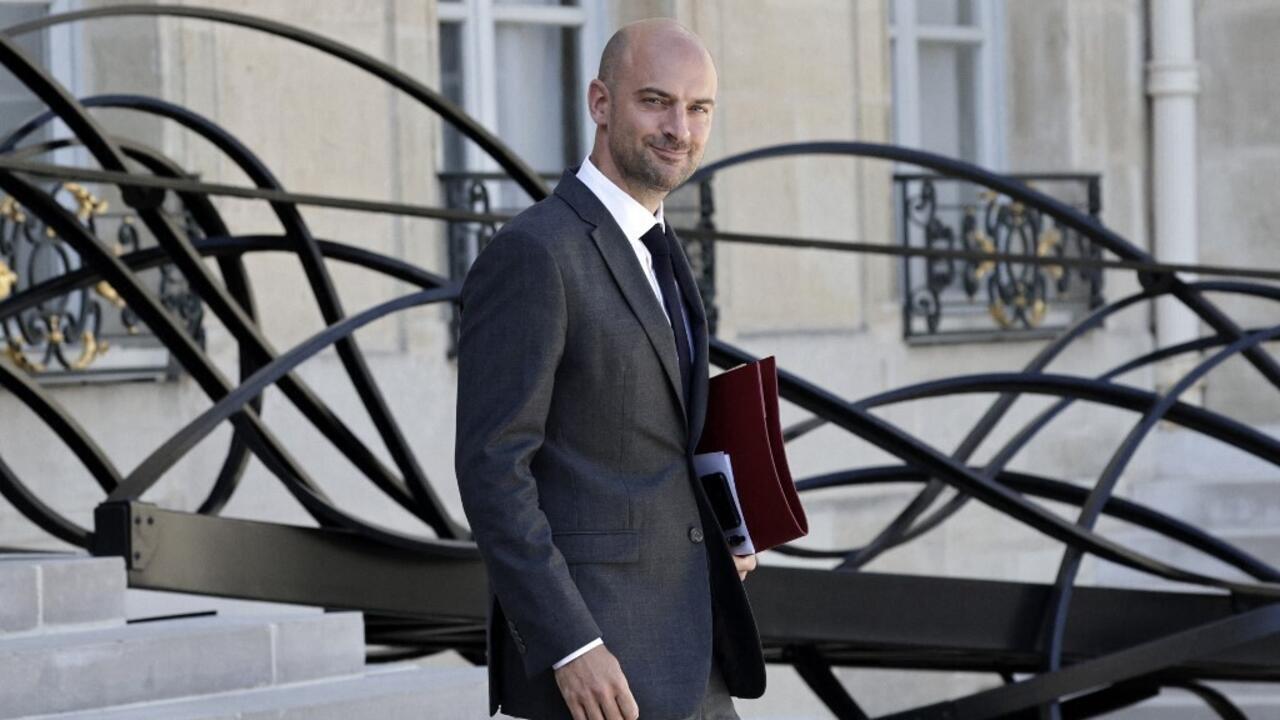 France's Minister for Europe and Foreign Affairs Jean-Noel Barrot leaves the presidential Elysee Palace in Paris, on August 27, 2025. © Stephane de Sakutin, AFP
France’s Foreign Ministry on Tuesday will gather experts on information manipulation for a special conference dedicated to "information warfare". Among the topics on the table will be the government’s brand new digital tool: French Response.
Launched last week on X (formerly known as Twitter), the account is designed to counter foreign disinformation targeting France. Described by Foreign Minister Jean-Noël Barrot as an "official response account", it aims to provide rapid replies to hostile allegations while complementing traditional diplomatic channels.
Its first intervention came on Friday, when it pushed back against US Secretary of State Marco Rubio’s claim that Hamas had withdrawn from hostage negotiations immediately after France announced plans to recognise a Palestinian state later in the year.
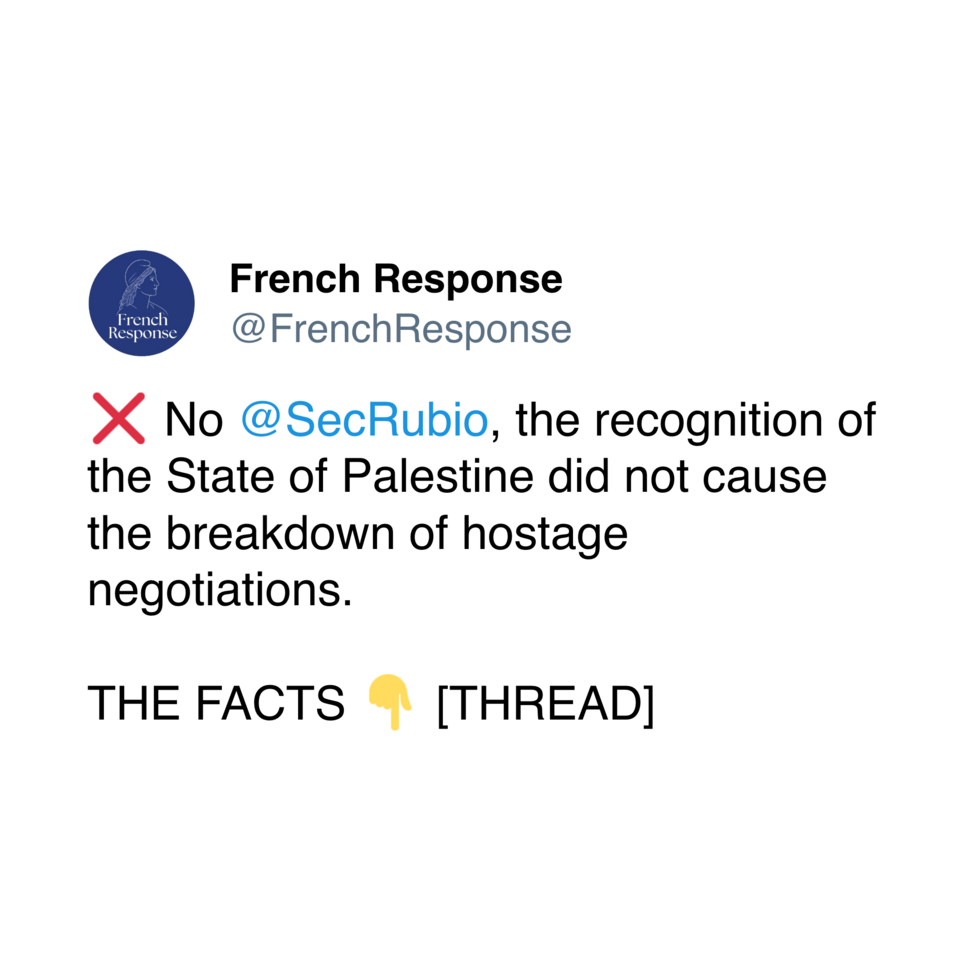
"The recognition of the State of Palestine did not cause the breakdown of hostage negotiations," French Response posted on X, refuting US Secretary of State Marco Rubio's claims. © Screenshot, FRANCE 24
"No @SecRubio, the recognition of the State of Palestine did not cause the breakdown of hostage negotiations," the account replied, posting a timeline showing Israeli officials had reported the collapse of talks before Emmanuel Macron’s announcement in July.
The launch signals a more assertive French approach in the Middle East, where Paris has faced criticism for its diplomatic positions. The ministry said the initiative is part of a broader strategy to defend France’s image internationally amid rising online disinformation campaigns. While initially focused on the Middle East, French Response could eventually cover other continents and subjects.
FRANCE 24 spoke with Dr Maxime Audinet, a research fellow in influence strategies at the Institute for Strategic Research (IRSEM), who is set to attend Tuesday’s conference, about the significance of the move.
FRANCE 24: How significant is the launch of French Response? Are we looking at a one-off experiment or a real shift in French diplomacy?
Dr Maxime Audinet: We’re at a key moment when it comes to influence strategies. The Ministry of Foreign Affairs is really at the forefront of these issues. If it ends after two tweets, given the current political context in France – where the government faced a confidence vote on Monday that led to its fall – it will just disappear without much consequence. But if we assume they’re serious and it sticks, then this is part of a much bigger shift.
Over the past three years, France has been transforming its approach to influence. Traditionally, French influence relied on cultural outreach and soft power – language, education, heritage. But now, more offensive approaches are being considered. The "French Response" account reflects this posture: moving from simply monitoring and debunking foreign disinformation, as with the Viginum programme [Editor's note: a unit launched by the government in 2021 dedicated to detecting, analysing and countering foreign information operations targeting the country], to actively producing France’s own narratives in the information space.
To what extent can one X account really make a difference in countering disinformation?
A single account won’t change international opinion. But it’s symbolic of a wider posture. France has recognised that the information space is a battlefield. It’s not just about fact-checking anymore. It’s about being proactive, using formats and tones that resonate.
We’ve seen examples already – humour, irony, even memes – used by states to gain traction. Ukraine has been very effective with this since 2022, while Russia and China have long used these methods, often without ethical restraint. For France, "French Response" shows a readiness to adapt, to be more direct and to speak the language of these platforms.
What are the main opportunities and risks for France in adopting this kind of online strategy?
The opportunity is to be more impactful. On platforms like X, messages that are emotionally charged, polemical, or bold have a much higher reach than those that are strictly factual, technocratic or bureaucratic. It’s about engaging more deeply, tapping into emotional resonance and making sure your message sticks.
It also shows that France accepts that the information space is now strategic. And if you want your voice to carry, you have to adapt to its codes.
But there are risks too, especially the risk of undermining public credibility if the tone becomes too aggressive or excessive. It’s a fine line to walk.
That said, we’re seeing certain ethical barriers breaking down. The sheer scale of disinformation threats has pushed the authorities toward a more pragmatic approach. As long as they stay within ethical bounds – no disinformation, no blatant lies like Russia – there is space to operate.
There’s a broad spectrum between total politeness and outright propaganda. And I think France is now learning to navigate that space.
This interview has been edited for length and clarity.
"No @SecRubio, the recognition of the State of Palestine did not cause the breakdown of hostage negotiations," the account replied, posting a timeline showing Israeli officials had reported the collapse of talks before Emmanuel Macron’s announcement in July.
The launch signals a more assertive French approach in the Middle East, where Paris has faced criticism for its diplomatic positions. The ministry said the initiative is part of a broader strategy to defend France’s image internationally amid rising online disinformation campaigns. While initially focused on the Middle East, French Response could eventually cover other continents and subjects.
FRANCE 24 spoke with Dr Maxime Audinet, a research fellow in influence strategies at the Institute for Strategic Research (IRSEM), who is set to attend Tuesday’s conference, about the significance of the move.
FRANCE 24: How significant is the launch of French Response? Are we looking at a one-off experiment or a real shift in French diplomacy?
Dr Maxime Audinet: We’re at a key moment when it comes to influence strategies. The Ministry of Foreign Affairs is really at the forefront of these issues. If it ends after two tweets, given the current political context in France – where the government faced a confidence vote on Monday that led to its fall – it will just disappear without much consequence. But if we assume they’re serious and it sticks, then this is part of a much bigger shift.
Over the past three years, France has been transforming its approach to influence. Traditionally, French influence relied on cultural outreach and soft power – language, education, heritage. But now, more offensive approaches are being considered. The "French Response" account reflects this posture: moving from simply monitoring and debunking foreign disinformation, as with the Viginum programme [Editor's note: a unit launched by the government in 2021 dedicated to detecting, analysing and countering foreign information operations targeting the country], to actively producing France’s own narratives in the information space.
To what extent can one X account really make a difference in countering disinformation?
A single account won’t change international opinion. But it’s symbolic of a wider posture. France has recognised that the information space is a battlefield. It’s not just about fact-checking anymore. It’s about being proactive, using formats and tones that resonate.
We’ve seen examples already – humour, irony, even memes – used by states to gain traction. Ukraine has been very effective with this since 2022, while Russia and China have long used these methods, often without ethical restraint. For France, "French Response" shows a readiness to adapt, to be more direct and to speak the language of these platforms.
What are the main opportunities and risks for France in adopting this kind of online strategy?
The opportunity is to be more impactful. On platforms like X, messages that are emotionally charged, polemical, or bold have a much higher reach than those that are strictly factual, technocratic or bureaucratic. It’s about engaging more deeply, tapping into emotional resonance and making sure your message sticks.
It also shows that France accepts that the information space is now strategic. And if you want your voice to carry, you have to adapt to its codes.
But there are risks too, especially the risk of undermining public credibility if the tone becomes too aggressive or excessive. It’s a fine line to walk.
That said, we’re seeing certain ethical barriers breaking down. The sheer scale of disinformation threats has pushed the authorities toward a more pragmatic approach. As long as they stay within ethical bounds – no disinformation, no blatant lies like Russia – there is space to operate.
There’s a broad spectrum between total politeness and outright propaganda. And I think France is now learning to navigate that space.
This interview has been edited for length and clarity.
No comments:
Post a Comment