Iranian Shipping Will Be Affected by UN Snap-Back Sanctions
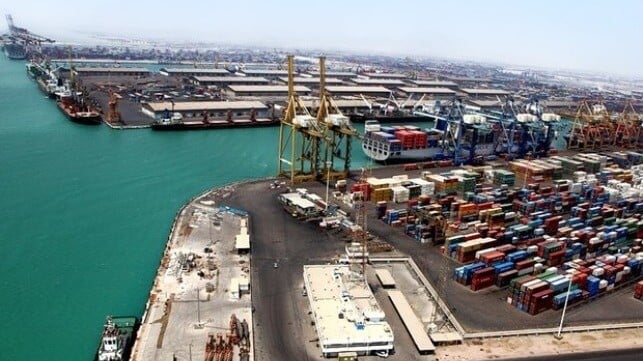
The UN Security Council voted on September 19 to reject an attempt to delay the re-imposition of the 2015 sanctions regime, under an automatic mechanism which can be triggered if Iran fails to observe previous agreements made to monitor activities associated with nuclear weapons development.
The move follows the failure of an Iranian team negotiating with France, Germany and the United Kingdom, known as the E3, to make credible proposals. The Iranian negotiating team, led by Foreign Minister Abbas Araghchi, requested a postponement of the snapback in exchange for a promise to re-open discussions with the United States, but without offering any substantive indications of what Iran might offer in such negotiations. Moreover, from furious debates both within the Iranian parliament and within the government-controlled media, it was unclear even if Foreign Minister Araghchi had the authority to promise the resumption of talks, let alone what such negotiations might concede.
Therefore, unless a breakthrough can be achieved by Iranian President Masoud Pezeshkian during the forthcoming General Assembly in New York, the 2015 sanctions regime will be re-imposed on Iran on September 27. But given the failure of negotiations between the E3 and Iran so far, the Iranians will have to make concrete proposals in writing, with the declared backing of the Iranian Supreme Leader, if snapback is to be averted.
The sanctions regime on track to be imposed will be significantly more effective than current restrictions imposed on Iran. Iran is currently under US maximum pressure sanctions, and the sanctions regimes imposed separately by Western nations. But the re-imposed regime will have UN authorization, the lack of which in the separate national sanctions schemes currently in force provides an excuse for some countries, such as China, India, Malaysia and the UAE, to continue trading with Iran. Restrictions on oil and gas exports, shipping, banking and access to the international financial system, weapons production, insurance and technical imports will all be tightened.
The prospect of this occurring is already provoking heated controversy in Iran, where the consequences are seen as potentially devastating. It is of some significance that Presidents Trump and Xi Jinping had their third telephone conversation this year on September 19, and are on track for a face-to-face meeting in South Korea. In these discussions, China’s domestic needs to ease the threat of US tariffs are likely to be prioritized over any desire to provide support to Iran. The increased pressures will have direct economic impacts. But it will also have political stability consequences, feeding through into the ferocious internal debate within the Iranian political elite between the hardliners and the IRGC, juxtaposed against pragmatists led by the Iranian President Pezeshkian.
For the maritime community, a reinvigorated anti-Iranian sanctions regime is likely to impact the operations of the government-owned 115 vessel merchant fleet operated by Islamic Republic of Iran Shipping Line Group (IRISL) and subsidiary companies, and the 38 aging VLCC tankers operated by National Iranian Tanker Company (NITC). There are also likely to be impacts on the relative protections currently enjoyed by Iranian oil held in tankers offshore, and on ship-to-ship transfers.
Iranian Navy Stokes a Political Problem in South Africa
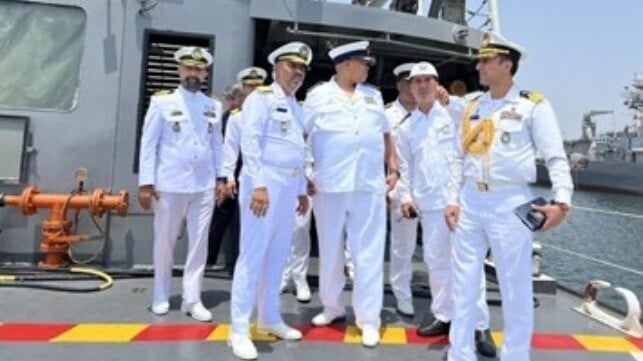
The Iranian Navy, and its potential participation in a South African naval exercise, is being used as a tool to prosecute political objectives, both in South Africa and in Iran.
Iran has lost many friends and allies, along with regional influence, since the conflict in Gaza initiated a roll-back of its Axis of Resistance. Hezbollah in Lebanon and Assad in Syria have been lost, Iranian influence curtailed in Iraq, and Armenia’s peace negotiations with Azerbaijan have come about at the expense of Iran. Even the confidence of support from Russia and China has waned, as both place greater emphasis on achieving political objectives with the United States than supporting Iran with its regional ambitions.
So with some enthusiasm, Iran has grabbed the hand of friendship offered by South Africa, which is seeking to attract participation in a joint naval exercise to be held under South African leadership. Of the BRICS nations invited to attend, representatives from South Africa, Russia, China, Ethiopia, Indonesia, and Iran attended a preparatory meeting in Cape Town on the Mosi-3 naval exercise in June. The exercise was scheduled to be conducted off the Western Cape in November, and would have followed on from the Exercise Mosi-1 held in November 2019 and Exercise Mosi-2 held in March 2023. The exercise has since been postponed, when South Africa realized that it would clash with the G20 conference scheduled to be held in South Africa at the same time. That clash was sufficient to prompt President Trump to cancel his attendance.
In the meantime, Iran had followed up the fleeting opportunity to participate in Exercise Mosi-3 by inviting the South African Chief of Staff General Rudzani Maphwanya to visit Tehran. Maphwanya was received by his Iranian opposite number Major-General Seyyed Abdolrahim Mousavi on August 12, his visit to Tehran not apparently approved beforehand by South African President Cyril Ramaphosa. At the meeting, Maphwanya said South Africa shared ‘common goals’ with the ‘peace-loving nation of Iran’, condemned US aggression and said it supported ‘Tehran’s outreach to Africa’.
This may have thrilled the Iranians, but not President Ramaphosa - who objected to this unprecedented freelancing by the South African military into the political space, especially at a time when South Africa is seeking to improved relations with the United States. But rather than firing General Maphwanya, the President’s subsequent criticism of him was considered by many in South Africa to be muted, insufficient to unwind the precedent set by General Maphwanya’s visit.
The head of South Africa’s Navy, Admiral Monde Lobese, visited the Iranian naval base in Bandar Abbas in August last year. In June 2021, IRINS Makran (K441) and the frigate IRINS Sahand (F74) made a port call in Cape Town, en route to Russia, and IRINS Makran returned in May 2023 with the frigate IRINS Dena (F75) on the last leg of the 86th Flotilla’s round the world cruise.
It remains to be seen when Exercise Mosi-3 will be rescheduled. But if it comes to pass, it will be a naval exercise with greater than normal political significance.
U.S. Revokes Sanctions Waiver on Iran’s Chabahar Port
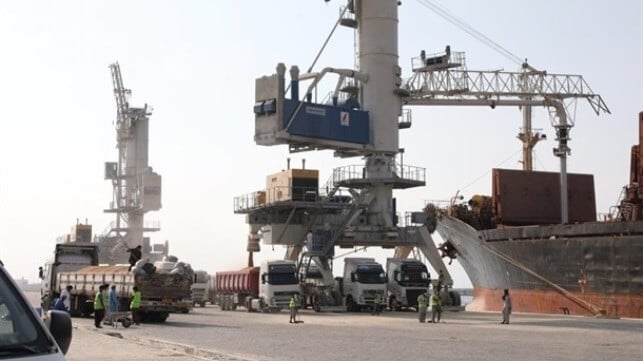
The U.S. government has revoked a sanctions exemption policy on Iran’s Chabahar port, a move seen as likely to affect the India-led development in the facility. In the past few months, the U.S. has declared a maximum pressure policy to isolate the Iranian regime, with tighter sanctions introduced against the country’s shipping sector. However, due to an exemption policy introduced by the U.S in 2018, Chabahar port has been insulated from the sanctions affecting the rest of Iran’s infrastructure. At the time, the exemption was to facilitate Afghanistan reconstruction.
During the same year, the Indian Ports Global Limited (IPGL) took over the operations of Chabahar port. This deal was formalized last year through a 10-year contract between IPGL and the Port & Maritime Organization of Iran. Under the agreement, IPGL committed to invest $370 million in the development of the port.
Located on Iran’s south-eastern coast along the Gulf of Oman, Chabahar port is a strategic investment for India as it targets to boost regional trade with central Asian countries, including Afghanistan. In addition, the Chabahar operations have seen India and Iran boost ties. Early this month, the two countries held diplomatic consultations in Tehran. The talks centered on advancing the Chabahar port project as well as the International North-South Transport Corridor, a multimodal route envisaged to connect the Indian Ocean and Persian Gulf to the Caspian Sea.
The U.S. move to end its sanctions waiver on Chabahar port will affect India’s regional connectivity plans. “The Secretary of State has revoked the sanctions waiver issued in 2018 effective September 29, 2025. Once the revocation is effective, persons who operate the Chabahar port may expose themselves to sanctions under the Iran Freedom and Counter-Proliferation Act (IFCA),” said the U.S Department of State.
Under India’s control, Chabahar port container throughput has grown immensely - from 6,000 TEU to over 90,000 TEU in the last two years. The ongoing modernization of the facility is now uncertain, especially if India abandons the project. Further, the Chabahar project presents a diplomatic conundrum for India as it is trying to balance its relations between U.S. and Iran. India’s trade minister Piyush Goyal is expected to visit Washington this week to progress tariff negotiations. Last month, the Trump administration doubled tariffs on Indian imports to 50%, which India hopes to reduce in scheduled negotiations this week.
Grain suction boom at Chabahar Port (AgriculturalEngineer96/CC BY SA 4.0)
No comments:
Post a Comment