It’s possible that I shall make an ass of myself. But in that case one can always get out of it with a little dialectic. I have, of course, so worded my proposition as to be right either way (K.Marx, Letter to F.Engels on the Indian Mutiny)
Saturday, September 20, 2025
PALEONTOLOGY
First Mesozoic amber deposit with preserved insects discovered in South America
The discovery, which took place in the province of Napo (Ecuador), opens a unique window into the past: it provides insight into the rich biodiversity of a dense, humid tropical forest in the southern hemisphere some 112 million years ago, when the modern continents broke away from the supercontinent Gondwana and large reptiles dominated the terrestrial ecosystems.
A scientific team has discovered the first Mesozoic amber deposit with preserved insects in South America in the province of Napo (Ecuador). The discovery, published in the journal Communications Earth & Environment, reveals that 112 million years ago there was a tropical rainforest with ferns, cycads and angiosperm plants, and describes a unique scenario for understanding the rich biodiversity and Cretaceous ecosystems in the southern hemisphere, little studied so far in the fossil amber record.
“This is the largest Mesozoic amber deposit in South America and one of the richest in Gondwana with bioinclusions. It is part of a recently discovered deposit in the Hollín Formation — detrital sedimentary rock levels of the Oriente Basin in Ecuador — and is dated to the Albian stage of the Lower Cretaceous, with well-preserved terrestrial arthropod remains (insects and spider web remains)”, says Professor Xavier Delclòs, from the Faculty of Earth Sciences and the Biodiversity Research Institute of the University of Barcelona (IRBio) and first author of the article.
The amber comes from a fluvial-lacustrine environment at the Genoveva quarry site (in the Tena region of the Amazon region). The resin-producing trees were probably araucariaceous conifers, according to geochemical and palynological analyses. “Everything indicates that the ancient ecosystem was wooded, humid and diverse, and has the oldest known association of angiosperm leaves in north-western South America,” says Delclòs, a member of the UB’s Department of Earth and Ocean Dynamics.
This study outlines a new framework for understanding equatorial ecosystems during the Cretaceous and the biogeographical relationships of their components when the modern continents broke away from the supercontinent Gondwana.
Teams from the Spanish Geological and Miner Institute National Center (IGME-CSIC), the Smithsonian Tropical Research Institute (Panama), the University of Rosario (Colombia), the Escuela Politécnica Nacional (Ecuador) and the Senckenberg Natural History Museum Frankfurt (Germany), among other institutions, have also participated in the study. Dense, damp forest with resin-producing trees
The study analysed 60 amber samples and identified 21 bioinclusions, with representatives of five insect orders, including Diptera (flies), Coleoptera (beetles) and Hymenoptera (ants and wasps), together with one spider web fragment. No plant remains were found within the amber, but a wide variety of plant fossils were identified in the rock samples, including spores, pollen and leaves.
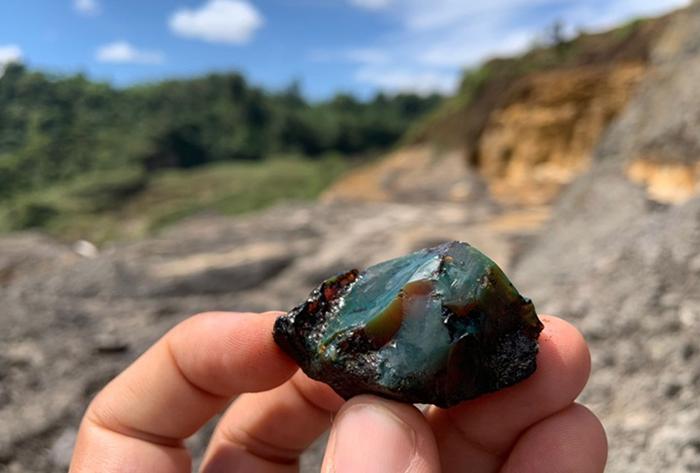
The team has analysed samples of amber and surrounding rock from the Genoveva mine in Ecuador and identified two different types of amber: one formed underground around the roots of resin-producing plants (without inclusions) and another that formed when the resin was exposed in the air (with inclusions).
“This amber is chemically mature and altered by exposure to oil, as the Hollín Formation is an oil source rock, and is currently commercially exploited”, notes César Menor Salván, professor at the University of Alcalá.
The characteristics of the bioinclusions and surrounding fossils suggest that the amber formed in a dense, humid forest environment dominated by resin-producing trees.
“Mostly chironomid and ceratopogonid dipterans were found, as well as springtails, coleoptera, hymenoptera, trichoptera, hemiptera and a fragment of a spider web. The insects point to the presence of freshwater bodies and a tropical rainforest in which the presence of rare families stands out, such as the wasps †Stigmaphronidae”, says Enrique Peñalver, researcher at the IGME in Valencia.
Carlos Jaramillo, from the Smithsonian Tropical Research Institute, says that “the pollen and macrofossils identified in the rocks that contained the amber reveal a forest with pteridophytes (ferns and related species), Araucariaceae and Cheirolepidaceae conifers, cycads and early angiosperms”, and adds that “epiphytic fungi have also been detected on the fossil leaves and resinicolous fungi”.
These characteristics contrast with the arid conditions observed in other South American deposits of the same age, such as the Crato Formation on the eastern margin of South America. In this case, no evidence of fire has been found, unlike many contemporary amber deposits in the northern hemisphere, probably due to the high humidity.
Experts stress that the discovery of this amber deposit is of great scientific relevance for future studies of this period. “Future excavations could help connect South American biodiversity with other regions of Gondwana, such as Antarctica, Australia and South Africa, where Cretaceous amber has also been found,” concludes Monica Solórzano Kraemer, from the Senckenberg Natural History Museum.
From left to right, Mónica Morayma Solórzano-Kraemer (Senckenberg Natural History Museum Frankfurt, Germany), Edwin Cadena (University of Rosario, Colombia), Xavier Delclòs (University of Barcelona) and Enrique Peñalver (Spanish Geological and Miner Institute National Center, IGME-CSIC).
Expert Xavier Delclòs (UB) at level G1 of the Genoveva mine.
From left to right, experts Enrique Peñalver (IGME-CSIC) and Xavier Delclòs (UB) at level G3 of the Genoveva mine.
The team has analysed samples of amber and surrounding rock from the Genoveva mine in Ecuador
The first amber deposits in South America containing preserved insects have been discovered in a quarry in Ecuador, reports a paper in Communications Earth & Environment. The finding provides a snapshot of a 112-million-year-old forest on the supercontinent Gondwana, and presents new possibilities for studying a currently little-known ancient ecosystem.
Amber (fossilised tree resin) samples have a wide date range, with the earliest dated to 320 million years ago, but there is a notable increase in the number of samples in the fossil record between 120 million and 70 million years ago, during the Cretaceous era (143.1 million to 66 million years ago). Amber can contain bio-inclusions — ancient plant or animal matter preserved inside the resin — which give researchers an opportunity to study organisms, such as insects and flowers, that are otherwise rarely preserved. However, until recently, almost all major identified amber deposits have been located in the Northern Hemisphere. As such, we have a limited understanding of the biodiversity and ecosystem of the Southern Hemisphere during the Cretaceous era, when the modern continents were breaking away from the supercontinent Gondwana.
Xavier Delclòs and colleagues analysed samples of amber and the surrounding rock from the Genoveva quarry in Ecuador. The amber, dated to approximately 112 million years ago, is part of a recently discovered deposit in the Hollín Formation, a sedimentary rock layer lying across the Oriente Basin in Ecuador. The authors identified two different types of amber: one that formed underground around the roots of resin-producing plants, and another that formed when resin was exposed to air. In the 60 analysed samples of aerial amber, the authors identified 21 bio-inclusions, consisting of members of five insect orders — including Diptera (flies), Coleoptera (beetles), and Hymenoptera (which includes ants and wasps) — along with a fragment of spider web. They also identified a wide variety of plant fossils in the rock samples, including spores, pollen, and other remains.
The authors conclude that the characteristics of the bio-inclusions and surrounding fossils suggest that the amber formed in a humid and densely vegetated forest environment, dominated by resin-producing trees, and located in the southern part of Gondwana. They argue that the discovery of the amber deposit is of critical importance for future studies of this period.
ANN ARBOR—A University of Michigan researcher helped identify the earliest known example of a toothy, tongue-like apparatus for biting in an ancient fish, marking the moment 310 million years ago that fish first took advantage of their gill bones to innovate the way they feed.
The fish, called Platysomus, lived at the beginning of the Pennsylvanian period, at a time when a group of fish called ray-finned fish were exploring new ways to make a living—including how they ate. Like most fish alive today, such as goldfish, salmon, cod and tuna, Platysomus was a ray-finned fish.
U-M paleontologist Matt Friedman was part of a team that discovered that the Platysomus had a plate of teeth suspended by a cradle of jointed bones that also supported the gills it used to breathe. The plate of teeth, situated on the floor of the mouth like a tongue, was in direct opposition to a plate of teeth above it, and the fish used the plates to crush and grind food. As it turns out, Platysomus was the first to evolve this feeding structure called a tongue bite.
"One of the most powerful things we have for understanding evolution is adaptation. We can see that different kinds of creatures can adjust to similar kinds of demands in different ways," said Friedman, director and curator of the U-M Museum of Paleontology.
"But in this case, this is cool because it's showing us a convergent adaptation. This extinct group of fishes discovered this trick, and actually, it turns out that many different groups of fishes figured out this trick at later times. After multiple times, that tells us a little bit about what the constraints on evolutionary change might be, or if there are pathways that are easier to evolve along than others."
A general question in evolutionary biology is how evolutionary outcomes occur in different groups of animals, Friedman says. Tracking how different groups of fish evolved a similar tool (tooth plates) to tackle similar problems (eating hard stuff) can help researchers understand if these groups travel similar evolutionary pathways.
That, in turn, allows biologists to find common patterns in the origins of these structures. The research, published in the journal Biology Letters, was supported by the U.S. National Science Foundation.
The name "platysomus" means flat-bodied, and as well as being flat, the fish had a deep body. Their shape presents challenges for finding fossils that allow researchers to look at internal structures: When fish die and become entombed in mud, they tend to lie on their sides, providing a clear side view of the fish, its body shape and some of its external structures, but compression during fossilization obscures structures inside the fish.
"They're deep-bodied animals. They look a little like an angel fish," Friedman said. "But not only were they flat in life, they're typically squished even more flat as fossils. So although whole fossil fish skeletons are common, it's often hard to extract details of the internal skeleton. Fossils probably preserve those parts, but they're deadly flat."
As a consequence, Friedman has spent a large part of his career scouring museum collections for uncrushed, three-dimensionally preserved fish heads that contain just this kind of internal information.
"Fish heads are a good target because they're really complicated. They have a lot of parts, and where you have a lot of parts, you have a lot of different connections," Friedman said. "Those connections can take different forms, and that's the basis of the variation that we might use to try and reconstruct evolutionary history."
Friedman and colleagues were CT scanning three-dimensional fish fossils in a UK museum when they spotted the peculiar internal gill skeletons in a uniquely uncrushed Platysomus head. They were surprised to see a series of well-developed tooth plates inside the mouth of the animal. This led them to scrutinize flattened Platysomus fossils, where painstaking digital dissections also revealed the trademark features of a tongue bite.
The fish living today that have biting plates most similar to Platysomus are bonefish, a game fish living in warm tropical and subtropical waters that mostly eat hard-shelled prey like crabs.
Friedman says the finding also points to the importance of museum collections. The key fossil that formed the basis of his study was likely collected more than 120 years ago, and had probably received little attention since then.
"There's a popular perception that as a paleontologist, to do anything new or find anything exciting, you need to go to the field and dig up a fossil," Friedman said. "That’s important, of course. But people have already collected a lot of fossils, and as we develop new techniques, we find ways to coax new bits of data out of materials that are already in museums."
Friedman's co-authors include Sam Giles of the University of Birmingham and Matthew Kolmann of the University of Louisville.
No comments:
Post a Comment