Up, Up and Away!
Can anything stop this market?
(Article originally published in July/Aug 2025 edition.)
The first six months of the year were a rollercoaster of ups and downs and backs and forths as the markets seesawed between highs and lows. The lows came in mid-April, shortly after April 2 – so-called "Liberation Day" – when Trump unleashed a wave of threatened tariffs on the world. The highs came both before and after Liberation Day but mainly after as all three indices set new records.
It was a nonstop blast, all right. For the record, the Nasdaq and S&P 500 were up over five percent for the six months while the Dow rose nearly four percent. Not earthshaking, but better than the alternative, especially in view of all the doomsday scenarios that rose up in response to a seeming unending series of crises.
"Nothing ever happens" is the new meme on Wall Street.
Despite wars, tariffs, spending bills, inflation, trade deficits, tax cuts – you name it – none of it seems to matter. Consumers and investors alike just shrug it off. The markets keep going up. So sit back and relax. Not to worry. In the end, it's all good.
Here's how Randy Forsyth put it in a recent Barron's piece:
But mainly, the first half gave rise to the investment meme of "Nothing ever happens," insofar as the stock market is concerned. Trade wars and the uncertain impact of tariffs on the economy; fiscal fights over the Big, Beautiful tax bill that resulted in the U.S. losing its last triple-A credit rating; and conflicts in the Middle East, including the U.S. bombing of Iranian nuclear sites on June 22. After all of that, the S&P 500 and the Nasdaq Composite are ending the first half at record highs.
And he's optimistic about the second half of the year:
Forget about the proverbial "wall of worry" that bull markets supposedly ascend. The new belief, "Nothing ever happens," is actually relevant to stocks and helped induce individual investors to buy the steep dip in April and May, putting a lie to all the hand-wringing. By halftime, the mood had swung back to FOMO, or fear of missing out.
CRYPTO & GOLD
The seemingly blasé approach of investors in the equity markets is mirrored by crypto investors, but even more so, as they seem to have a blind faith in the coins' ability to go up. Take Bitcoin, for example. It was up about 15 percent in the first half of the year. Last year it rose a whopping 121 percent! It's currently trading around $120,000.
Why bother with the equity markets when you can make money like that in crypto?
And it will only get better as the Trump Administration legitimizes cryptocurrencies of all kinds and they begin trading on real exchanges. Well, they're already trading on real exchanges and being offered by blue-chip investment houses. You can even buy a Bitcoin ETF and brag to your friends that you're now "into crypto."
Excuse me while I buy some more Coinbase (which, incidentally, is up more than 50 percent this year) and Robinhood (up 160 percent!).
The real winner of the first six months was not stocks or crypto but, amazingly, gold. That stodgiest of investments was up 25 percent – on top of a 29 percent increase in 2024 – and is currently trading at around $3,300 an ounce, an all-time record. Since when do both gold and crypto outpace equities?
Oh, and you can also buy gold as an ETF, and you don't have to tell anybody. Just keep it to yourself (like cash under the mattress, except in this case the cash is getting more valuable).
So there seem to be two different things going on here – an appetite for risk (crypto) and an desire for safety (gold). That's at the extremes, and it's okay to do both, especially since they're outpacing traditional investments. In the middle are all the rest of us, plodding along in stocks and bonds.
But that's where I want to be. I'll take my five percent in the first six months of the year – and another five percent between now and year-end – and live happily ever after.
SHIPPING STOCKS
So let's take a look at the wonderful world of maritime and see how some of these stocks did.
Not so good, actually. And not unlike most of the market, for that matter. It's been a very narrow rally, really, limited largely to Big Tech and AI. The rest of the market, including shipping stocks, has moved in a limited range.
And for good reason. Too much uncertainty, especially surrounding tariffs and trade, which directly affect shipping. If global trading volumes decline, as they will if some of the threatened tariffs go into effect, that will directly impact shipping.
So don't look for any good news regarding the container, tanker, ro-ro and bulker trades. They will likely continue to stagnate. Offshore too, despite the "drill, baby, drill" mantra, as the price of oil remains stuck in the mid-$60s and offshore wind flounders. "Nothing ever happens" has traditional shipping markets on edge – with one exception. Cruising.
Given all the strife in the world today, people are looking for an escape, and cruise lines are the beneficiary. Two in particular – Viking and Royal Caribbean – are big winners. Let's start with Viking (VIK).
The darling of Baby Boomers and the brainchild of Torstein Hagen, Viking's stock is up an impressive 30 percent so far this year and currently trades around $57. It's more than doubled from its IPO price of $24/share back in May 2024 and continues to generate solid earnings from its loyal base of affluent clients.
As you cruisers out there well know, the company pioneered river cruising in Europe, starting more than 25 years ago, and has since expanded into small ship and ocean cruising worldwide. With a fleet of nearly 100 vessels, it's consistently voted #1 in its various categories (river, ocean, expedition) by upscale publications like Travel+Leisure and Condé Nast Traveler and has won numerous awards for excellence.
It's a cruise line "For the Thinking Person" and features "Experiences created for curious travelers." It's famously noted for its TV advertising on programs like "Masterpiece Theatre" and "Downton Abbey" and was one of the first cruise lines of any type to advertise on TV.
Royal Caribbean (RCL), #2 among cruise lines in terms of size, did even better. Its stock is up more than 50 percent this year and has doubled over the last 12 months, currently trading around $315. Can it go any higher? That's the big question.
Many analysts think so and have price targets ranging as high as $400, and there are good reasons to be optimistic. It reported earnings recently and blew past estimates, earning more than $1 billion on revenues of $4.5 billion.
"The strong demand we are seeing across our new ships and land-based destinations reinforces that our strategy is working and resonating with today's traveler," noted Jason Liberty, President & CEO, in the company's earnings release. "As consumer preferences continue to evolve – toward more frequent vacations, closer-in vacation planning, and a greater focus on meaningful, experience-driven travel – our experiences are designed to meet these evolving expectations. These trends, combined with our pipeline of bold, guest-centric initiatives, position us not only to create value for our shareholders, but to continue winning share of the growing $2 trillion global vacation market."
Sounds pretty upbeat to me! RCL even pays a dividend – a small one, I'll admit (75 cents/share) – but it's the only company among the major players to do so, and it's certainly a sign of confidence.
NOTHING EVER HAPPENS
So sit back, relax. Ignore all the ups and downs of tariffs, trade, wars and ceasefires, inflation and jobs reports. The market keeps going up.
Nothing ever happens.
The opinions expressed herein are the author's and not necessarily those of The Maritime Executive.
Vietnam traders say gold reforms to help dong, curb price gap

Vietnam’s plans to loosen the state’s grip and reform the gold market will help reduce currency volatility and narrow an outsized gap between domestic and global prices, according to the nation’s gold association.

“The policy move will better regulate the gold market, limit smuggling and help stabilize the dong,” Huynh Trung Khanh, vice chairman of the Vietnam Gold Traders Association, said in an interview in Ho Chi Minh City.
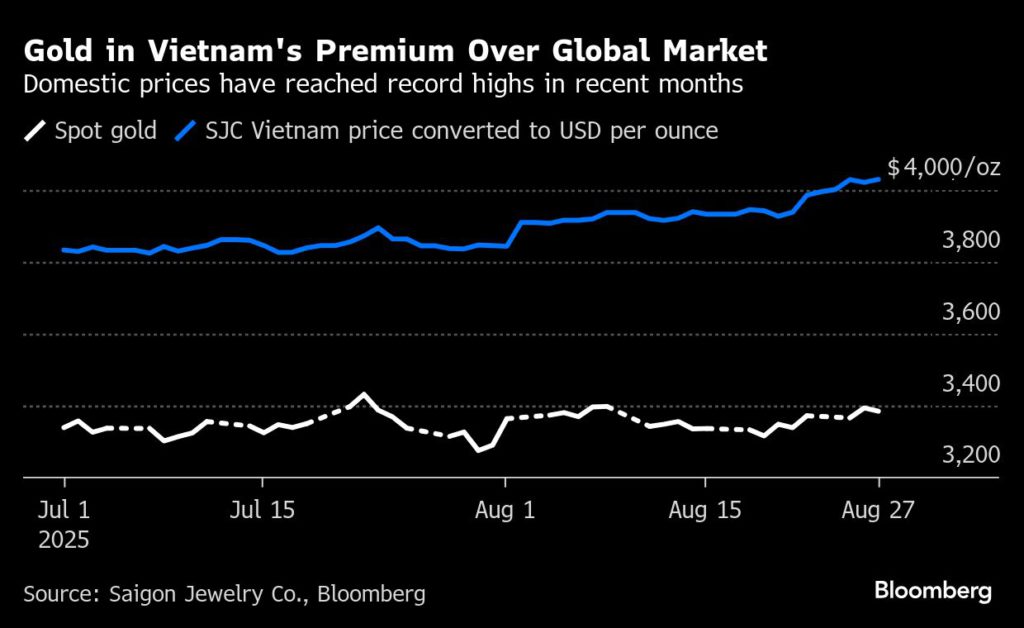
The government has outlined plans to end its monopoly on imports and exports of raw bullion, let some companies and banks obtain licenses, and allow trading on a state-run exchange. The moves come because prices in Vietnam’s existing gold market have become distorted, with the local premium over offshore prices leading to smuggling and pressure on the dong.
“The Vietnamese government is proceeding with the opening of its market in a careful and controlled manner, given that more than half of the eight approved banks are state-owned,” said Lee Liang Le, a Singapore-based analyst from Kallanish Index Services. “Nonetheless, this is welcome progress for both Vietnam and its regional counterparts, particularly the easing of restrictions on gold imports.”
The changes have been described as representing a “pivotal shift” for Vietnam, and encapsulate the country’s broader move away from state control to private enterprise.
They also come as investor and central bank demand have helped gold become one of the world’s best-performing commodities this year. But Vietnam’s prices have often run ahead of global rates, despite government efforts to reduce the difference.
The price gap surged to as much as 20 million dong ($758) per tael last month before easing to about 14 million dong, or a 10% premium to offshore prices, according to Khanh. The government aims to narrow the spread to just 2–3%, he added.
Still, investors are awaiting detailed guidelines from the central bank. The decree on gold market changes formally takes effect Oct. 10, and the central bank is preparing a circular with details.
“Some dealers see it as a good business opportunity to sell gold to Vietnam, but they are waiting for more details on rules around gold imports,” Kallanish’s Lee said.
Vietnamese authorities have said they plan to impose a personal income tax on gold trading to curb speculation in the metal. They are also weighing a requirement for gold transactions to be conducted via bank transfers, to improve market transparency.
That comes after neighboring Thailand said it’s considering a tax on baht-denominated gold trades, amid concern at the market’s impact on the Thai currency.
Khanh said the reforms could have a broader impact than just the gold market.
“Vietnam has the skills and low labor costs to build a world-class jewelry industry,” Khanh said. “With the right policies, we could export billions of dollars’ worth of jewelry, just like our neighboring countries, and we can import gold from the US to process and re-export to China, helping balance trade with both countries.”
Based on import licenses issued in the past, Vietnamese households could be sitting on at least 500 tons of gold, according to Khanh. With the country having seen multiple conflicts in the past century, many people hoard their gold at home, away from the banking system.
“That’s a huge volume of gold sitting idle,” he said. “Bringing it into circulation would spur business activity, curb hoarding and speculation, and ease pressure on the dong.”
(By Francesca Stevens and Nguyen Dieu Tu Uyen)
Congo seeks to tap more gold with new mines amid soaring prices
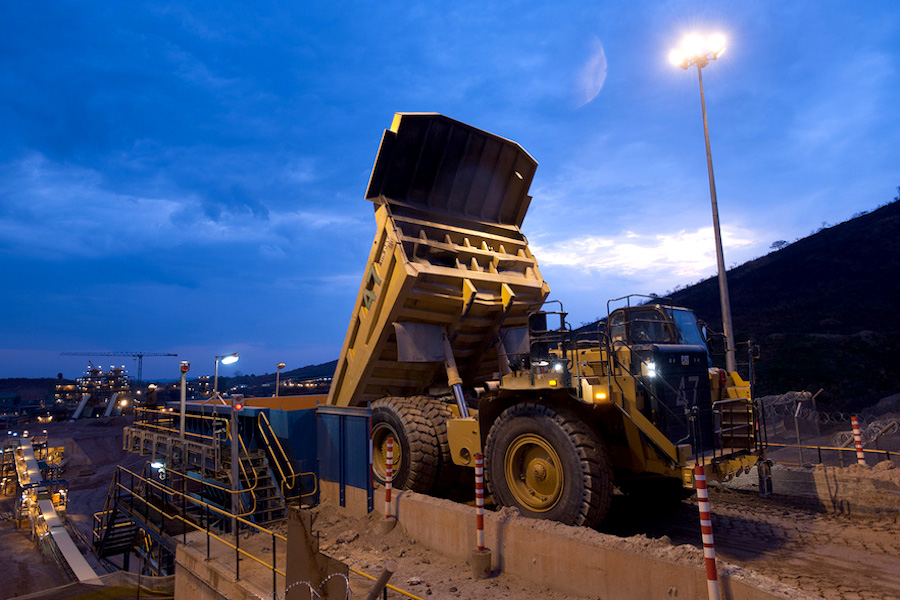
Democratic Republic of Congo says it loses 60 tons of gold a year to smuggling. The new mines minister wants the country to build new sites to recapture that wealth.
Louis Watum, who became minister last month, previously developed Africa’s biggest gold mine at Kibali, now owned by Barrick Mining Corp. He sees more projects like it on the horizon.
“There’s a lot of talks in the pipeline and a few deals might be announced in the near future,” Watum told Bloomberg in an interview in New York Wednesday. “We are talking with not only existing big mining houses like Barrick. We open again space for newcomers as well.”
Despite the success of Kibali, Congo has struggled to develop gold assets in its conflict-ridden east. Traffickers and armed groups dominate the trade, much of which transits through neighboring Uganda and Rwanda to the United Arab Emirates. With the gold price near record highs, 60 tons of gold could be worth more than $7 billion, a transformative revenue source for a poor country.
Watum, who also developed Ivanhoe Mines Ltd.’s copper and zinc projects in Congo, is in talks with the US over a forthcoming minerals, infrastructure and security deal, which he said are “quite advanced.”
“Once we’ve agreed on that framework, it’s going to be a lot more” business-to-business discussions with US companies, he said. “We’re trying to put as much as we can on the table for them.”
He said he is also looking to resolve longstanding disputes with some of the country’s biggest copper and cobalt miners, including Glencore Plc., Eurasian Resources Group and China’s CMOC Group Ltd.
Earlier this month Watum flew to Kazakhstan with Congolese President Felix Tshisekedi and held talks with ERG, which was in danger of losing at least one of its several projects in the country.
“I don’t think expropriating assets from their operators is a right signal to send to the world,” he said. “They also need to discharge on their obligations, and if they don’t, then we’re going to have also again a conversation to see how we take things forward.”
Watum has also talked to Glencore’s management about outstanding payments, he said.
In response to questions, a Glencore spokesperson said, “We continue to engage with the government.”
Cyrille Mutombo, Barrick’s Congo country manager, said in a message Thursday the company “is ready to invest in future growth in both the north eastern DRC and the copper belt.”
ERG did not immediately respond to messages requesting comment.
Watum said he also has started discussions with CMOC — the world’s biggest cobalt producer — over a new cobalt export quota, and is pushing for development of Congo’s lithium assets with other interested miners.
China’s Zijin Mining Group Co., Australia’s AVZ Minerals Ltd. and the US mining explorer KoBold Metals Co. are all hoping to develop projects in the country.
“When you have an economically viable deposit,” Watum said. “it doesn’t matter who’s going to mine it. It’s going to be mined sooner or later.”
(By Michael J. Kavanagh)
Hedge fund Waratah snaps up gold stocks as rally powers ahead
One of Canada’s largest hedge fund managers is piling into gold stocks in anticipation that bullion’s record-setting rally is only just beginning.
Waratah Capital Advisors has invested in mid-size Canadian producers including Equinox Gold Corp. and Centerra Gold Inc. as well as exploration and development companies including Artemis Gold Inc. in its funds, said chief investment officer Brad Dunkley. He and Blair Levinsky founded Toronto-based Waratah in 2010.
“Gold’s been in the bull market with some ramp-ups and then some periods where it gives back — but if you zoom out, gold’s been very strong,” Dunkley said in an interview. “It’s just getting started.”
Bullion prices have almost doubled over the past two years and hit fresh records above $3,790 an ounce this week. Gold has been among this year’s best performing commodities due to a broad confluence of factors including an easing of Federal Reserve policy, central bank buying and lingering geopolitical tensions that fuel investor appetite for the safe-haven asset.
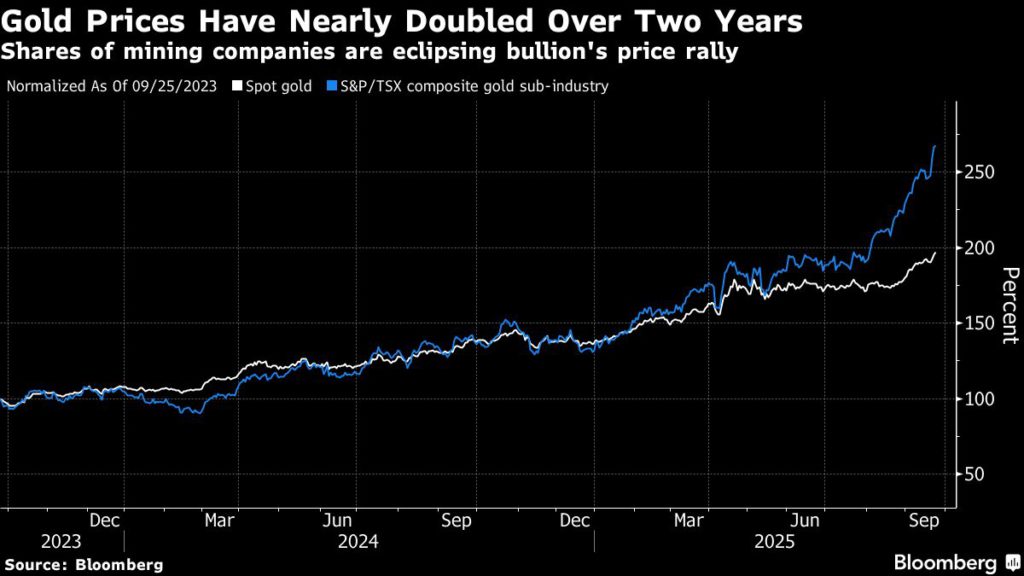
Gold equities are back in vogue after investors shunned the sector for years due to poor returns. Money typically flows in when commodities rally, with higher prices translating into greater revenue for gold producers since it usually brings improved margins and cash flows.
Stocks of gold companies have now become “compelling investments” thanks to the unprecedented bullion rally, said Dunkley, whose firm manages C$3.64 billion ($2.6 billion). He said mining companies now have “astounding” margins and are piling up cash, with cash flows and profit comparable to software companies.
Mid-size mining companies with low-grade ore and higher operating costs are starting to benefit from rising bullion prices, according to Dunkley, who cited Equinox and Centerra as examples. Shares of Vancouver-based Equinox have more than doubled this year, while Toronto-based Centerra has gained about 67%.
Waratah also is investing in firms it sees as potential takeover targets and early-stage exploration companies. The fund manager sees Artemis and Snowline Gold Corp. as companies likely to be acquired by bigger firms amid dealmaking momentum that typically happens during a commodity price rally.
The firm’s Waratah Special Opportunities Fund is the most exposed to gold. Returns for the C$88 million strategy rose almost 29% for the first eight months of this year, according to an investor letter seen by Bloomberg. The fund has produced average annual returns of almost 13% since inception in 2013. Waratah Performance, a C$817 million fund, is the second-most exposed to gold. Returns climbed 12% during the eight-month period.
Home bias
Waratah is also eyeing companies that stand to benefit from what it expects will be a boom in exploration activity for precious metals and critical minerals. It’s pursuing Canadian companies that can build mines within the country, Dunkley said. A new mine with a long reserve life and “very high margins” would be an ideal candidate for investors wanting to deploy money in Canada.
“One of our themes is jurisdiction matters,” he said. “Canada’s a great place to build and operate a mine, and it’s a safe political jurisdiction.”
One company that fits the bill is Goliath Resources Ltd., according to Dunkley. Goliath’s stock has more than tripled since the start of the year. The Toronto-based firm is exploring a large high-grade gold deposit in British Columbia.
Waratah also likes copper and counts Hudbay Minerals Inc. as an industry favorite given its prospects of being able to take advantage of US President Donald Trump’s push to revive America’s copper industry.
“They have this thing called Copper World in Arizona,” Waratah’s investment analyst, Grant McAdam, said in the interview. “The US administration has made it very apparent that they want domestic production and this is one of the ones that’s fully permitted, ready to go.”
(By Layan Odeh and Yvonne Yue Li)
Silver price hits $45 amid equity market weakness

Silver prices rose above $45 an ounce for the first time since 2011 on Thursday, bolstered by an increased risk-off sentiment in equity markets amid worries about the trajectory of the US economy.
Spot gold hit an intraday high of $45.07 — its highest in over 14 years — before pulling back to around $44.70 per ounce, for a 1.8% rise.
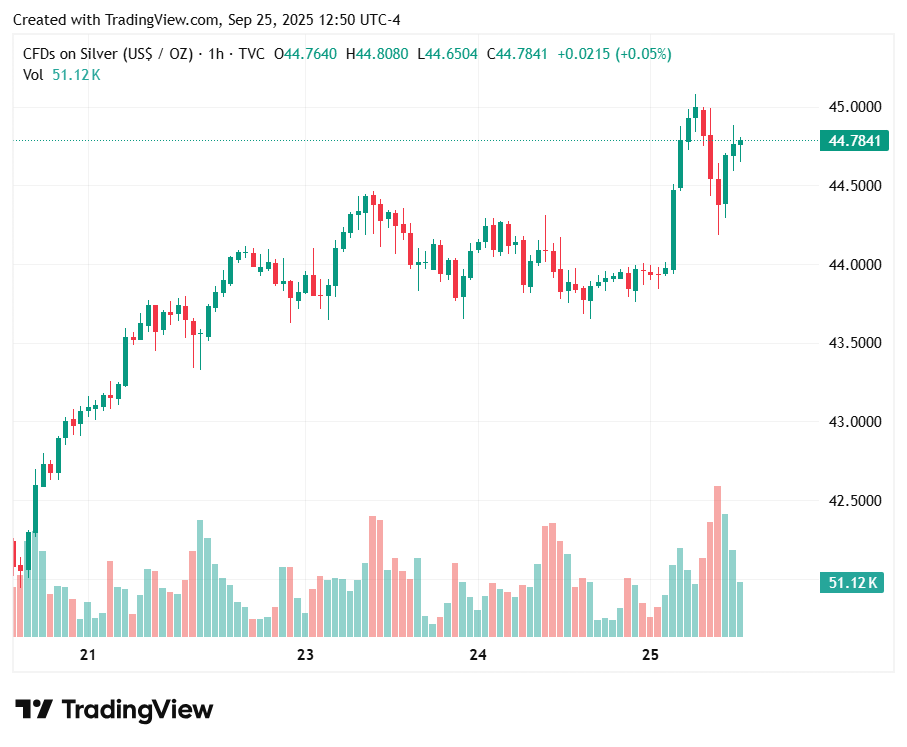
The move takes silver’s year-to-date gains up to over 55%, surpassing that of its more expensive sister metal gold, which has seen multiple record highs this year. The bullish drivers include a weakening US dollar, relentless central bank buying and rising geopolitical risks.
Surging demand for gold exchange-traded funds this month is also signalling a growing clamor for safe-haven assets. Inflows into global gold ETFs surged to a record $10.5 billion so far in September, with year-to-date inflows exceeding $50 billion, according to Citigroup.
“ETF has outshined all other gold demand sectors this year and is the single most important contributor to the gold price rally in our view,” the bank’s analysts said in an emailed note.
In recent weeks, precious metals have been gaining momentum as markets anticipated the beginning the Federal Reserve’s rate cut cycle. Since its first 25-basis-point cut last week, US stock markets have come under pressure amid stretched asset valuations.
The second-quarter GDP data on Thursday clouded the Federal Reserve’s policy path, as a surprise economic lift may have dampened expectations of further cuts.
Looking ahead, traders will focus on the US personal consumption expenditures price index due Friday. The Fed’s preferred measure of underlying inflation likely grew at a slower pace last month, which would boost the argument for rate cuts.
“Softer inflation could strengthen the case for Fed rate cuts, supporting bullion, with markets pricing two cuts this year,” Kaynat Chainwala, analyst at Kotak Securities, said in a note on Thursday.
(With files from Bloomberg)
No comments:
Post a Comment