It’s possible that I shall make an ass of myself. But in that case one can always get out of it with a little dialectic. I have, of course, so worded my proposition as to be right either way (K.Marx, Letter to F.Engels on the Indian Mutiny)
Monday, October 27, 2025
REVOLUTION FROM BELOW
UBC research reveals why honey bees overthrow their queen
New research shows how queen viral infections disrupt colony stability — and identifies a key pheromone that could help maintain cohesive, productive hives.
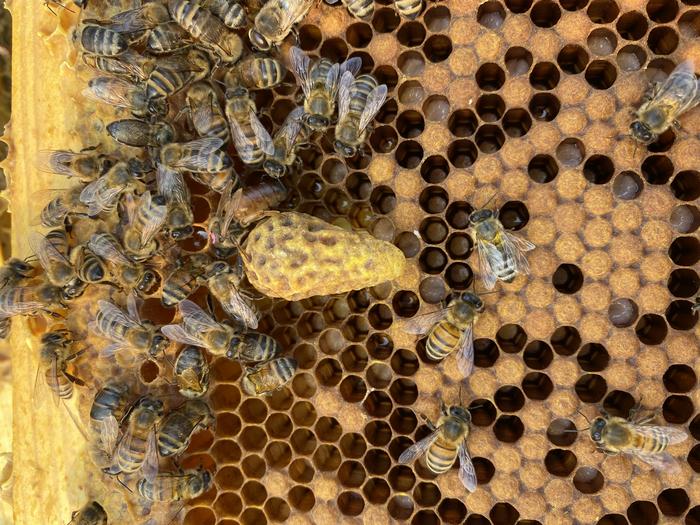
Queen bee standing on a supersedure cell (peanut-shaped structure, center). Within the supersedure cell is a new queen bee that the workers have reared as a replacement.
It sounds like the plot of a medieval historical drama: A once-powerful monarch, weakened by illness, is overthrown by her previously loyal subjects. But in honey bee colonies, such high-stakes coups aren’t just fantasy — they’re a common occurrence that comes with both risk and reward for bee colonies and the food systems that depend on them.
Known as supersedure, the process occurs when the tens of thousands of worker bees in a colony sense their queen is no longer laying enough eggs and coordinate to replace her with a new, healthier queen. While this survival strategy helps wild colonies adapt, it can spell trouble for managed hives, leading to gaps in egg-laying, weaker colony populations and ultimately less pollinating and honey production.
Now, researchers at the University of British Columbia have made an important discovery that illuminates why these violent revolts occur and how they’re coordinated with such remarkable synchronicity.
Published recently in PNAS, the research team found that common viral infections shrink a queen’s ovaries, reducing both her egg-laying capacity and her production of methyl oleate, a pheromone that normally keeps workers loyal. When methyl oleate levels drop, workers will “smell” the queen’s weakness and begin preparing her successor.
“A healthy queen can lay as many as 850 to 3,200 eggs per day, which is more than her whole body weight,” said senior author Dr. Leonard Foster, a professor of biochemistry and molecular biology at UBC’s Faculty of Medicine and Michael Smith Laboratories. “But in our experiments, virus-infected queens laid fewer eggs and produced less methyl oleate. That pheromone reduction seems to be the signal to workers that a queen is no longer fit to continue.”
Bees pollinate about one-third of the world’s crops, making them essential to healthy food systems, food security and the health of people and communities worldwide.
Beekeepers have been reporting problems with queen failure and premature supersedure for many years, with recent surveys identifying "poor queens" as the most frequently reported cause of overwintering losses.
The research highlights how viral infections are a driving factor behind these challenges, disrupting the delicate balance of chemical signals that maintain order in a hive.
Importantly, the findings also point to a practical way for beekeepers to intervene and manage supersedure. In proof-of-concept field trials, colonies given synthetic pheromone blends that included methyl oleate were much less likely to rear new queens compared to colonies that received blends without it.
“That could be a big deal for beekeepers,” said Dr. Foster. “Supersedure can be disruptive and costly, but supplementing colonies with methyl oleate could help stabilize hives during periods when continuous productivity is most important.”
The findings open the door to new management strategies for commercial beekeepers dealing with viral outbreaks, especially during periods of peak pollination or honey production to prevent untimely queen loss.
“Our research really emphasizes how virus infections in queens can be a major problem for beekeepers,” said first author Dr.Alison McAfee, a research associate at UBC’s Michael Smith Laboratories and North Carolina State University. “Previous studies showed that failing queens were heavily infected with viruses, and now we know that those infections can lead to supersedure, which is risky for the colony and expensive for beekeepers to manage.”
The research also highlights the role of varroa mites — parasitic pests that can spread the viruses linked to queen failure — underscoring the importance of keeping colonies healthy and parasite-free.
Queen infections are so far an underappreciated problem, said Dr. McAfee, who hopes that this research will change that.
“Keeping the queen healthy is one more reason why it is so critical to think ahead and keep varroa levels under control,” Dr. McAfee added. "There is currently no treatment for viruses in honey bee colonies, but now that we better understand their impact, we can change the way we manage varroa to give the queen a better chance.”
Interview language(s): English
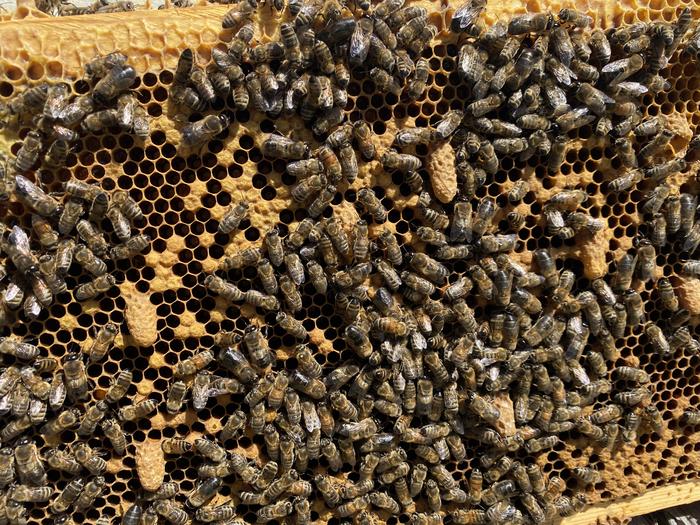
Several supersedure cells on a honey bee frame indicate that the worker bees are rearing replacement queens.
Insect population declines have now received considerable public, and scientific attention with a recent “special issue in Nature” (volume 628 Issue 8007) covering the environmental challenges facing insect populations with metadata synthesized from 106 studies or continuous biomonitoring datasets assessing trends in insect abundance spanning 16-27 years. However, abundance per se cannot fully inform species’ health - a prime example comes from multifarious crops and stock animals, which may face long-term sustainability challenges, despite their large population sizes. Furthermore, long-term monitoring datasets with repeatable sampling methods are rarely available for insects, further increasing uncertainties about current status. Genetic information preserved within museum specimens acts as a historical record, reflecting the genetic makeup of target species and their populations during specific historical periods. This provides invaluable historical data for analyzing the impact of recent human activities on populations. The sheer volume of insect museum specimens — far greater than other taxonomic groups — gives them a significant advantage in dissecting the influence of recent anthropogenic changes.
Based on this, a collaborative research team — involving the Institute of Zoology, Chinese Academy of Sciences (CAS), China Agricultural University, the University of Copenhagen (Denmark), and other institutions — turned its attention to these "time archives": centuries-old historical museum specimens.
Reading Precious Historical Information from Museum Specimens
The research team acquired 46 specimens of the Asian honeybee (Apis cerana) dating back approximately 120 years and performed whole-genome comparison with 352 modern samples. The samples covered the primary geographical populations of A. cerana. According to records of the Chinese National Animal Collection Resource Center, only a single A. cerana specimen reaches to this age. This rarity underscores the significance of the genomic datasets, positioning this study as one of the first systematic museomic investigations in non-model insect species. The results showed that although the main A. cerana lineages did not disappear over the century, the genetic diversity of their core populations significantly declined. In other words, even if population numbers may be stable, their "genetic health" is quietly deteriorating. This drop in genetic diversity suggests that the honeybees' ability to cope with future climate change and environmental pressures may be weakening.
Pesticides: The Invisible Force Driving Rapid Honeybee Evolution
The team further analyzed the SNP loci that underwent significant temporal shifts in allele frequency. These genes were found to be highly concentrated in regions associated with nervous system function, including synaptic membranes, ion channels, and nicotinic acetylcholine receptors (nAChRs) — the primary targets of commercial pesticides. This finding strongly suggests that the widespread use of pesticides over the past century has likely become the main evolutionary driver of genomic change in A. cerana. This implies that the honeybee is undergoing a "genetic evolutionary race" to adapt to the chemical environment created by humans.
The "Time Capsule" from Malaysia
Further analyses revealed that the modern Malaysian honeybee population retained more "ancient" genetic characteristics in these rapidly evolving gene regions. This makes them a potential "historical archetype" of A. cerana, suggesting they may exhibit weaker resistance to pesticides. A clothianidin exposure experiment showed that honeybees from Central China had a significantly higher survival rate after 14 days of exposure compared to the Malaysian population. The Malaysian bees exhibited high mortality even at low pesticide concentrations. Transcriptome analysis further revealed that the X3 transcript of the nAChR α gene was significantly downregulated in the Central China population. This transcriptional change is likely closely linked to their enhanced pesticide resistance.
This study establishes a novel framework for quantifying population declines and provides policymakers with scientifically-guided strategies to monitor biodiversity changes, highlighting the irreplaceable value of museum specimens in evidence-based conservation. The phenotypic prediction and validation of the Malaysian population, which retains ancestral traits (functioning as a contemporary analogue of historical populations), provides an exemplar case applicable to numerous non-model species of conservation concern. Discovery of such populations fills a critical “missing-link” previously absent in most paleogenetic research, and thus enables the elucidation of mechanisms by which focal species deal with diverse environmental pressures. Lastly, this study also demonstrates how international specimen exchanges can overcome regional biodiversity documentation gaps in the post-globalization era with geo-political tensions.
###
This study was supported by fundings from Ministry of Science and Technology of the People’s Republic of China, National Natural Science Foundation of China, Institute of Zoology, Chinese Academy of Sciences, Danish National Research Foundation.
No comments:
Post a Comment