It’s possible that I shall make an ass of myself. But in that case one can always get out of it with a little dialectic. I have, of course, so worded my proposition as to be right either way (K.Marx, Letter to F.Engels on the Indian Mutiny)
Thursday, October 09, 2025
Bay scallops surge on Virginia’s Eastern Shore
Locally extinct in Virginia since the 1930s, Bay scallops are now thriving thanks to restoration efforts by William & Mary’s Batten School & VIMS
Virginia’s bay scallop population is experiencing an unprecedented resurgence, thanks to years of dedicated restoration work led by the Batten School & VIMS Eastern Shore Laboratory (ESL) in Wachapreague. Once locally extinct due to habitat loss, bay scallops are now multiplying exponentially in the restored eelgrass meadows of the Eastern Shore’s southern coastal bays, possibly setting the stage for a future recreational fishery.
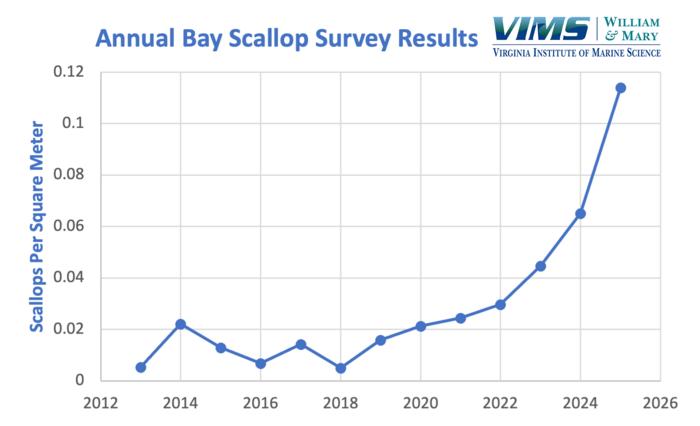
The VIMS ESL’s 2025 Bay Scallop Survey documented an average density of 0.114 scallops per square meter, with researchers routinely finding multiple scallops within a single square meter — something unimaginable just a few years ago. With the recent trend of progressive growth, researchers estimate the population will double in less than 1.5 years.
“The restoration of bay scallops to their former range along the Virginian Eastern Shore represents a significant societal and ecological achievement,” said VIMS ESL Director Richard Snyder.
Importantly for seafood lovers, the new numbers match Florida’s minimum population density for a stable population, opening the possibility that Virginians may one day be able to harvest local bay scallops themselves. The commonwealth currently has a moratorium on harvesting wild bay scallops.
“In New England, North Carolina and Florida, individuals with a fishing license can harvest scallops,” explained VIMS ESL Assistant Director Stacy Krueger-Hadfield. “The next step for us is to review management and regulatory frameworks being used for harvest elsewhere and provide advice to the Virginia Marine Resources Commission to establish rules for Virginia, so that we don't decimate the population we just restored.”
Bay scallops (Argopecten irradians) once thrived in Virginia waters until an eelgrass wasting disease in the 1930s decimated their natural habitat. For approximately 90 years, the species was absent from the commonwealth’s coastal bays.
However, in 1997, Batten School & VIMS researchers launched a seed-based submerged aquatic vegetation (SAV) restoration project now considered the largest and most successful seagrass restoration in the world. With the reintroduction of eelgrass, scientists saw an opportunity to bring back bay scallops. Early years showed relatively low, fluctuating numbers, but recently the population has grown exponentially and researchers say its upper limit remains unknown.
“It’s incredibly fulfilling to see this progress,” said Darian Kelley, a nursery manager at VIMS ESL who works closely with regional shellfish farmers. “The combined success of the seagrass and scallop restoration efforts is creating a more resilient and productive coastal ecosystem while potentially adding a new product to our state’s aquaculture industry.”
For more information about this year’s Bay Scallop Survey results and the history of the restoration efforts, visit the Batten School & VIMS website.
William & Mary's Batten School & VIMS Eastern Shore Laboratory conducts an annual survey documenting the population of bay scallops in Virginia's coastal bays.
Credit
Reba Turner Smith, Batten School & VIMS Eastern Shore Laboratory
Caption
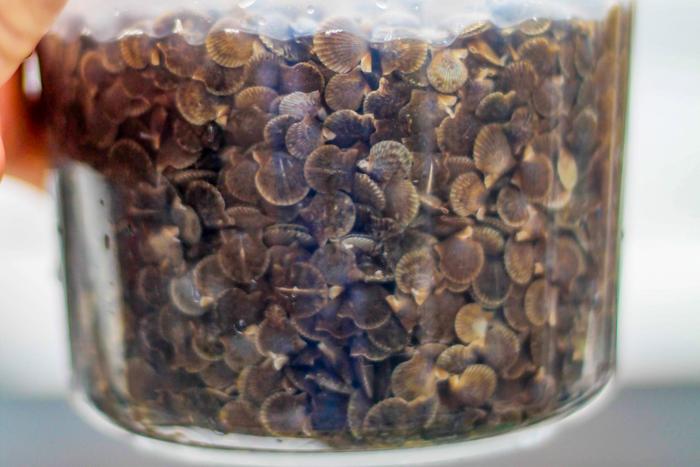
Bay scallops are bred at William & Mary's Batten School & VIMS before being released into Virginia's coastal bays.
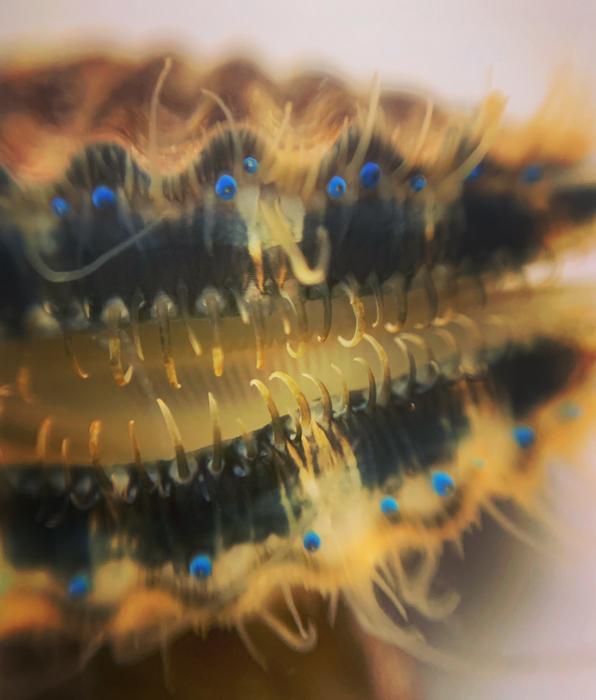
Bay scallops are a short-lived species, making restoration efforts difficult to manage.
Bay scallops live in seagrass beds, which provide structure and cover for juveniles. An eelgrass wasting disease in the 1930s decimated bay scallop habitat in Virginia, leading to a local extinction.
Bay scallops grown at William & Mary's Batten School & VIMS Eastern Shore Laboratory.
Credit
Reba Turner Smith
Bay scallops are raised in the Castagna Shellfish Research Hatchery, an 1800 sq.ft. seawater facility that houses William & Mary's Batten School & VIMS Eastern Shore Laboratory's aquaculture research.
No comments:
Post a Comment