Japan's hardline conservative Sanae Takaichi elected first female prime minister
JAPANESE MAGGIE THATCHER
Japan's parliament elected ultraconservative Sanae Takaichi as the country’s first female prime minister Tuesday, a day after her struggling party struck a coalition deal with a new partner expected to pull her governing bloc further to the right.
Issued on: 21/10/2025
By: FRANCE 24
JAPANESE MAGGIE THATCHER
Japan's parliament elected ultraconservative Sanae Takaichi as the country’s first female prime minister Tuesday, a day after her struggling party struck a coalition deal with a new partner expected to pull her governing bloc further to the right.
Issued on: 21/10/2025
By: FRANCE 24
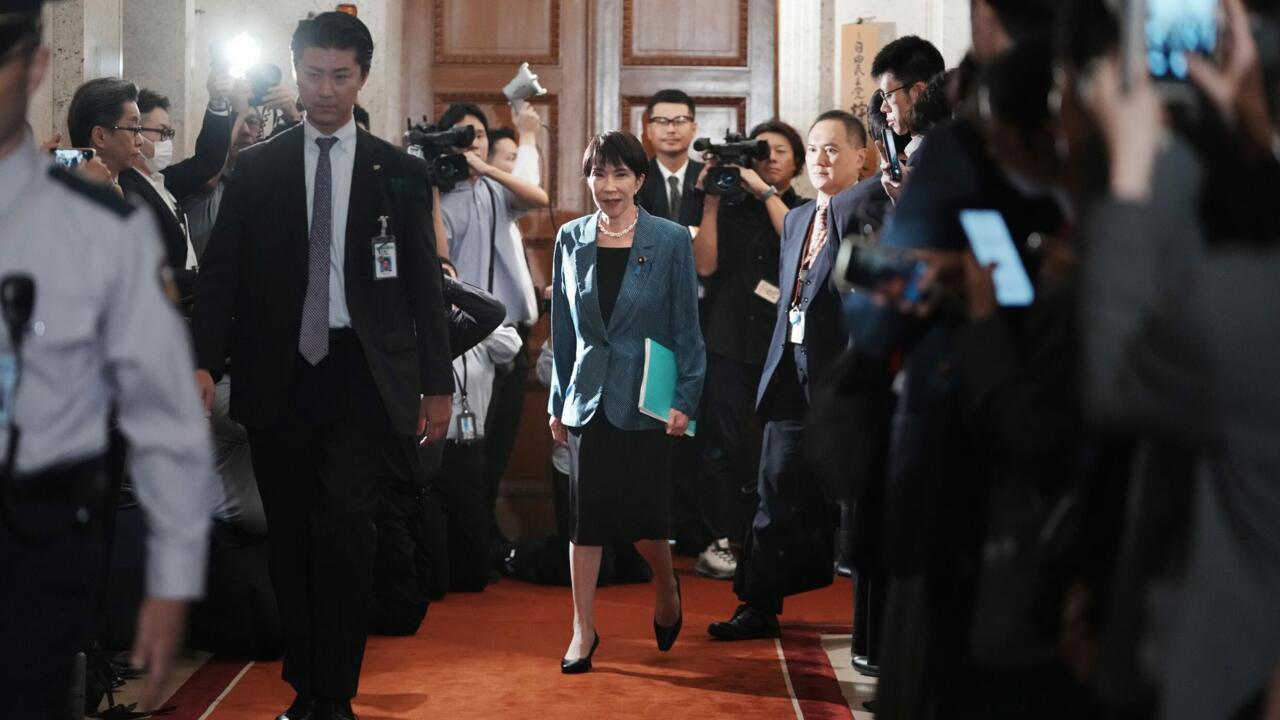
Sanae Takaichi walks before signing a policy agreement in Tokyo on October 20, 2025.
© Kazuhiro Nogi, AFP
Hardline conservative Sanae Takaichi was elected Japan’s first female prime minister on Tuesday, shattering the nation’s glass ceiling and setting it up for a forceful turn to the right.
An acolyte of former Prime Minister Shinzo Abe and an admirer of Britain’s Margaret Thatcher, Takaichi received 237 votes in the lower house election to choose the next premier, topping the majority of the 465-seat chamber.
Her victory marks a pivotal moment for a country where men still hold overwhelming sway. But it is also likely to usher in a sharper move to the right on things like immigration and social issues.
Takaichi’s victory was secured after her Liberal Democratic Party, which has governed Japan for most of its postwar history, agreed to a coalition deal with the right-wing Japan Innovation Party, known as Ishin, on Monday.
After years of deflation, Japan is now grappling with rising prices, something that has sparked public anger and fuelled support for opposition groups including far-right upstarts.
Like Abe, Takaichi is expected to favour government spending to jumpstart the weakened economy. That has prompted a so-called “Takaichi trade” in the stock market, sending the Nikkei share average to record highs, the most recent on Tuesday. But it has also caused investor unease about the government’s ability to pay for additional spending in a country where the debt load far outweighs annual output.
Takaichi had enough votes to get the premiership, but to govern effectively she will need the backing of more opposition lawmakers, said Tadashi Mori, a professor of politics at Aichi Gakuin University.
“The two parties do not command a majority in either chamber and to ensure a stable government and gain control of key parliamentary committees, they will need to secure more than half the seats,” he said.
Any attempt to revive Abenomics could also run into trouble, Mori said, because it was devised to fight deflation.
“In today’s inflationary environment, further stimulus risks only weakening the yen. Likewise, cutting the consumption tax may spur demand, but it won’t curb rising prices.” Takaichi was also approved by the less-powerful upper house and will be sworn in as Japan’s 104th prime minister on Tuesday evening to succeed the incumbent Shigeru Ishiba, who last month announced his resignation to take responsibility for election losses.
(FRANCE 24 with Reuters)
Hardline conservative Sanae Takaichi was elected Japan’s first female prime minister on Tuesday, shattering the nation’s glass ceiling and setting it up for a forceful turn to the right.
An acolyte of former Prime Minister Shinzo Abe and an admirer of Britain’s Margaret Thatcher, Takaichi received 237 votes in the lower house election to choose the next premier, topping the majority of the 465-seat chamber.
Her victory marks a pivotal moment for a country where men still hold overwhelming sway. But it is also likely to usher in a sharper move to the right on things like immigration and social issues.
Takaichi’s victory was secured after her Liberal Democratic Party, which has governed Japan for most of its postwar history, agreed to a coalition deal with the right-wing Japan Innovation Party, known as Ishin, on Monday.
After years of deflation, Japan is now grappling with rising prices, something that has sparked public anger and fuelled support for opposition groups including far-right upstarts.
Like Abe, Takaichi is expected to favour government spending to jumpstart the weakened economy. That has prompted a so-called “Takaichi trade” in the stock market, sending the Nikkei share average to record highs, the most recent on Tuesday. But it has also caused investor unease about the government’s ability to pay for additional spending in a country where the debt load far outweighs annual output.
Takaichi had enough votes to get the premiership, but to govern effectively she will need the backing of more opposition lawmakers, said Tadashi Mori, a professor of politics at Aichi Gakuin University.
“The two parties do not command a majority in either chamber and to ensure a stable government and gain control of key parliamentary committees, they will need to secure more than half the seats,” he said.
Any attempt to revive Abenomics could also run into trouble, Mori said, because it was devised to fight deflation.
“In today’s inflationary environment, further stimulus risks only weakening the yen. Likewise, cutting the consumption tax may spur demand, but it won’t curb rising prices.” Takaichi was also approved by the less-powerful upper house and will be sworn in as Japan’s 104th prime minister on Tuesday evening to succeed the incumbent Shigeru Ishiba, who last month announced his resignation to take responsibility for election losses.
(FRANCE 24 with Reuters)

Japan's Sanae Takaichi. Photo Credit: X
October 21, 2025
By Dr. Rajaram Panda
When Japan’s governing party, the Liberal Democratic Party (LDP) elected former Economic Security Minister Sanae Takaichi, a hard-line ultra-conservative and China hawk, as its new leader on 4 October, making her likely to become the country’s first female prime minister, it raised eyebrows in some quarters. The path to the high office was not smooth, however. The LDP received further setback when its junior coalition partner, the Komeito, pulled out from the alliance because of policy differences. Since the LDP does not have a majority in either of the two Houses of the Diet, roping in some opposition parties to the formation of a coalition government required concessions and compromises.
After series of parleys, the LDP and the major opposition Nippon Ishin no Kai or Japan Innovation Party (JIP) effectively struck a policy deal for coalition. However, the JIP chief Hirofumi Yoshimura offered support to Takaichi from outside the Cabinet. Both Takaichi and Yoshimura signed a coalition agreement on their alliance on 20 October, which marked a new phase in Japan’s multiparty politics following the Komeito party’s departure from its 26-year alliance with the LDP. With the assurance received from the JIP to vote for Takaichi in the extraordinary Diet session to select the next prime minister on 21 October, her bid to become Japan’s first female prime minister was virtually assured. The move by the LDP and JIP marks a new phase in Japan’s multiparty politics following the Komeito party’s departure from its 26-year alliance with the LDP.
When the leaders of the conservative LDP and smaller right-leaning group were in talks, the JIP’s co-head, Fumitske Fujita, raised expectations for a deal on 17 October, saying the two parties had made “big progress” in coalition talks. At present, the JIP has no plan to send ministers to Takaichi’s Cabinet and thus shall support from outside. This would mean that Takaichi’s government would not be full-fledged alliance that the LDP maintained with the Komeito. This also raises concern over stability of Takaichi’s government.
Does it mean that Takaichi’s path ahead would be smooth? Far from it, she is likely to face a rocky road. As said, adjustment, concessions and compromises of certain policy stances would be the guiding mantra of the Takaichi’s government. The LDP already offered to working toward banning donations from companies and other organisations and exempting food items from Japan’s sales tax. The JIP proposed eliminating the tax on food items for two years. In contrast, Takaichi is a fiscal dove. She had called for higher spending and tax cuts to cushion consumers from rising inflation and criticised the Bank of Japan’s decision to raise interest rates. Like her mentor Shinzo Abe, Takaichi favours revising Japan’s pacifist Constitution to recognise the role of Japan’s expanding military.
Even after the LDP and JIP join hands, her government still falls short of a majority of 233 in the powerful 465-member House of Representatives. Days after centrist Komeito, the “peace party” decided to quit the coalition with the LDP, Takaichi and Yoshimura pledged to begin talks with the possibility of creating a new government. The LDP agreed to JIP’s proposal to lower the consumption tax rate to zero from the current level of up to 10 per cent, and to abolish corporate and organisational donations by September 2027, when Takaichi’s tenure as party president expires. Takaichi also accepted Yoshimura’s demand to cut the number of Diet seats, which he called a “nonnegotiable condition”. At the moment, the JIP’s role would be just advisory to the Prime Minister. As a part of the ruling bloc, JIP’s goal is to put policies into action, rather than seek Cabinet slots.
At present, in the lower house, the LDP holds 196 seats, the main opposition Constitutional Democratic Party of Japan (CDPJ) 148, the JIP 35, and Komeito 24. With the LDP — the biggest force in parliament –joining the JIP form a coalition, their combined seats would total 231. Komeito, supported by Japan’s largest lay Buddhist organization Soka Gakkai, whose membership has declined amid an aging population, criticized the LDP over its high-profile slush fund scandal that has eroded the ruling camp’s popularity across the board. Meanwhile, Yuichiro Tamaki, leader of the Democratic Party for the People, which holds 27 seats in the lower house, expressed willingness to work with Takaichi in areas where their policies align.
For a while, Takaichi’s aspiration to become Japan’s first female prime minister when she was elected as the head of the hurling party was derailed when LDP’s junior partner for 26 years Komeito broke the alliance. Since then, she was working to cobble together a different alliance, putting her chances back on track. With the JIP agreeing to support but not join the government with ministerial berths, her ambition was achieved.
When the LDP and the JIP were holding talks exploring the possibility of a coalition government, other opposition figures were also scrambling and hinting at a vague CDP-DPP-Komeito bloc coming together to form a government. However, that lacked substance from the outset. Clearly, the opposition parties miscalculated Takaichi’s strategy to rope in the JIP into the alliance talk. The leaders of the three opposition parties – Jun Azumi of CDP, Tetsuo Saito of Komeito, and Yuichiro Tamaki of DPP – misread the strategy of Takaichi reaching out to the JIP. The trio thought that Takaichi’s team had no real channel to the JIP as the JIP was effectively betting on Agriculture Minister Shinjiro Koizumi to win the LDP race and was already talking with his camp. That proved to be the damp squib. The trip clearly missed LDP’s quiet diplomacy.
The trio miscalculated on another count. The Komeito felt once it left the coalition, Takaichi will withdraw from the race as she would not have the numbers. Komeito even entertained the “Tamaki-for-PM” idea. This was the idea CDP secretary-general Azumi floated. The reasoning behind this idea was that the trio together shall cobble together with the CDP with 148 seats, JPI 35, the DPP 27, and Komeito 24, totalling 234 seats, which would have been one more than the 233-seat majority. With this four-party alliance would have outnumbered the LDP, pushing it into opposition. In that scenario, Takaichi would have been stranded all alone. The four-party group let the golden chance slip through the fingers. The fragmented opposition failed to agree a common joint candidate for premier. For a while it seemed the opposition bloc was inching toward a unified candidate but that was not to be. They had broad-based policy differences that at the end proved difficult to overcome. From the beginning the parliamentary arithmetic looked tight.
Takaichi will be walking the tightrope. She needs to prioritise constantly on consultation whenever there are differences with the JIP. JIP’s demands would continue to test the LDP’s limits, especially on political finance. The challenge before Takaichi would be not to concede too much as that might alienate her own party and undermine longer-term stability once she assumes office of the prime minister. Both the leaders of the LDP and the JIP have reportedly already reached an agreement on 12 points that the JIP champions. These involve basic policies regarding constitutional reforms, national security, and energy, including nuclear power.
Takaichi’s biggest challenge would be to restore political stability and both the LDP and the JIP need to cooperate and agree to translate their policies into concrete measures for implementation. It is a truism that political parties with left-leaning views are losing support among Japanese voters. This was proved when the LDP fared badly in the Lower House election on 27 October 2024, and Upper House election on 20 July 2025. It is here Takaichi needs to demonstrate her political skills and ensure that realistic policies are implemented. Many of the 12 points raised by the JIP overlap with the LDP’s own positions, including policies concerning foreigners in Japan. This is the task before the negotiators of both the LDP and JIP to find out a workable path.
While on the domestic policy front, there does not seem to be major differences, on foreign policy and national security, which includes the revision for the three security-related documents decided by the Fumio Kishida Cabinet in 2022. The JIP favours enabling stand-off defence capabilities, such as long-range missiles with counterattack capabilities.
Japan’s security is under threat as three hostile neighbours – China, Russia and North Korea – are deepening their strategic ties. The previous governments in Japan have prioritised to strengthen the defence capabilities in response to the region’s changing security environment to protect Japan from potential external threat. Takaichi’s task ought to be in pursuance of such a policy.
Japan is undergoing this political battle at home on government formation just days before the US President Donald Trump arrives by the end of October. Trump will travel to Japan before the annual Asia-Pacific Economic Cooperation (APEC) summit in South Korea. Takaichi’s task at hand is to convey the impression to Trump that Japan’s political situation is stable and that there would not be major policy disruption impacting Japan-US relations.

Dr. Rajaram Panda
Dr. Rajaram Panda is former Senior Fellow at Pradhanmantri Memorial Museum and Library (PMML). Earlier Dr Panda was Senior Fellow at MP-IDSA and ICCR Chair Professor at Reitaku University, JAPAN. His latest book "India and Japan: Past, Present and Future" was published in 2024 by Knowledge World. E-mail: rajaram.panda@gmail.com
No comments:
Post a Comment