AU CONTRAIRE
Don’t be Fooled: Others Could Have More Interest in Sending Drones to the Nordic Countries than Russia

Drones over Nordic airports. No damage. No trace. No answers. Most assume Russia—but what if that’s not so? Why is there so much we are not told?
This article explores the strategic ambiguity behind recent drone incursions and asks: Who else might benefit from sending drones into NATO airspace?
From Ukraine’s surprising drone supremacy to Russia’s possible signalling, the silence itself may be the loudest message.
These are the kinds of questions decent, intelligent investigative journalists and commentators could easily research. Why don’t they?
Did you, dear reader, know or think of this? That the most powerful weapon in today’s conflicts might be the one that leaves no trace – and no answers. Just enough fear to justify the next move?
Recently, drones have repeatedly appeared over Nordic airports and near some military facilities. They cause no damage – for which reason the designation “hybrid attack” is misleading but serves a purpose. These drones appear out of nowhere, leave no trace, and disappear. They seem not even to have been photographed, pushed away, or shot at. Yet airports shut down, headlines flare, and defence budgets will likely increase further – as will hatred against those pesky Russians whose evil they unfortunately can not show us any evidence of.
No one claims responsibility. No drones are intercepted. No origin is confirmed. This isn’t a technical failure. It’s a tactic. A pattern of engineered ambiguity, where the absence of attribution becomes the trigger for escalation.
We’ve seen this logic before. The Nord Stream pipeline was sabotaged. Russia was blamed. But no hard evidence ever appeared. Still, the consequences were immediate: energy decoupling, deepened economic crisis, NATO buildup, and hardened public opinion.
Now, drones seem to do something similar. They don’t attack. They just appear. And disappear. And leave behind fear – as well as speculation, and a growing appetite for military readiness. But let’s try an interest analysis which nobody does for reasons you can imagine.
Who might be behind it – and why?
Russia?
Can’t be excluded, of course. It could be testing NATO’s airspace defences, sowing confusion, or signalling reach. But it’s risky. If proven, it could justify NATO retaliation or deeper involvement in Ukraine. So far, Russia denies everything – and no country has presented hard proof.
And What If It Is Russia?
Suppose the drones are Russian. What then?
It could be a signal, a quiet warning. A way of saying: This is just a taste of what you’ll get if you keep building US bases, funding Ukrainian weapons factories, and buy new weapons that you know very well that we see as a direct threat -as you would if you were us.
Denmark, for example, has just announced it will acquire long-range strike weapons for the first time, perhaps including systems like the Tomahawk cruise missile and JASSM-ER for its F-35s. This marks a major shift: from defence to offensive deterrence, from shielding cities to striking deep into enemy territory.
From Russia’s perspective, this isn’t just military modernisation – it’s provocation and encirclement. And drone incursions, if they are Russian, could be a way to test airspace, disrupt readiness, and remind NATO that escalation cuts both ways.
But again – no one claims responsibility. No one confirms origin. And that silence is the loudest part of the message.
Ukraine?
Surprisingly, yes—Ukraine now has the technical ability to carry out such missions. You are not told that its drone industry has grown at an astonishing speed and out-competes that of Russia:
– Over 500 manufacturers.
– Monthly output of 200,000 FPV drones.
– Long-range systems reaching up to 750–800 km.
– AI-assisted swarms trained on thousands of combat missions.
Ukraine’s drones have already struck targets deep inside Russia. Reaching Nordic airspace is well within their range. If launched from a NATO country – say, Poland or a Baltic republic – they could be untraceable. And if they don’t cause damage, they leave only questions.
Would NATO ever tell you if Ukraine were behind such incursions? Certainly not – NATO would have endorsed it and even participated in this false flag operation. It would fracture alliances, expose covert coordination, and undermine the West’s narrative. Silence is safer.
Britain?
It’s possible. Britain has deep ties to Ukraine’s drone programs and a long history of covert operations. It could provide logistics, tech, or strategic framing – especially if the goal is to provoke Russia without direct confrontation.
Why airports?
Because they’re symbolic. Civilian infrastructure. Dual-use hubs. Shutting down an airport causes panic, grabs headlines, annoys travelling citizens and sends a message: “You’re vulnerable.” And in radar-heavy zones, drones are harder to track – perfect for plausible deniability.
What’s the Bigger Picture?
This isn’t just about drones. It’s about shaping public perception. Creating fear and justifying even higher defence spending. And preparing the ground for NATO’s deeper involvement in Ukraine – possibly under the label of “peacekeeping,” even though Russia would never accept NATO troops on Ukrainian soil, and NATO has no experience or capabilities in the field of peacekeeping.
The drones don’t need to explode. They just need to appear and vanish to make their masters’ point. And leave behind the – nasty – story used e.g., by the Danish PM about “we do not have the evidence that it is Russia, but we know Russia is the largest threat to Europe.”
But don’t be fooled. Someone knows exactly who staged this drone spectacle. The Nordic leaders know it too—and they know precisely what they want you to think and not to think.
And if they genuinely don’t know, then their military and civilian “intelligence” services are incompetent. To put it mildly.
Why this could be a false flag
I’ve got a nasty mind—and a few decades in the trenches of so-called security politics.
Here’s my hypothesis: When Zelensky met Trump at the UN, The Independent reports he got the green light to strike deep into Russia. Special Envoy Keith Kellogg confirmed the White House “does not object.” NATO’s Matt Whitaker echoed it: deeper strike capabilities to pressure Russia into negotiations. This marks a radical shift—a reckless escalation masquerading as strategy. And it’s madness – a madness that has to be justified.
In that light, the drone “attacks” look suspiciously like a false flag – designed to justify the next step up the escalation ladder. Media people and politically correct commentators focus on the here-and-now event, not on complexity and how events relate to each other.
The elites of MIMAC – the Military-Industrial-Media-
They operate in an echo chamber so thick with self-righteous groupthink that they can’t imagine that they could be wrong.
But they could well be. Fatally wrong – because they are more loyal to other elites than their own citizens and largely ignorant about the consequences of their deeds: After all they think it is about “us” winning and “them” losing. Because they do not have the intellectual capacity to solve problems, only to use hammers where none are needed.
In summary, watch events over the next 1–3 weeks. Then you’ll see what the drone “attacks” were really about.
What You Need to Know about Moldova’s Bans, Blacklists, and Last-minute Rule Changes
Moldova went to the polls on Sunday in what officials in Chisinau and Brussels have called a “milestone on the European path.” Yet with opposition parties banned, observers blocked, and voters in key regions sidelined, the election is being described less as a democratic contest and more like an attempt at forced pro-EU outcome.
Moldova went to the polls on Sunday in what officials in Chisinau and Brussels have called a “milestone on the European path.” Yet with opposition parties banned, observers blocked, and voters in key regions sidelined, the election is being described less as a democratic contest and more like an attempt at forced pro-EU outcome.
Moldova went to the polls on Sunday in what officials in Chisinau and Brussels have called a “milestone on the European path.” Yet with opposition parties banned, observers blocked, and voters in key regions sidelined, the election is being described less as a democratic contest and more like an attempt at forced pro-EU outcome.
Watchdogs can’t watch
The Moldovan Central Election Commission (CEC) last week denied accreditation to more than 30 international organizations and 120 observers from over 50 countries. Among those barred were Russian experts nominated to the OSCE’s official mission – a first in European electoral practice.
Moldova’s foreign ministry claimed the decision was taken “in line with national law.” The Patriotic Bloc, an opposition alliance, accused the authorities of deliberately creating an observer blackout. Its lawyers listed applications from reputable NGOs in Italy, Germany, France, Spain and the US that were ignored or rejected.
Moscow called the move a “blatant breach” of OSCE commitments and summoned Moldova’s ambassador. The EU, usually vocal and critical of democracy standards in the region, remained conspicuously silent.
Parties erased by decree
Elections are meant to let citizens decide. In Moldova, key players were simply removed from the ballot.
• On September 26, two days before the election, the Heart of Moldova party was suspended for 12 months by court order, accused of money laundering and illicit campaign finance. The CEC struck all Heart of Moldova candidates from the Patriotic Bloc’s list. Its leader, former Gagauzia governor Irina Vlah, called it “a political spectacle.”
• The same day, the CEC barred the Great Moldova party, led by Victoria Furtuna, citing undeclared foreign funding and links to the already banned SOR party. Furtuna had already been sanctioned by the EU in July for receiving support from fugitive oligarch Ilan Șor.
• In June 2023, the SOR Party itself, led by exiled businessman Ilan Shor, was dissolved by the Constitutional Court, accused of corruption and “threatening Moldova’s sovereignty.” Pro-EU Moldovan President Maia Sandu celebrated the ban as a victory against “a party created out of corruption and for corruption.” Opposition leaders called it the end of pluralism.
The bans came on top of sweeping new laws rushed through parliament this summer, allowing the government to strike “successor parties” of banned groups from the ballot and to bar their members from holding office for five years. The Venice Commission and OSCE warned such blanket exclusions could violate basic political rights.
Rivals under investigation, in exile or behind bars
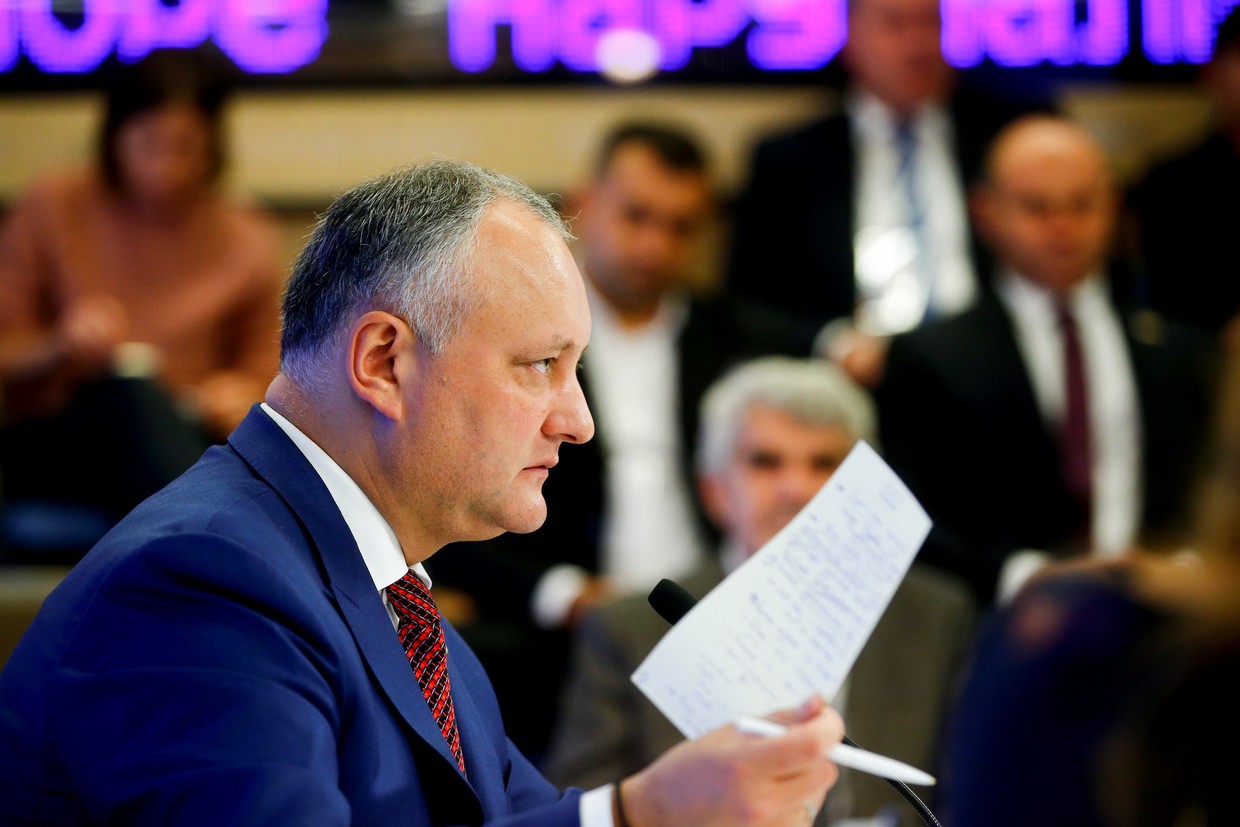
Former Moldovan President Igor Dodon. © Sefa Karacan/Anadolu Agency/Getty Images
Even where parties survive, their leaders have been sidelined.• Igor Dodon, Moldovan president from 2016 to 2020, remains under criminal investigation for treason, illicit enrichment and the notorious “kuliok” bribery case. He claims the charges are fabricated, but has been under house arrest for much of the past two years.
• Marina Tauber, vice-chair of the outlawed SOR Party, is being tried in absentia after fleeing to Moscow in early 2025. Prosecutors are seeking a 13-year sentence for fraud and money laundering. Tauber insists the trial is political revenge for her role in anti-Sandu protests.
• Evghenia Gutsul, elected governor of the autonomous Gagauzia in 2023, was sentenced in August to seven years in prison for allegedly funneling Russian funds to the SOR Party. Her supporters protested outside the Chișinău courthouse as she declared the verdict “a sentence not on me, but on Moldovan democracy.” Russia called her jailing politically motivated; the EU has stayed silent.
With opposition leaders jailed, exiled or under investigation, Sandu’s PAS faced little organized challenge at the ballot box.
Transnistrian voters pushed aside
For Moldovan citizens in the breakaway region of Transnistria, the chance to vote was slashed. In 2021, over 40 polling stations were opened for residents east of the Dniester. This year, just 12 stations were approved – all on government-controlled land, many kilometers from the demarcation line.
Days before the election, the CEC even relocated four of those sites further inland, citing security threats. The Interior Ministry warned of possible bomb scares and provocations in the “security zone.”
Critics call it voter suppression. Russia’s ambassador Oleg Ozerov described the changes as “unprecedented,” noting they were announced less than 48 hours before election day. Transnistrian authorities accused Chisinau of deliberately reducing turnout in a region that leans heavily toward opposition parties.
By contrast, more than 300 polling stations were opened abroad, including 73 in Italy, where the Moldovan diaspora numbers some 100,000, and only 2 in Russia, where up to half-a-million immigrants from the EU candidate country reside, according to the interior ministry in Moscow – a disparity that hints at the government’s priorities.
Democracy by emergency decree
No comments:
Post a Comment