D.E.I.
In historic appointment, Sarah Mullally will be the first female archbishop of Canterbury
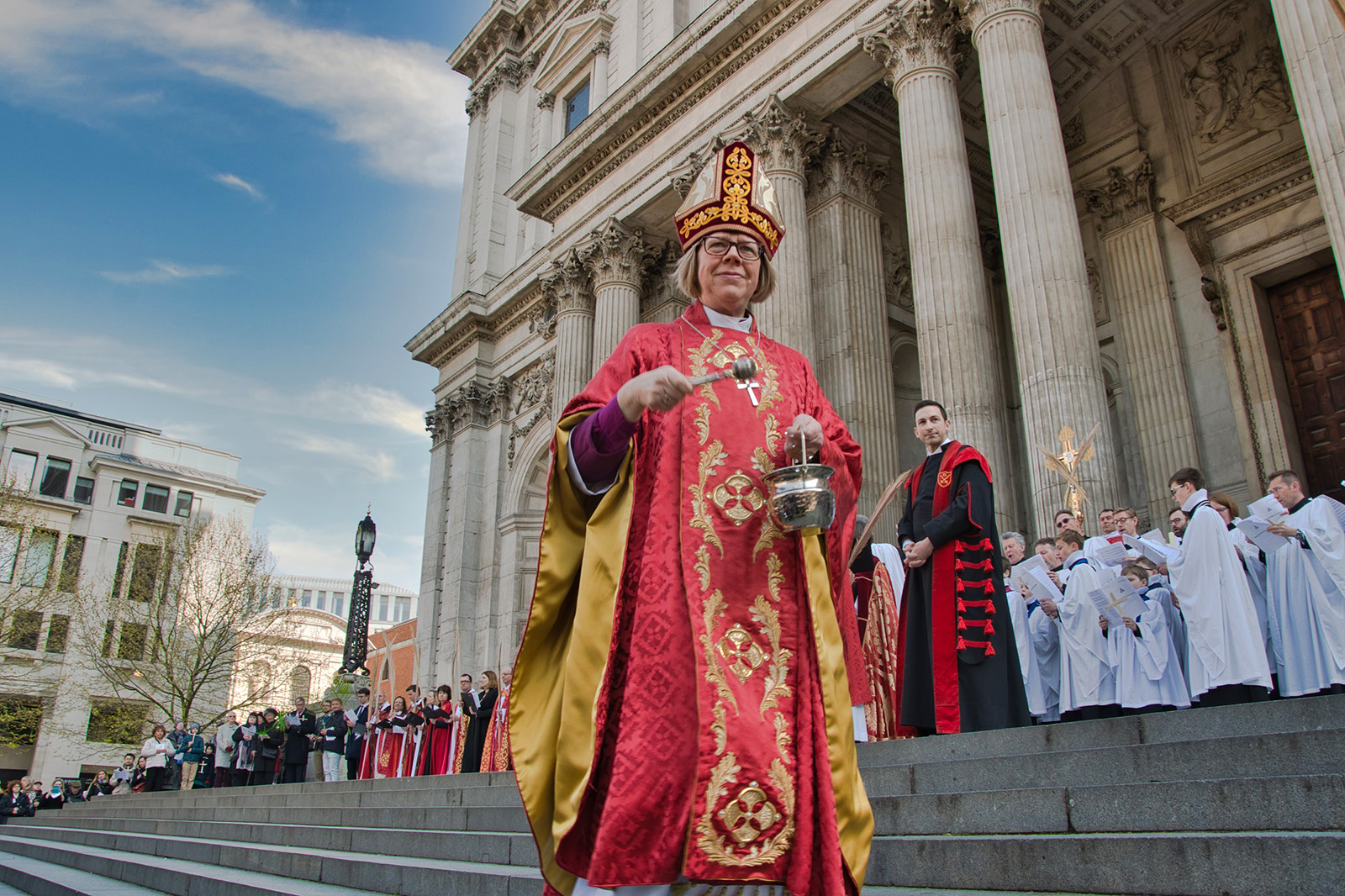
LONDON (RNS) — The Rt. Rev. Sarah Mullally has been named the 106th archbishop of Canterbury, a historic decision by the Church of England that places a woman as leader of the church and as first among equals among bishops in the 85 million-strong worldwide Anglican Communion.
The appointment of Mullally, currently the Bishop of London, was confirmed by Downing Street on Friday morning (Oct. 3) after being approved by King Charles III, 10 months after the dramatic resignation of Justin Welby following a decade-old scandal involving a prolific abuser in Christian youth camps. A former chief nurse of the National Health Service, she has helped the Archbishop of York, Stephen Cottrell, run the Church of England in the interregnum since Welby quit.
In her remarks about her appointment on Friday at Canterbury Cathedral, Mullally referred to the Christian Holy Week ritual imitating Christ washing the feet of his disciples: “Washing feet has shaped my Christian vocation as a nurse, then a priest, then a bishop. In the apparent chaos which surrounds us, in the midst of such profound global uncertainty, the possibility of healing lies in acts of kindness and love.”
Mullally spoke of the divisions in society and what the Church of England can offer: “In an age that craves certainty and tribalism, Anglicanism offers something quieter but stronger: shared history, held in tension, shaped by prayer, and lit from within by the glory of Christ. That is what gives me hope. In our fractured and hurting world, that partnership in the Gospel could not be more vital.”
But Mullally’s gender and her views on same-sex marriage are likely to widen divisions in some Church of England circles and in the Anglican Communion more broadly, even as she will be welcomed by others as a sign that women have broken the “stained glass ceiling” a decade after women could first be appointed as bishops in the British national church.
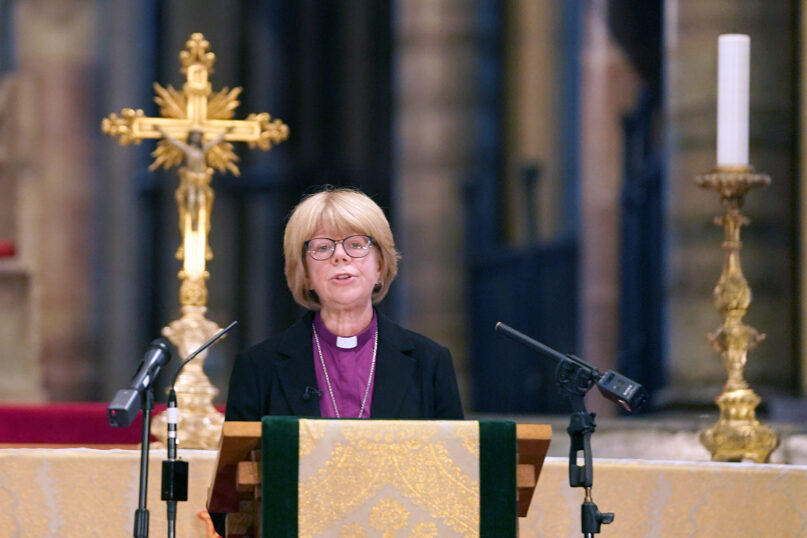
Sarah Mullally, the new Archbishop of Canterbury, spiritual leader of the world’s
85 million Anglicans, speaks inside Canterbury Cathedral in Canterbury, England
, Friday, Oct. 3, 2025. (AP Photo/Alberto Pezzali)
Besides a number of Church of England bishops who will not be willing to receive Communion from a woman, some African Churches in the communion are expected to bridle at a female leader. The Global Fellowship of Confessing Anglicans, known as GAFCON, a movement of Anglican denominations that reject women’s leadership and acceptance of LGBTQ+ members, said that “the majority of the Anglican Communion still believes that the Bible requires a male-only episcopacy.”
The appointment of a woman to head the Church of England may also impact Anglican relations with the Orthodox and Roman Catholic Churches, which have male priesthoods, although the Roman Catholic Archbishop of Westminster, Cardinal Vincent Nichols, who has worked with Mullally on ecumenical issues, welcomed her appointment.
Friday’s announcement followed a protracted search to find Welby’s successor. As the Church of England is the country’s established church, the search was conducted by the Crown Nominations Committee, whose chairman, former MI5 boss Lord Evans, was appointed by Prime Minister Keir Starmer. For the first time, the 17-member commission included five representatives from the churches outside the United Kingdom, mostly in the former British Empire, that make up the bulk of the Anglican Communion.
Archbishop-designate Mullally, who is married with two children, was first ordained a priest while working as a nurse. In 2004, after five years as chief nursing officer, where she had been responsible, according to the NHS’ website, “for providing clinical and professional leadership for all nurses, midwives and nursing associates across health and social care in England,” she left to work as a priest full time.
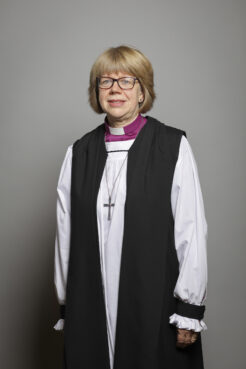
Official portrait of The Lord Bishop of London, the Rt. Rev. Sarah Mullally, in 2019. (Photo by Roger Harris/Wikimedia/Creative Commons)
She was named bishop of Crediton, Devon, in 2015 and three years later was appointed bishop of London, the third-most senior episcopal office in the Church of England after the archbishops of York and Canterbury. In recent months she combined her nursing and episcopal experience to speak powerfully in a debate in the House of Lords, where 26 Anglican bishops sit as a right of their office, on the assisted death bill going through parliament.
The church’s child sexual abuse and safeguarding failings that culminated in Welby’s resignation will loom over her tenure, and in her statement on Friday, Mullally, who has been caught up in the debates over children’s safety in the church, said: “As a church, we have too often failed to recognize or take seriously the misuse of power in all its forms. As Archbishop, my commitment will be to ensure that we continue to listen to survivors, care for the vulnerable, and foster a culture of safety and well-being for all.”
Mullally also faces some disagreement among rank-and-file clergy and congregants over the church’s recent churning over same-sex partnerships and tensions over a move to offer blessings for LGBTQ+ unions. Marriage has been extended to gay couples in the United Kingdom as a civil matter, but not in the Church of England.
But the long and often tense discussions in the church over Living in Love and Faith, a planned review of church teachings on LGBTQ+ acceptance, should be completed by the time Mullally takes over the role of archbishop of Canterbury early next year. Plans for remedies for sexual abuse victims are also expected to be in place by her installment, giving her a clean slate to begin with.
The Rev. Ian Paul, member of the General Synod’s evangelical Christian wing, told a Religion Media Centre webinar on Friday, “We don’t need a savior; we’ve already got one. We need someone to focus on due process.”
But Mullally has been greeted warmly by other leaders. The Rt. Rev. Sophie Jelley, bishop of Coventry, described her in the same webinar as “a wise and bold leader,” saying Mullally “is able to occupy the public space without being anxious and has developed a strong reputation in the Diocese of London in working with difference” — a reference to not only London’s multiculturalism, but the different strands in the Church of England.
Justin Humphreys, chief executive of the child-abuse watchdog organization Thirtyone:eight, also thought Mullally had the right skills for the Church of England: “There has been lost trust across the Church of England. People must be at the centre of what we do and Sarah can hold people and process together.”
Also in the archbishop-designate’s in-box will be concerns about declining church attendance and the consequent burden on those remaining of the costly upkeep of hundreds upon hundreds of historic church buildings.
More immediately, Mullally will need to be elected by the College of Canons of Canterbury Cathedral with confirmation of that election by a special ecclesiastical court, when she will legally become the new archbishop of Canterbury. After that, she will pay homage to the king, and then a formal installation will take place at Canterbury Cathedral in the spring. By then, Mullally will be 64, so will serve just six years in the role before retirement, making her episcopate, which normally runs 10 years, a relatively short one.
On Friday, Mullally focused as much on the Church of England’s work in communities around the U.K. “In parishes across this nation, I see faithful clergy and congregations worshipping God and loving their neighbors. I see thousands of churches running food banks and homeless shelters. I see hospitals and prison chaplains caring for people and families in times of desperation. I see Church of England schools educating a million children across this country.”
In paying tribute to these humble but time-honored functions of the Church of England, she seemed to place her hope not in solving the church’s recent difficulties, but in preserving those things that give her new global constituency hope in the life of the church.
In Africa, new Canterbury archbishop is celebrated by some, challenged by conservatives
NAIROBI, Kenya (RNS) — When Sarah Mullally's appointment was announced, many African women bishops cheered, hoping she will breathe new life into the communion.
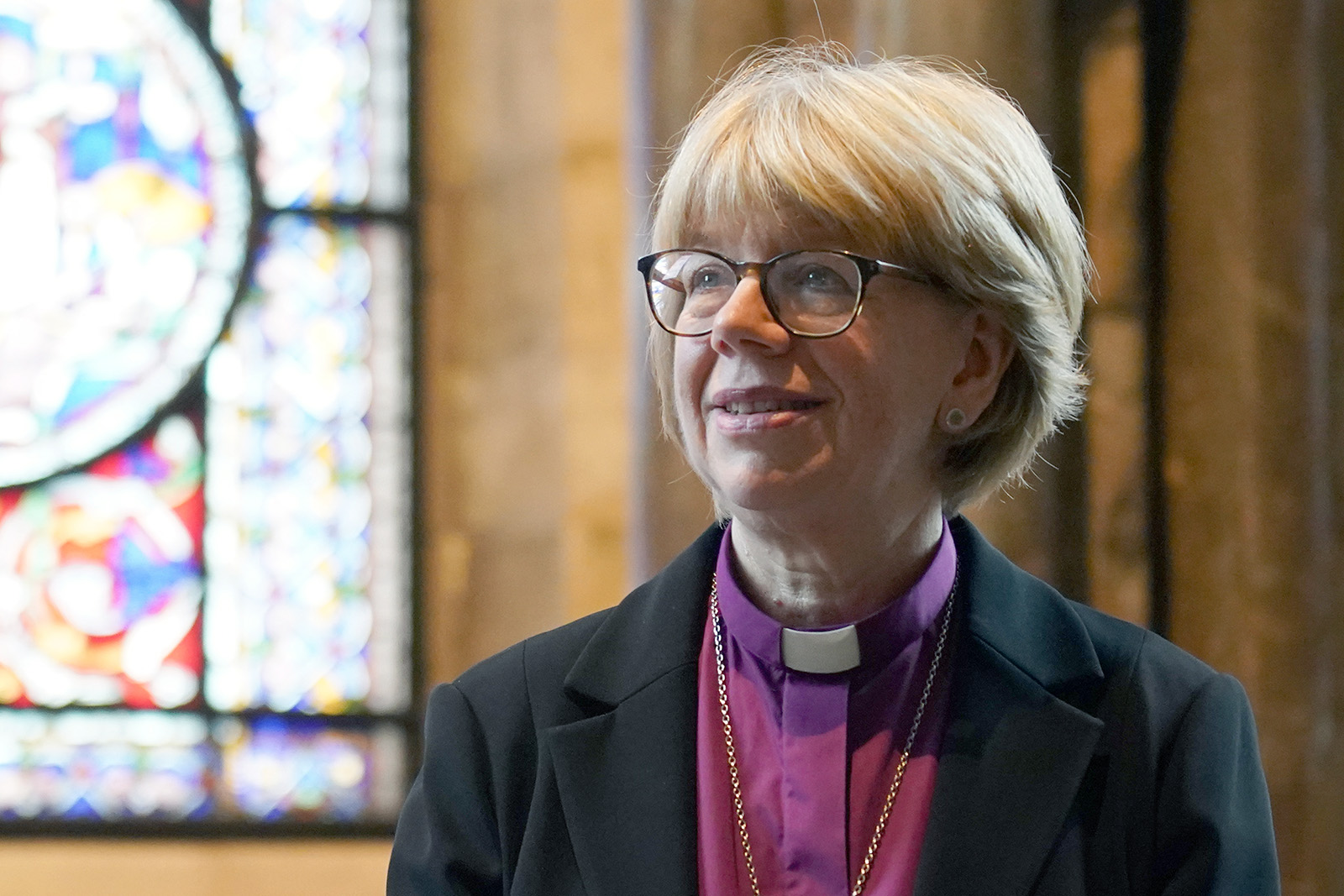
The Rt. Rev. Sarah Mullally, the new archbishop of Canterbury, spiritual leader of the world's 85 million Anglicans, poses for the media inside Canterbury Cathedral in Canterbury, England, Friday, Oct. 3, 2025. (AP Photo/Alberto Pezzali)
Fredrick Nzwili
October 3, 2025
RNS
NAIROBI, Kenya (RNS) — Anglican women bishops in Africa are celebrating the unprecedented appointment of the Rev. Sarah Mullally as archbishop-elect of Canterbury, becoming on Friday (Oct. 3) the first woman selected as spiritual leader of the Church of England. Meanwhile, African traditionalists are rejecting the move as another miss for the Anglican Communion struggling to remain united.
Mullally, 63, is a former nurse who was ordained a priest in 2006. She became the first female bishop of London in 2018. She will be voted on by other bishops and installed next year, The Associated Press reported.
Former Canterbury Archbishop Justin Welby left the post in January, after resigning amid allegations he mishandled a series of abuses by volunteers at Christian summer camps. The process to identify Welby’s successor was closely watched in Africa, and some clerics and Anglicans questioned why it took so long. But when Mullally’s appointment was announced, African women bishops cheered, hoping she will breathe new life into the communion.
“It is very significant — we are very excited about (it) and we are talking about it as women bishops,” the Rev. Emily Onyango, an assistant bishop of the Diocese of Bondo in Kenya, told RNS. “It means a lot for the church. Being the first woman archbishop of Canterbury, we believe things will be done differently. … We know there will be justice in the church, and we know she will work for peace and unity — something we need both in the church and in the world.”
Most of the world’s Anglicans live in the Global South, particularly Sub-Saharan Africa. In 2020, the region had more than 63 million baptized Anglicans, compared to around 23 million in Europe. Large populations of Anglicans live in Nigeria, Uganda, Kenya and Southern Africa.
But soon after the announcement, Rwandan Archbishop Laurent Mbanda, who is chairman of the Global Fellowship of Confessing Anglicans, a conservative global Anglican movement, said in a statement that Mullally’s appointment abandoned global Anglicans, saying the Church of England chose a leader who would further divide the already split communion. He accused her of failing to uphold her consecration vows, saying she took an oath to “banish and drive away all strange and erroneous doctrine contrary to God’s Word.” He argued she instead has promoted unbiblical teachings regarding marriage and sexual morality.
In 2023, when asked by a reporter whether sexual intimacy in a same-sex relationship is sinful, Mullally said some such relationships could be blessed, which Mbanda referenced in his statement. She also voted in favor of introducing blessings of same-sex marriage into the Church of England.
Mbanda, the archbishop of Kigali, Rwanda, said GAFCON leaders had hoped the Church of England would take their position into consideration in deliberating over the choice of a new archbishop.
“Sadly, they have not done so,” said Mbanda, adding that although some will welcome Mullally’s appointment as the first woman archbishop of Canterbury, the majority of the Anglican Communion in Africa believe the Bible requires a spiritual leader who is a man.
Mbanda said in the statement that for over a century-and-a-half, the archbishop of Canterbury has functioned not only as the church leader of England, but also as a spiritual and moral leader of the Anglican Communion broadly. Due to the alleged failure by the new leader-elect to guard the faith, the office could no longer function as a credible leader of African Anglicans, he said.
But Onyango questioned whether GAFCON leaders were reading their Bibles properly, saying Jesus Christ didn’t come to the world because he was male, but to save every human being.
“I think their understanding of Scripture is very different,” she said.
Regarding homosexuality — a divisive issue in the church — Onyango said she expected Mullally to approach the matter through dialogue.
“We have a lot of hope because we think she will be a person of dialogue who will be listening,” Onyango said. “I think many of the problems in the church are because people don’t listen to each other. They take one stand and do not consider the opinions of other people.”
In South Africa, Thabo Makgoba, archbishop of Cape Town, said the Anglican Church in Southern Africa considered the appointment of the first woman as archbishop of Canterbury a “thrilling development.”
“We heartily welcome the announcement and look forward to working with her as we try to respond prophetically and pastorally to what God is up to,” Makgoba said.
No comments:
Post a Comment