CUTTING NOSE TO SPITE FACE
BP-JERA JV Pulls Plug on US Offshore Wind Citing Unfavorable Market
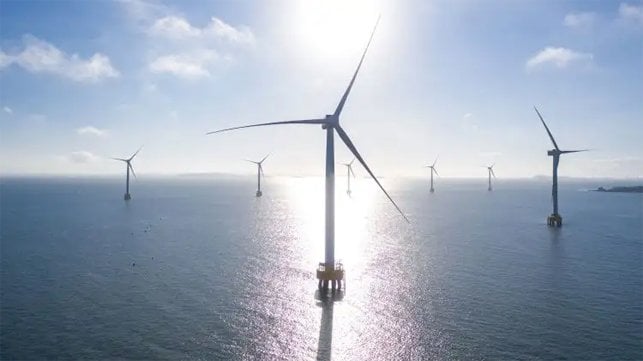
The joint venture company formed between BP and JERA announced that it has decided not to proceed at this time with the development of its Beacon Wind project off the coast of Massachusetts. Calling it a “difficult decision,” the companies said they had determined to reduce activities in the United States to “a minimal level,” reporting they will close operating activities in the market and dismiss all staff team members.
“Unfortunately, in the present environment, we see no viable path to the development of our Beacon wind project and have concluded that we cannot continue our investment in the market,” the company said in a written statement. “The U.S. is a market with significant long-term potential for offshore wind, which we still believe can play a key role in the country’s energy transition.”
The joint venture company was announced last year and launched in August 2025. At the time, it said it would “seek to continuously prioritize and optimize its portfolio of projects based on value and will leverage access to external capital and competitive financing.” The initial focus was to develop the existing pipeline established between the two companies, as well as to operate their assets. JERA Nex BP said it had a total potential generating capacity worldwide of 13 GW, including around 1 GW installed, 7.5 GW in the development pipeline, and an additional 4.5 GW of secured leases.
The CEO of JERA Nex BP, Nathalie Oosterlinck, had said in August on the launch of the company that it had a strong operational portfolio and an extensive pipeline. They have a global portfolio of onshore and offshore wind as well as solar and batteries, but Beacon Wind was its only U.S. offshore wind project.
The lease for Beacon Wind, which is located 17 nautical miles southwest of Nantucket, Massachusetts, and 52 NM east of Montauk Point, New York, was originally awarded in a December 2018 auction with the lease effective in April 2019. It belonged to Equinor, which later entered into a joint venture with BP. That JV was dissolved at the end of 2023, with BP taking full control of the 128,000-acre lease.
The first phase of the project, which was to have 1,230 MW, had already obtained a 25-year offtake agreement with New York for its power. The Biden administration had completed the environmental review, but the approval of the Construction and Operation Plan was still pending. The plan envisioned a second phase with 1.2 GW at a later date.
Signs of doubts over the project appeared in February when the project withdrew its application with New York for the transmission system. The project had been hailed for the plan to creatively reuse the Astoria (New York) Power Complex.
The Beacon Wind lease was awarded in the same auction as Vineyard Wind, which is under construction, and Mayflower Wind (now SouthCoast Wind), which is being developed in a partnership between EDP and ENGIE. This project is in court as it is one that the Trump administration has chosen to challenge the existing approvals.
JERA Nex BP said it would maintain the Beacon lease and “wait for a more favorable moment” to resume the project’s development.
BP and JERA Abandon U.S. Offshore Wind Project Amid Policy Shift

A joint venture between BP and Japan’s JERA has decided to pull the plug on a major offshore wind project in the United States, citing soaring costs and a change in federal policies.
JERA Nex BP said inflation had also motivated its decision, which would see its U.S. workforce laid off over the next few months, the company said in a statement.
“JERA Nex bp has taken the difficult decision to reduce our activities in the US to a minimal level and will close our operating activities in the market. Unfortunately, as a result of this, all team members will leave the company in the coming months,” the statement said.
“The US is a market with significant long-term potential for offshore wind, which we still believe can play a key role in the country’s energy transition. Unfortunately, in the present environment, we see no viable path to the development of our Beacon wind project and have concluded that we cannot continue our investment in the market,” the company also said.
The Trump administration has been on the war path against energy transition companies, but offshore wind has received a special focus, with the President repeatedly declaring his dislike for the technology, which critics have pointed to as one of the most expensive non-hydrocarbon energy sources and an environmental problem because of bird and whale deaths—the latter disputed by pro-wind activists and the bird deaths considered within acceptable limits.
The Beacon offshore wind installation, between Cape Cod and Long Island, was supposed to have a total capacity of 2.5 GW covering 128,000 acres. BP said in a fact sheet for the project that it would generate energy to supply as many as 1 million households in the northeastern U.S. Despite the cancellation of the project, BP and JERA said they would keep the lease for the location for the time being.
By Irina Slav for Oilprice.com
DEME Takes Delivery of Large WTIV with Hybrid Power to Reduce Emissions
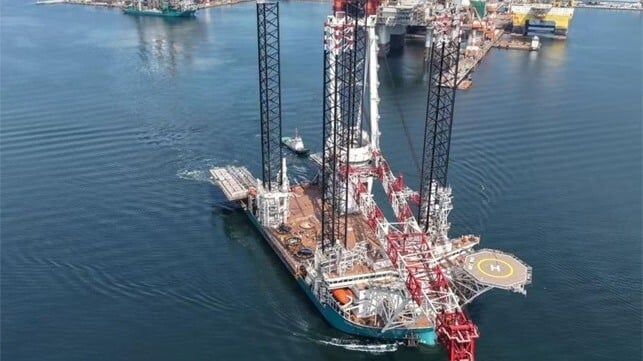
Belgium’s DEME Group is advancing ambitions to expand its role as a major player in offshore wind installations after taking delivery of an installation vessel that is being touted as having the capabilities to deliver some of the largest projects in the world. The first of two new vessels being delivered to the company in the coming months, it also uses new technology to be more sustainable.
Just seven months after paying $1 billion to acquire Norway-based offshore contractor Havfram, DEME has taken delivery of the wind turbine installation vessel Norse Wind. Construction of the vessel was started by Havfarm and was one of the elements that made the acquisition an attractive opportunity to expand in the sector.
Built by China’s CIMC Raffles Shipyard, the vessel was designed for large projects. The newbuild was designed by GustoMSC and is equipped to install turbines with rotor diameters of more than 300 meters and XXL monopiles weighing up to 3,000 tons. The vessel’s 3,200-tonne crane enables operation in water depths of up to 70 meters, setting a new standard in lifting capacity, speed, and efficiency. It is designed to handle the newest 15 MW and 20 MW turbines.
The shipbuilder highlights the first-of-its-kind direct-current power system, which makes it possible to run the vessel on batteries. Unlike alternating current vessels, which require the diesel-generators to be running continuously, the Norse Wind will draw power from batteries for her onboard systems, and the diesel generators will run intermittently to recharge the batteries. CIMC Raffles reports that it also makes it possible for the vessel to carry heavier loads while reducing emissions.
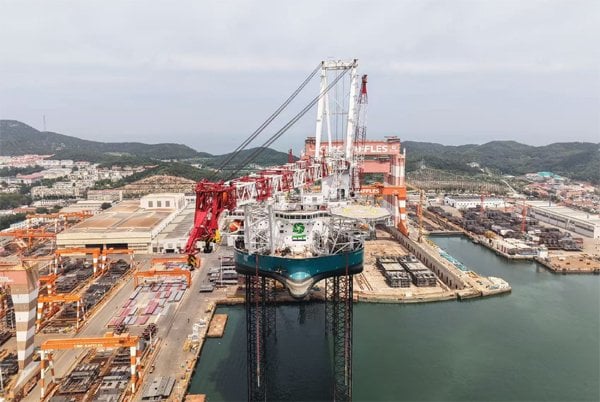
(DEME)
The vessel is also built to operate in extreme weather conditions. It has an advanced dynamic positioning system, which will help to keep it stable in conditions up to Force 8 winds (Gale 34 to 40 knots). It can handle rough seas and operate in low temperatures such as negative 15 C (5 F).
DEME highlights that Norse Wind is already contracted for several major offshore wind projects. Her first job, which is set to commence in the first half of next year, will be at the Nordseecluster B offshore wind farm in Germany that is jointly being implemented by RWE and Norges Bank Investment Management.
Early this month, DEME secured a sizable contract to carry out the transportation and installation works for the inter-array cables for the project that is located approximately 50 kilometers north of the island of Juist in Germany. The project will have a total capacity of up to 1.6 GW.
The Belgian company will transport and install a total of 124 kilometers of inter-array cables for the second project stage, Nordseecluster B, connecting all 60 foundations for the wind turbines to the offshore substation in the German North Sea.
“Norse Wind represents an important step in strengthening DEME’s position as a leading player in offshore wind installation,” said Even Larsen, Business Unit Director Global WTG and O&M at DEME. “This state-of-the-art vessel enables us to deliver even larger and more complex projects, further enhancing our capabilities.”
The company highlights that work is also well underway on the sister ship, Norse Energi. The second vessel was launched in July and is scheduled for delivery early in 2026.
No comments:
Post a Comment