Around 200,000 people have returned to Gaza's north under ceasefire, civil defence agency says
After two years of brutal war in Gaza, a ceasefire came into effect on Friday. Israel started pulling back its troops as thousands of displaced Palestinians began to trek back to their wrecked homes. While many felt a sense of relief, others erred on the side of caution as the future of the truce pushed by US President Donald Trump remains unclear.
Issued on: 10/10/2025 -
By: FRANCE 24
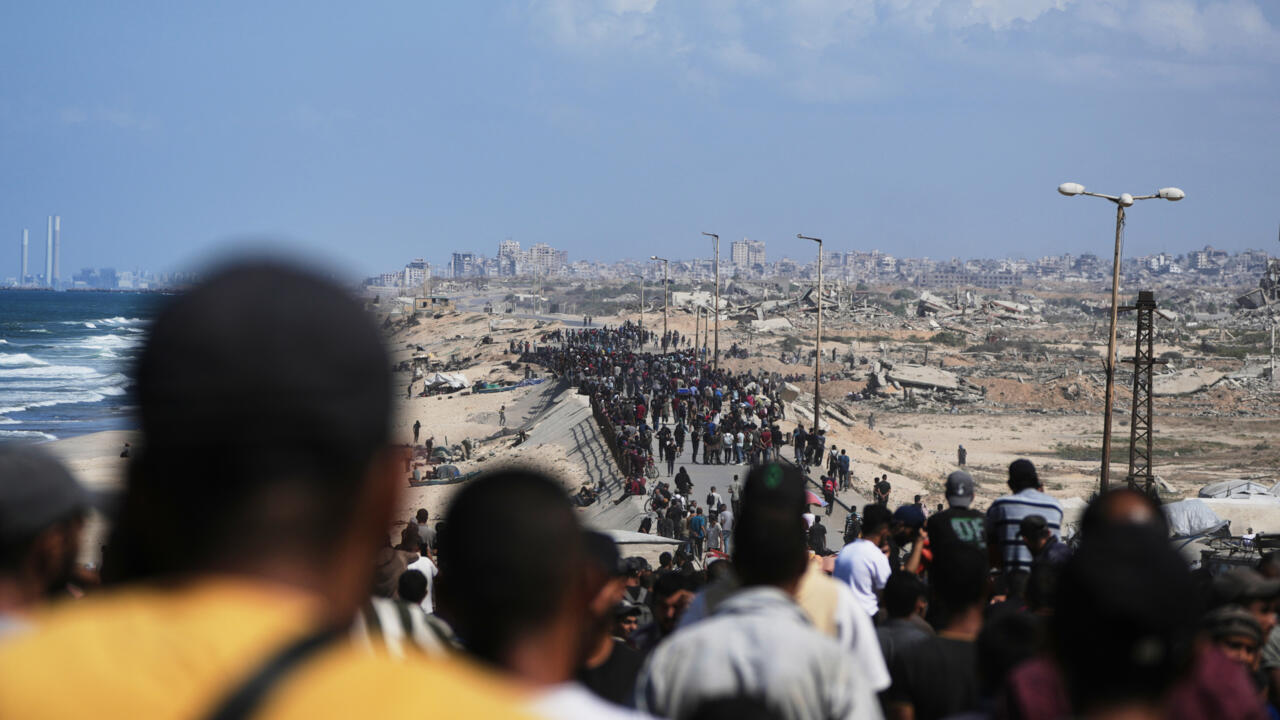
Displaced Palestinians walk along the coastal road near Wadi Gaza in the central Gaza Strip, moving toward northern Gaza, on October 10, 2025.
© Abdel Kareem Hana, AP
01:58
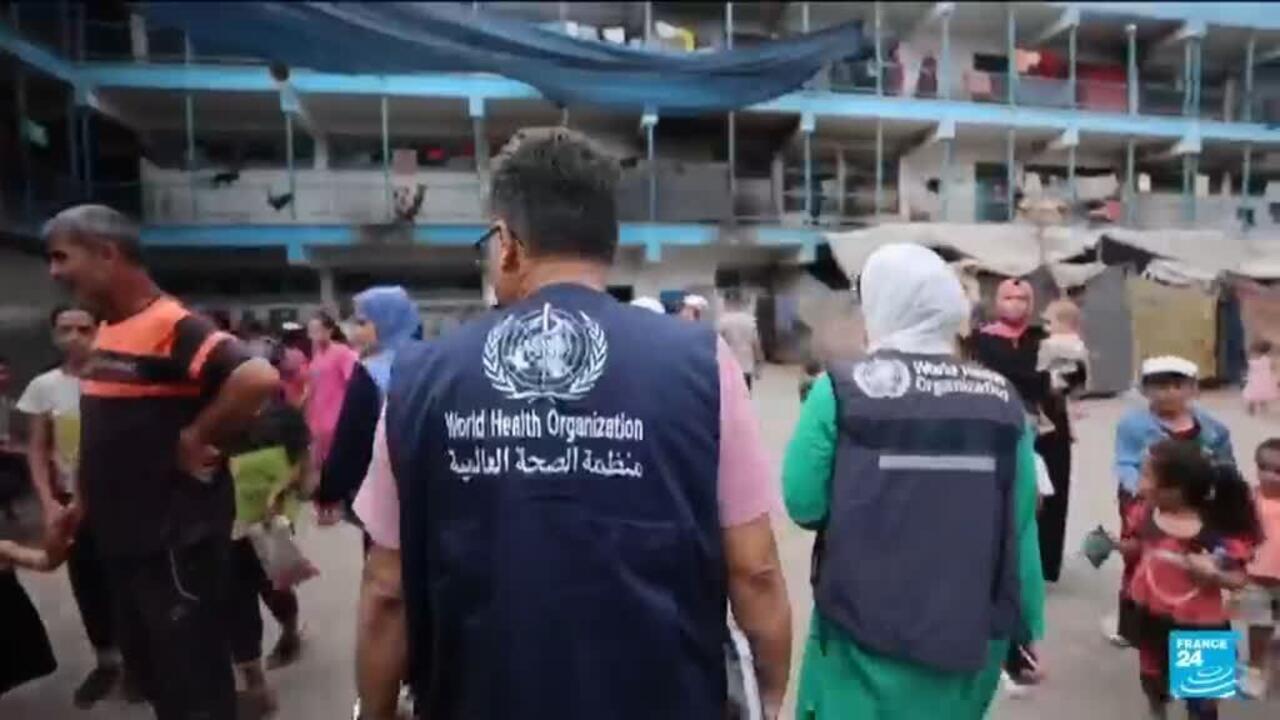
A ceasefire between Israel and Hamas came into effect in Gaza on Friday, the military said, hours after Israel’s Cabinet approved a deal to pause the fighting and exchange the remaining hostages for Palestinian prisoners.
Tens of thousands of people who had gathered in Wadi Gaza in central Gaza started walking north after the Israeli military’s announcement at noon local time. Beforehand, Palestinians reported heavy shelling in parts of Gaza throughout Friday morning, but no significant bombardment was reported after.
01:58
A ceasefire between Israel and Hamas came into effect in Gaza on Friday, the military said, hours after Israel’s Cabinet approved a deal to pause the fighting and exchange the remaining hostages for Palestinian prisoners.
Tens of thousands of people who had gathered in Wadi Gaza in central Gaza started walking north after the Israeli military’s announcement at noon local time. Beforehand, Palestinians reported heavy shelling in parts of Gaza throughout Friday morning, but no significant bombardment was reported after.
© France 24
01:58
01:58
The ceasefire marks a key step toward ending a ruinous two-year war that has killed tens of thousands of Palestinians, reduced much of Gaza to rubble, destabilised the Middle East, and left dozens of hostages, living and dead, in the territory.
Still, the broader plan advanced by US President Donald Trump includes many unanswered questions, such as whether and how Hamas will disarm and who will govern Gaza.
Despite those questions, Israeli Prime Minister Benjamin Netanyahu insisted in a televised statement Friday that the next stages would see Hamas disarm and Gaza demilitarised.
“If this is achieved the easy way, so be it. If not, it will be achieved the hard way,” Netanyahu said. He added that Hamas agreed to the deal “only when it felt that the sword was on its neck – and it is still on its neck”.
Read more Does Israel and Hamas signing the Gaza ceasefire deal mean the war is over?
Israeli military spokesman Brig. Gen. Effie Defrin said troops had completed their withdrawal to the deployment lines by Friday afternoon, a few hours after the ceasefire officially went into effect.
Earlier, an Israeli security official, speaking on condition of anonymity due to the sensitivity of the withdrawal, said the military would control around 50 percent of Gaza in their new positions.
A steady stream of people, the vast majority on foot, crammed onto a coastal road in the central Gaza Strip, heading north to see what might have remained of their homes. Others headed to other parts of the Palestinian territory in the south.
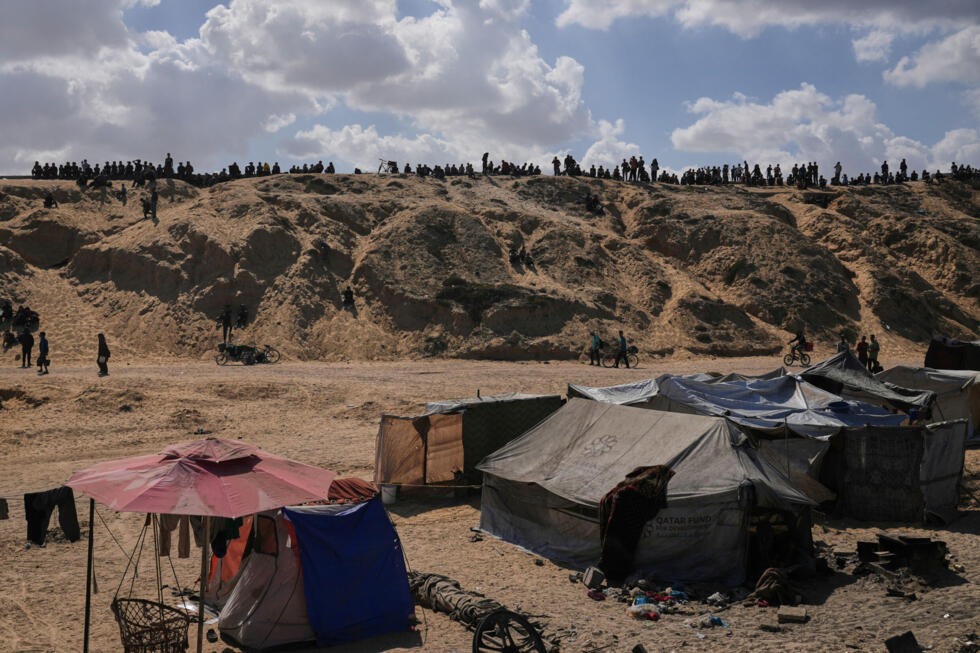
Makeshift tents along the coastal road near Wadi Gaza in the central Gaza Strip.
© Abdel Kareem Hana, AP
”We want to go back," said Fayez AlMajdoub, one of the crowd who had been displaced from northern Gaza. "I want to go and make sure my home is still there. That’s what I want to know.”
Another man displaced from northern Gaza, Jamal Mesbah, said he too was heading back.
“My family is waiting, and we packed our stuff as we may return home. But we still suffered,” he said. "There wasn’t much joy, but the ceasefire somewhat eased the pain of death and bloodshed, and the pain of our loved ones and brothers who suffered in this war.”
In Gaza's southern city of Khan Younis, hundreds of Palestinians attempted to return to their homes, only to find wrecked buildings, rubble and destruction upon the withdrawal of the Israeli troops.
“There was nothing left. Just a few clothes, pieces of wood, and pots,” said Fatma Radwan, who was displaced from eastern Khan Younis. People were still trying to retrieve bodies from under the rubble, she added.
Many buildings were flattened, and none was undamaged, as people went back to search for their belongings. “We came to a place that is unidentifiable. An unidentifiable town. Destruction is everywhere,” said Hani Omran, who was also displaced from eastern Khan Younis.
Taking stock of the devastation
The war began when Hamas-led militants stormed into Israel on October 7, 2023, killing some 1,200 people and taking 251 hostage.
In Israel’s ensuing offensive, more than 67,000 Palestinians have been killed in Gaza and nearly 170,000 wounded, according to Gaza’s Health Ministry, which doesn’t differentiate between civilians and combatants but says around half the deaths were women and children. The ministry is part of the Hamas-run government, and the United Nations and many independent experts consider its figures to be the most reliable estimate of wartime casualties.
The war has also triggered other conflicts in the region, sparked worldwide protests and led to allegations of genocide that Israel denies.
Under the deal, Israeli troops have withdrawn to new positions in Gaza, and all 48 hostages still in captivity are expected to be released. Israel believes around 20 of them are alive.
In exchange, Israel will release around 2,000 Palestinian prisoners. A list Israel published Friday did not include high-profile prisoner Marwan Barghouti, the most popular Palestinian leader and a potentially unifying figure. Israel views him and some others as terrorist masterminds who murdered Israeli civilians and has refused to release them in past exchanges.
Read moreJailed Palestinian leader Marwan Barghouti is 'most qualified', says former Mossad chief
Khalil al-Hayya, a senior Hamas official and lead negotiator, said Thursday evening that all women and children held in Israeli jails will be freed.
The hostage and prisoner releases are expected to begin Monday, two Egyptian officials briefed on the talks and a Hamas official said, though another official said they could occur as early as Sunday night. The officials spoke on condition of anonymity because they were not authorised to be publicly named speaking about the negotiations.
Five border crossings are expected to reopen, including the Rafah crossing between Gaza and Egypt, the Egyptian and Hamas officials said. That will allow aid to flow into the territory, parts of which are experiencing famine.
The Trump plan calls for Israel to maintain an open-ended military presence inside Gaza, along its border with Israel. An international force, comprised largely of troops from Arab and Muslim countries, would be responsible for security inside Gaza.
To help support and monitor the ceasefire deal, US officials said they would send about 200 troops to Israel as part of a broader, international team. The officials spoke on condition of anonymity to discuss details not authorised for release.
The US would also lead a massive internationally funded reconstruction effort.
The plan also envisions an eventual role for the Palestinian Authority – something Netanyahu has long opposed. But it requires the authority, which administers parts of the West Bank, to undergo a sweeping reform program that could take years.
The Trump plan is even more vague about a future Palestinian state, which Netanyahu firmly rejects.
(FRANCE 24 with AP)
”We want to go back," said Fayez AlMajdoub, one of the crowd who had been displaced from northern Gaza. "I want to go and make sure my home is still there. That’s what I want to know.”
Another man displaced from northern Gaza, Jamal Mesbah, said he too was heading back.
“My family is waiting, and we packed our stuff as we may return home. But we still suffered,” he said. "There wasn’t much joy, but the ceasefire somewhat eased the pain of death and bloodshed, and the pain of our loved ones and brothers who suffered in this war.”
In Gaza's southern city of Khan Younis, hundreds of Palestinians attempted to return to their homes, only to find wrecked buildings, rubble and destruction upon the withdrawal of the Israeli troops.
“There was nothing left. Just a few clothes, pieces of wood, and pots,” said Fatma Radwan, who was displaced from eastern Khan Younis. People were still trying to retrieve bodies from under the rubble, she added.
Many buildings were flattened, and none was undamaged, as people went back to search for their belongings. “We came to a place that is unidentifiable. An unidentifiable town. Destruction is everywhere,” said Hani Omran, who was also displaced from eastern Khan Younis.
Taking stock of the devastation
The war began when Hamas-led militants stormed into Israel on October 7, 2023, killing some 1,200 people and taking 251 hostage.
In Israel’s ensuing offensive, more than 67,000 Palestinians have been killed in Gaza and nearly 170,000 wounded, according to Gaza’s Health Ministry, which doesn’t differentiate between civilians and combatants but says around half the deaths were women and children. The ministry is part of the Hamas-run government, and the United Nations and many independent experts consider its figures to be the most reliable estimate of wartime casualties.
The war has also triggered other conflicts in the region, sparked worldwide protests and led to allegations of genocide that Israel denies.
Under the deal, Israeli troops have withdrawn to new positions in Gaza, and all 48 hostages still in captivity are expected to be released. Israel believes around 20 of them are alive.
In exchange, Israel will release around 2,000 Palestinian prisoners. A list Israel published Friday did not include high-profile prisoner Marwan Barghouti, the most popular Palestinian leader and a potentially unifying figure. Israel views him and some others as terrorist masterminds who murdered Israeli civilians and has refused to release them in past exchanges.
Read moreJailed Palestinian leader Marwan Barghouti is 'most qualified', says former Mossad chief
Khalil al-Hayya, a senior Hamas official and lead negotiator, said Thursday evening that all women and children held in Israeli jails will be freed.
The hostage and prisoner releases are expected to begin Monday, two Egyptian officials briefed on the talks and a Hamas official said, though another official said they could occur as early as Sunday night. The officials spoke on condition of anonymity because they were not authorised to be publicly named speaking about the negotiations.
Five border crossings are expected to reopen, including the Rafah crossing between Gaza and Egypt, the Egyptian and Hamas officials said. That will allow aid to flow into the territory, parts of which are experiencing famine.
The Trump plan calls for Israel to maintain an open-ended military presence inside Gaza, along its border with Israel. An international force, comprised largely of troops from Arab and Muslim countries, would be responsible for security inside Gaza.
To help support and monitor the ceasefire deal, US officials said they would send about 200 troops to Israel as part of a broader, international team. The officials spoke on condition of anonymity to discuss details not authorised for release.
The US would also lead a massive internationally funded reconstruction effort.
The plan also envisions an eventual role for the Palestinian Authority – something Netanyahu has long opposed. But it requires the authority, which administers parts of the West Bank, to undergo a sweeping reform program that could take years.
The Trump plan is even more vague about a future Palestinian state, which Netanyahu firmly rejects.
(FRANCE 24 with AP)
Gaza ceasefire: Who are the 20 living hostages set to be freed by Hamas before Monday night?
Israel and Hamas have begun to implement a deal providing for a ceasefire and the release of the 20 Israeli hostages still believed to be alive in Gaza – and the return of the bodies of 26 captives presumed dead. Here's what we know about the hostages still held by Hamas.
Issued on: 10/10/2025 -
FRA CE24
By: Pauline ROUQUETTE
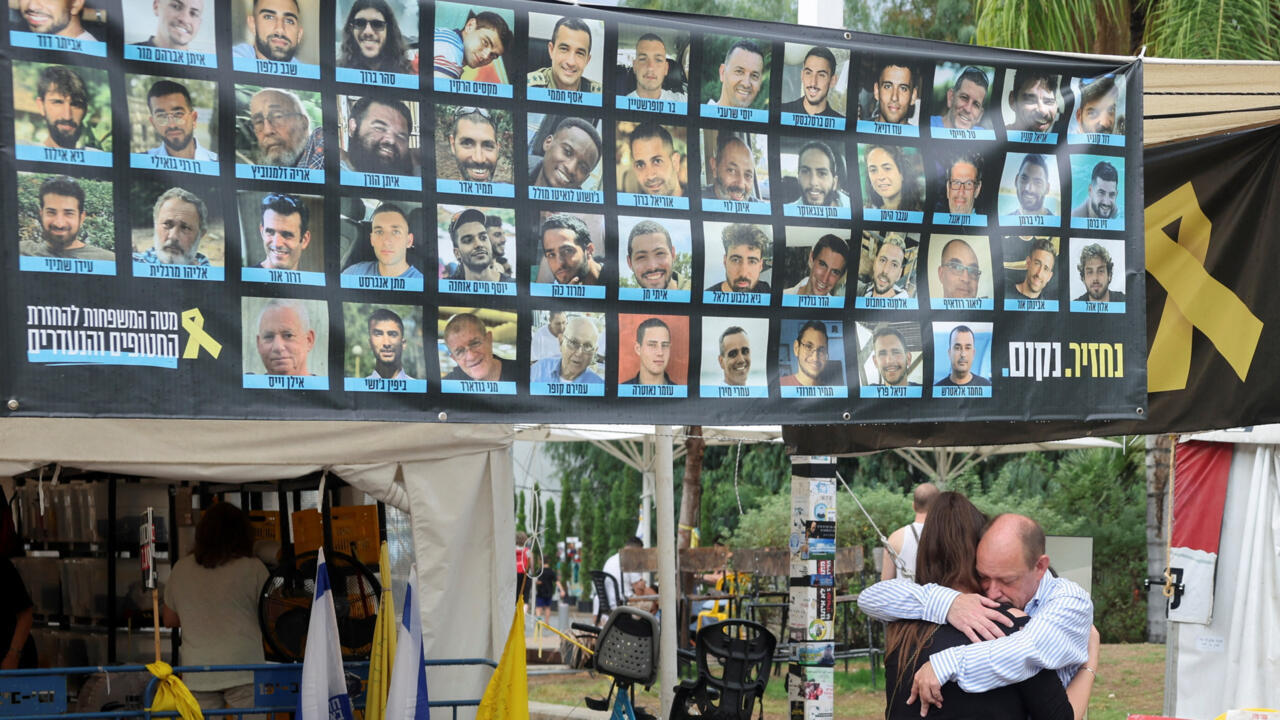
People embrace in front of a banner displaying photos of hostages at the "hostages square" after US President Donald Trump announced that Israel and Hamas had agreed on the first phase of a ceasefire in Gaza, in Tel Aviv, on October 9, 2025. © Ronen Zvulun, Reuters
After two years of war, a ceasefire deal between Israel and Hamas came into effect Friday at noon local time, clearing the way for a partial withdrawal of troops and a full suspension of hostilities in Gaza within 24 hours. Israeli and foreign hostages held there are to be freed no later than 72 hours after that – by Monday evening. In return, hundreds of Palestinian prisoners held in Israel will be released.
Read moreDoes Israel and Hamas signing the Gaza ceasefire deal mean the war is over?
The war in Gaza began after Hamas-led militants stormed through Israeli towns and the Nova music festival on October 7, 2023, killing 1,200 people and capturing 251 hostages.
Dozens of captives were rescued or released over the past two years. The Israeli government says that there are still 20 hostages alive in Gaza. They are:
Matan Angrest, 22
This young Israeli soldier was captured on October 7 from his tank at the Nahal Oz military base on the Gaza border.
News from former hostages who were held with Angrest in the underground tunnels of the Gaza Strip is disturbing. In April 2025, his mother, Anat Angrest, told The Times of Israel that former hostages had told her that Matan was “starving and being held in a little cage in the dark".
"He doesn’t see the daylight," she said. "He is exposed to torture and violence and never sees the Red Cross.”
In a Hamas propaganda video released on March 7, Matan appeared very weak and showed signs of mistreatment.
“Matan’s face is not symmetric anymore,” Anat Angrest told the Times. “His hand that was badly injured wasn’t treated, and we know it doesn’t function anymore. He will be disabled his whole life”.
Gali Berman and Ziv Berman, 28
These twin brothers were abducted from the Kfar Aza kibbutz.
Their family had no news of them until February 2025, after some 30 hostages were released as part of a previous ceasefire, when they were told that the twins were alive but being held separately and in poor health.
In a statement last month, the family said: “We know you don't understand how you can still be there, or when you will be free again. We promise you this will happen – you will return to the safe embrace of your mother. Hold on just a little longer, survive, and dream of a happy ending.”
Elkana Bohbot, 36
Married and father of a five-year-old boy, this Israeli-Colombian national was kidnapped by Hamas from the Nova festival near the Reim kibbutz, where he was working as a logistics manager.
His wife and mother were able to speak to him on the phone before losing contact with him. Elkana told them he was helping to evacuate the wounded, according to The Times of Israel. A few hours later, his family discovered a video of him posted by Hamas, in which he appeared tied up on the ground, his face covered in blood.
In two Hamas propaganda videos released in March and May, Elkana appeared very weak, lying down, unable to speak. Another hostage, Yosef-Chaim Ohana, spoke on his behalf – prompting his relatives to alert the leaders of many countries, notably France, to Elkana's worrying physical and mental state.
On Tuesday, his aunt, Ruth Amiel, expressed concern on i24 News that she had not heard news of her nephew “for several months”.
“In our hearts, we know he is there, that he is alive. We hope he will not lose hope and confidence and that he knows we are doing everything we can to see him return to us,” she said.
Read moreIsraelis mourn victims of the Nova festival massacre two years after October 7 attacks
Rom Braslavski, 21
A security guard at the Nova music festival, Rom also stayed behind to help others during the Hamas attack, his family told NBC Los Angeles.
According to a testimony published by the Hostages and Missing Families Forum, he was trying to rescue someone injured in the attack when he was hit by a volley of gunfire. The family haven't heard from him since.
Ariel Cunio, 28, and David Cunio, 35
The two brothers were abducted during the attack on Kibbutz Nir Oz – the closest community to Gaza – along with several members of their family.
Eitan Cunio, another brother who managed to escape the Hamas attackers, told the Jewish Chronicle that Ariel's last message said: “We are in a horror movie.”
Ariel's partner, Arbel Yehud, was released on January 30, 2025 under a ceasefire agreement between Hamas and Israel.
David Cunio's wife, Sharon Aloni Cunio, and their three-year-old twin daughters, Ema and Yuly, were released in November 2023.
Sharon's sister, Daniele Aloni, and her six-year-old daughter, Emilia, were both released the same month.
Evyatar David, 24
On the morning of the attack, Evyatar sent a message to his family from the Nova festival to say that the event was under attack. His family claims to have later received a text message from an unknown number containing a video of Evyatar handcuffed on the floor in a dark room.
According to the Israeli Foreign Ministry, he is still held captive by Hamas in Gaza.
Evyatar David “is a person full of life, he is a very kind soul”, his brother Ilay David told ABC News on Sunday.
In August, Hamas released a video of Evyatar David in captivity, raising concerns about his health.
“He was emaciated, skin and bones” – recalling pictures from 80 years ago at the end of the Holocaust, Ilay David said. “We know that the only thing keeping Evyatar alive is his faith – and you can see it in his eyes.”
Guy Gilboa-Dalal, 24
Kidnapped at the Nova festival with his childhood friend Evyatar David, he appeared briefly in a propaganda video released by Hamas in September.
“It’s so hard, missing him all day every day,” his brother Gal Gilboa-Dalal, who was also at the festival but escaped the attack, told The Guardian. “And as time goes by it’s getting harder and harder [to bear], and harder and harder to see the light at the end of the tunnel.”
Maxime Herkin, 37
A Russian-Israeli citizen and father of a young daughter, he had left Ukraine to settle in Israel, according to his family.
He was abducted at the Nova festival, which he had been invited to at the last minute. His mother had heard nothing about him until last May. In a propaganda video released by Hamas, Herkin appears covered in bandages, and, speaking under duress, suggests that he had been wounded in an Israeli bombing raid.
Eitan Horn, 38
An Argentine citizen, he was abducted from Nir Oz kibbutz along with his brother Yair, who was 46 at the time of the attack, and released last February.
Eitan worked in education and helped welcome new arrivals to Israel, according to The Jerusalem Post.
Bipin Joshi, 24
An agriculture student, this Nepalese national was in Israel to continue his studies. According to The Times of Israel, he was kidnapped from Alumim kibbutz, where he was doing an internship.
“We just want him back,” his sister told the newspaper in August. “It‘s too much for me and my family.”
Segev Kalfon, 27
On October 7, 2023, he attempted to flee the Nova festival by crossing the motorway, but was captured by Hamas. According to his mother, he worked in a bakery and was studying finance.
His family said they were very concerned for his safety, noting that he already suffered from severe anxiety before his abduction.
Bar Kuperstein, 23
Bar Abraham Kuperstein was working at the Nova festival when the attack took place and tried to help save lives and evacuate the wounded when he was taken hostage, his family told The Jerusalem Post.
His relatives said they identified him in a video of Israeli prisoners that was made public by Hamas last April, but say they have received no further information since then.
Omri Miran, 48
Kidnapped from the Nahal Oz kibbutz, he appeared in a Hamas propaganda video in April, although the date the video was made was not specified.
His family said they desperately wanted him to be reunited with his wife, Lishay, and their two young daughters, Roni and Alma.
“Roni just celebrated her fourth birthday – a second without her father,” his brother-in-law, Moshe Lavi, told NPR in August. “Alma is two years old. Never celebrated a birthday with her father. He was kidnapped when she was six months old. I want to see him back with Lishay, my sister, with his father, Danny, and his siblings.”
Eitan Abraham Mor, 25
Eitan Abraham Mor was a security guard at the Nova festival. He was seen helping others to safety, according to The Times of Israel.
In June 2024, his father told Israeli radio that the “last sign of life” the family had had of Eitan was four months earlier, without giving further details.
Tamir Nimrodi, 20
This young soldier, who lived on a military base near the border with Gaza, was 18 years old when he was taken, barefoot and without his glasses, according to The Jerusalem Post.
“He always said I was his best friend. We had a rare connection," his mother, Herut Nimrodi, told the paper. "I pray for the chance to have moments with him again. The emptiness in my heart is indescribable.”
Yosef-Chaim Ohana, 25
According to The Jerusalem Post, Yosef-Chaim Ohana was at the Nova festival to celebrate his departure for the United States to begin training as a pilot. A friend who was there that day told his mother that Ohana stayed behind to help people escape the gunfire before fleeing himself.
Several weeks after the attack, the Israeli army informed his relatives that he was being held prisoner in Gaza.
Alon Ohel, 24
Kidnapped at the Nova festival, this Israeli-German pianist appears briefly in a Hamas propaganda video released in September, wearing a black T-shirt and urging Prime Minister Benjamin Netanyahu to secure the release of all hostages still being held.
Alon’s mother, Idit Alon, told the Jerusalem Post that seeing the video gave her hope: “There’s still something of him, his smile – in one moment it gives a lot of hope.”
Avinatan Or, 32
Avinatan Or and his partner Noa Argamani were abducted during the festival and immediately separated. Noa Argamani was released in June 2024.
Avinatan's relatives received news of him for the first time in March 2025.
“We always knew he was alive. Now it's officially confirmed,” his brother Moshe said at the time. Since then, no further information has been received.
Matan Zangauker, 25
Matan Zangauker was kidnapped in Nir Oz kibbutz along with his girlfriend, 31-year-old Lana Gritzewsky. A Mexican national, she was released on November 30, 2023 after 55 days in captivity.
In an op-ed published by USA Today, she said she could not focus on her recovery while her boyfriend remained in captivity.
‘My Matan, stay strong,’ his mother, Einav Zangauker, wrote in an open letter to her son published in the daily Haaretz on Monday. “I will never give up on you.”
Hamas has indicated that recovering the bodies of the hostages who died in captivity may take longer than releasing those who are alive.
The International Committee of the Red Cross Friday said all releases of Israeli hostages and Palestinian prisoners called for in the Gaza ceasefire agreement should be carried out "safely and with dignity". Previous transfers of hostages in the war have sparked anger in Israel, following chaotic scenes during the handovers as Hamas paraded hostages before crowds. The Geneva-based humanitarian organisation has said it had facilitated the release of 148 hostages and 1,931 detainees since October 2023. It has also facilitated the return of human remains.
They 26 hostages whose deaths have been confirmed have been identified as: Itay Chen, Inbar Hayman, Arie Zalmanowicz, Lior Rudaeff, Eliyahu Margalit, Meny Godard, Amiram Cooper, Tamir Adar, Muhammad Al-Atarash, Sahar Baruch, Uriel Baruch, Ronen Engel, Hadar Goldin, Ran Gvili, Tal Haimi, Guy Illouz, Eitan Levi, Joshua Loitu Mollel, Omer Neutra, Dror Oz, Oz Daniel, Daniel Peretz, Yossi Sharabi, Asaf Hamami, Sonthaya Oakkharasri and Sudthisak Rinthalak.
This article was adapted from the original in French.
After two years of war, a ceasefire deal between Israel and Hamas came into effect Friday at noon local time, clearing the way for a partial withdrawal of troops and a full suspension of hostilities in Gaza within 24 hours. Israeli and foreign hostages held there are to be freed no later than 72 hours after that – by Monday evening. In return, hundreds of Palestinian prisoners held in Israel will be released.
Read moreDoes Israel and Hamas signing the Gaza ceasefire deal mean the war is over?
The war in Gaza began after Hamas-led militants stormed through Israeli towns and the Nova music festival on October 7, 2023, killing 1,200 people and capturing 251 hostages.
Dozens of captives were rescued or released over the past two years. The Israeli government says that there are still 20 hostages alive in Gaza. They are:
Matan Angrest, 22
This young Israeli soldier was captured on October 7 from his tank at the Nahal Oz military base on the Gaza border.
News from former hostages who were held with Angrest in the underground tunnels of the Gaza Strip is disturbing. In April 2025, his mother, Anat Angrest, told The Times of Israel that former hostages had told her that Matan was “starving and being held in a little cage in the dark".
"He doesn’t see the daylight," she said. "He is exposed to torture and violence and never sees the Red Cross.”
In a Hamas propaganda video released on March 7, Matan appeared very weak and showed signs of mistreatment.
“Matan’s face is not symmetric anymore,” Anat Angrest told the Times. “His hand that was badly injured wasn’t treated, and we know it doesn’t function anymore. He will be disabled his whole life”.
Gali Berman and Ziv Berman, 28
These twin brothers were abducted from the Kfar Aza kibbutz.
Their family had no news of them until February 2025, after some 30 hostages were released as part of a previous ceasefire, when they were told that the twins were alive but being held separately and in poor health.
In a statement last month, the family said: “We know you don't understand how you can still be there, or when you will be free again. We promise you this will happen – you will return to the safe embrace of your mother. Hold on just a little longer, survive, and dream of a happy ending.”
Elkana Bohbot, 36
Married and father of a five-year-old boy, this Israeli-Colombian national was kidnapped by Hamas from the Nova festival near the Reim kibbutz, where he was working as a logistics manager.
His wife and mother were able to speak to him on the phone before losing contact with him. Elkana told them he was helping to evacuate the wounded, according to The Times of Israel. A few hours later, his family discovered a video of him posted by Hamas, in which he appeared tied up on the ground, his face covered in blood.
In two Hamas propaganda videos released in March and May, Elkana appeared very weak, lying down, unable to speak. Another hostage, Yosef-Chaim Ohana, spoke on his behalf – prompting his relatives to alert the leaders of many countries, notably France, to Elkana's worrying physical and mental state.
On Tuesday, his aunt, Ruth Amiel, expressed concern on i24 News that she had not heard news of her nephew “for several months”.
“In our hearts, we know he is there, that he is alive. We hope he will not lose hope and confidence and that he knows we are doing everything we can to see him return to us,” she said.
Read moreIsraelis mourn victims of the Nova festival massacre two years after October 7 attacks
Rom Braslavski, 21
A security guard at the Nova music festival, Rom also stayed behind to help others during the Hamas attack, his family told NBC Los Angeles.
According to a testimony published by the Hostages and Missing Families Forum, he was trying to rescue someone injured in the attack when he was hit by a volley of gunfire. The family haven't heard from him since.
Ariel Cunio, 28, and David Cunio, 35
The two brothers were abducted during the attack on Kibbutz Nir Oz – the closest community to Gaza – along with several members of their family.
Eitan Cunio, another brother who managed to escape the Hamas attackers, told the Jewish Chronicle that Ariel's last message said: “We are in a horror movie.”
Ariel's partner, Arbel Yehud, was released on January 30, 2025 under a ceasefire agreement between Hamas and Israel.
David Cunio's wife, Sharon Aloni Cunio, and their three-year-old twin daughters, Ema and Yuly, were released in November 2023.
Sharon's sister, Daniele Aloni, and her six-year-old daughter, Emilia, were both released the same month.
Evyatar David, 24
On the morning of the attack, Evyatar sent a message to his family from the Nova festival to say that the event was under attack. His family claims to have later received a text message from an unknown number containing a video of Evyatar handcuffed on the floor in a dark room.
According to the Israeli Foreign Ministry, he is still held captive by Hamas in Gaza.
Evyatar David “is a person full of life, he is a very kind soul”, his brother Ilay David told ABC News on Sunday.
In August, Hamas released a video of Evyatar David in captivity, raising concerns about his health.
“He was emaciated, skin and bones” – recalling pictures from 80 years ago at the end of the Holocaust, Ilay David said. “We know that the only thing keeping Evyatar alive is his faith – and you can see it in his eyes.”
Guy Gilboa-Dalal, 24
Kidnapped at the Nova festival with his childhood friend Evyatar David, he appeared briefly in a propaganda video released by Hamas in September.
“It’s so hard, missing him all day every day,” his brother Gal Gilboa-Dalal, who was also at the festival but escaped the attack, told The Guardian. “And as time goes by it’s getting harder and harder [to bear], and harder and harder to see the light at the end of the tunnel.”
Maxime Herkin, 37
A Russian-Israeli citizen and father of a young daughter, he had left Ukraine to settle in Israel, according to his family.
He was abducted at the Nova festival, which he had been invited to at the last minute. His mother had heard nothing about him until last May. In a propaganda video released by Hamas, Herkin appears covered in bandages, and, speaking under duress, suggests that he had been wounded in an Israeli bombing raid.
Eitan Horn, 38
An Argentine citizen, he was abducted from Nir Oz kibbutz along with his brother Yair, who was 46 at the time of the attack, and released last February.
Eitan worked in education and helped welcome new arrivals to Israel, according to The Jerusalem Post.
Bipin Joshi, 24
An agriculture student, this Nepalese national was in Israel to continue his studies. According to The Times of Israel, he was kidnapped from Alumim kibbutz, where he was doing an internship.
“We just want him back,” his sister told the newspaper in August. “It‘s too much for me and my family.”
Segev Kalfon, 27
On October 7, 2023, he attempted to flee the Nova festival by crossing the motorway, but was captured by Hamas. According to his mother, he worked in a bakery and was studying finance.
His family said they were very concerned for his safety, noting that he already suffered from severe anxiety before his abduction.
Bar Kuperstein, 23
Bar Abraham Kuperstein was working at the Nova festival when the attack took place and tried to help save lives and evacuate the wounded when he was taken hostage, his family told The Jerusalem Post.
His relatives said they identified him in a video of Israeli prisoners that was made public by Hamas last April, but say they have received no further information since then.
Omri Miran, 48
Kidnapped from the Nahal Oz kibbutz, he appeared in a Hamas propaganda video in April, although the date the video was made was not specified.
His family said they desperately wanted him to be reunited with his wife, Lishay, and their two young daughters, Roni and Alma.
“Roni just celebrated her fourth birthday – a second without her father,” his brother-in-law, Moshe Lavi, told NPR in August. “Alma is two years old. Never celebrated a birthday with her father. He was kidnapped when she was six months old. I want to see him back with Lishay, my sister, with his father, Danny, and his siblings.”
Eitan Abraham Mor, 25
Eitan Abraham Mor was a security guard at the Nova festival. He was seen helping others to safety, according to The Times of Israel.
In June 2024, his father told Israeli radio that the “last sign of life” the family had had of Eitan was four months earlier, without giving further details.
Tamir Nimrodi, 20
This young soldier, who lived on a military base near the border with Gaza, was 18 years old when he was taken, barefoot and without his glasses, according to The Jerusalem Post.
“He always said I was his best friend. We had a rare connection," his mother, Herut Nimrodi, told the paper. "I pray for the chance to have moments with him again. The emptiness in my heart is indescribable.”
Yosef-Chaim Ohana, 25
According to The Jerusalem Post, Yosef-Chaim Ohana was at the Nova festival to celebrate his departure for the United States to begin training as a pilot. A friend who was there that day told his mother that Ohana stayed behind to help people escape the gunfire before fleeing himself.
Several weeks after the attack, the Israeli army informed his relatives that he was being held prisoner in Gaza.
Alon Ohel, 24
Kidnapped at the Nova festival, this Israeli-German pianist appears briefly in a Hamas propaganda video released in September, wearing a black T-shirt and urging Prime Minister Benjamin Netanyahu to secure the release of all hostages still being held.
Alon’s mother, Idit Alon, told the Jerusalem Post that seeing the video gave her hope: “There’s still something of him, his smile – in one moment it gives a lot of hope.”
Avinatan Or, 32
Avinatan Or and his partner Noa Argamani were abducted during the festival and immediately separated. Noa Argamani was released in June 2024.
Avinatan's relatives received news of him for the first time in March 2025.
“We always knew he was alive. Now it's officially confirmed,” his brother Moshe said at the time. Since then, no further information has been received.
Matan Zangauker, 25
Matan Zangauker was kidnapped in Nir Oz kibbutz along with his girlfriend, 31-year-old Lana Gritzewsky. A Mexican national, she was released on November 30, 2023 after 55 days in captivity.
In an op-ed published by USA Today, she said she could not focus on her recovery while her boyfriend remained in captivity.
‘My Matan, stay strong,’ his mother, Einav Zangauker, wrote in an open letter to her son published in the daily Haaretz on Monday. “I will never give up on you.”
Hamas has indicated that recovering the bodies of the hostages who died in captivity may take longer than releasing those who are alive.
The International Committee of the Red Cross Friday said all releases of Israeli hostages and Palestinian prisoners called for in the Gaza ceasefire agreement should be carried out "safely and with dignity". Previous transfers of hostages in the war have sparked anger in Israel, following chaotic scenes during the handovers as Hamas paraded hostages before crowds. The Geneva-based humanitarian organisation has said it had facilitated the release of 148 hostages and 1,931 detainees since October 2023. It has also facilitated the return of human remains.
They 26 hostages whose deaths have been confirmed have been identified as: Itay Chen, Inbar Hayman, Arie Zalmanowicz, Lior Rudaeff, Eliyahu Margalit, Meny Godard, Amiram Cooper, Tamir Adar, Muhammad Al-Atarash, Sahar Baruch, Uriel Baruch, Ronen Engel, Hadar Goldin, Ran Gvili, Tal Haimi, Guy Illouz, Eitan Levi, Joshua Loitu Mollel, Omer Neutra, Dror Oz, Oz Daniel, Daniel Peretz, Yossi Sharabi, Asaf Hamami, Sonthaya Oakkharasri and Sudthisak Rinthalak.
This article was adapted from the original in French.
No comments:
Post a Comment