Sweden’s crowd-forecasting platform ‘Glimt’ helps Ukraine make wartime predictions
Sweden has been stepping up its support for Ukraine, including signing a letter of intent this week on up to 150 Gripen fighter jets. Ukraine is even using its online crowd-forecasting platform, which uses thousands of user responses to predict future events – and potentially, developments in the war.
Issued on: 24/10/2025
Sweden has been stepping up its support for Ukraine, including signing a letter of intent this week on up to 150 Gripen fighter jets. Ukraine is even using its online crowd-forecasting platform, which uses thousands of user responses to predict future events – and potentially, developments in the war.
Issued on: 24/10/2025
FRANCE24
By:Grégoire SAUVAGE
By:Grégoire SAUVAGE
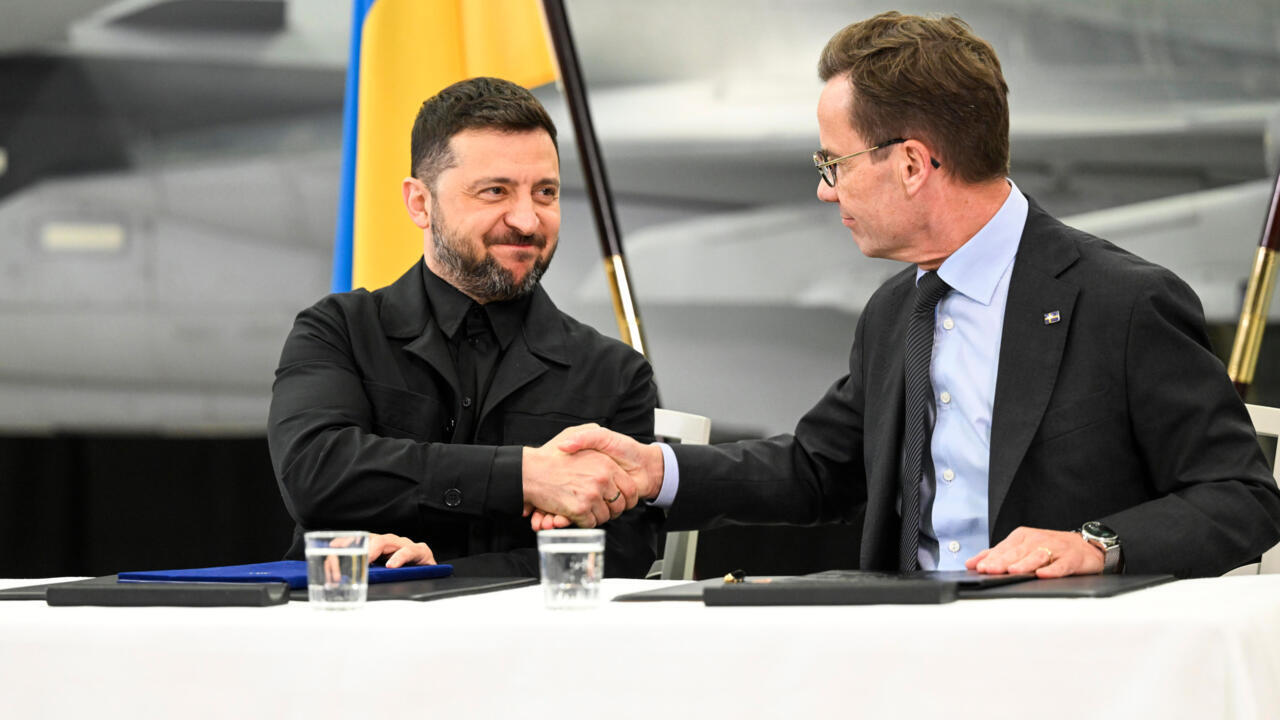
Sweden's Prime Minister Ulf Kristersson, right and Ukrainian President Volodymyr Zelenskyy hold a joint press conference following their meeting and visit to Saab, in Linköping, Sweden, October 22, 2025. © Fredrik Sandberg, AP
New NATO member Sweden is boosting support to Ukraine, with a letter of intent signed this week on the sale of up to 150 Gripen fighter jets. Shortly after joining NATO in March 2024 and bringing an end to two centuries of military non-alignment, Sweden approved a €989 million military support package that included Archer self-propelled artillery systems and long-range drones.
Its latest contribution to the war effort is Glimt, an innovative project launched by the Swedish Defence Research Agency (FOI) earlier this year. Glimt is an open platform that relies on the theory of “crowd forecasting”: a method of making predictions based on surveying a large and diverse group of people and taking an average. "Glimt" is a Swedish word for "a glimpse" or "a sudden insight". The theory posits that the average of all collected predictions produces correct results with “uncanny accuracy”, according to the Glimt website. Such “collective intelligence” is used today for everything from election results to extreme weather events, Glimt said.
Between 2011 and 2015, the United States’ ACE (Aggregative Contingent Estimation) program of the Intelligence Advanced Research Projects Activity gathered 10,000 forecasters. Over the course of its existence, ACE collected millions of forecasts on geopolitical events.
“We used this method and research, and we suggested to the Ukrainians that it could improve their understanding of the world and its evolution,” said Ivar Ekman, an analyst for the Swedish Defence Research Agency and programme director for Glimt.
"If you have a large group of people, you can achieve great accuracy in assessing future events. Research has shown that professional analysts don’t necessarily have a better capacity in this domain than other people," Ekman said.
Group forecasting allows for a broad collection of information while avoiding the cognitive bias that often characterises intelligence services. Each forecaster collects and analyses the available information differently to reach the most probable scenario and can add a short comment to explain their reasoning. The platform also encourages discussion between members so they can compare arguments and alter their positions.
Available in Swedish, French and English, the platform currently has 20,000 registered users; each question attracts an average of 500 forecasters. Their predictions are later sent to statistical algorithms that cross-reference data, particularly the relevance of the answers they provided. The most reliable users will have a stronger influence on the results; this reinforces the reliability of collective intelligence.
Will Zelensky meet Putin in 2025?
Glimt focuses on questions regarding the future of the war in Ukraine because they were all posed by the Ukrainian intelligence services: Will Zelensky and Putin meet in 2025? “There is a 10 percent chance,” forecasters responded. Will Tomahawk missiles be sent to Ukraine before February 1, 2026? “There is a 25 percent probability,” said Glimt.
Other questions involve the economic consequences of the war, the possibility of full Russian control of the Donetsk region by next summer or the outcome of the 2026 legislative elections in Hungary, a country led by Russian President Vladimir Putin's closest ally within the European Union, Viktor Orban.
“The questions generally cover a period ranging from a few weeks to a year. This data is therefore designed to be useful in Ukraine’s day-to-day existence,” said Ekman. “Beyond that, we don't know how Ukrainians make their decisions. It’s obviously a sensitive issue regarding the work of their government."
Glimt reflects a renewed enthusiasm for predictive tools since Russia’s full-scale invasion of Ukraine, with wargaming on the rise – among military officers and civilians alike.
“By providing information on global trends, Glimt helps Ukraine adapt and reinforce its defence strategy, increasing its chances of success against Russian aggression,” Sweden's Defence Minister Pal Jonson said as the project was launched.
Glimt doesn’t claim to be a crystal ball; it’s simply one tool among many for forecasting Ukraine’s future. The nation continues to face uncertainty amid the war and the numerous reversals of US President Donald Trump.
The US president has recently hardened his tone toward Putin, announcing new sanctions this week on Russia’s two largest oil companies. But there is little hope for a quick end to the war.
“Not before 2026,” said 91 percent of Glimt’s forecasters.
This article has been translated from the original in French.
New NATO member Sweden is boosting support to Ukraine, with a letter of intent signed this week on the sale of up to 150 Gripen fighter jets. Shortly after joining NATO in March 2024 and bringing an end to two centuries of military non-alignment, Sweden approved a €989 million military support package that included Archer self-propelled artillery systems and long-range drones.
Its latest contribution to the war effort is Glimt, an innovative project launched by the Swedish Defence Research Agency (FOI) earlier this year. Glimt is an open platform that relies on the theory of “crowd forecasting”: a method of making predictions based on surveying a large and diverse group of people and taking an average. "Glimt" is a Swedish word for "a glimpse" or "a sudden insight". The theory posits that the average of all collected predictions produces correct results with “uncanny accuracy”, according to the Glimt website. Such “collective intelligence” is used today for everything from election results to extreme weather events, Glimt said.
Between 2011 and 2015, the United States’ ACE (Aggregative Contingent Estimation) program of the Intelligence Advanced Research Projects Activity gathered 10,000 forecasters. Over the course of its existence, ACE collected millions of forecasts on geopolitical events.
“We used this method and research, and we suggested to the Ukrainians that it could improve their understanding of the world and its evolution,” said Ivar Ekman, an analyst for the Swedish Defence Research Agency and programme director for Glimt.
"If you have a large group of people, you can achieve great accuracy in assessing future events. Research has shown that professional analysts don’t necessarily have a better capacity in this domain than other people," Ekman said.
Group forecasting allows for a broad collection of information while avoiding the cognitive bias that often characterises intelligence services. Each forecaster collects and analyses the available information differently to reach the most probable scenario and can add a short comment to explain their reasoning. The platform also encourages discussion between members so they can compare arguments and alter their positions.
Available in Swedish, French and English, the platform currently has 20,000 registered users; each question attracts an average of 500 forecasters. Their predictions are later sent to statistical algorithms that cross-reference data, particularly the relevance of the answers they provided. The most reliable users will have a stronger influence on the results; this reinforces the reliability of collective intelligence.
Will Zelensky meet Putin in 2025?
Glimt focuses on questions regarding the future of the war in Ukraine because they were all posed by the Ukrainian intelligence services: Will Zelensky and Putin meet in 2025? “There is a 10 percent chance,” forecasters responded. Will Tomahawk missiles be sent to Ukraine before February 1, 2026? “There is a 25 percent probability,” said Glimt.
Other questions involve the economic consequences of the war, the possibility of full Russian control of the Donetsk region by next summer or the outcome of the 2026 legislative elections in Hungary, a country led by Russian President Vladimir Putin's closest ally within the European Union, Viktor Orban.
“The questions generally cover a period ranging from a few weeks to a year. This data is therefore designed to be useful in Ukraine’s day-to-day existence,” said Ekman. “Beyond that, we don't know how Ukrainians make their decisions. It’s obviously a sensitive issue regarding the work of their government."
Glimt reflects a renewed enthusiasm for predictive tools since Russia’s full-scale invasion of Ukraine, with wargaming on the rise – among military officers and civilians alike.
“By providing information on global trends, Glimt helps Ukraine adapt and reinforce its defence strategy, increasing its chances of success against Russian aggression,” Sweden's Defence Minister Pal Jonson said as the project was launched.
Glimt doesn’t claim to be a crystal ball; it’s simply one tool among many for forecasting Ukraine’s future. The nation continues to face uncertainty amid the war and the numerous reversals of US President Donald Trump.
The US president has recently hardened his tone toward Putin, announcing new sanctions this week on Russia’s two largest oil companies. But there is little hope for a quick end to the war.
“Not before 2026,” said 91 percent of Glimt’s forecasters.
This article has been translated from the original in French.
By AFP
October 25, 2025

French charity association Kernic Solidarites members Christian Abaziou (R) and Gerard Le Duff (L) sorted fishnets collected by the association to be sent to Ukraine for use against drone attacks - Copyright AFP Peter PARKS
Antoine Agasse
Once used to scoop fish from the sea off the coast of France, recycled fishing nets are finding new life in Ukraine to protect the country’s roads and military infrastructure from Russian drone attacks.
“It smells like rotten fish,” joked Christian Abaziou, 70, as he picked up a piece of used netting at Roscoff port in western Brittany’s Finistere department.
He and his fellow volunteer Gerard Le Duff, 63, members of the Kernic Solidarites association, were awaiting a delivery of used nets.
Stuffed into giant white bags to be recycled, they loaded the packed piles of thin green netting into a truck to be sent on its way to Ukraine, where they are used to entangle Russian drones.
In early October, the two men had already transported 120 kilometres (75 miles) of nets to Ukraine. And a second truck carrying 160 km of nets left Friday from nearby Treflez.
“When we started humanitarian convoys three years ago, drones weren’t part of the picture at all,” said Gerard, the association’s president.
But the war has evolved, “and now it’s a drone war”.
– ‘Proud’ to help –
Russia’s drone arsenal used against Ukraine includes small flying devices identical to those sold commercially, but equipped with explosives and capable of striking more than 25 km from the front line.
To defend against them, Ukrainians have been covering roads with nets mounted on poles, stretching for hundreds of kilometres.
As drones approach, they get trapped—like insects in a spider’s web.
When Abaziou learned of this new tactic, he quickly got in touch with a retired fisherman.
“Within 48 hours, I had all the fishing nets I needed,” he said.
“It’s from the heart,” said Jean-Jacques Tanguy, 75, former president of the Finistere fisheries committee.
According to him, fishermen “are proud to know that their used equipment… is going to help save lives”.
Fishing nets, replaced annually, pile up along the docks of Breton ports.
“The ones we collect are destined for recycling. They might as well serve a good cause,” said Marc-Olivier Lerrol, deputy director of Roscoff port, which gathers around 20 to 25 tonnes of nets per year.
“You’re always welcome — come back anytime!” he called out to Gerard and Christian in farewell.
– ‘Moved to tears’ –
Stored alongside several tonnes of soup, infant formula and medical supplies, the nets are transferred to a Ukrainian truck at the Polish border, more than 2,000 km from Brittany.
The first convoy headed to Zaporizhzhia in the south, where the nets are meant to protect certain neighbourhoods of the city.
The second is expected to go a bit farther south, toward Kherson, a city also facing the daily threat of drones.
A Frenchman living in Ukraine, who wished to remain anonymous, facilitated the exchanges between Kyiv and the volunteers in Brittany.
“There’s a huge need for nets here,” he told AFP.
“The idea that Breton volunteers would think to send kilometres of fishing nets to save lives in Ukraine… When you tell that to any Ukrainian, they’re moved to tears.”
Looking ahead, Abaziou hopes Ukrainians will send transporters to collect the nets in Brittany.
“We’ll help gather and load them, but we don’t have the budget to continue (the convoys) ourselves.”
Kernic Solidarites isn’t the only group sending nets to the Ukrainian front.
Stephane Pochic, owner of a fleet of trawlers in Finistere’s Loctudy, sent some in August via a Hautes-Alpes-based association, Arasfec Paca.
“It’s a symbolic gesture to show our support,” Pochic told AFP.
And the fishermen’s solidarity movement isn’t limited to France.
Ukrainian positions are also being protected by nets from Northern Europe, notably Sweden and Denmark.
No comments:
Post a Comment