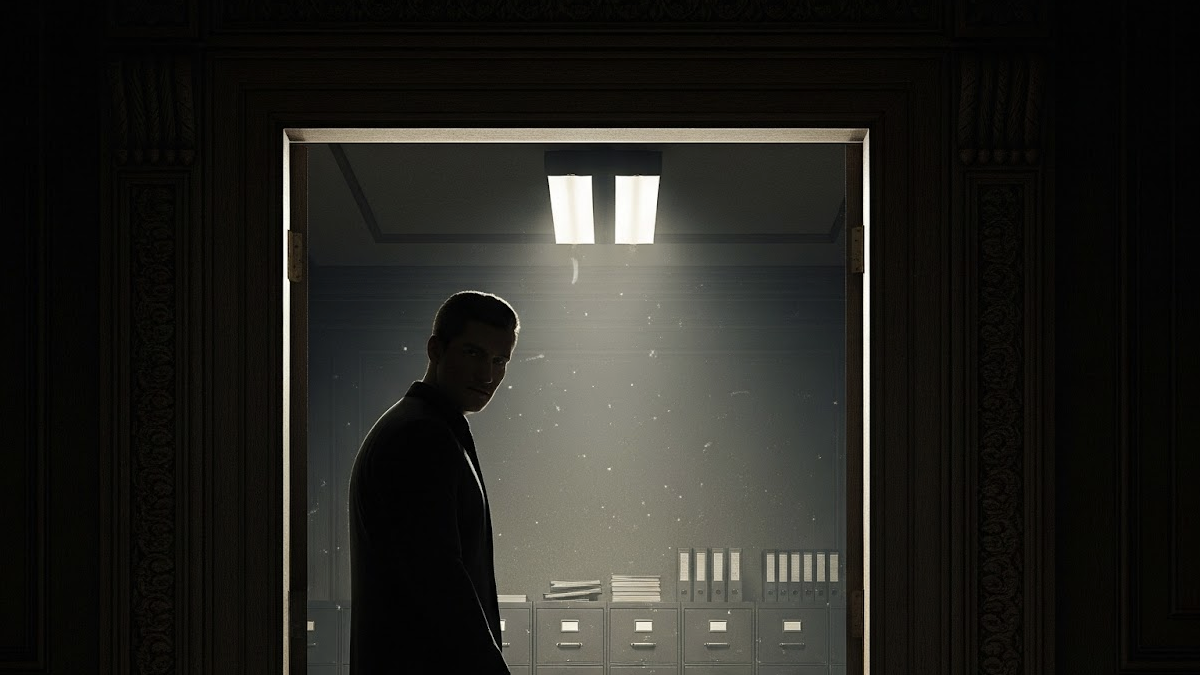
The 1974 film The Parallax View concludes with a silhouette of a man with a gun in front of a doorway revealing white light. For the length of this film, the character of journalist Joseph Frady has been undercover investigating the Parallax Corporation, responsible for a series of assassinations, only to discover they have been one step ahead of him the whole time. Philosopher Mark Fisher writes,
This anonymous figure with a rifle in a doorway is the closest we get to seeing the conspiracy (as) itself. The conspiracy in The Parallax View never gives any account of itself…Although presumably corporate, the interests and motives of the conspiracy in The Parallax View are never articulated (perhaps not even to or by those actually involved in it.) Who knows what the Parallax Corporation really wants? Is it a commercial front for political interests, or is the whole machinery of government a front for it?
The film was released at a time when high-profile assassinations were taking place, some of which the federal government played a conspiratorial role in, as with Malcom X and Fred Hampton. However, the government is only marginally referenced in The Parallax View. Quoting Frederic Jameson, Fisher notes The Parallax Corporation is motivated not with concern for the “personal” but “for the vitality of the network or the institution, a disembodied distraction or inattentiveness.”
The film was released at the cusp of the neoliberal order. Three years prior, the “Nixon Shock” had been imposed, as Nixon effectively dismantled the Bretton Woods exchange-rate system. Five years later came the “Volcker Shock,” when after declaring “the standard of living of the average American has to decline,” chairman of the Federal Reserve Paul Volcker drastically raised interest rates, which ballooned to nearly 20%. Neoliberalism would be organized as a collection of conspiracies. In 1975, writing for the Trilateral Commission in response to what he called the “democratic distemper” of the 1960s, Samuel P. Huntington proposed “moderation in democracy,” recalling fondly when “Truman had been able to govern the country with the cooperation of a relatively small number of Wall Street lawyers and bankers.” That year, in New York City, after years of the City accruing billions in debt to the banks, the banks refused to continue accepting City bonds. Instead, they demanded the establishment of a Financial Control Board consisting of nine people, eight of them bankers. A year later, massive austere structural changes were imposed, with slashes to social spending and citywide layoffs to make way for subsidies and tax cuts for big business. Between 1973 and 2015, inequality in New York rose faster than in any other state with the income share of the top 1% tripling in that time, rising 20.5 percentage points.
In 1982, Ronald Reagan praised New York’s neoliberal turn with, “We’re not going back to the glory days of big government.” Reagan and his neoliberal successors like George H.W. Bush, Bill Clinton, and George W. Bush, would cut Welfare, slash taxes for the rich, bail out banks that failed as a result of deregulation, and sign free-trade agreements that gutted US manufacturing, while drastically escalating state repression, developing and expanding new institutions to police immigration, executing a war on drugs, and ramping up surveillance as part of the War on Terror. The result was deindustrialization, stagnating wages, a drastic increase in the unhoused and prison populations, increased state violence, a crumbling infrastructure, job precarity, and widening inequality.
Huntington was not some marginal figure as part of an obscure think tank. Under Jimmy Carter’s administration, Huntington would be appointed White House coordinator of security planning for the National Security Council. Jimmy Carter was himself a member of the Trilateral Commission along with his vice-president, secretary of state, secretary of defense, and secretary of the treasury. Further, Huntington’s ideas were not radical in powerful circles. As modern capitalism developed and inequality widened, intellectuals increasingly had to contend with the opposing interests of different classes. In his 1928 book Propaganda, Edward Bernays, the “father of public relations,” advocated for the US to be a “leadership democracy administered by the intelligent minority who know how to regiment and guide the masses.” He endorsed the concept of advertisers and propagandists as making up an “invisible government” to “manipulate” the “unseen mechanism of society.”
One of Bernays’ mentors was Walter Lippman, who coined the term “the manufacture of consent,” and noted, if the way public opinion arises is understood, there are “opportunities for manipulation open to anyone.” Famously, Noam Chomsky and Edward Herman titled their book Manufacturing Consent: The Political Economy of the Mass Media, dealing with the way mass media skews reality in favor of corporate-sponsored state narratives. They noted that when Ben Bagdikian wrote Media Monopoly in 1983, fifty firms dominated the greater part of every mass medium and only seven years later, that number had dropped to twenty-three. With the deregulation of the Federal Communications Commission in the 1990s and early 2000s, by 2012, just six corporations controlled 90% of US media.
Under neoliberalism, the persuasive role of capital has been obscured. Recently, it was revealed that the nonprofit Chorus had initiated a Chorus Creator Incubator Program, secretly providing influencers, many of whom market themselves as independent, with monthly payments as high as $8,000. Influencers signed contracts that prevented them from disclosing the agreement with Chorus, which is funded by The Sixteen Thirty Fund, a dark-money organization that has anonymously received donations as high as $50.5 million. Journalist Taylor Lorenz reported that according to contracts she reviewed, “creators in the program must funnel all bookings with lawmakers and political leaders through Chorus.”
YouTuber David Pakman, a participant in the program, defended himself and Chorus saying, “for years I’ve been saying the Left needs to organize independent media in the way that the Right has been doing.” But the Right has not been organizing “independent” media. They’ve been flooding the coffers of right-wing influencers and propagandists to mainstream and popularize reactionary politics with millions of dollars. In fact, The Sixteen Thirty Fund was created to function as the inverse image of Koch Brother money, the Koch Brothers having drawn on the pockets of industry and billionaires like themselves to fundamentally revamp the Republican Party. For decades, they funneled dark money through super PACs to bankroll GOP candidates and provide the astroturf for the Tea Party Movement. Koch-funded think tanks like the Heritage Foundation, the George C. Marshall Institute, and the American Enterprise Institute, among more than thirty others, propagated free-market ideology and pressured politicians into conforming to Tea Party demands.
One group to have received Koch money with that of a plethora of billionaires and their foundations, was Turning Point USA (TPUSA), a non-profit that would garner a mass following on YouTube and social media, hold propaganda events at schools, and establish student chapters that support far-right causes on college campuses. It was cofounded in 2012 by Charlie Kirk and businessman Bill Montgomery and was funded early on by billionaire Republican megadonor Foster Friess. Kirk’s life was mired in corporate conspiracy, dark money, and backdoor dealings. Up until his recent assassination, he was forced to contend with Bernays’ “invisible government.” In August, he met with billionaire TPUSA backer Bill Ackman, who reportedly pressured him on the topic of Israel and Gaza in what was described as an “intervention” over an infinitesimally slight shift in Kirk’s coverage of the issue.
As Donald Trump laid the groundwork for pairing neoliberal economics with reactionary social conservatism, Charlie Kirk followed suit, playing a large role in exciting a reactionary base. Initially Kirk focused on extolling the value of markets and limited government, TPUSA’s “Socialism Sucks” stickers evoked Reagan-era conservatism. As Kirk came into prominence, he broadened his horizons to social issues, speaking at the 2020 Republican National Convention railing against Covid precautions and founding TPUSA Faith in 2021 with the explicit mission to “eliminate wokeism from the American pulpit.” Kirk argued that abortion is worse than the Holocaust, that George Floyd died of an overdose and not from Derek Chauvin’s knee, and that if he saw a Black pilot flying the plane he was on, he would “be like, boy, I hope he’s qualified.”
The “limited government” policies that Kirk advocated in his live-streamed events and on his YouTube show had long produced material conditions conducive to despair and anguish. As Chris Hedges writes, “The reconfiguring of American society into an oligarchy and the collapse of our democratic institutions have left most of the population disempowered.” Upward mobility and home ownership has declined while household debt and student loans have increased. As a result, Hedges continues, society is afflicted by a series of “self-destructive pathologies,” among them, “opioid addiction…suicide…hate groups and mass shootings.”
The exact circumstances surrounding Kirk’s assassination remain unclear. Much of the narrative surrounding the events leading up to his death were recently problematized in a post on X by FBI director Kash Patel, who listed a host of oddities with the FBI’s own narrative, noting the FBI is “meticulously investigating” a series of theories and questions that have been brought up online. What we do know is the alleged shooter has been described as chronically online. Similarly, friends of the recent shooter at the ICE facility in Dallas also described him as chronically online, endlessly ironic, and a frequenter of the far-right forum 4Chan. These two shooters, along with school shooters and mass shooters, are the product of neoliberal technological society in decline. Journalist Will Sommer wrote in his book about QAnon: “It’s a symptom of the world we live in, a product of unchecked social media platforms, a crumbling education system, rampant political polarization and the crumbling of offline communities.” Nihilistic violence is a byproduct of this world that Kirk helped create.
In The Parallax View, as Joseph Frady is undercover, attempting to be recruited by the Parallax Corporation, he is tested to see if he has the violent nature necessary for assassination. But in our later stage of capitalism, capital has removed itself further from the conspiracy than the one meticulously cultivated by the Parallax Corporation. Assassins are produced in a world of economic anxiety, stoked by algorithms promoting increasingly radical political content online to enhance engagement. They arm themselves in a country with flimsy gun laws, the product of big money in politics. Chaotic violence can then be capitalized upon by whichever political agenda. In Trump’s case it is to demonize the Left and trans people. In the case of Candace Owens, to further her content in social media algorithms that promote provocative material (she has hinted at an Israel connection to Kirk’s assassination). The chaos of neoliberalism is endlessly self-producing, its corporate conspiracies vast and deliberately concealed. Meanwhile, we are left in the position of Frady at the end of The Parallax View, able to grasp that there is much we don’t know but not much more after that.
No comments:
Post a Comment