The United States Prepares for War on Venezuela
Monday 27 October 2025, by Dan La Botz
The United States is preparing for war against Venezuela. While President Donald Trump has asserted that the country’s goal is to stop shipments of Venezuelan drugs to the United States, in private conversations U.S. officials have made it clear that Secretary of State Marco Rubio plans to remove Venezuelan President Nicolás Maduro. This forms part of Trump’s goal of reasserting U.S. domination in Latin America such as it exercised in the nineteenth century by gunboats and in the twentieth century by installing friendly governments.
The preparations for the war have involved attacks on small boats that began in early September. Trump claims the boats were carrying drugs, though no proof has been provided. Altogether as of this time (Oct. 26), the United States forces have destroyed ten boats and killed 43 people in international waters in the Caribbean and the Pacific Ocean. The Trump administration claims that the United States is engaged in national self-defense because drugs like fentanyl kill tens of thousands of Americans, though Venezuela is not a significant producer or trafficker of fentanyl nor is it a major source of cocaine. Many legal experts have stated that these extra-judicial killings are simply murder on the high seas,
On October 2, 2025, the Trump administration designated several Latin American cartels as “foreign terrorist organizations” and “unlawful combatants,” and said that the cartel actions constitute an "armed attack against the United States.” The U.S. government claims that Maduro controls el Cartel de los Soles, the criminal organization responsible for drug trafficking. “Just as al-Qaida waged war on our homeland, these cartels are waging war on our border and our people,” said Secretary of Defense Pete Hegseth. Democrats and some Republicans have criticized the operation. Senator Jack Reed of Rhode Island has argued that the military is not “empowered to hunt down suspected criminals and kill them without trial.” Others have suggested that if he is serious, Trump should ask for a declaration of war, but he says he will not do so.
The Real Goal: A Coup against Maduro
The real goal of the United States is the removal of Maduro. The drive to eliminate the Maduro government comes from Marco Rubio, a Cuban-American Miami and former Florida Senator. On August 7, the U.S. offered a bounty of $50 million for information leading to the arrest and/or conviction of Venezuelan President Nicolás Maduro, a measure clearly intended to foment a coup. In mid-October Trump authorized the CIA to conduct covert actions in Venezuela while about the same time, turning up the pressure, B-52 bombers began to fly along the Venezuelan coast.
The United States has about 10,000 troops and many military aircraft in the Caribbean. And for years it has also had several warships in the region, including destroyers with guided middles. Now Trump is sending the Gerald Ford aircraft carrier, the world’s largest warship, to Venezuela, accompanied by five destroyers, a cruiser, and a submarine. The Ford carries about 75 fighter jets and a crew of 4,500. Clearly such enormous military power is not about drug interdiction but is rather preparation for an attack on Venezuela.
It is unlikely that U.S. troops will fight on the ground; rather Trump will take a page from Russian dictator Vladimir Putin’s playbook and use artillery and bombs to destroy military bases and to terrorize and demoralize the population. All of this to bring about a coup.
Trump ran for president as an opponent of foreign wars and regime change, but now the “peace president,” as he calls himself, will wage war. It looks like American imperialism in Latin America is back-with a vengeance.
26 October 2025
Attached documentsthe-united-states-prepares-for-war-on-venezuela_a9236.pdf (PDF - 905.1 KiB)
Extraction PDF [->article9236]
Dan La Botz was a founding member of Teamsters for a Democratic Union (TDU). He is the author of Rank-and-File Rebellion: Teamsters for a Democratic Union (1991). He is also a co-editor of New Politics and editor of Mexican Labor News and Analysis.
International Viewpoint is published under the responsibility of the Bureau of the Fourth International. Signed articles do not necessarily reflect editorial policy. Articles can be reprinted with acknowledgement, and a live link if possible.
No to a US war on Venezuela!
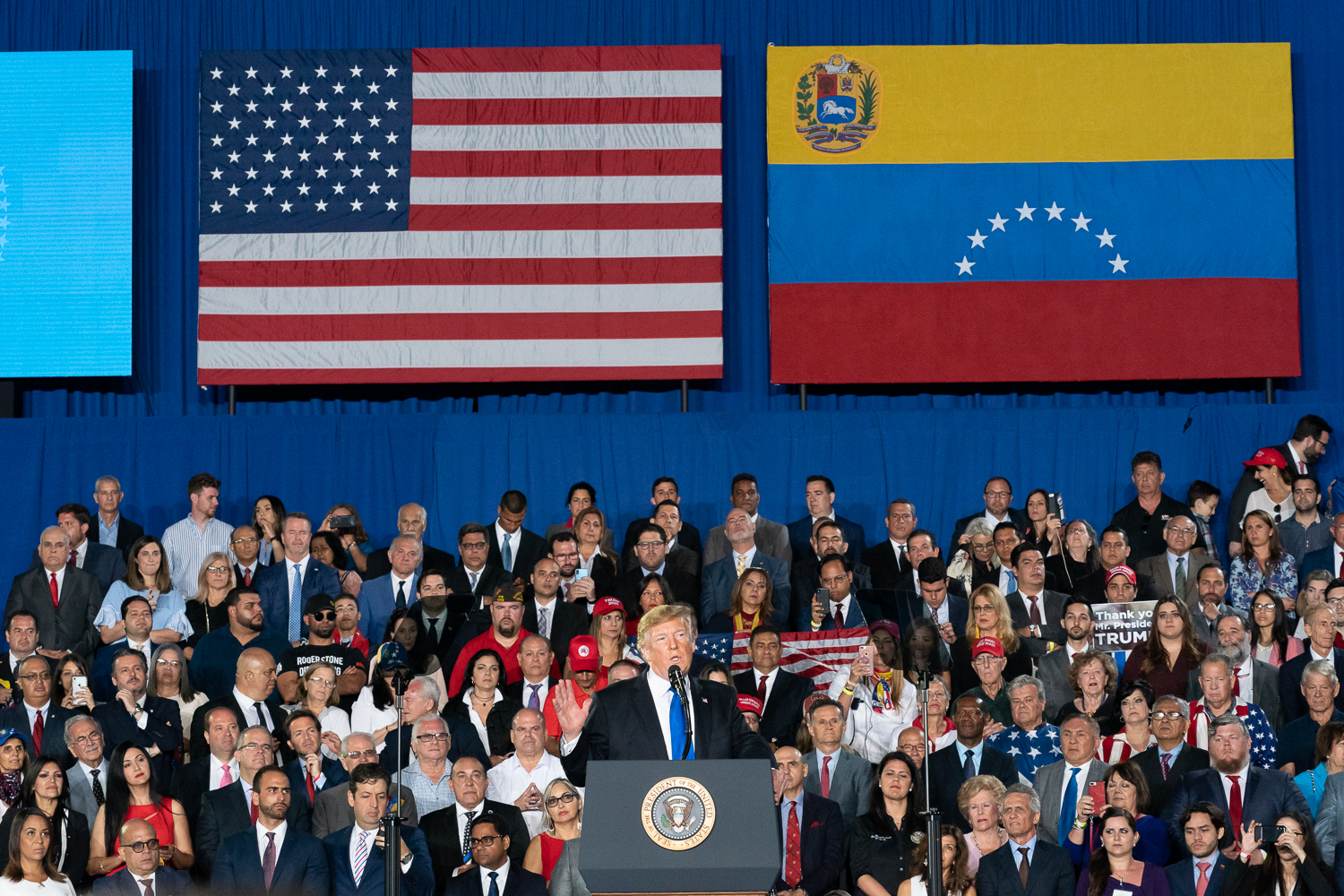
For the past few weeks the Trump administration has intensified its long-standing aggression against Venezuela by deploying warships (including a nuclear submarine) in the Caribbean Sea in a purported anti-narcotics operation. US forces have carried out at least five incidents of strikes on boats in Venezuelan waters to date, killing 37 people. Trump’s latest move has been to authorise the CIA to conduct covert operations inside Venezuela.
President Nicolas Maduro, as Venezuela’s current leader, has been a focus of this ‘war on drugs’ narrative, justifying the US’s illegal actions by demonising him as a ‘narco-terrorist’ engaged in drug trafficking, despite UN evidence to the contrary. The US also portrays him as being an illegitimate leader, offering a bounty of $50 million for his capture.
But overthrowing the Bolivarian Revolution has been a project of US imperialism ever since Huge Chávez became President in 1999 and set about transforming the country through a series of far-reaching measures including healthcare, education, land redistribution and anti-poverty programmes.
Key to these revolutionary changes was, and still is, the massive wealth in oil reserves that Venezuela has – the largest in the world – and the revenues generated from them. Chávez’s massive programme of wealth redistribution redirected these oil revenues to collective social purposes rather than funding the opulent lifestyle of Venezuela’s elites.
Additionally, to help realise his vision that “another world is possible”, not just for Venezuela, Chávez also envisaged (and ultimately helped create) key regional organisations to unite Latin American voices and provide progressive economic alternatives to neo-liberalism.
Aghast at what this represented, both politically and economically, the US has ever since then, in concert with the extreme right-wing elites in Venezuela, sought to destabilise the country and effect ‘regime change’.
In 2002, a US-backed military coup temporarily ousted Chávez before a spontaneous popular uprising restored him to the presidency. Other US tactics to destabilise the country have included massive funding of opposition groups to try –unsuccessfully – to win elections, coupled with disinformation campaigns to isolate the country, campaigns of violence on the streets, further coup attempts and domestic sabotage.
But the most powerful US weapon against Venezuela has been an increasingly severe set of economic sanctions, illegal under international law, designed to destroy the economy and bring the country to its knees.
The US sanctions, first introduced by Obama in 2015 and ramped up by Trump in his first presidency into a crippling economic, trade and financial blockade, led to a 99% fall in oil revenues and well over a hundred thousand unnecessary deaths.
Complementing this, Trump has at various times threatened military action against Venezuela. He also backed minor politician Juan Guaidό’s attempt to bring about ‘regime change’ by declaring himself ’interim president’ in 2019. But despite lavish bankrolling of his activities, including insurrectionary adventures, with confiscated Venezuelan assets, this attempt at ‘regime change’ fizzled out when the right-wing Venezuelan opposition ditched Guaidó in December 2022.
Throughout and to this day, the British government has supported the US’s policy, even levying its own sanctions and withholding 31 tons of Venezuelan gold worth roughly $2 billion lodged in the Bank of England’s vaults.
Despite all this, the Venezuelan economy has survived – even growing by between 5 to 6% in 2024 – though at the cost of great hardship for millions of ordinary Venezuelans.
But the political and economic dynamics motivating this drive by US imperialism to secure ‘regime change’ have not lessened.
Politically, Venezuela’s commitment to Latin American independence and resistance to neo-liberalism are anathema to the US’s historic and continuing commitment to the Monroe Doctrine. Recent progressive left electoral successes in Mexico, Colombia, Honduras, Brazil and Uruguay, for example, are seen by the US government as a challenge to its dominance.
Economically, Venezuela is a rich country with vast mineral reserves, but the prize is its oil. In 2023 Trump himself publicly admitted that he wanted to overthrow Maduro to secure control over Venezuela’s oil, mirroring the way he boasted in 2020 that he was militarily occupying Syria’s crude oil-rich regions in order to “take the oil”.
The overthrow of the Bolivarian Revolution would enable the US to control Venezuela’s oil and help sustain the US’s faltering economy, as well as shore up the rhetoric of Trump’s ‘America First’ agenda.
But Trump is being challenged domestically, in the media and Congress. Although Congressional Democrats have long supported sanctions against Venezuela, their Senate resolution requiring Trump to seek Congressional authorisation before any further military strikes purportedly aimed at drug cartels was defeated 48-51 (with two Republicans in favour and one Democrat against).
Opposition in Latin America and the Caribbean is much more forthright. The region is clear about the enormous implications if the US were to be successful in securing ‘regime change’, especially for the future of blockaded Cuba, which has been in US Secretary of State Marco Rubio’s sights for longer than Venezuela, and for heavily-sanctioned Nicaragua. Trump has also been making very similar threats against President Petro’s government in Colombia, calling openly for ‘regime change’.
Encapsulating these concerns, the ALBA bloc of countries issued a statement strongly condemning the US’s actions: “These manoeuvres not only constitute a direct attack on the independence of Venezuela, but also a threat to the stability and self-determination of all the peoples of Latin America and the Caribbean (…) We categorically reject the orders from the United States government to deploy military forces under false pretexts, with the clear intention of imposing illegal, interventionist policies that are contrary to the constitutional order of the States of Latin America and the Caribbean.”
The Venezuela Solidarity Campaign (VSC) has launched a petition urging governments and political actors internationally to join in opposing military intervention and all threats to peace in the region.
The British government has disgracefully failed to join the criticism being voiced in Latin America and the US of Trump’s illegal actions, committing only to “fighting the scourge of drugs…accordance with the fundamental principles of the UN Charter”.
A linked letter to Keir Starmer and Yvette Cooper is therefore urging them to join the international effort against military intervention and in support of peace.
VSC will be joining with forces across the British labour, peace and solidarity movements to express maximum opposition to US military aggression in the weeks and months ahead.
No comments:
Post a Comment