Trump’s new Israel-Palestine peace plan: The ‘Deal of the Millennium’ after the ‘Deal of the Century’
First published in Arabic at Al-Quds al-Arabi. Translation from Gilbert Achcar's blog.
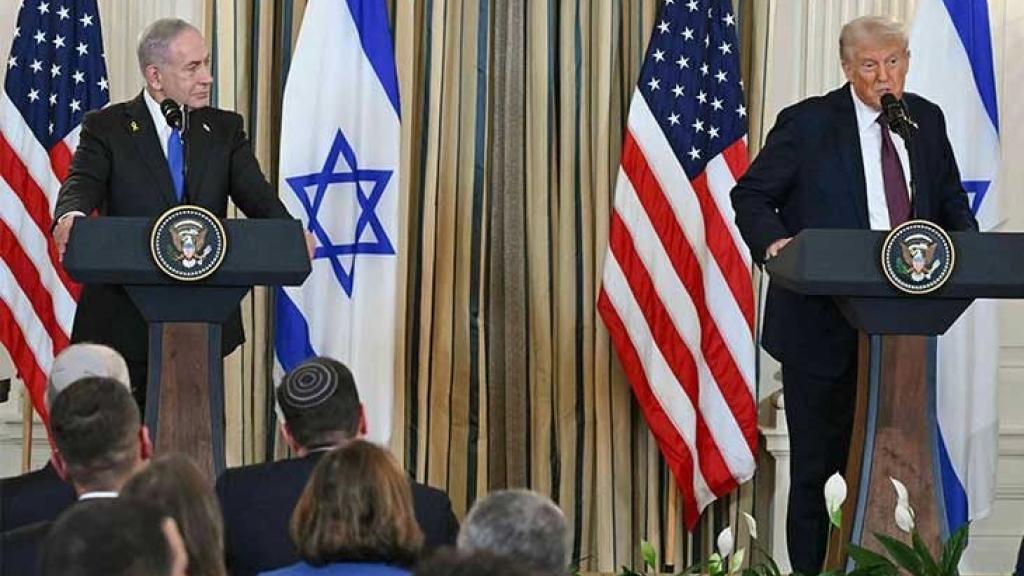
More than five years ago, on January 28, 2020, then-U.S. President Donald Trump unveiled his peace plan for Palestine at a White House ceremony attended by Israeli Prime Minister Benjamin Netanyahu. The plan was drafted by Trump’s son-in-law, Jared Kushner. During his election campaign, Trump had pledged to broker what he called the “Deal of the Century” between the Arabs and the State of Israel—a phrase Netanyahu echoed in his effusive praise of the U.S. president during the event.
Last Monday, Trump’s characteristic self-promotion and growing narcissism resurfaced as he described the announcement of the plan — co-authored by Kushner and former British Prime Minister Tony Blair — as “potentially one of the great days ever in civilization,” claiming it could resolve “things that have been going on for hundreds of years and thousands of years.”
The truth is that the latest “Millennium Deal,” like its predecessor, the “Deal of the Century,” will ultimately resolve nothing (see “Recognizing a Palestinian State Doesn’t Mean a Free Palestine,” Jacobin, September 25, 2025). In stating, “While Gaza redevelopment advances and when the PA reform program is faithfully carried out, the conditions may finally be in place for a credible pathway to Palestinian self-determination and statehood” (Point 19), the plan implicitly acknowledges that, in its current form, it is not grounded in the Palestinian people’s right to self-determination. Instead, it treats this right as a mere possibility (“may”). Indeed, Netanyahu wasted no time confirming in a post-announcement interview that he does not recognize this right, and that Israel “will forcibly resist it.”
This flawed foundation renders Trump’s new plan even less realistic than the one he unveiled five years ago. While the original “Deal of the Century” proposed the establishment of a State of Palestine comprising parts of the West Bank and the entire Gaza Strip, the new plan calls for the imposition of an international mandate over Gaza. This proposal echoes the colonial mandates established after World War I and is inspired by the international administration installed in Kosovo in 1999. It is precisely this precedent that explains former British Prime Minister Tony Blair’s involvement in the project to administer Gaza under Trump’s leadership. Blair played a central role in the Kosovo War and the subsequent decisions surrounding its governance.
While the plan calls for a gradual withdrawal of the Israeli army from Gaza, to be replaced by an “international stabilization force” (a name borrowed from the mission in Bosnia and Herzegovina), it specifies that the Israeli military will “progressively hand over the Gaza territory it occupies to the ISF according to an agreement they will make with the transitional authority, until they are withdrawn completely from Gaza, save for a security perimeter presence that will remain until Gaza is properly secure from any resurgent terror threat” (Point 16).
In other words, even if the plan is implemented exactly as intended, the Israeli military will retain control over a “security perimeter” carved approximately one kilometer deep into Gaza along the entire border with the Zionist state — an area stretching roughly 60 kilometers. Construction of this perimeter began at the outset of the Israeli invasion, clearly in anticipation of maintaining control over it following any broader withdrawal from the rest of the Strip.
Ultimately, even if Hamas accepts the Trump plan under pressure from Arab and Muslim governments that have endorsed it (the movement had not yet announced its position at the time of writing), and the “Deal of the Millenium” begins to be implemented, the path forward remains steep and perilous — and is likely to end in a complete deadlock. The plan would result in a permanent fait accompli, during which Israeli control over large parts of the Gaza Strip would be solidified. Israel would likely invoke the renewed “terror threat” — including even the most basic forms of resistance, which are bound to persist — as a pretext to maintain its occupation of much of Gaza, mirroring its long-standing occupation of the West Bank. That occupation has officially been considered “temporary” under international law for 58 years.
Palestinian Subordination: Donald Trump’s Gaza Peace Plan

He had moments of discomfort and embarrassment – pressed into calling the Qatari Prime Minister by his host to apologise for striking Doha and made to pay lip service to the prospect of a Palestinian state – but Israel’s Benjamin Netanyahu had many reasons to be pleased. On September 29, President Donald Trump advanced a peace proposal that essentially preserves Israeli pre-eminence regarding the fate of Palestinians, though it entails a cessation of hostilities, an affirmation that Gazans would not be expelled (those leaving would have the right to return), and an injunction against Israeli annexation of the Strip. But Hamas, militarily and politically, would have to surrender all claims, with the Palestinian Authority shepherded and supervised by foreign powers.
Trump’s peace proposal comprises twenty points. They include a “deradicalized terror-free zone”, Gaza’s redevelopment for the benefit of its people aided by “a panel of experts who have helped birth some of the thriving miracle cities in the Middle East”, and an immediate end to the war on its acceptance by the parties. Israel would withdraw to an agreed upon line in anticipation of a hostage release, during which all military operations would cease pending complete withdrawal. All hostages, dead and alive, would be returned within 72 hours, to be followed by the release of 250 Palestinian life sentence prisoners and Gazans detained since October 7, 2023.
Hamas and militant factions will forfeit any role in governing Gaza, with any offensive infrastructure and equipment destroyed, but any of its members wishing to commit to “peaceful co-existence” and decommissioning of weapons will be granted amnesty, with those wishing to leave given safe passage to receiving countries. Compliance by the militant group will be overseen by “regional partners”. Full aid would resume, with the UN and Red Crescent restored to their role as chief distributors.
On the issue of governance, a temporary technocratic “apolitical Palestinian committee” of qualified Palestinians and “international experts” would form a temporary transitional body, subject to a “Board of Peace” personally chaired by Trump. Most unfortunately, it is likely to include such figures as Sir Tony Blair, the Middle East’s typhoid Mary when it comes to peace. The transitional authority would hold the reins till reforms by the Palestinian Authority had been completed. With immediacy, however, the US would work with Arab and international partners to deploy an “International Stabilisation Force” to Gaza. The ISF will be responsible for training Palestinian police forces and provide support in terms of vetting recruits, with assistance from Jordan and Egypt.
The proposal clearly envisages a significant role for the ISF, though says about who will comprise it. Israel will not, under the plan, occupy or annex Gaza, surrendering what territory it has taken to the ISF. Even if Hamas were to delay or reject the proposal, the Israeli Defense Forces would still hand over occupied territory of “terror-free areas” to the stabilisation force but retain a security perimeter to stem “any resurgent terror threat.”
The plan also envisages the establishment of an interfaith dialogue to promote the values of peace between the parties, and a “credible pathway to Palestinian self-determination and statehood” if the programs for Gaza’s redevelopment and PA reform take place as planned. A vague US promise to “establish a dialogue” between Israel and the Palestinians regarding peaceful and prosperous co-existence rounds off the points.
There was palpable grumbling from the Israeli camp. Netanyahu undoubtedly harbours ambitions of finishing “the job”, and there is little to say the war will not resume once the Israeli hostages are returned. Having previously rejected any governing role of the Palestinian Authority in Gaza, he now reluctantly accepts the idea subject to a “radical and genuine overhaul” of the body.
Finance Minister Bezalel Smotrich, one of the right-wing heavies in the Israeli cabinet, is threatening to withdraw his Religious Zionist Party from the coalition. Agreeing with the plan had been “an act of wilful blindness that ignores every lesson of October 7.” It would only “end in tears.” Fellow zealot, National Security Minister Itamar Ben-Gvir, is also likely to be seething.
Opposition leader Yair Lapid is also suspicious of Netanyahu, who tends to say “yes” when visiting Washington, “standing in front of the cameras at the White house, feeling like a breakthrough statesman.” On returning to Israel, however, he always seemed to add a qualifying “but”, his political base always reminding him “who the boss is.”
In keeping with history, the Trump plan, even if it were to be implemented to the letter, enshrines the essential subordination of Palestinian goals to the dictates of other powers. Palestinian military presence is not only to be curtailed but essentially eliminated altogether. Hamas, never consulted regarding the peace terms, is to accept its own effacing. The PA is to accept its own subservience and infantilisation. The Gazans are also to accept an economic and development program dictated and directed from without. Statehood is to be kept in cold storage till appropriate, controlled conditions for its release are approved – and certainly not by the Palestinians themselves. They, it would seem, remain the considered errant children of international relations, mistrusted and requiring permanent, stern invigilation.
No comments:
Post a Comment