Pilot Project Achieves Better Than Projected 98% Reduction in Methane Slip
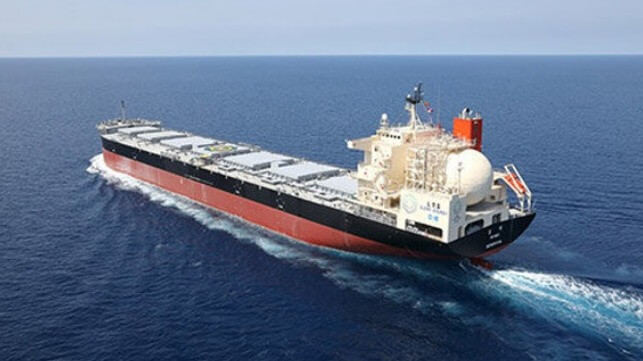
A multi-year Japanese project sponsored by the government is reporting that it has achieved much higher than anticipated reductions in unburnt methane emissions (methane slip) during demonstrations on an in-service bulker operated by Japan’s Mitsui O.S.K. Lines. They are testing methane oxidation catalysts, noting that it is a first for the technology, and confirms very promising results in tackling a key environmental concern.
The project began in 2021 as part of efforts sponsored by Japan’s New Energy and Industrial Technology Development Organization (NEDO) with the goal of reducing methane emissions by at least 70 percent. Unburnt methane scientists report has a higher greenhouse effect than CO2 and takes far longer to break down, making it is high priority in the efforts to reduce GHG emissions.
Hitachi Zosen and Yanmar Power Technology developed the methane oxidation catalyst system. It is placed on the exhaust pipe, similar to the application of emissions SOx scrubbers, and the methane is oxidized to reduce methane slip.
The companies undertook land-based tests in December 2023 and reported achieving a reduction rate of 93.8 percent at 100 percent load. The system combines with an exhaust gas recirculation technology that recirculates engine exhaust gases to reduce unburnt methane slip and NOx. The results were independently verified by ClassNK and reviewed with NEDO for continued support.
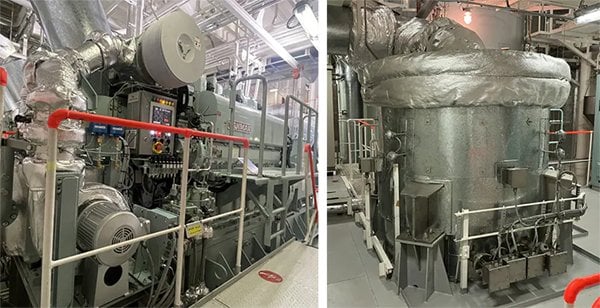
Methane slip reduction system on board (Left: EGR system, Right: Methane oxidation catalyst layer) (Yanmar)
Japan’s industrial and engineering corporation Kanadevia Corporation (formerly Hitachi Zosen) continues to lead the project. Working with Yanmar and MOL, the goal was to modify the land-based test equipment for onboard use on a large, LNG-fueled coal carrier.
MOL’s vessel Reimei was fitted for the tests, which began in May 2025. Delivered in November 2023 from Japan’s Namura Shipbuilding Co., the 95,792 dwt bulker is a Panamax coal carrier. It operates for Japan’s Kyushu Electric Power Co., transporting coal to Japan for thermal power plants.
Test results during the demonstration reported a 98 percent reduction in methane slip, far exceeding the 70 percent goal of the project and the earlier 93.8 percent reduction in the land-based trials. They highlight that the vessel was operating under normal conditions, including a fluctuation in load rate due to weather conditions, and was at a practical operating load (75 percent) while achieving the 98 percent reduction.
Onboard trials are continuing into FY 2026 to evaluate overall system performance and catalyst durability. The aim is to commercialize the system starting in FY 2027.
MOL is First Shipping Company to Join Australia’s Ammonia Bunkering Project
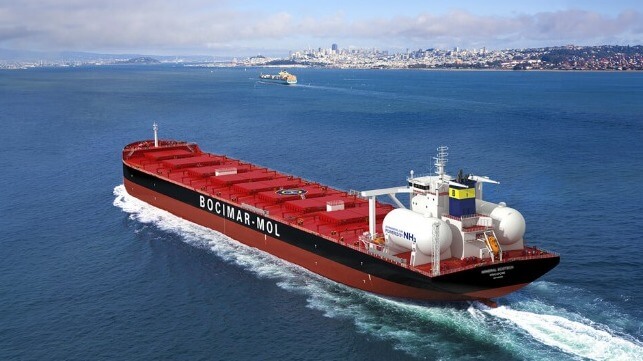
Japan’s Mitsui O.S.K. Lines is joining the effort to develop an ammonia bunkering operation in Australia’s Pilbara as part of the efforts to establish a green shipping corridor between the iron ore region and Asia. MOL becomes the first shipping company in the project, which was announced in June, that anticipates bunkering the Capesize bulkers that transport the ore and an ammonia export business.
MOL will be working with an Australian company, NH3 Clean Energy, which is responsible for the supply of blue ammonia, and Oceania Marine Energy, which will operate the bunkering business. Pilbara Ports Authority is participating in the project and is responsible for managing and operating the Port of Dampier, where they anticipate the operation will be based, and they will issue the bunkering licenses.
The goal is to commence the bunkering operations for Capesize bulkers at the ports of Dampier and Port Hedland by 2030. They highlighted that the Pilbara region of Western Australia is a natural for the program as the world’s largest iron ore export port.
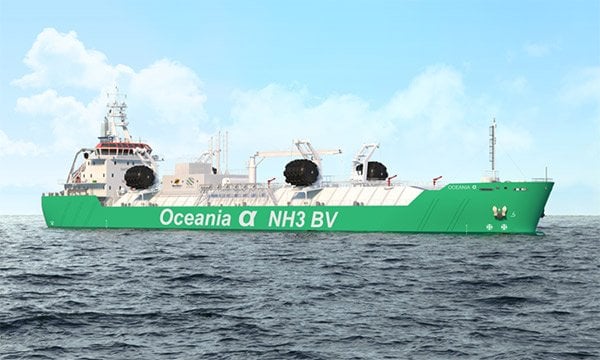
Concept of the ammonia bunkering vessel planned for the Pilbara operation (Oceania)
MOL has already committed to ammonia dual-fuel vessels in a partnership with CMB.TECH. It will charter and operate three Capeszie bulkers CMB.Tech is having built by China State Shipbuilding Corp.’s Qingdao Beihai Shipbuilding Company. CMB.Tech launched the project in 2023, working with WinGD to develop a 72-bore ammonia-fueled engine, and MOL has agreed to take the three vessels each on a 12-year charter. MOL reports it will bring the operator’s perspective to the project to develop ammonia bunkering.
When the bunkering project was announced, Pilbara Ports’ CEO, Sam McSkimming commented, “With approximately 4,000 vessel visits associated with bulk exports and more than 1,000 distinct bulk carriers visiting our ports annually, the Pilbara is a natural beachhead to kick-start the clean fuel transition. The green iron corridor between the Pilbara and East Asia has the scale, stable demand, port infrastructure, and risk management experience to support the significant investment that maritime decarbonization requires.”
NH3 is developing its WAH2 project planned for neighboring Maitland, which would use the existing gas and pipeline infrastructure, along with carbon capture in the production of clean ammonia. The company said that the anticipated initial bunkering demand of 300,000 TPA of clean ammonia would represent approximately half of the planned production capacity from Phase 1 on the WAH2 Project, with the remainder available for export as a fuel for heavy industry, including power generation. It is currently working on pre-FEED studies and says the new agreement with MOL will contribute to the final FID decision expected by the end of 2026.
No comments:
Post a Comment