Report: Japan and U.S. to Sign Memorandum on Shipbuilding Cooperation
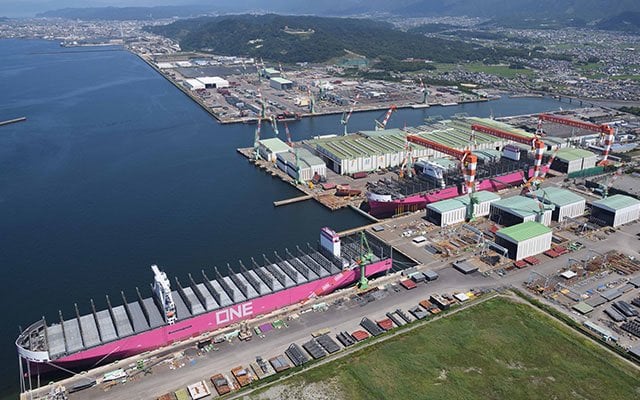
Japan is prepared to sign a memorandum with the United States providing additional details on the investment in shipbuilding that was continued in the countries trade talks. The Yomiuri Shimbun news outlet reports the signing is likely to happen on Monday, October 27, time to Donald Trump’s visit to Japan, which will also see the two countries’ leaders sign a memorandum for greater cooperation.
Japan committed to an investment of $550 billion in the United States during its prolonged trade talks with the Trump administration. Like South Korea, Japan dangled investment and cooperation with its shipbuilding industry as one of the elements to win a more favorable trade agreement. While Japanese shipbuilding has seen its market share slip dramatically in the past two decades, it still remains the world’s third-largest shipbuilder, and the government is providing financial support for projects developing new technologies for shipping.
The Yomiuri Shimbun reports the new agreement calls for the formation of a Japan-U.S. shipbuilding working group that will focus on investments that can be made to make the shipbuilders more efficient and competitive. They call for considering standardizing ship design and parts, and possibly having Japan design parts that could be produced in the United States. By standardizing designs, they propose that the countries could repair each other’s ships.
Another part of the cooperation focuses on new technologies. The report cites the use of AI to improve ship design and functionality.
The Japanese government has called for large investments into its shipbuilding industry. Last week, the country’s shipbuilders’ association, which represents 17 leading companies, said the companies were prepared to invest approximately $2.3 billion using their own financing. They are calling for the government to provide the remainder to reach the goal of a $6.5 billion investment in the industry by 2035.
The government views shipbuilding as a critical sector. It is anxious to combat China’s dominance of the sector, and working with the U.S. could help to increase market share. The U.S. Navy has occasionally used Japanese shipyards to make repairs on vessels. Japan’s Mitsubishi Heavy Industries highlighted in May 2025 that it was completing the first large-scale maintenance contract bid on and won for a U.S. Navy vessel. It was part of the Navy’s strategy to make more repairs locally for forward-deployed vessels.
Japan remains a builder mostly of containerships, dry bulk, and tankers, with it receiving approximately 8 percent of global shipbuilding orders in 2024.
Hyundai and HII Expand Relationship Targeting US Navy and Commercial Ships
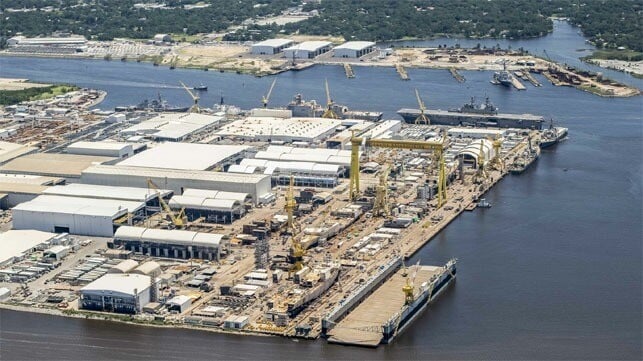
HD Hyundai Heavy Industries, South Korea’s largest shipbuilder, and HII (Huntington Ingalls Industries) signed an agreement designed to further expand their cooperation in shipbuilding and repair, as they target the U.S. Navy and commercial shipping. It is the next step in support of a relationship was launched this year, designed to take advantage of the opportunities in South Korea’s Make American Shipbuilding Great Again initiative.
HII and HHI signed the agreement at the Asia-Pacific Economic Cooperation forum to advance their joint objectives in the shipbuilding dialogue between the United States and South Korea. As part of the trade negotiations, South Korea pledged earlier this year to invest $150 billion in the U.S. shipbuilding industry as part of a larger $350 billion investment to support the United States. South Korea’s HD Hyundai and Hanwha Ocean are the two shipbuilders moving most aggressively to capture the opportunities.
Hyundai and HII cite the exploration of joint investments to strengthen and expand U.S. shipbuilding as one of their key goals. They are also discussing “strategic teaming” opportunities and plan to collaborate on engineering, R&D, and technology implementation.
“This marks the beginning of deeper collaboration between not only our companies, but each of our countries, that will support enduring changes to military and commercial shipbuilding in America,” said Eric Chewning, HII’s executive vice president of maritime systems and corporate strategy. “We look forward to working collaboratively with HHI, the U.S. and South Korean governments, and with our customers to transform the U.S. shipbuilding industrial base and enable accelerated throughput in our shipyards.”
The agreement follows an announcement that the two shipbuilders were jointly pursuing the assignment for the U.S. Navy’s next-generation logistics ship. The Navy recently released a request for proposals for the design contract.
They look to leverage HII’s strong relationship with the U.S. Navy and HHI’s track record of building auxiliary vessels. The South Korean company highlights that it delivered its first auxiliary vessels, HMNZS Endeavour in 1987 and the new HMNZS Aotearoa in 2020, both to the Royal New Zealand Navy. Hyundai also cites three Cheonji-class and one Soyang-class auxiliary ships supplied to the South Korean Navy.
The two companies announced their partnership in April, reporting they would be focusing on best practices to improve cost efficiency and shorten construction schedules. They have also said they were exploring opportunities to expand U.S. shipbuilding capacity for national security, and HD Hyundai has been reported to be considering buying a U.S. shipyard.
Hyundai says it is committed to strengthening the U.S. Navy Indo-Pacific in-theater ship lifecycle support. After being certified in 2024 to bid in the U.S. Navy’s MRO (Maintenance, Repair, and Overhaul) business, HD Hyundai began its first repair assignment in September 2025 on the support ship USNS Alan Shepard at its HD Hyundai Mipo yard in Ulsan, South Korea.
HD KSOE Awarded DNV AIP for SMR-Powered Container Vessel Design
[By DNV]
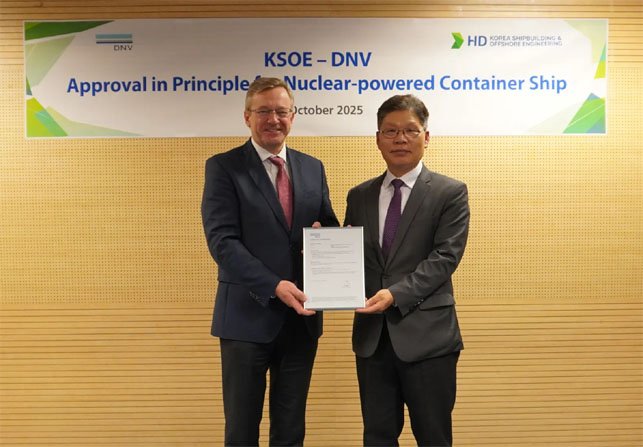
Classification society DNV has awarded HD Korea Shipbuilding & Offshore Engineering (HD KSOE) an Approval in Principle (AiP) for a new 15,000 TEU container vessel design powered by Small Modular Reactor (SMR) technology. The presentation was attended by Sungkon Han, Executive Vice President of the Green Energy Research Lab at HD KSOE, Geir Dugstad, Technical Director at DNV, and Ole Christen Reistad, Senior Principal Researcher and nuclear research lead at DNV, who discussed the outcome of the project and the potential for nuclear-powered shipping at DNV’s Busan offices.
The design demonstrates the application of SMR technology in a 15,000 TEU container vessel, capable of operating at 24 knots. The vessel concept incorporates a supercritical CO?-based power generation system, which can provide higher thermal efficiency and a reduced equipment footprint compared to conventional steam-based systems. DNV has reviewed the conceptual design of the nuclear-powered ship in line with the relevant rules and regulations and the safety levels as outlined in SOLAS Ch. VIII and the IMO Code of Safety for Nuclear Merchant Ships.
Dr. Kwangpil Chang, CTO of HD KSOE, commented on the project: “This SMR-powered container vessel concept represents a key milestone in our efforts to explore alternative fuels for decarbonizing shipping. The design focuses intensely on the safety of the vessel and advancing the propulsion system in the application of SMR technology. In addition, we have developed a novel shielding and containment system, which is designed to maintain reactor safety and vessel survivability even in the event of collisions, groundings, or sinking accidents. We will continue to collaborate with global partners to advance marine nuclear technologies.”
During the development of the ship design concept, the DNV team worked closely with HD KSOE to assess the vessel’s overall safety and the design of the advanced power generation system. This review includes the vessel’s main functions, power supply and overall approach to safety. In May 2025, HD KSOE and DNV also conducted a HAZID (Hazard Identification) workshop at DNV’s headquarters in Oslo to identify potential risks and accident scenarios for nuclear-powered vessels and to guide improvements in the design.
Geir Dugstad, Technical Director at DNV, commented: “Shifting environmental requirements and advances in technology are reigniting interest in nuclear propulsion as a potential solution for maritime decarbonization. But with little recent experience in utilizing nuclear power for cargo vessels, this AiP represents an important first step in building the technical verification process for nuclear-powered vessels. We are very pleased to award KSOE this new AiP, which is the well-deserved result of an intensive and productive cooperation, which we look forward to continuing as this exciting technology continues to develop.”
DNV recently released a new white paper on the potential of nuclear vessels for commercial shipping. It examines the reactor technologies, vessel construction and operation, fuel management, waste handling, and the oversight of nuclear supply chains.
An Approval in Principle (AiP) is an independent assessment of a concept within a defined framework of requirements. It confirms the feasibility of the design and verifies that no significant technical barriers exist to its implementation.
The products and services herein described in this press release are not endorsed by The Maritime Executive.
No comments:
Post a Comment