It’s possible that I shall make an ass of myself. But in that case one can always get out of it with a little dialectic. I have, of course, so worded my proposition as to be right either way (K.Marx, Letter to F.Engels on the Indian Mutiny)
Thursday, October 30, 2025
SPACE/COSMOS
Why does matter even exist? Tufts physicists help uncover clues
Analysis of international physics experiments finds neutrinos may have tipped the matter/antimatter balance at the beginning of the universe
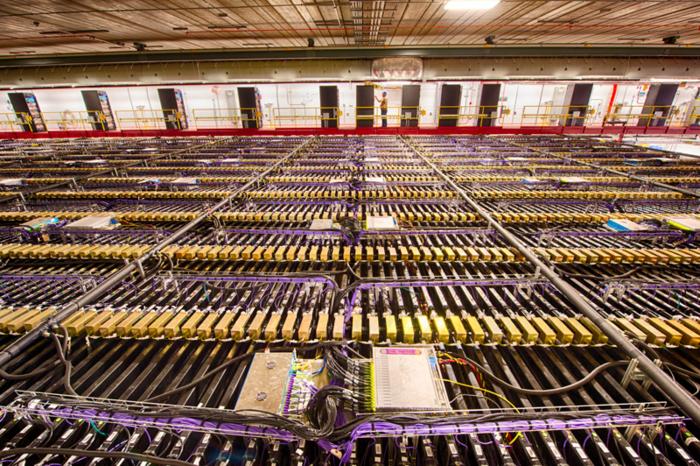
Neutrinos interact with the main detector—a massive 14,000-ton device composed of about 344,000 small PVC plastic modules filled with a liquid, which emits light when a neutrino triggers the release of charged particles. “Detection is a challenge,” said Jeremy Wolcott. “We have to sort out oscillated neutrinos from the accelerator from unoscillated accelerator neutrinos, cosmic-ray particles, and other background particles that come in contact with the detector.”
In the beginning of the universe, there should have been nothing but light. Based on current models without modification, physicists calculate that the Big Bang would have created equal amounts of matter and antimatter, ultimately annihilating each other and leaving a universe made purely of photons.
And yet here we are, orbiting a star, one of over 100 billion stars circling the Milky Way galaxy, among 2 trillion galaxies in the observable universe, all made of matter, with little antimatter to be found. Why this is the case has been one of the most puzzling questions facing physicists today.
Now, results from a large Fermilab-led collaborative study published in Nature, which included Tufts University physicists Hugh Gallagher, W. Anthony Mann, and Jeremy Wolcott among two international teams of hundreds of researchers, suggest a possible reason why matter persisted after the creation of the universe.
The Fermilab NOvA scientific collaboration, together with the T2K project in Japan, found that the oscillation behavior of neutrinos—electrically neutral subatomic particles about 10 million to 100 million times lighter than an electron—may have led to increase in the matter to antimatter ratio to the tune of one part per billion.
Why that might have been the case relates to how neutrinos behave. In the current universe, neutrinos can be generated during radioactive decay, which occurs in abundance in the Earth’s core, or when hydrogen fuses into helium, as it does in the Sun’s core.
Neutrinos are produced as a certain “flavor” (electron neutrino, muon neutrino, or tau neutrino). Each flavor is made up of not just a single pure wave, but is a superposition, or mix, of three wave functions, each with a slightly different mass.
Oscillating Like Piano String
Think of a neutrino as a musical chord, made up of sound generated by three strings, each with a different mass—a heavier bass string, a medium string, and a light string vibrating at different frequencies. A harmonious chord will have string frequencies in simple ratios, for example 2:1, 3:2, or 4:3.
As a neutrino moves through space, the larger mass function (bass string in the analogy) shifts in frequency relative to the smaller mass functions (lighter strings), similar to detuning one of the strings in a musical chord. In music, three strings vibrating at slightly different frequencies from harmonic ratios create constructive and destructive interference as phases move past each other. The result is a wobble or pulsation in volume that creates a beat pattern.
For neutrinos moving through space, the shifting wave frequencies of the three mass functions create a quantum beat pattern, observed as the oscillation between different flavor states.
“In the experiments, which stretched over 10 years, we made neutrinos and antineutrinos of one flavor (tau) in a particle accelerator and let them propagate hundreds of miles through the Earth,” said Wolcott, a Tufts research assistant professor.
“The detectors—a near one and a far one—pick up neutrinos of a different flavor due to the oscillations,” he said. “Our goal was to determine whether the oscillations were different between matter-based neutrinos and antimatter neutrinos. If neutrinos and antineutrinos oscillate differently, ending with slightly different mass, then their creation at the beginning of the universe could have led to an excess of matter over antimatter.”
Still Awaiting Definitive Data
The NOvA experiment did in fact pick up differences in oscillation between neutrinos and antineutrinos, but a definitive conclusion on the matter/antimatter imbalance remains out of reach until more data can be collected.
“One of the challenges with measuring neutrino oscillation is that there are a lot of degrees of freedom, including uncertainty in the ordering of the mass states—we still don’t know which mass function is the heaviest or lightest,” said Wolcott, “so we need a lot of data to help sort that out.”
The Tufts team made critical contributions to understanding of how neutrinos interact with the main detector—a massive 14,000-ton device composed of about 344,000 small PVC plastic modules filled with a liquid, which emits light when a neutrino triggers the release of charged particles.
The “far detector” was constructed in Ash River, Minnesota, 503 miles from the source of neutrinos created at Fermilab, just outside of Chicago. The “near detector,” a smaller version near the source in Illinois, takes a baseline measurement of the neutrinos exiting the particle accelerator. The two measurements are compared to determine the extent of neutrino oscillations.
“Detection is a challenge. We have to sort out oscillated neutrinos from the accelerator from unoscillated accelerator neutrinos, cosmic-ray particles, and other background particles that come in contact with the detector,” said Wolcott, who also coordinated the effort to analyze the neutrino oscillations that emerged from both the NOvA and T2K experiments.
“To put that in perspective, particles from natural sources hit the detector 150,000 times per second, but on average we only catch one neutrino per day from the particle accelerator source,” he said. “Most neutrinos slip through the Earth and our detectors and continue traveling through space, which is why they are sometimes called ‘ghost particles.’”
It’s a plot device beloved by science fiction: our entire universe might be a simulation running on some advanced civilization’s supercomputer.
But new research from UBC Okanagan has mathematically proven this isn’t just unlikely—it’s impossible.
Dr. Mir Faizal, Adjunct Professor with UBC Okanagan’s Irving K. Barber Faculty of Science, and his international colleagues, Drs. Lawrence M. Krauss, Arshid Shabir and Francesco Marino have shown that the fundamental nature of reality operates in a way that no computer could ever simulate.
Their findings, published in the Journal of Holography Applications in Physics, go beyond simply suggesting that we’re not living in a simulated world like The Matrix. They prove something far more profound: the universe is built on a type of understanding that exists beyond the reach of any algorithm.
“It has been suggested that the universe could be simulated. If such a simulation were possible, the simulated universe could itself give rise to life, which in turn might create its own simulation. This recursive possibility makes it seem highly unlikely that our universe is the original one, rather than a simulation nested within another simulation,” says Dr. Faizal. “This idea was once thought to lie beyond the reach of scientific inquiry. However, our recent research has demonstrated that it can, in fact, be scientifically addressed.”
The research hinges on a fascinating property of reality itself. Modern physics has moved far beyond Newton’s tangible “stuff” bouncing around in space. Einstein’s theory of relativity replaced Newtonian mechanics. Quantum mechanics transformed our understanding again. Today’s cutting-edge theory—quantum gravity—suggests that even space and time aren’t fundamental. They emerge from something deeper: pure information.
This information exists in what physicists call a Platonic realm—a mathematical foundation more real than the physical universe we experience. It’s from this realm that space and time themselves emerge.
Here’s where it gets interesting. The team demonstrated that even this information-based foundation cannot fully describe reality using computation alone. They used powerful mathematical theorems—including Gödel’s incompleteness theorem—to prove that a complete and consistent description of everything requires what they call “non-algorithmic understanding.”
Think of it this way. A computer follows recipes, step by step, no matter how complex. But some truths can only be grasped through non-algorithmic understanding—understanding that doesn’t follow from any sequence of logical steps. These “Gödelian truths” are real, yet impossible to prove through computation.
Here’s a basic example using the statement, “This true statement is not provable.” If it were provable, it would be false, making logic inconsistent. If it’s not provable, then it’s true, but that makes any system trying to prove it incomplete. Either way, pure computation fails.
“We have demonstrated that it is impossible to describe all aspects of physical reality using a computational theory of quantum gravity,” says Dr. Faizal. “Therefore, no physically complete and consistent theory of everything can be derived from computation alone. Rather, it requires a non-algorithmic understanding, which is more fundamental than the computational laws of quantum gravity and therefore more fundamental than spacetime itself.”
Since the computational rules in the Platonic realm could, in principle, resemble those of a computer simulation, couldn’t that realm itself be simulated?
No, say the researchers. Their work reveals something deeper.
“Drawing on mathematical theorems related to incompleteness and indefinability, we demonstrate that a fully consistent and complete description of reality cannot be achieved through computation alone,” Dr. Faizal explains. “It requires non-algorithmic understanding, which by definition is beyond algorithmic computation and therefore cannot be simulated. Hence, this universe cannot be a simulation.”
Co-author Dr. Lawrence M. Krauss says this research has profound implications.
“The fundamental laws of physics cannot be contained within space and time, because they generate them. It has long been hoped, however, that a truly fundamental theory of everything could eventually describe all physical phenomena through computations grounded in these laws. Yet we have demonstrated that this is not possible. A complete and consistent description of reality requires something deeper—a form of understanding known as non-algorithmic understanding.”
The team’s conclusion is clear and marks an important scientific achievement, says Dr. Faizal.
“Any simulation is inherently algorithmic—it must follow programmed rules,” he says. “But since the fundamental level of reality is based on non-algorithmic understanding, the universe cannot be, and could never be, a simulation.”
The simulation hypothesis was long considered untestable, relegated to philosophy and even science fiction, rather than science. This research brings it firmly into the domain of mathematics and physics, and provides a definitive answer.
New research uses laboratory experiments to demonstrate that water is naturally created during the planet formation process. By squeezing and heating planetary analog materials between the tips of two diamonds, scientists from Carnegie, IPGP, and UCLA demonstrated that interactions between a young planet's atmosphere and its primitive magma ocean generates water and dissolves hydrogen into the magma melt. This work has major implications for our understanding of planetary habitability and the search for exoplanets that could host life.
Credit: Image courtesy of Navid Marvi/Carnegie Science.
Washington, DC—Our galaxy’s most abundant type of planet could be rich in liquid water due to formative interactions between magma oceans and primitive atmospheres during their early years, according to new research published in Nature by Carnegie’s Francesca Miozzi and Anat Shahar.
Of the more than 6,000 known exoplanets in the Milky Way, so-called Sub-Neptunes are the most common. They are smaller than Neptune and more massive than Earth and believed to have rocky interiors with thick hydrogen-dominated atmospheres.
This makes them good candidates for testing ideas about how rocky planets, like our own, acquired an abundance of water—which was critical for the rise of life on Earth and is considered a fundamental component of planetary habitability.
“Our rapidly increasing knowledge about the vast diversity of exoplanets has enabled us to envision new details about the earliest stages of rocky planet formation and evolution,” Miozzi explained. “This opened the door to considering a new source for planetary water supplies—a long-debated mystery among Earth and planetary scientists—but experiments designed with this purpose in mind were absent.”
This work is part of the interdisciplinary, multi-institution AEThER (Atmospheric Empirical, Theoretical, and Experimental Research) project, which was founded and is led by Shahar. Funded by the Alfred P. Sloan Foundation, the initiative combines expertise across a diversity of fields—including astronomy, cosmochemistry, planetary dynamics, petrology, mineral physics, and more—to answer fundamental questions about the characteristics that enable rocky planets to develop favorable conditions for hosting life. Their work has a particular focus on attempting to link observations of planetary atmospheres to the evolution and dynamics of their rocky bodies.
Previous mathematical modeling research has demonstrated that interactions between atmospheric hydrogen and iron-bearing magma oceans during planet formation can produce significant quantities of water. However, comprehensive experimental tests of this proposed source of planetary water had not been performed until now.
Miozzi and Shahar led an international team of researchers from the Institut de Physique du Globe de Paris (IPGP) and UCLA to create the conditions under which such interactions between hydrogen—representing the early planetary atmosphere—and iron-rich silica melt—representing the formative magma ocean—would occur in a young planet. They accomplished this by compressing samples up to nearly 600,000 times atmospheric pressure (60 gigapascals) and heating them to over 4,000 degrees Celsius (7,200 degrees Fahrenheit).
Their experimental environment mimics a critical phase of the rocky planet evolutionary process. Such bodies are formed from the disk of dust and gas that surrounds a young star in the period after its birth. This material accretes into bodies which crash into each other and grow larger and hotter, eventually melting into a vast magma ocean. These young planets are often surrounded by a thick envelope of molecular hydrogen, H2, which can act like a “thermal blanket,” maintaining the magma ocean for billions of years before it cools.
“Our work provided the first experimental evidence of two critical processes from early planetary evolution,” Miozzi indicated. “We showed that a copious amount of hydrogen is dissolved into the melt and significant quantities of water are created by iron-oxide reduction by molecular hydrogen.”
Taken together, these findings demonstrate that large amounts of hydrogen can be stored in the magma ocean while water formation is occurring. This has major implications for the physical and chemical properties of the planet’s interior, with potential effects also on core development and atmospheric composition.
“The presence of liquid water is considered critical for planetary habitability,” Shahar concluded. “This work demonstrates that large quantities of water are created as a natural consequence of planet formation. It represents a major step forward in how we think about the search for distant worlds capable of hosting life.”
No comments:
Post a Comment