It’s possible that I shall make an ass of myself. But in that case one can always get out of it with a little dialectic. I have, of course, so worded my proposition as to be right either way (K.Marx, Letter to F.Engels on the Indian Mutiny)
Wednesday, October 22, 2025
Photosynthesis without the burn
Marine algae use a unique pigment, siphonein, to shield photosynthesis from excess light
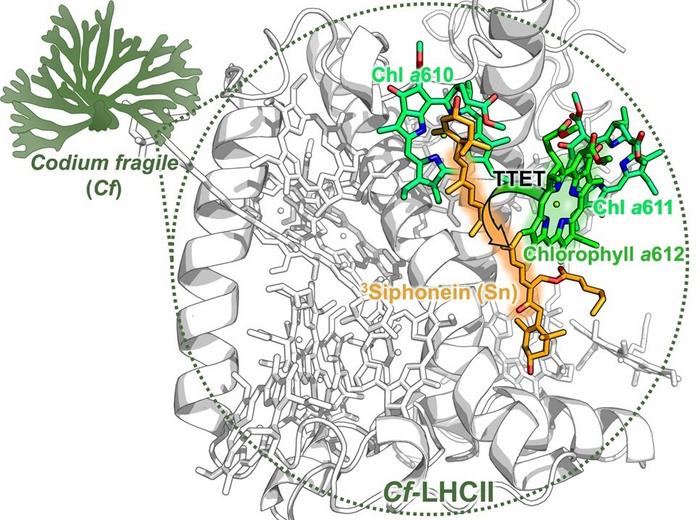
At the L1 site, the pigment siphonein (orange) binds close to a cluster of chlorophyll molecules (Chl a610–a612, green), enabling efficient energy quenching.
Too much sun can ruin a day at the beach. It can also ruin photosynthesis, scorching plants and other organisms that depend on capturing sunlight for energy. Beneath the waves, though, algae have found a clever shield. Osaka Metropolitan University researchers and their colleagues discovered that a pigment called siphonein helps marine green algae keep photosynthesis humming, without the burn.
Photosynthetic organisms rely on delicate light-harvesting complexes (LHCs) to capture sunlight for energy. During photosynthesis, chlorophyll absorbs light and enters an excited singlet state. Under normal light conditions, this energy is efficiently transferred to the photosynthetic reaction center to drive chemical reactions. But excessive light can push chlorophyll molecules into a dangerous “triplet” state, which is a source of reactive oxygen species capable of causing oxidative damage.
“Organisms use carotenoids to quickly dissipate excess energy, or quench these triplet states, through a process called triplet-triplet energy transfer (TTET),” said Ritsuko Fujii, lead author and associate professor at the Graduate School of Science and Research Center for Artificial Photosynthesis at Osaka Metropolitan University.
Until now, however, the rules governing this photoprotection remained largely unknown.
The research team looked for an answer in Codium fragile, a marine green alga. Similar to terrestrial plants, it possesses a light-harvesting antenna called LHCII, but with a twist: it contains unusual carotenoids such as siphonein and siphonaxanthin, which allow the alga to use green light for photosynthesis.
“The key to the quenching mechanism lies in how quickly and efficiently the triplet states can be deactivated,” said Alessandro Agostini, researcher at the University of Padua, Italy and co-lead author of the study.
Using advanced electron paramagnetic resonance (EPR) spectroscopy, which detects triplet excited states directly, the team compared spinach plants with Codium fragile. In spinach, weak signals of chlorophyll triplet states remained detectable. In contrast, in Codium fragile, these harmful states vanished entirely, clear evidence that carotenoids in the algal system quench them completely.
“Our research has revealed that the antenna structure of photosynthetic green algae has an excellent photoprotective function,” Agostini said.
Combining EPR with quantum chemical simulations, the team pinpointed siphonein, located at a key binding site in LHCII, as the primary driver of this remarkable protective effect. Their work also clarified the electronic and structural principles underlying efficient TTET, showing how the peculiar electronic structure of siphonein and its position in the LHCII complex strengthen its ability to dissipate excess energy.
The findings demonstrate that marine algae have evolved unique pigments not only to capture the green-blue light available underwater but also to enhance their resilience against excessive sunlight.
Beyond advancing our understanding of photosynthesis, the study results open the door to developing bio-inspired solar technologies with built-in protective mechanisms, and more durable and efficient renewable energy systems.
“We hope to further clarify the structural characteristics of carotenoids that increase quenching efficiency, ultimately enabling the molecular design of pigments that optimize photosynthetic antennae,” Fujii said.
The findings were published in Cell Reports Physical Science.
###
About OMU
Established in Osaka as one of the largest public universities in Japan, Osaka Metropolitan University is committed to shaping the future of society through the “Convergence of Knowledge” and the promotion of world-class research. For more research news, visit https://www.omu.ac.jp/en/ and follow us on social media: X, Facebook, Instagram, LinkedIn.
Siphonein enables an effective photoprotective triplet quenching mechanism in green algal light-harvesting complexes
Article Publication Date
21-Oct-2025
The first ecological–biotechnological seaweed survey in Israel
The unique conditions of the Israeli Mediterranean Sea serve as an “ecological laboratory” fostering extraordinary nutritional and health properties in seaweeds
A pioneering ecological–biotechnological survey reveals that the Israeli Mediterranean Sea may represent a natural hotspot for resilient seaweeds enriched with nutritional and bioactive compounds. The research team describes them as a “green treasure” — an untapped, sustainable resource for superfoods, pharmaceuticals, and eco-friendly cosmetics, as well as a natural ally in climate mitigation.
A team of researchers from Tel Aviv University and the Israel Oceanographic and Limnological Research Institute (IOLR) has conducted the first comprehensive ecological–biotechnological seaweed survey in Israel. Their findings suggest that the unique ecological conditions along the Israeli Mediterranean coast—warm, sunny, and dynamic—create a natural habitat that supports the growth of distinctive and resilient seaweeds (macroalgae) rich in nutritional and health-promoting compounds. The researchers believe these properties could serve as a foundation for groundbreaking innovations in food, health, and biotechnology.
The study was led by Dr. Doron Yehoshua Ashkenazi of Tel Aviv University and IOLR, under the supervision of Prof. Avigdor Abelson from the School of Zoology at Tel Aviv University, and Prof. Álvaro Israel from IOLR Haifa, in collaboration with Dr. Eitan Salomon from the National Center for Mariculture in Eilat. Additional contributors included Prof. Félix L. Figueroa and Julia Vega from the University of Málaga, Spain, along with Guy Paz head of the laboratory at IOLR, and Dr. Shoshana Ben-Valid. The study was published in the scientific journal Marine Drugs.
Over several years, the researchers collected nearly 400 specimens, identifying 55 seaweed species—predominantly red, alongside brown and green seaweed. In contrast to earlier reports suggesting two annual peaks in seaweed productivity, this study indicates a single productive period in springtime, strongly suggesting an ecosystem shift likely driven by global warming.
Seasonality also had a pronounced effect on seaweed chemistry. Biochemical analyses revealed that local seaweeds exhibit particularly high protein content during winter, reaching several tens of percent of their dry weight, making them a promising alternative protein source for both human and animal nutrition. Antioxidant levels peaked in spring, increasing by up to 286% in some species. These findings highlight seaweed as a natural source of health-promoting compounds and potential therapeutic agents that may contribute to longevity and immune support. The seaweed also contained high levels of phenolic compounds, and natural UV filters, making them ideal for eco-friendly cosmeceutical applications.
Dr. Doron Ashkenazi explains: "Israel, located at the easternmost edge of the Mediterranean Sea, offers unique environmental conditions: a subtropical climate with year-round sunlight, rocky shores with small tidal fluctuations, and relatively high salinity and irradiance. Together, these factors stimulate the development of seaweeds with unique chemical traits that act as natural ‘biological factories,’ producing bioactive compounds in remarkable concentrations.”
“We believe that this study, together with the growing seaweed research field, can place Israel at the forefront of global marine biotechnology. In addition to being ‘a land flowing with milk and honey,’ Israel has also been blessed with a unique sea — the Israeli Mediterranean.”
Prof. Álvaro Israel emphasizes: "This study provides valuable insights into the environmental factors that influence seaweed growth and quality, allowing us to translate this knowledge into practical aquaculture methods. Seaweed offers immense environmental benefits—they require no arable land, generate oxygen, capture carbon, and purify water from pollutants. They stand at the forefront of sustainable aquaculture, merging environmental advantages with economic opportunities.
Dr. Eitan Salomon adds: “Our findings illustrate the untapped biotechnological potential of seaweeds for the future of humanity – from functional foods and pharmaceuticals to a variety of advanced health applications.”
Prof. Avigdor Abelson concludes: “The Israeli Mediterranean Sea is a unique natural laboratory. It can serve as a model for understanding the impacts of climate change on marine ecosystems and help predict which species may thrive in a warming world. Beyond its scientific value, seaweeds represent a strategic national and global resource that can help address future challenges in food security, health, and the environment.”
The research is dedicated to the memory of Dr. Itzchak (Itzik) Brickner of blessed memory, one of Israel’s legendary marine biologists, in recognition of his friendship, mentorship, and inspiration.
No comments:
Post a Comment