Gaza Officials Say Israel Has Violated Ceasefire 80 Times in First 10 Days
Source: Truthout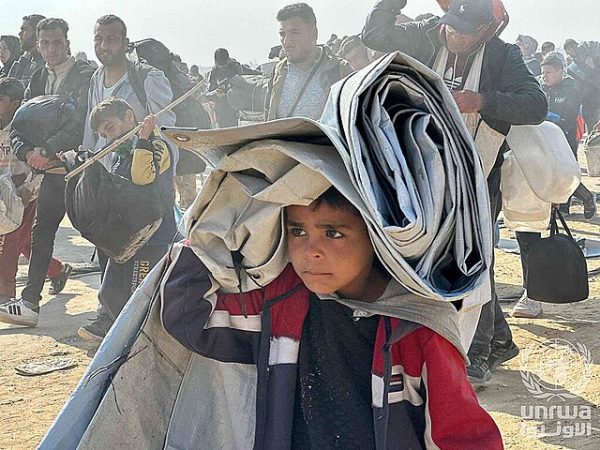 Image by Hussein Jaber, Creative Commons 3.0 igo
Israel has committed at least 80 violations of the ceasefire agreement since it began just 10 days ago, Palestinian officials have said, leaving hundreds of casualties as Israeli officials threaten to return to their extermination campaign now that the living Israeli captives have been returned.
In a statement on Sunday, the Gaza Government Media Office said that Israel had killed 97 Palestinians and injured over 230 amid the ceasefire. These violations show the Israeli government’s wish to break the agreement and return to its genocidal aggression, the office said.
“These violations ranged from direct fire against civilians to deliberate shelling and targeting, the use of simultaneous air strikes, and the arrest of a number of civilians,” it said, per Al Jazeera’s translation. “These practices reflect the occupation’s continued aggressive approach, its clear desire for escalation on the ground, and its constant thirst for blood and killing.”
This includes an attack on Friday in northern Gaza, in which Israel attacked a vehicle and killed 11 members of the same family, simply trying to return to their home. The attack killed seven children. Israel claimed that the vehicle had crossed a line of demarcation where Israeli forces are still deployed — an area that encompasses the majority of Gaza and that is not clearly marked by the military.
“They had crossed the so-called ‘yellow line’, an imaginary boundary mentioned by the Israeli army,” said Mahmoud Basal, Gaza Civil Defense spokesperson, per The Guardian. “I am certain the family couldn’t distinguish between the yellow and red lines because there are no actual physical markers on the ground.”
It also includes numerous violations on Sunday, during which Israel seemingly temporarily suspended the ceasefire agreement after two Israeli soldiers were killed in an explosion in Rafah. Israel blamed Hamas, saying that fighters fired an anti-tank and carried out a bombardment and said it would end all humanitarian aid delivery.
However, shortly after, Israeli officials said the ceasefire was back on and that it had resumed aid delivery. Officials did not give a reason, but Drop Site journalist Ryan Grim reported that the explosion actually happened when an Israeli settler ran over an unexploded ordnance.
“Soon after the explosion in Rafah, I’m told by a source familiar, the White House and Pentagon knew that the incident was caused by an Israeli settler bulldozer running over unexploded ordnance — contradicting [Israeli Prime Minister Benjamin] Netanyahu’s claim that Hamas had popped up from tunnels,” Grim wrote on social media.
“After Netanyahu said he was blocking all aid from entering Gaza in response, and unleashed a bombing campaign, the administration conveyed to Israel that they know what happened. Netanyahu then announced he would re-open the crossings in a few hours,” he went on.
Palestinian journalist Younis Tirawi also reported this, and further said that the Israeli government implemented a gag order to the media on the incident. Axios reporter Barak Ravid similarly said that Israeli officials said it was due to pressure from the Trump administration that the decision was turned back.
Israel has already been limiting aid into Gaza and refusing to open the Rafah border crossing, once the most important crossings for aid delivery. Officials accuse Hamas of violating its agreement to release Israeli captives’ bodies, but officials have said that it is impossible to retrieve all of the bodies as long as Israel continues blocking the entry of heavy equipment that can clear rubble.
Top Israeli ministers have been pushing for an end to the ceasefire. “Enough with the folding,” wrote Defense Minister Itamar Ben-Gvir on X on Sunday.
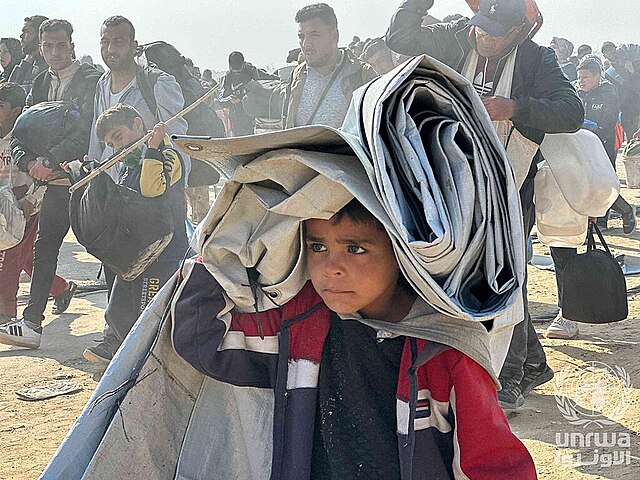
Israel has committed at least 80 violations of the ceasefire agreement since it began just 10 days ago, Palestinian officials have said, leaving hundreds of casualties as Israeli officials threaten to return to their extermination campaign now that the living Israeli captives have been returned.
In a statement on Sunday, the Gaza Government Media Office said that Israel had killed 97 Palestinians and injured over 230 amid the ceasefire. These violations show the Israeli government’s wish to break the agreement and return to its genocidal aggression, the office said.
“These violations ranged from direct fire against civilians to deliberate shelling and targeting, the use of simultaneous air strikes, and the arrest of a number of civilians,” it said, per Al Jazeera’s translation. “These practices reflect the occupation’s continued aggressive approach, its clear desire for escalation on the ground, and its constant thirst for blood and killing.”
This includes an attack on Friday in northern Gaza, in which Israel attacked a vehicle and killed 11 members of the same family, simply trying to return to their home. The attack killed seven children. Israel claimed that the vehicle had crossed a line of demarcation where Israeli forces are still deployed — an area that encompasses the majority of Gaza and that is not clearly marked by the military.
“They had crossed the so-called ‘yellow line’, an imaginary boundary mentioned by the Israeli army,” said Mahmoud Basal, Gaza Civil Defense spokesperson, per The Guardian. “I am certain the family couldn’t distinguish between the yellow and red lines because there are no actual physical markers on the ground.”
It also includes numerous violations on Sunday, during which Israel seemingly temporarily suspended the ceasefire agreement after two Israeli soldiers were killed in an explosion in Rafah. Israel blamed Hamas, saying that fighters fired an anti-tank and carried out a bombardment and said it would end all humanitarian aid delivery.
However, shortly after, Israeli officials said the ceasefire was back on and that it had resumed aid delivery. Officials did not give a reason, but Drop Site journalist Ryan Grim reported that the explosion actually happened when an Israeli settler ran over an unexploded ordnance.
“Soon after the explosion in Rafah, I’m told by a source familiar, the White House and Pentagon knew that the incident was caused by an Israeli settler bulldozer running over unexploded ordnance — contradicting [Israeli Prime Minister Benjamin] Netanyahu’s claim that Hamas had popped up from tunnels,” Grim wrote on social media.
“After Netanyahu said he was blocking all aid from entering Gaza in response, and unleashed a bombing campaign, the administration conveyed to Israel that they know what happened. Netanyahu then announced he would re-open the crossings in a few hours,” he went on.
Palestinian journalist Younis Tirawi also reported this, and further said that the Israeli government implemented a gag order to the media on the incident. Axios reporter Barak Ravid similarly said that Israeli officials said it was due to pressure from the Trump administration that the decision was turned back.
Israel has already been limiting aid into Gaza and refusing to open the Rafah border crossing, once the most important crossings for aid delivery. Officials accuse Hamas of violating its agreement to release Israeli captives’ bodies, but officials have said that it is impossible to retrieve all of the bodies as long as Israel continues blocking the entry of heavy equipment that can clear rubble.
Top Israeli ministers have been pushing for an end to the ceasefire. “Enough with the folding,” wrote Defense Minister Itamar Ben-Gvir on X on Sunday.
The Gaza Peoples’ Tribunal: Exploring Palestinian Erasure
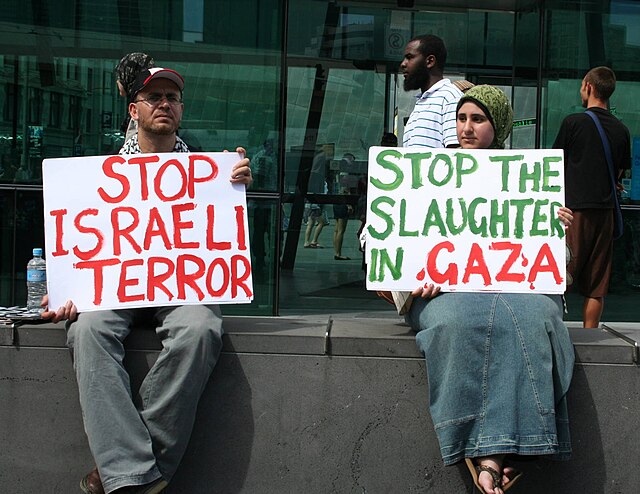
The Gaza Tribunal, a people’s tribunal, was formed a year ago in response to the failure of the established world order of sovereign states and international institutions to stop what experts and ordinary people increasingly recognised as genocide in Gaza.
The Gaza Tribunal will hold its final session from 23-26 October 2025 at Istanbul University.
Our initiative was inspired by an earlier civil society effort during the Vietnam War, when leading public intellectuals Bertrand Russell and Jean-Paul Sartre established the Russell Tribunal, which held hearings in 1966 and 1967.
Its mission was to report on the international crimes of the United States and to legitimise growing anti-war sentiment in the West.
The underlying premise was that when the state system fails to uphold international law or to ensure accountability for grave crimes that affect global peace and security, people possess a residual authority and responsibility to act.
In the half-century since, many similar tribunals have emerged around the world. Their shared purpose is to speak truth to power and legitimise solidarity initiatives that seek to mount pressure on governments and institutions to take action.
Such people’s tribunals are also intended to encourage civil society activism, such as the Boycott, Divestment and Sanctions (BDS) movement launched by Palestinian NGOs in 2005.
Unlike national or international courts, people’s tribunals do not claim legal authority.
They are overtly partisan, driven by moral conscience rather than formal procedure. They provide a platform for survivor testimony and expert analysis, with the aim of mobilising global activism in pursuit of justice.
Their focus extends beyond legal culpability to encompass broader moral and political responsibility. The tribunal embodies these principles through its Jury of Conscience – individuals of diverse backgrounds and nationalities who share a commitment to moral integrity and to exposing the Palestinian ordeal in Gaza.
Seeking truth
In certain respects, the tribunal’s work resembles that of United Nations truth-seeking mechanisms, such as the reports of the special rapporteur on the situation of human rights in the Palestinian territories. These have persuasively documented evidence of genocidal intent by Israel and its complicit allies.
Yet unlike the tribunal, UN rapporteurs operate as neutral experts, professionally bound to follow evidence wherever it leads.
In an unprecedented act of retaliation, the current UN special rapporteur, Francesca Albanese, was personally sanctioned by the US government, denied entry to the country despite her credentials and had her American assets frozen.
This punitive response to UN truth-telling underscores the need for independent civil society efforts to expose the reality of human suffering caused by Israel’s unlawful and immoral policies.
From its inception, the tribunal has pledged complete independence from government interference, with no active politicians or officials involved in its work.
It is against this background that some may argue that recent developments, particularly US President Donald Trump‘s much-publicised diplomacy and the resulting fragile ceasefire in Gaza, render the tribunal redundant.
They may see the tribunal as an unhelpful distraction from the supposed work of peacebuilding, or from the UN’s paralysis in the face of two years of genocide in an occupied territory where it bears a special institutional responsibility.
The reality, however, is that such developments make the tribunal more essential than ever. When governments and international institutions abandon justice, it falls to ordinary people to uphold it.
Illusions of peace
The attention devoted in recent days to the so-called Trump ultimatum to Hamas, whose acceptance led to the return of all Israeli hostages within 72 hours, reflected the coercive nature of the process.
Hamas was told to comply or face a US-backed Israeli resumption of the genocide that Trump, in his fiery language, forecast as the “opening of the gates of hell”.
Hamas dutifully delivered all of the living hostages and as many of the remains of the dead as it managed to recover. In response, Israel released nearly 2,000 Palestinians imprisoned without charge since 7 October 2023 – effectively hostages themselves.
This prisoner exchange produced a ceasefire in Gaza, accompanied by celebrations in Israel limited to the return of the hostages, and in Gaza, expressing joy about the ceasefire, the release of detained Palestinians, and the partial withdrawal of Israeli forces.
At the same time, there were many flaws in the arrangements when viewed from a Palestinian perspective.
The proposed transition to a peaceful future, outlined in the 20-point plan and boasted about by Trump in grandiose terms, seems at best premature and, more likely, never to be realised.
Recent statements and behaviour by Israel’s leaders and public appear as determined as ever to pursue a dehumanising and punitive approach towards the still unwelcome Palestinian presence in Gaza and the West Bank.
Israeli ceasefire violations in the first few days resulted in at least 10 Palestinian deaths and the blocking of half of the agreed humanitarian deliveries to a population that is starving, disease-ridden, lacking potable water, and deprived of health services and medicines.
The Palestinian population, stunned and devastated by two years of genocide that deliberately destroyed health and sanitation facilities as well as more than 90 percent of residential structures, continues to suffer under catastrophic conditions.
To live without bombs, even temporarily, is surely a blessing. Yet to exist in primitive tent communities without toilets or kitchens, amid rubble containing the missing bodies of friends, neighbours and relatives, should be regarded as a slowdown of the genocidal assault but hardly its end – or even its replacement by a post-genocide phase resembling the pre-7 October 2023 apartheid-style occupation.
A broken process
In this atmosphere, it remains imperative to expose Israel’s harsh policies and practices that continue to impose emergency, dehumanising conditions and vulnerabilities upon the entrapped population of Gaza.
Israel is reported to have given material support to anti-Hamas clans and gangs to aggravate the grave conditions that persist.
While the ceasefire and the prospect of a peaceful future may be welcomed, it is notable that the positive results were achieved through reliance on an unlawful ultimatum threatening intensified violence.
Beyond this, the entire process was guided by and weighted in favour of Israel and the United States – the two states most closely identified with the perpetration of two years of unremitting genocide.
In effect, the political actors guilty of genocide were rewarded by being entrusted with controlling the peace process for their own benefit.
This is a perversion of justice. Imagine the outrage if surviving Nazi leaders had been authorised to preside over the post-World War Two peace process.
The ‘legitimacy war’
The tribunal does not claim historic importance, but its relevance remains undiminished. It exists to validate the charge of genocide and to reaffirm the Palestinian struggle for self-determination and statehood.
Both dimensions of the present Gaza reality are airbrushed out of existence by the self-congratulatory bombast of Trump’s diplomacy.
Those who perpetrated genocide have so far not only evaded any kind of formal accountability for their crimes but have also benefited, except to the extent that Israel is now experiencing eroded legitimacy as a sovereign state and is widely viewed as a pariah.
This dynamic of delegitimation has occurred despite the international community’s complete failure to apply standards of accountability in the form of reparations or a reconciliation process that exchanges acknowledgement of past crimes for amnesty.
That others, rather than the perpetrators and their enablers, are expected to bear the costs of Gaza’s reconstruction is an assault on the very notion of moral and legal responsibility.
What the tribunal seeks to achieve is the sharpening of a populist tool that constructs an accurate archive and narrative of past and present.
Its assessments contribute to the relevance of voices of conscience in civil society – a form of symbolic politics that influences questions of legitimacy.
In this respect, the side that won the “legitimacy war” for control of moral and legal discourse generally determined the political outcome of the anti-colonial struggles of the last half-century, despite being militarily inferior.
These are lessons the US should have learned in Vietnam, and Israel in its long encounter with the Palestinian people.
Although the future is highly uncertain, there is little doubt that, as of now, the Palestinians have won the legitimacy war – an outcome that will be certified by the proceedings of the Gaza Tribunal.
In their struggle against Zionist settler colonialism, Palestinians have achieved a notable symbolic victory since 7 October 2023, and Israel a corresponding defeat.
To record and document this outcome in Gaza is, by itself, enough to justify holding the Gaza Tribunal’s final session in the days ahead.

A Gaza Gambit: The Art of the Doomed Deal
I am rarely surprised by anything Trump says anymore. There is no lie too transparent to stop him—remember “sunny” when it was overcast? Or his absurdly erroneous claims that he “ended seven wars,” including conflicts between Cambodia and Thailand, Kosovo and Serbia, the Democratic Republic of Congo and Rwanda, Pakistan and India, Israel and Iran, Egypt and Ethiopia, and Armenia and Azerbaijan.
Forget that Armenia (which Trump previously confused with Albania) and Azerbaijan have not yet ratified a deal. Just last week, on October 14, 2025, Armenian Foreign Minister Ararat Mirzoyan reaffirmed that constitutional reform is an internal matter and that Armenia will not accept Azerbaijan’s demands as a precondition to any treaty. Yet Trump proudly declared he had ended this “un-endable war.”
Trump’s ceasefire theater in Gaza is not unique in its grotesque self-service, though it is exceptionally dangerous. Accuracy and accountability matter. We have seen premature “mission accomplished” declarations and exaggerated optimism too many times before.
Since the fragile U.S.-brokered truce came into effect on October 10, Israel has killed nearly 100 Palestinians and wounded 230 in Gaza, Al Jazeera reports. Over days of accusation and counteraccusation—trust comes from making and keeping agreements, not being forced into them. Israeli forces have repeatedly opened fire on unarmed Palestinians and launched airstrikes despite the ceasefire—do we even have one? The latest was on Sunday, when Israel claimed Hamas fighters attacked its soldiers in Rafah—a zone under Israeli control. The Israeli military said two soldiers were killed, accusing Hamas of violating the agreement before launching a “massive and extensive wave” of strikes across the Strip.
Hamas’s armed wing, the Qassam Brigades, denied involvement, which they frequently do; noting it has no presence in Rafah and no contact with fighters there. This was not the only time Hamas has been accused of violating the ceasefire. Israel has also said Hamas is dragging its feet on returning the bodies of 28 captives killed during Israel’s own bombardment of Gaza.
This is the backdrop against which Trump has been boasting about his supposed “peace deal.” What he calls a triumph of diplomacy is, in reality, a fragile pause repeatedly ruptured by violence—one that has neither stopped the killing nor met the humanitarian needs of Gaza’s civilians. When nearly 100 Palestinians are killed during a truce negotiated under U.S. auspices, calling it “peace” isn’t just misleading; it is morally indefensible. Trump’s deal, like so many of his foreign policy gambits, is less about resolution than performance—another chance to claim victory while others pay the cost in blood.
By contrast, the Biden administration’s negotiated ceasefire, while still imperfect and fragile, has been rooted in multilateral coordination and humanitarian oversight. It involves ongoing monitoring, U.N. facilitation, and aid delivery mechanisms designed to prevent the rapid breakdown seen under Trump’s watch. Biden’s approach reflects the sober reality that peace cannot be declared by press release—it must be maintained through trust, accountability, and sustained humanitarian access. Unlike Trump, Biden never claimed to have been the one who brought lasting peace to the Middle East.
Yet the contrast also underscores a deeper truth: in Gaza, words like “deal” and “truce” are only as meaningful as the lives they protect. So long as violence continues under the guise of restraint, claims to peace ring hollow. Trump’s gambit—his showy, self-serving approach to negotiation—was never about ending bloodshed, only about staging it as a win. It is the theater of diplomacy without its substance, a hollow performance that mistakes applause for victory.
Trump’s pattern of claiming credit for work he did not do is consistent. He has declared “victories” that never existed, whether in foreign conflict, domestic policy, or pandemic response. In Gaza, this pattern has real human consequences. The UN Development Program estimates Gaza’s damage at $70 billion, with $20 billion needed in the next three years alone. For comparison, USAID’s 2023 budget request—before Trump gutted it—was around $38 billion. Photo-op diplomacy and airdropped aid do not meet the actual needs of civilians on the ground.
Doctors Without Borders has welcomed a ceasefire, but they continue to call for an end to the ongoing humanitarian catastrophe. They report treating pediatric burn victims, children injured by bomb blasts, boiling water, and fuel fires in makeshift shelters. History teaches the same lesson repeatedly: Israel and Hamas have signed ceasefires in 2008, 2012, 2014, 2019, and 2021, all of which collapsed. Threats of retaliation, coercion, and theatrics are not diplomacy—they are a recipe for repeated failure.
Trump is claiming a victory that does not exist. The only thing he’s done that earns him credit was to push for a release of the 20 remaining living hostages, but it’s looking more and more like a ploy to get something Israel wanted and get Trump the high praise he heaps upon himself, not the grand achievement he claims.
He has placed his political needs ahead of humanity. It is a gambit—an attempt to secure a win despite enormous risks. Rigorous studies of peace accords show measurable differences: loosely worded agreements are far more likely to fail because of suspicion, room for interpretation, and distrust. The lack of timelines, accountability structures, and enforcement mechanisms in Trump’s announcement contrasts sharply with Biden’s more empirically grounded approach.
Even the logistics are implausible. Gaza is flattened—70–90 percent of its infrastructure destroyed—making promises about hostages and aid delivery nearly impossible to implement. Pledged aid rarely reaches civilians in need, and Hamas’ supposed disarmament remains a mirage. The global aid system is already strained, weakened by budget cuts and the rise of authoritarianism worldwide. Premature victories are the only kind Trump can claim. His administration thrives on stagecraft, not statecraft.
Ultimately, this gamble erodes U.S. credibility in peacebuilding. Declaring peace for headlines while violence continues undermines both moral authority and practical leverage in conflict resolution. Sustainable peace requires honesty, accountability, and a commitment to the lives of those affected—not applause, not political theater. Trump’s Gaza gambit is a stark reminder that real peace cannot be staged; it must be built, brick by brick, with truth and trust as its foundation.
Wim Laven, Ph.D., syndicated by PeaceVoice, teaches courses in political science and conflict resolution.
Gaza Peace Plan is a Cruel Deception
Decent, concerned people have been waiting impatiently for the UN General Assembly to use a ‘Uniting For Peace’ resolution to circumvent the US veto and intervene in Gaza with a protection force. Under this mechanism, when the Security Council is deadlocked, the authority to act passes to the General Assembly where the US has no veto.
But UNGA have dragged their feet and allowed Trump and his Zionist business friends to seize the initiative with a fake peace plan that conceals their main motive, which is to perpetuate Israel’s dominance and profit hugely from designating Gaza and the West Bank as a fantastic development zone under their control.
However, international law says the Palestinians must be allowed to govern their territories — including Gaza’s marine oil and gas field — with whatever help they choose, under UN supervision and not dictated by outsiders like Trump and his band of get-rich property developers. Their “eternal peace” plan is deliberately short on detail, ignores international law, shuts out the Palestinian Authority, bypasses the United Nations, lacks any kind of authorisation from the global community, and reeks of sleaze. None of it acknowledges the Palestinians’ inalienable rights. Trump’s 20-point ‘peace’ plan for Gaza is a cruel hoax.
The US’s track record is one of chronic bias, not least because its QME doctrine guarantees Israel a ‘qualitative military edge’ to ensure the apartheid state always has the upper hand over it neighbours. Until that legislation is repealed no US president or government appointee can be considered an honest broker in Middle East affairs.
Yet here we see Trump abusing his powers and pushing aside the UN in an attempt to take control of the countless lucrative business opportunities thrown up by the Gaza tragedy. How are Donald Trump and a handful of chancers, who include the disgraced Tony Blair, able to usurp UN powers and exploit an appalling situation resulting from the genocidal devastation he himself had a big hand in? This is not an occasion for ‘deals’. It’s time to exercise the Palestinians’ right to freedom strictly in accordance with international law and help them achieve independence.
And what are we to make of demands for Hamas to disarm and take no part in future governance of their country? Under the plan Israel will only withdraw troops (eventually) to the perimeter inside Gaza’s border. So they’ll remain in occupation indefinitely. They already occupy Gaza’s airspace, airwaves and coastal waters, and control all entry points and exits. Their record in honouring ceasefires is abysmal and they are poised to resume their genocidal slaughter on any whim. If you were Hamas would you disarm?
Besides, who governs Palestine is entirely a decision for the Palestinian people. As far as I’m aware, Hamas are still the legitimate, democratically elected government in Gaza. And they are perfectly entitled under international law (and various UN resolutions, for example 3246 and 37/43) to put up armed resistance against any illegal occupier using military force. So is this attempt by Israel and its Western allies to bring about regime change actually lawful? And for balance what about regime change in the genocidal terror state next door?
We saw Trump and Netanyahu holding hands and smirking as they launched their 20-point plan. Trump said Netanyahu had agreed to it — even though Netanyahu has vowed repeatedly that Israel will never allow a Palestinian state to emerge — and Arab countries were onboard. Trump then issued a blood-curdling threat to Hamas that if they didn’t accept his plan within 3 days he would give Israel the green light to carry on with the genocide with himself, presumably, continuing to supply the ammunition. “All HELL, like no one has ever seen before” would be let loose, he said.
So it’s not about freedom for Palestinians, a right they’ve been denied for over a century. Nor are the vile duo aiming to deliver justice for the Palestinians, whose land this is. The more you think about it the clearer it becomes that the ‘peace’ plan is simply a cruel hoax to perpetuate the subjugation of the Palestinians, protect Israel’s dominance and ensure the Zionists’ long-term ambition to create a Greater Israel is finally achieved.
The Trump-Netanyahu partnership and their hand-picked friends are a private club bent on greed and self-aggrandisement. How legally valid is any of that? And is the international community really going to allow such a preposterous scheme to go ahead with the likes of Donald Trump and Tony Blair in charge?
What does the UN say about the “Eternal Peace” plan?
A team of 28 independent human rights experts, appointed by the United Nations Human Rights Council, have said they welcome parts of the peace plan such as a permanent ceasefire, rapid release of unlawfully detained persons, an influx of humanitarian aid under United Nations supervision, no forced displacement from Gaza, the withdrawal of Israeli forces and the non-annexation of territory. But they add that these are broadly requirements of international law anyway and shouldn’t depend on a formal peace plan.
The experts warn that other elements of the plan are inconsistent with fundamental rules of international law and the 2024 Advisory Opinion of the International Court of Justice (ICJ) which demands that Israel ends its unlawful presence in the Occupied Palestinian Territory.
They list 15 serious objections to Trump’s plan including the following:
Any peace plan must respect the ground rules of international law. The future of Palestine must be in the hands of the Palestinian people – not imposed by outsiders under extreme conditions of duress in yet another scheme to control their destiny.
The United Nations – not Israel or its closest ally – has been identified by the ICJ as the legitimate authority to oversee the end of the occupation and the transition towards a political solution in which the Palestinians’ right of self-determination is fully realised. But there is no provision in the plan for a leading role for the UN, General Assembly or Security Council, or even for the UN Relief and Works Agency for Palestine Refugees in the Near East (UNRWA), which is vital to assisting and protecting Palestinians.
The plan does not guarantee the Palestinian right of self-determination as international law requires, and it is subject to vague pre-conditions concerning Gaza’s redevelopment, Palestinian Authority reform, and a “dialogue” between Israel and Palestine. Palestine’s future would thus be at the mercy of decisions by outsiders, not in the hands of Palestinians as international law commands.
The plan also requires more negotiations with Israel, when the Israeli Prime Minister has already declared that Israel would “forcibly resist” statehood. This contradicts the International Court of Justice (ICJ) finding that fulfilling the right of self-determination cannot be conditional on negotiations.
The “temporary his contradicts the International Court of Justice (ICJ) finding that fulfilling the right of self-determination cannot be conditional transitional government” is not representative of Palestinians and even excludes the Palestinian Authority, which further violates self-determination and lacks legitimacy.
Oversight by a “Board of Peace” chaired by the US President is not under United Nations authority or transparent multilateral control, while the US is a deeply partisan supporter of Israel and not an “honest broker”. This proposal is reminiscent of colonial practices and must be rejected.
An “International Stabilisation Force”, outside the control of the Palestinian people and the United Nations as a guarantor, would replace Israeli occupation with a US-led occupation, contrary to Palestinian self-determination.
Partial Israeli occupation continues indefinitely through a “security perimeter” inside Gaza’s borders, which is absolutely unacceptable.
Nothing is said regarding the demilitarisation of Israel, which has committed international crimes against the Palestinians and threatened peace and security in the region through aggression against other countries.
De-radicalisation is imposed on Gaza only, while public incitement to genocide has been dominant rhetoric in Israel.
The plan largely treats Gaza in isolation from the West Bank including East Jerusalem, when these areas must be regarded as a unified Palestinian territory and State. The plan does not address other fundamental issues such as ending illegal Israeli settlements in the West Bank (including East Jerusalem), borders, compensation, and refugees.
An “economic development plan” and “special economic zone” could result in illegal foreign exploitation of resources without Palestinian consent.
The International Court of Justice has been crystal clear: conditions cannot be placed on the Palestinian right of self-determination. The Israeli occupation must end immediately, totally and unconditionally, with due reparation made to the Palestinians. But there is no duty on Israel and those who have sustained its illegal attacks in Gaza to compensate Palestinians for illegal war damage.
Accountability and justice are integral to sustainable peace but there is nothing of this in the plan.
All this should have warned nations participating in Trump’s plan to have nothing to do with it. It may deliver a short break in the carnage and an exchange of (some) prisoners but genuine peace is evidently not on Trump’s agenda.
A resolution will soon come before the UN Security Council to authorise and spell out the mission of the proposed International Stabilisation Force and ensure it is properly founded on international law. But will the US agree with that? A refusal (veto) might be the very thing to trigger a ‘Uniting for Peace’ move mentioned above.
Also, there is no mention of restoring Gaza’s airport and seaport which, one would have thought, is essential to the task of reconstruction.
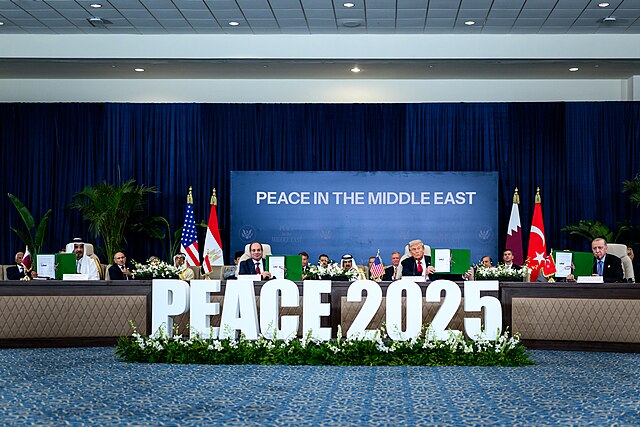
So what exactly did Trump and his special guests sign at the peace summit at Sharm el-Sheikh on 13 October?
The Trump Declaration for Enduring Peace and Prosperity
Presidential Memoranda
October 13, 2025
We, the undersigned, welcome the truly historic commitment and implementation by all parties to the Trump Peace Agreement, ending more than two years of profound suffering and loss — opening a new chapter for the region defined by hope, security, and a shared vision for peace and prosperity.
We support and stand behind President Trump’s sincere efforts to end the war in Gaza and bring lasting peace to the Middle East. Together, we will implement this agreement in a manner that ensures peace, security, stability, and opportunity for all peoples of the region, including both Palestinians and Israelis.
We understand that lasting peace will be one in which both Palestinians and Israelis can prosper with their fundamental human rights protected, their security guaranteed, and their dignity upheld.
We affirm that meaningful progress emerges through cooperation and sustained dialogue, and that strengthening bonds among nations and peoples serves the enduring interests of regional and global peace and stability.
We recognize the deep historical and spiritual significance of this region to the faith communities whose roots are intertwined with the land of the region — Christianity, Islam, and Judaism among them. Respect for these sacred connections and the protection of their heritage sites shall remain paramount in our commitment to peaceful coexistence.
We are united in our determination to dismantle extremism and radicalization in all its forms. No society can flourish when violence and racism is normalized, or when radical ideologies threaten the fabric of civil life. We commit to addressing the conditions that enable extremism and to promoting education, opportunity, and mutual respect as foundations for lasting peace.
We hereby commit to the resolution of future disputes through diplomatic engagement and negotiation rather than through force or protracted conflict. We acknowledge that the Middle East cannot endure a persistent cycle of prolonged warfare, stalled negotiations, or the fragmentary, incomplete, or selective application of successfully negotiated terms. The tragedies witnessed over the past two years must serve as an urgent reminder that future generations deserve better than the failures of the past.
We seek tolerance, dignity, and equal opportunity for every person, ensuring this region is a place where all can pursue their aspirations in peace, security, and economic prosperity, regardless of race, faith, or ethnicity.
We pursue a comprehensive vision of peace, security, and shared prosperity in the region, grounded in the principles of mutual respect and shared destiny.
In this spirit, we welcome the progress achieved in establishing comprehensive and durable peace arrangements in the Gaza Strip, as well as the friendly and mutually beneficial relationship between Israel and its regional neighbors. We pledge to work collectively to implement and sustain this legacy, building institutional foundations upon which future generations may thrive together in peace.
We commit ourselves to a future of enduring peace.
Donald J. Trump
President of the United States of America
Abdel Fattah El-Sisi
President of the Arab Republic of Egypt
Tamim bin Hamad Al-Thani
Emir of the State of Qatar
Recep Tayyip Erdoğan
President of the Republic of Türkiye
Only 3 of the 193 members states of the United Nations were invited to attend. Hamas and Israel were both absent. Sheer woffle and it was signed only by Trump, El-Sisi, Al-Thani and Erdogan. How representative was this charade? How legally valid?
Where does this leave the near-universal pledge to recognise Palestinian statehood (and make it happen)?
Trump and some of his allies seem totally ignorant of their solemn duty to recognise Palestinian statehood. Fortunately, UN Resolution 37/43 of December 1982 is there to help. It comprehensively re-affirms previous resolutions and treaties on the universal right to self-determination and the speedy granting of independence to colonial countries and peoples in order to provide an effective guarantee that human rights may be observed. Note the words “speedy granting”. Palestinians have been kept waiting for over 100 years for an effective guarantee of their human rights.
And 37/43 considers that denying the Palestinian people their inalienable rights to self-determination, sovereignty, independence and return to Palestine, and the repeated acts of aggression by Israel against the peoples of the region, constitute a serious threat to international peace and security. It strongly condemns those Governments that do not recognise the right to self-determination and independence of all peoples still under colonial and foreign domination and alien subjugation, notably the Palestinian people.
No comments:
Post a Comment