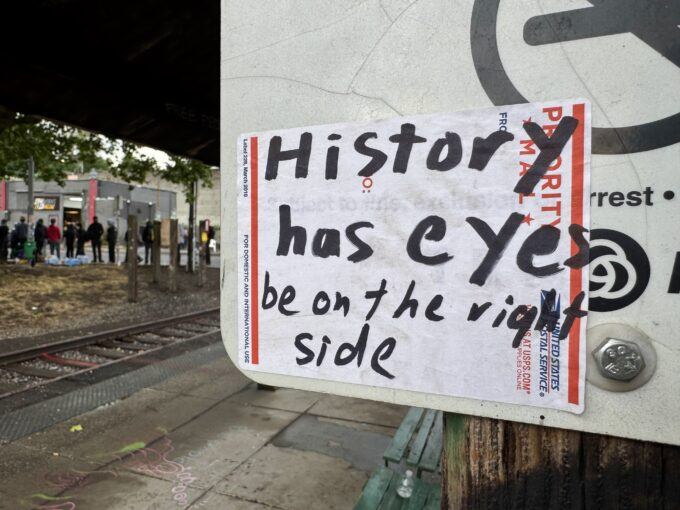
Historically, the most terrible things war, genocide, and slavery have resulted not from disobedience, but from obedience.
– Howard Zinn
The irony is unbearable. Trump has saturated public life in lies, turned immigrants and Black citizens into targets of contempt, and made corruption and violence the grammar of governance. He pledges loyalty to dictators, surrounds himself with sycophants and thugs, and uses state power to abduct foreign students, persecute immigrants, and declare war on the so-called left, grotesquely blaming them for Charlie Kirk’s death, even before a suspect was arrested. What should be a moment of grief over Charlie Kirk’s death has been twisted into a weaponized spectacle, with Trump and his allies rushing to frame the assassination as proof of leftist extremism.
As Jeffrey St. Clair observed, “Leaders of the Right didn’t waste much time counseling their ranks to restrict themselves to ‘thoughts and prayers’ over the murder of Charlie Kirk. Even before the assassin had been identified or a motive uncovered, they blamed the ‘violent rhetoric’ of the Left for Kirk’s death.” This is not mourning, it is the oldest trick in the authoritarian playbook: accuse first, investigate never, weaponize tragedy to consolidate power.
In this poisonous narrative, the real “enemies within” are not the racists, insurrectionists, corrupt corporations, and right-wing extremists who stormed the Capitol, but the critics of authoritarian power as well as groups designated as “other.” Against them, Trump and his allies wage war on the First Amendment, turning freedom of speech from a cornerstone of democracy into its target. In their framing, freedom of speech is recast not as a bulwark of democracy but as its enemy.
From comedians and journalists to students, educators, and independent groups, every dissenting voice is branded a conspirator in imagined crimes–their real offense nothing more than speaking against cruelty when silence was demanded. Or committing the crime of not being loyal enough to Donald Trump. As Hannah Arendt once warned, under totalitarianism thinking itself becomes dangerous. Authoritarianism in its many forms arises in part from the failure to think—a prescient warning in the age of manufactured ignorance. The normalization of ignorance, thoughtlessness, and moral blindness in the age of Trump is foundational to creating fascist subjects who cannot tell right from wrong, truth from lies, or justice from evil.
This warning is even more urgent today, for there is a horrifying ignorance in Trump that unleashes predatory passions, stretching from his embrace of war criminals and historical amnesia to the fatal strikes he ordered on three alleged drug-smuggling vessels. For Trump, the legality of such acts is irrelevant. Violence coupled with criminalizing dissent is central to the logic of annihilation at the core of fascist politics.
This is fascism’s signature maneuver. Hitler did it in 1933 after the Reichstag fire, blaming communists and invoking emergency powers to suspend civil liberties. Mussolini did it in 1925 after the assassination of Giacomo Matteotti, turning a moment of crisis into a justification for outlawing opposition and silencing presses. Orbán has perfected the tactic in Hungary, scapegoating “Soros-funded leftists” to dismantle universities, criminalize protest, and eviscerate the press.
Trump is no exception. He exploits Kirk’s death not to grieve but to consolidate power. His message is blunt: dissent is violence, criticism is terrorism, disloyalty is a crime, and free speech itself is a threat to Trump’s ideological panopticon. The vicious amplification of this line of toxic thinking is evident in Elon Musk declaring “The Left is the party of murder,” and Trump’s consigliere Laura Loomer demanding the state “shut down, defund, and prosecute every single Leftist organization…The Left is a national security threat.” It reaches hysterical heights in the anti-communist rhetoric of Stephen Miller, the White House deputy chief of staff, who has likened the left to a “vast domestic terrorist network,” which he vowed to uproot and dismantle. The rhetoric is chilling not only for its cruelty but for its naked embrace of repression and the threat of violence as policy.
The consequences of Trump’s assault on dissent flare like a blazing neon sign in Times Square, impossible to ignore. Under his lawless reign, even satire is recast as treason, branded a ‘hate crime,’ as though laughter itself had become treason. Academic institutions that keep alive the memory of history and the struggles for freedom are stalked with mob-like threats, extortion masquerading as patriotism, intimidation parading as loyalty. Canadian citizens are being threatened with visa revocation simply for making what Marco Rubio, Stephen Miller, Pam Bondi, and others defined as critical comments about Kirk’s death. This sends a chilling message: Trump’s authoritarian reach now crosses borders, extending its silencing power beyond U.S. soil. In this twisted logic, simply making a critical remark about Kirk is branded as a ‘celebration’– a perverse distortion far removed from reality. Kirk’s death should be mourned, but that is distinct from condemning his far-right ideological beliefs.
These acts of silencing are never isolated. They are instruments of power that legitimate broader forms of state violence. Censorship, propaganda, and the glorification of cruelty converge to normalize repression as both necessary and inevitable. Corporations and universities bow in fear and greed, sacrificing every shred of public responsibility to feed an unending hunger for power and capital. Nowhere is this surrender more shameful than in higher education, where universities crush dissent and betray their own students by handing over the names of those protesting genocide to the Trump administration. tragically repeating the cowardice of fascist-era campuses. Even worse, Ken Klippenstein reports that “the Trump administration is preparing to designate transgender people as ‘violent extremists’ in the wake of Charlie Kirk’s murder and are considering compiling a watchlist of Trans people.
It is a chilling echo of fascist-era complicities, a moral collapse disguised as institutional neutrality. The echo is haunting and has given rise to a new McCarthyism of campus informants, a reprise of the shameful complicities of fascist-era universities. As journalist David French argued on MSNBC’s All In with Chris Hayes show, the current attacks on free speech and dissidents critical of Trump are worse than McCarthyism, because it is “larger and broader in scope. It is more aggressive. It stretches across all aspects of American society.” This is not merely an institutional failure but a moral collapse, a repudiation of knowledge, conscience, and the very democratic commitments that should define the purpose of the academy. What we are witnessing is McCarthyism reborn with a vengeance–surveillance, informants, blacklists. Higher education has long unsettled the right, especially since the democratizing struggles of the sixties. Today that fear has hardened into something darker: not merely efforts to weaken its critical role, but the imposition of pedagogical tyranny that turns universities into laboratories of indoctrination.
Trump, Rubio, Miller, Bondi, and their cohort of democracy-haters now threaten to strip dissenting Americans of their passports, revoke citizenship, and criminalize free speech. They howl in outrage at being compared to fascists, even as their actions mirror the same grim playbook: militarizing society, crushing dissent, concentrating power in the hands of a cult leader, and reanimating the legacy of white supremacy and racial cleansing.
Trump hails Netanyahu, a war criminal, as a war hero. With grotesque irony, he denounces the left as the true perpetrators of violence. At home, his vindictiveness is just as corrosive: boasting of pressuring ABC to fire Jimmy Kimmel. This petty act of vengeance amounts to his own assault on the First Amendment and is a chilling reminder of how fragile free speech becomes under authoritarian whim. Yet no alarm is sounded when Fox News host Brian Kilmeade casually suggests exterminating the homeless through “involuntary lethal injections.” Nor does outrage rise in the Trump administration, or much of the mainstream press, over the United States’ complicity in Israel’s genocidal war on Gaza, where, as the Quds News Network reports, “At least 19,424 children have been killed in Israeli attacks over 700 days of genocide in Gaza, the equivalent of one child every 52 minutes. Among the victims are 1,000 infants under the age of one.” Silence here is not neutrality; it is complicity in barbarism.
When the conduct of comedians is criminalized, it is not simply a matter of taste, decorum, or even misplaced moral outrage, it is a direct assault on the principle of free speech. Comedy has always served as a space where hypocrisy is unmasked, abuses of power are ridiculed, and the absurdities of authoritarian politics are laid bare. In fact, when Vladimir Putin first came to power in 2000, one of the early targets of his cultural crackdown was the satirical television show “Kukly” (Куклы, meaning dolls), a puppet show produced by the independent channel NTV. Apparently being called the little Tsar puppet was too much for him to tolerate. This ruthless act of censorship was widely seen as a watershed moment in Putin’s consolidation of power. Of course, the real issue here is that to police or punish comedians for doing what they do is to signal that the state now seeks to control even the spaces of laughter and irony.
This criminalization is more than censorship; it is a canary in the coal mine for gauging the advance of fascism. When jokes are reclassified as crimes, the warning could not be clearer: what begins with comedians will not end with them. It marks the testing of boundaries, the normalization of repression, and the silencing of one of the oldest and most effective forms of dissent. The move reveals the fragility of regimes that cannot tolerate critique, no matter how playful or irreverent, and it signifies a broader project to narrow public space until only official voices remain.
In this sense, the attack on comedy should not be dismissed as a trivial or secondary issue. It is a symbolic and practical escalation of authoritarian politics, one that exposes the contempt fascist movements hold for humor, irony, and dissenting speech. If laughter is made a crime, then resistance itself is already under indictment. Repressing dissent has a long history in the U.S extending from the Red Scare of the 1920s to the domestic repression that followed Bush’s war on terrorism. Today’s attacks on dissent are more widespread, damaging, and unchecked than much of what we have seen in the past. To borrow a phrase from Terry Eagleton, Trump and his MAGA stooges are drunk “on fantasies of omnipotence” and revel in acts of violence, destruction, and the exercise of boundless state power.
The parallels with fascist history could not be more ominous. The Reichstag fire decree suspended civil liberties and imprisoned communists; today, Trump declares dissent worthy of censorship and if Pam Bondi is to be taken at face value will be labeled as hate speech and subject to state repression. Benito Mussolini used Giacomo Matteotti’s assassination to further consolidate his own power; today, Trump uses Kirk’s death to silence students, educators, and journalists. Orbán dismantled Hungary’s free press and universities by conjuring enemies; today, Trump and Miller invoke “the radical left” as an existential threat.
Violence in America’s militarized streets now fuses with what John Ganz calls a “sanctimonious hue and cry … over the martyred dead, hysteria is whipped up about terrorism and public disorder [and] the power of the state is brought to bear against public figures who oppose and criticize the regime.” Fear has become the regime’s preferred weapon, wielded alongside a politics of erasure, historical amnesia, and ruthless denial.
Jeffrey St. Clair noted with grim precision that Kirk’s killing is “awful, disgusting and about as American as it gets”, but the hypocrisy lies in Trump’s silence after earlier acts of MAGA violence: “When two Democratic legislators and their spouses were assassinated by a Trump supporter in Minnesota a few weeks ago, Trump said nothing. Nada. Zilch.” Violence committed by the Right elicits no outrage, but a single death weaponized against the Left becomes the justification for a war on dissent. As St. Clair recounts, the ledger of right-wing violence between 2018 and 2025 reads like a requiem: the assault on CDC headquarters, the murder of Officer David Rose, the plot to seize Governor Gretchen Whitmer, the massacre of 23 souls in an El Paso Walmart, and the slaughter of 11 worshippers at Pittsburgh’s Tree of Life synagogue. Every act carried the rhythm of cruelty; every atrocity struck like a warning written in fire and blood.
In spite of the nefarious claims by Trump, Miller, Bondi, and other officials that the left bears responsibility for Charlie Kirk’s death, the facts tell a different story. NBC News reports that “the federal investigation into the assassination of conservative activist Charlie Kirk has yet to find a link between the alleged shooter, 22-year-old Tyler Robinson, and left-wing groups on which President Donald Trump and his administration have pledged to crack down.” The Trump regime refuses to acknowledge this, erasing evidence and fabricating a narrative designed to demonize its critics. This distortion follows a familiar historical pattern, yet what the Trump administration refuses to admit and desperately hide is that, according to the Anti-Defamation League, “since 2002, right-wing ideologies have fueled more than 70% of all extremist attacks and domestic terrorism plots in the United States.”
This is not simply denial but calculated deceit. By inverting reality, blaming dissenters for the violence overwhelmingly fueled by their own ideological allies, the Trump administration wages war on truth itself, weaponizing lies to justify repression. This is the oldest tool of authoritarianism; a script lifted from the fascist playbook in which regimes fabricate internal enemies to mask their own violence.
This is the machinery of fascism: scapegoating, historical amnesia, and the fabrication of a “threat within” to mobilize fear and erase accountability. To remain silent in the face of such lies is to allow history’s darkest patterns to repeat. The ominous rattling of boxcars is no longer mere metaphor; it is rehearsal. The same trains that once ferried enemies of the state, Jews, communists, Roma, and others- to concentration camps echo in today’s discourse of surveillance, detention, and deportation. These echoes abroad make the danger at home impossible to ignore. The first targets are always the vulnerable, immigrants, refugees, students, and the homeless. But the machinery of repression, once primed, sweeps wider. What begins at the margins always moves to the center.
First the masked thugs of state-sponsored terror descended on immigrants, then on student protesters; they occupied neighborhoods, turned cities into militarized staging grounds, and normalized violence as the language of lawless rule. Now the machinery of repression is tightening its grip, moving ever closer to ordinary citizens. A shadow from an authoritarian past has fallen across the republic, and unless it is confronted, the future will echo the grim theaters of repression already unfolding in Hungary, India, and Argentina.
In all these countries including the United States, leaders of the new fascism speak with vomit in their mouths and blood on their hands. They share a language that Toni Morrison calls “a dead language” It is an “oppressive language that does more than represent violence; it is violence;” Trump and his minions traffic in a repressive language infused with power, censored and censoring. Ruthless in its policing duties, it has no desire or purpose other than maintaining the free range of its own narcotic narcissism, its own exclusivity and dominance. It offers mass spectacles, a moral somnambulance, and a psychotic infatuation for those who seek refuge in unchecked power. It forges a community built on greed, corruption, and hate, steeped in a scandal of hollow fulfillment.
In the current historical moment ripe with a politics wedded to revenge, systemic racism, and the building of a police state, language is weaponized, functioning as a powerful force for manufactured ignorance. The Trump administration turns grief into a rallying cry for repression. The radical imagination is now doused in conspiracy theories and civic ignorance. A hollow politics of cruelty now finds its match in the ruthlessness of state terrorism. At home, Trump and his political hacks imagine themselves as victims while they spread violence, misery, cruelty, and moral decay both at home and abroad. The stakes could not be clearer: silence is complicity, and to speak, to talk back, and to engage in non-violent action is now the most urgent precondition for building powerful modes of collective resistance. The lights are going out fast, but there is still time to make justice, equality, and freedom the foundation for a radical democracy; resistance is no longer optional but the urgent political and moral task of our time.

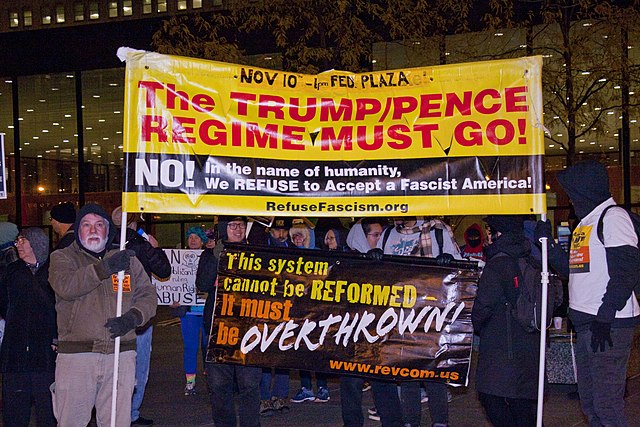
With each passing day, the Trump administration becomes more authoritarian, shifting the country from a flawed democracy to some variant of fascism. What is President Donald Trump’s ultimate aim? Is he an old-fashioned authoritarian or some type of a new fascist or neofascist? What is the duty of democratic-minded citizens under an emerging dictatorship? Political scientist/political economist, author, and journalist C. J. Polychroniou addresses these and other questions about the current political climate in the United States in the interview that follows with the French-Greek independent journalist and writer Alexandra Boutri.
Alexandra Boutri: I’d like to start by asking you how worried you are about the collapse of “democracy” in the United States and whether it is worth defending a governing system that has worked almost exclusively for the super-rich and the privileged classes.
C. J. Polychroniou: This is a provocative but nonetheless gripping question! My own feeling is that everyone who cares about fundamental personal freedoms, such as freedom of speech, and basic human rights, such as the rights to health, education, a decent standard of living, and a clean environment, should be terribly worried about what is happening in the United States under the current administration. President Donald Trump and his cronies are a real menace to everything that defines a decent society in today’s world. First of all, they want to go back to a time when whiteness was dominant and there was a clear racial hierarchy. They despise racial equality and have nothing but contempt for poor and working-class people. They loathe the idea of an open society and find intolerable constraints on their powers to do as they please. Trump’s priority is concentrating wealth and power for himself and his family. It is a self-serving, special interest presidency unlike anything we have seen in contemporary U.S. politics. George W. Bush’s corrupt presidency, with its long-standing connections to the oil industry, pales in comparison to the way Trump is using the office of the presidency to increase his own personal wealth and that of his family. Donald Trump is the ultimate used car sales conman who will say and do anythig to make an extra buck. For him, democracy and the rule of law are meaningless concepts as evidenced by the way he is systematically targeting universities, courts, the press, and his political opponents. He is astonishingly corrupt, shockingly cruel, and all his political moves are out of the authoritarian playbook. I should add that he is also one of the dumbest presidents, profoundly ignorant of history, geography and scores of other subjects. As so many sources have pointed out, he most likely does have a “lethal aversion to reading.”
Now, you are right of course in pointing out that the system of government in the United States is one that has favored overwhelmingly the rich and the powerful. American democracy is a sham in many ways. The United States is best defined as an oligarchy rather than a democracy. Still, it has been a free country, up until recently, which means the pursuit of political alternatives were open to the citizenry, although the challenges of doing so were and remain unquestionably enormous. Now, unfortunately, we find ourselves at a stage where concerned citizens have to fight for the mere protection of personal freedoms. Resisting Trump’s authoritarianism is a must if there is to be any hope for a better future. We need to defeat the neofascists. That’s the number one priority. But we need to do this while advocating a real alternative for a sustainable future.
Alexandra Boutri: Why is Trump so keen to use the military on home soil? In Portland, he has even authorized troops to make use of “full force.” Has he gone completely bonkers?
C. J. Polychroniou: I see several reasons behind the wannabe dictator’s yearning to use the military to implement his domestic policies and enforce his dystopian view of America. First, he is doing it as a form of intimidation, which is of course an old fascist tactic. It is really his way of letting everyone know that there is a new sheriff in town who doesn’t tolerate dissent and refuses to accept challenges to the way he thinks the country ought to be run. After all, you should know that the “beloved leader” knows best how to run a country after having studied extensively the works of Plato, Aristotle, Cicero, Hobbes, Locke, Montesquieu, and so on and so forth.Second, he is doing it because Republicans are clearly behind his vision of using the military as a tool for his domestic policy goals but also because he is worried about the outcome of the 2026 midterm elections. His actions target Democratic-leaning cities, so it’s all part of a PR campaign and very little to do with some strategic crackdown on crime. In Washington, DC., the National Guard was not deployed to neighborhoods where crime is higher than in other areas but to tourist sites where there is very little crime. At any rate, his MAGA base loves this display of such authoritarian tactics in an alleged fight against crime in blue cities.
Third, he is doing it because it boosts his ego and makes him feel like a strongman. This was the purpose of the idiotic military parade in Washington, DC this past June to mark the Army’s 250th anniversary, which, conveniently enough, coincided with the “beloved leader’s” 79th birthday. We must not underestimate how important of a role psychology plays in Trump’s behavior.
Finally, the intrusion of the military into civilian life could very well be for the purpose of normalizing such a situation in the event that a coup becomes necessary at some point down the road in order to keep Trump and the Republicans in power.
Alexandra Boutri: Old-fashioned authoritarian, fascist, neo-fascist, or proto-fascist? What’s the best way to describe Trump and his actions?
C. J. Polychroniou: There are subtle differences between authoritarian regimes, military dictatorships, fascism, and Nazism. What we are witnessing today is the decline of liberal democracies under the oppressive weight of 45 years of neoliberal policies and the rise of a new wave of right-wing authoritarianism that can be called neofascist or proto-fascist. In practical terms, it makes very little difference how we label Donald Trump’s dystopian vision of America and the actions of his administration as long as we are absolutely clear that they represent a real threat to the most fundamental human rights and values that were discussed earlier. He is an authoritarian bully carrying out policies with tactics that bear similarities to fascism and who undoubtedly would like to see in place some sort of a proto-fascist social order based on white supremacy and plutocracy. He is a racist to the core, and that alone makes him intrinsically some sort of a fascist. Moreover, if it was entirely up to him, he would remain in power till the end of his life and rule with an iron fist. I have no doubt whatsoever about that.
Alexandra Boutri: Out of plain intellectual curiosity, what’s the difference between fascism and Nazism?
C. J. Polychroniou: Fascism and Nazism are similar ideologies that rely on mass irrationality, the cult of personality, the supremacy of the state, mysticism and the rejection of Enlightenment values, and the glorification of violence. In crime, both regimes enforced the death penalty (Italy had abolished the death penalty in 1889 while pre-Nazi Germany came close to doing so on many occasions, but all such efforts were always overturned in the end) and both ideologies are deeply racist and antisemitic. Still, there were differences between Italian fascism and Nazism in racial matters. Biological determinism and “blood” played a much more central role in Nazi ideology than it did in fascism. In fact, it was America’s racial laws that shaped Nazi policies in Germany, as James Whitman has so convincingly shown in his book Hitler’s American Model: The United States and the Making of Nazi Race Law. It was the Nazis who practiced mass extermination and genocide of groups deemed as “inferior races.”
Alexandra Boutri: How could democratically-minded citizens respond to an emerging dictatorial regime and protect democracy, even a flawed one?
C. J. Polychroniou: A soft dictatorial regime is emerging in the US, which could easily become a hard one if Trump is allowed to carry out to the end his reactionary agenda. When a country heads toward a dictatorship, rebellion becomes a duty. We need, first and foremost, solidarity. We need to protect those most vulnerable while at the same time taking political action through whatever legal means are available against presidential abuses of power. Protests, strikes, boycotting companies that support Trump, letting officials know where we stand, and joining groups advocating social change are useful tools and mechanisms of resistance. Educational work is also of critical importance in letting people know what is happening and raising public consciousness. General strikes are very difficult to organize in the US, and the closest the country has come to a national general strike was in 1886. But they can be a very effective form of direct action as they target the political regime itself as well as the system’s economy. Indeed, there have already been calls for the sort of direct action that will shut down the country from people like Democratic Representative Jim McGovern and Sara Nelson, head of the Association of Flight Attendants, and such calls may increase and become louder as the actions of the wannabe dictator become more threatening and increasingly more brutal.
I like to believe that we will not see in the US what Greece and Chile experienced in 1967 and 1973, respectively, but the United States is moving exactly in that direction. On September 22, Trump signed an executive order designating Antifa as a ”domestic terrorist organization.” Three days later, he issued a National Security Presidential Memorandum (NSPM-7) on Countering Domestic Terrorism and Organized Political Violence, accompanied by a fact sheet. This memorandum, which is far more dangerous than the Antifa order, is a truly fascist blueprint that directs the federal government to go after “anti-fascist,” “anti-capitalist” movements in the US. It basically targets anyone who is opposing Trump and his MAGA ideology.
One may say that these are ”paper tiger executive actions” and that Trump doesn’t have the legal authority to create new crimes, but such arguments miss the point. Trump has the entire repressive apparatus of the US state behind him, and he is someone who has shown us repeatedly that the Constitution and the rule of law mean nothing to him. He even has the Supreme Court backing his unlawful acts on immigration aids, political prosecutions, and withholding foreign aid. This is someone who does not hesitate to use the military to carry out deadly strikes against boats in the Caribbean and to order troops to use “full force” against American citizens protesting his fascist policies. The day when we see tanks rolling through the streets across America and curfews imposed may, perhaps, not be that far away after all.

No comments:
Post a Comment