When Ceasefire Finally Arrived Here in Gaza, What Poured Out of Me Was Grief
Now that the airstrikes have stopped, we face a new devastation, assessing our ruined homes and mourning our loved ones.
By Dalia Abu Ramadan ,
 Palestinians rally around aid trucks which entered from the Karem Abu Salem crossing, in Khan Younis in the southern Gaza Strip, on October 12, 2025.OMAR AL-QATTAA / AFP via Getty Images
Truthout is an indispensable resource for activists, movement leaders and workers everywhere. Please make this work possible with a quick donation.
Ithought that joy would keep me awake after the ceasefire in Gaza was confirmed in the hours before dawn on October 10, but instead, tears did. I opened my phone to check on my people, only to find sorrow spreading everywhere. After two years of endless war, what poured out of many of us was not joy — it was the grief we had buried too long.
There was no true cry of joy around me as there was at the start of the previous 60-day truce in January, which had ended quickly and was followed by the return of war. That painful experience was enough to break our spirits, making the celebration of the current ceasefire muted, cautious, and heavy with grief.
By the time the news of the ceasefire came, the Israeli military had killed 67,806 people in Gaza and left 170,066 more wounded and 9,500 missing. It had erased entire cities, leaving them uninhabitable and destroying every trace of life.
On the morning of October 9, 2025, I woke up in my tent in Khan Younis, the part of southern Gaza that I had fled to on September 23, after my life in the north was stripped of everything human.
Living in that tent, I was trying to hold on to the hope of graduating — finishing what I had started despite it all. I studied through power outages and internet blackouts, inside a tent that barely shielded me from the cold, just to prove to myself that the war hadn’t defeated me yet. It was a daily struggle between the will to live and the feeling of helplessness.
Related Story
In Gaza City, I Have Been Rendered Homeless in My Homeland
After our apartment was bombed, we tried to flee south but failed, returning to our ruined home only to be bombed again. By Dalia Abu Ramadan , Truthout September 24, 2025
I was surprised to hear ongoing airstrikes and shelling in the area I had fled to, despite the news of an imminent ceasefire. The situation was terrifying.
That day, when I heard that Trump planned to announce a ceasefire, I didn’t believe it; he had made that promise many times before.
I was living through a despair I had never known before. I was surprised to hear ongoing airstrikes and shelling in the area I had fled to, despite the news of an imminent ceasefire. The situation was terrifying, especially during the final critical hours of the war, when we all felt unsafe. After enduring two years of conflict, it was difficult to imagine that civilians could still die even amid mentions of a coming ceasefire.
Despair took over, and I went to sleep — until a call from my uncle in northern Gaza woke me at 2 a.m., telling me that Trump had officially announced the success of the first stage of the ceasefire. The rest of my exhausted family woke up; we heard the news, said, “Alhamdulillah” (“thank god”), and went back to sleep. I stayed up crying, unburying my grief.
The ceasefire was officially implemented at 12 p.m. on October 10, 2025. I heard ululations echoing across the camps — cries of relief that the killing had stopped, yet not of true joy. We know that new wars await us — even if we no longer contend with weapons, we now contend with the enormity of our grief and loss.
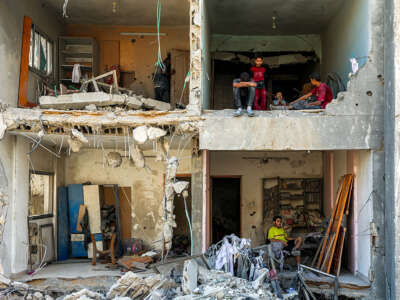
Those who lost their families would face the devastation of absence — remembering the smallest details of a life that no longer exists. And I, like many others, face another devastation — that of losing my home. My house was destroyed. It wasn’t just walls that fell, but a space filled with safety, laughter, and memories. Now, I carry my home within me, not upon the land.
Wafaa Al-Astal, my father’s cousin’s wife, lost her son Abdullah Haider Al-Astal in an Israeli strike in the al-Mawasi area of Khan Yunis. Israeli authorities had advised residents from northern Gaza to evacuate to that area, claiming it was safe. Yet Abdullah and his friends were targeted there. “I felt the depth of the pain when I heard the war had ended,” Wafaa told me. “My son, who was 21, had been waiting for that day. But as a mother, I still consider myself luckier than those who lost all their children, and have none left.”
Unfortunately, Israeli forces have not fully withdrawn from the Gaza Strip: Israel still controls about 58 percent of the territory. They only withdrew from central Gaza City and the Tel al-Hawa and Al-Rimal neighborhoods, while remaining in parts of northern Gaza such as Beit Lahia, Beit Hanoun, and sections of eastern and western Shujaiya.
After this partial withdrawal, many people returned to the rubble of their homes, trying to assess what remained of their lives. But the ceasefire was only the beginning of another phase of pain.
All of my father’s friends who returned north found their homes completely destroyed. As for us, our house in Tel al-Hawa, a neighborhood in the northern part of Gaza, had already been reduced to ruins during the first month of the war.
Even in the Mawasi area of Khan Younis in southern Gaza, where I was temporarily displaced after the escalation of fighting in the north, I saw many residents returning to Khan Younis City, the center of the governorate, carrying the same sorrow. Among them was my father’s cousin’s son, who went to Khan Younis City — one of the areas from which Israeli forces had withdrawn — only to find that all his property had been completely destroyed.
All of my father’s friends who returned north found their homes completely destroyed.
If the war had ended long ago, joy would have filled every home. But now, the situation is different: nearly every household, north and south, is mourning a family member killed by Israel during this genocide. All of us have lost a part of ourselves; no one has remained unchanged, especially after two years of this brutal extermination war.
Most of us have lost loved ones forever. Many have also lost limbs — hands or feet — and will suffer for the rest of their lives. Around 4,000 children are enduring these injuries.
The world thinks we are “happy” now, but how could we be? My city is dead in every sense: Israel has largely destroyed its homes, hospitals, universities, and schools. Two years of hell have turned our lives upside down. The question now is: when will we reclaim the old Gaza? And will we ever regain the 58 percent of the land that caused so many people to be displaced?
We continue to love Gaza despite its destruction, despite the ruins, despite all that we have lost. People abroad ask me, “Will you emigrate?” I answer, “How could I? I have lived two years of death, refusing to leave!”
We live here, amid the ruins and destruction, trying to get through each day as best we can. Gaza is our soul and our heart, even in the hardest moments. No matter how much the Israeli military tries to destroy us, it cannot break our will or kill our love for this land. We will stay, live, love, and resist!
This article is licensed under Creative Commons (CC BY-NC-ND 4.0), and you are free to share and republish under the terms of the license.

Dalia Abu Ramadan
Dalia Abu Ramadan is a Palestinian storyteller and aspiring graduate of the Islamic University of Gaza, sharing powerful narratives that reflect the strength, resilience, and challenges of life in Gaza.
The West’s Dehumanization Of Arabs Is Completely Unforgivable
These last two years have shown us that Western civilization doesn’t need protection, it needs redemption. It needs to save its soul.

In October 2024, a Lebanese writer named Lina Mounzer wrote, “ask any Arab what the most painful realization of the last year has been and it is this: that we have discovered the extent of our dehumanization to such a degree that it’s impossible to function in the world in the same way.”
I’ve thought about that line a lot over the last year.
I thought about it as Israel hammered Lebanon with at least 20 airstrikes during a supposed “ceasefire”.
I thought about it during the Gaza ceasefire negotiations when the Western political/media class kept calling the Israelis held by Hamas “hostages” while calling the innocent Palestinians held captive by Israel “prisoners”.
I think about it as the IDF continues to murder Palestinian civilians every day during the Gaza “ceasefire” when they are deemed to be traveling into forbidden areas, because Palestinians are so dehumanized that Israel sees bullets as a perfectly legitimate means of directing civilian foot traffic.
I think about it as these daily ceasefire violations and acts of military slaughter barely make a blip in the western news media, while any time anything happens that makes western Jews feel anxious or upset, it dominates headlines for days.
I thought about it while the western political/media class solemnly commemorated the second anniversary of the October 7 attack, even as the daily death toll from the Gaza holocaust ticked along with its victims unnamed and unacknowledged by those same institutions.
I thought about it when all of Western politics and media stopped dead in its tracks and stood transfixed for days on the assassination of Charlie Kirk while ignoring the genocide he had spent the last two years of his life actively manufacturing consent for.
Day after day after day, we see glaring, inexcusable discrepancies between the amount of attention that is given to the violent death of an Arab and the attention that is given to the violent death of an Israeli, a Western Jew, or any Westerner.
These last two years have been a time of unprecedented unmasking in all sorts of ways, but I think that’s the one that’s going to stick with me the most. The way Western civilization came right out into the cold, harsh light to admit, day after day after day, that they don’t truly view Arabs as human beings.
Ours is a profoundly sick society.
One of the main arguments you’ll hear from rightists about why the West needs to support Israel is that Israel is helping to defend the West from the savage Muslim hordes — a sentiment that Israeli pundits and politicians have been all too happy to feed into of late. It’s revealing because it’s just coming right out and saying that slaughtering Muslims is a virtue in and of itself, so anyone who kills Muslims is an ally of the West.
But whenever I come across this argument, all I can think is, why would anyone want to defend the West if this is what it has become?
Even if we pretend that these delusions that Arabs and Islam pose some kind of threat to Western civilization are valid, why would it even matter? This civilization does not deserve to be saved. Not if we’re going to be living like this.
If we’ve become so detached from our own humanity that we can’t even see innocent children as fully human just because they live somewhere else and have a different religion, then we are the monsters. We are the villains. We are everything the craziest Zionist pretends the Arabs are.
These last two years have shown us that Western civilization doesn’t need protection; it needs redemption. It needs to save its soul.
No comments:
Post a Comment