Trump’s ‘peace’ in the Middle East: A retrocolonialism built on sand
First published at The International Marxist-Humanist.
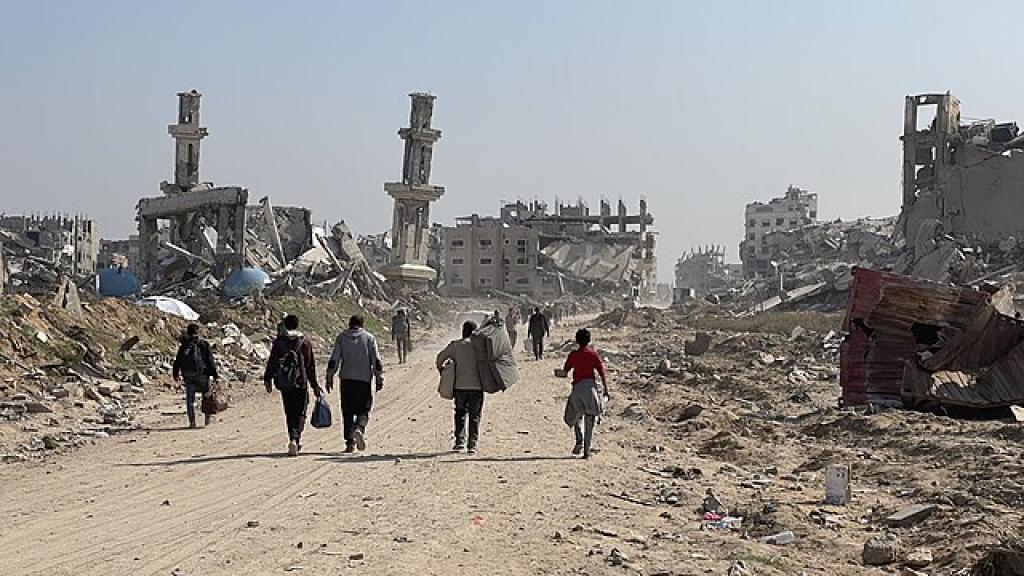
After two years, the guns are silent, at least for the most part. Long-suffering Palestinians are heading back to their hometowns and villages in Gaza, and the remaining Israeli hostages and some Palestinian prisoners are being released. Meanwhile, the Israeli Knesset has toasted US autocrat Donald Trump as the hero of the hour, and Arab, Muslim, and Western European leaders — from the EU nations to Egypt, and from Turkey to the Gulf monarchies and Pakistan — have gathered to celebrate these developments, while also genuflecting to Trump.
These bizarre ceremonies — in Jerusalem and Sharm El-Sheikh — proceeded with nary a word about the 67,000 Palestinian deaths that have resulted in legitimate genocide charges against Israel, nor the fact that not a single Palestinian representative was involved in the elaboration of the “peace” plan, nor the lack of even the kind vague promises of future elections that usually follow impositions from above like military invasions and coups.
In fact, Trump’s twenty-point “peace” plan does not contain the word “election” or “representative.” It does state:
Gaza will be governed under the temporary transitional governance of a technocratic, apolitical Palestinian committee, responsible for delivering the day-to-day running of public services and municipalities for the people in Gaza. This committee will be made up of qualified Palestinians and international experts, with oversight and supervision by a new international transitional body, the ‘Board of Peace,’ which will be headed and chaired by President Donald J. Trump, with other members and heads of state to be announced, including Former Prime Minister Tony Blair.
In short, what is proposed is a retrocolonialist protectorate, reminiscent of the imperialist machinations that divided up the Ottoman Empire after World War I — the infamous Sykes-Picot Agreement — or even of the carving up of Africa by European powers in 1884-85.
This will not pass!
As the celebrated Arab Marxist Gilbert Achcar predicts on his blog:
As for the proud Palestinian people, they have spent a century proving their refusal to submit to their oppressors — whether the British Mandate authorities or the Zionist government. They will not kiss Donald Trump’s hand or show him ‘appreciation,’ no matter what those who claim to represent them may do. They will not submit to the so-called Peace Council chaired by Trump, which includes figures like Tony Blair, George W. Bush’s partner in the occupation of Iraq. Instead, the Palestinian people will continue their struggle for full rights, undiminished. (“Trump at the Knesset and Sharm el-Sheikh: A Festival of Obsequiousness,” Oct. 14, 2025).
During two years of hellish bombardments, of an Israeli genocide that has surely killed untold numbers beyond the 67,000 officially reported, the Palestinian people of Gaza have never given up. Not a single hostage was ever turned over to Israeli forces despite death raining down and starvation stalking the land for over 700 days. As they streamed back into their ruined cities and towns, one marcher declared ringingly to the global media:
We, Palestinians, are showing our attachment to our land and our resilience” (Laure Stephan, “A Gaza, le retour massif des deplacés dans le nord de l’enclave, Le Monde, Oct. 13, 2025).
Nor will the people of the world give up, especially the youth, who have engaged in two years of truly colossal street demonstrations, strikes, and occupations in support of Palestine. Among the latest manifestations here were a giant rally in Amsterdam, a massive general strike in Italy. Even in the US, public opinion has shifted so far against Israel and its genocide that a rightwing commentator complained recently, “Everybody under 30 is against Israel” (David Halbfinger, “Test for Israel: Repairing Ties to U.S. Voters,” NY Times, Oct. 13, 2025).
To be sure, the silence over Palestine that existed in the region and the world before October 7, 2023 has been shattered by the events of the past two years. Palestine is sure to remain high on the agenda of movements for global justice and peace for the foreseeable future.
For now, though, the Trump “peace” plan is a bitter, imperialist pill that the region is being forced to swallow. It and the world have had to watch the smiling perpetrators of genocide claim victory, ringed by supposed friends of the Palestinian people. At least for now, this has been a defeat for Palestine and for the global movement for human liberation.
Defeats like this are a time to regroup and continue the struggle, which we will surely do.
They are also occasions for reflection and rethinking. For the last two years have not only shattered the complacency of those regional and global powers that thought they could ignore Palestine, that the Palestinian people had been defeated, bottled up behind Israel’s apartheid walls, and silenced.
These two years have also shattered the Axis of Resistance backed by Iran, and including the Syrian regime, Lebanese Hezbollah, and the Houthi-ruled part of Yemen, all of them declared supporters of Palestinian Hamas. They were unable or unwilling to aid Gaza in any meaningful way. The overthrow of the murderous Assad regime in Syria due to mass disaffection in the face of a small military force, and the barbaric Israeli attacks on Iran and Lebanon have severely weakened, if not destroyed, this alliance of convenience.
New pathways of resistance to the new and undisguised forms of imperialism developing around Trump’s Gaza “peace” plan will need to be found. Many will question the recourse to armed attacks by well-disciplined groups operating in secret, and links to dubious allies, vs. the kind of public mass movements that have been the hallmark of all successful revolutionary movements in recent years, and which are evidenced in the Gen Z revolutions taking place around the world today.
As we continue and deepen our support for the Palestinian resistance and our demands that those responsible for the genocide be held to account, and above all for the full national liberation of the Palestinian people, we will also be, as Marxist-Humanists, engaging in the global debates about where to go from here.
— Approved as a Statement of the Steering Committee of the International Marxist-Humanist Organization on October 15, 2025
There are no ceasefires on stolen land: Liberation, not liberal Zionism
First published at Spectre.
Social media is filling up with images of what can only be called joyous determination — images of Gazans returning to their devastated city and rebuilding, reconstructing, renewing. I cannot stop watching videos of children hugging their cats, of women and men laying bricks on a bombed-out home, of twins reuniting. All this amidst what the IOF called “finishing touches” to their two-year holocaust: as they were forced to retreat from Gaza, they set fire to food, homes, and a critical water treatment plant in their own version of “festival of the oppressor.”
The current ceasefire includes consistent bad faith deals from the usual suspects. The Israeli list of Palestinians to be released as part of the hostage exchange has carefully left out the names of several popular leaders whose release Hamas has insisted upon. Among them are Marwan Barghouti (popular leader, often called the Palestinian Mandela), Ahmad Saadat (Secretary-General of the Marxist group the Popular Front for the Liberation of Palestine), Hassan Salameh (Qassam Brigade member with forty-eight life sentences, the third highest among all Palestinian prisoners), and Abbas al-Sayyed (senior Hamas Leader).
The two sides at the negotiating table seem to have been negotiating for completely different realities, with Hamas asking for a permanent ceasefire guaranteed by the United States and Israel asking for a “demilitarized Gaza” with Hamas completely dismantled. In his televised address to the nation, Benjamin Netanyahu declared that “If this [dismantling of Hamas] is achieved the easy way — so be it. If not — it will be achieved the hard way.”1 The United States of course has refused to comment on any of this — perhaps the President is waiting for Jared Kushner’s riviera plan with Leo DiCaprio’s hotel chain?
In these circumstances every Palestinian — and everyone serious about winning freedom for Palestine — knows that the ceasefire is simply a respite, and an unstable one at that. After all, the IOF still controls 53 percent of Gaza. Even if the active genocide moves away from the headlines (undoubtedly to the relief of mainstream Western media), all of us know that the everyday violence will continue in Gaza and the West Bank. Ceasefire or no ceasefire, settlers and the IOF will continue to harass, violate, and kill Palestinians. Under these circumstances, nothing is more urgent than an assessment of the ceasefire and a collective discussion of future strategies for the international Palestine movement. It is the movement, of course, that has brought us to this point.
What ceasefire on stolen land looks like
While is true that the Zionist project continues, the current respite has won some short-term victories:
- Israel has been reduced to a global pariah.
- None of the Palestinian leadership has been exiled.
- The Blair Witch Project — Mouin Rabbani’s brilliant term for former UK Prime Minister Tony Blair’s prospective leading role in Gaza’s interim authority — seems to have been put on hold.2
- Some aid is trickling in.
- Most importantly, Palestinians are finally returning to their homes in a city where caring for the living can never be paused, even for a moment, to mourn the dead.
While the wins may seem momentous after two years of publicly broadcast genocide, the alarming aspects of this ceasefire deal are also becoming more evident:
- Israel has yet to be held accountable for their internationally recognized war crimes.
- No major Western power has cut financial ties with Israel or imposed sanctions.
- The plans for an archipelago of “Bantustans” in Palestine have not been withdrawn. Nor have the grotesque plans for Gaza as a beach resort.
- Despite the two-year long holocaust, a full 76 percent of US Jews still view Israel’s existence “as vital for the future of the Jewish people” (though many of those remain critical of Israel’s actions in Gaza).3 The idea that Zionism and settler colonialism are the only solutions to (very real) European antisemitism continues to thrive.
Once the deal is weighed thus, it becomes clear that there can never be any permanent ceasefire on stolen land. For the movement, then, “right of return” and “land back” remain our goals.
Moving from respite to liberation
Let me clarify at the outset the social movements that I think brought us this small respite: the global spread of large internationalist marches, the campus revolts, the flotillas, the magnificent general strike in Italy, and the less spectacular but equally significant labor actions on campuses and other workplaces.4 And, finally and most importantly, Palestinian actions against the Occupation in Gaza and the West Bank. These actions, taken together, are what constitute “the movement” at this current moment. This movement, in all its component parts, needs to be strengthened and spread in order to move from respite to liberation.
If we on the left take this task of amplifying our reach seriously, there are bound to be debates about the fine print, which strategies are best, with whom we should be collaborating, how we deal with state repression, and so on. Comradely debate is the hallmark of a healthy left and since October 7, we have seen some truly generative discussions in the movement about the role of violence, the meaning of decolonization and sovereignty, and the relationship between capitalism and colonialism. I believe that Jacobin has published Eric Blanc’s interview with Hoda Mitwally and Bashir Abu-Maneh in this spirit: as a contribution to a discussion about strategy.5 It is a long piece, and I encourage everyone to read it. But here I want to challenge a few of their contentions with a different perspective.
The first assumption of the piece is that the movement in the United States has “failed to consistently build the biggest and broadest coalition possible.”
The second assumption is that the narrowness of the movement is attributable to the ultraleft politics of its leadership. The two examples they cite are:
(a) that the campus “encampments’ rhetoric was often kind of inflammatory (and prone to misinterpretation), which undercut efforts to involve and persuade others to join the fight for a ceasefire and divestment”;
(b) that some Palestinian groups, which they acknowledge “have led some of the bigger protests,” are essentially “middle-class activists” who insist on excluding even liberal Zionists from the movement. This, the authors reason, is because these activists do not understand class politics. It is for such misguided reasons that these ostensibly ultraleft activists have harsh criticisms of DSA representatives such as Alexandria Ocasio-Cortez (who supports the Iron Dome) and Jamal Bowman (who refuses to abide by the DSA’s own resolution on BDS); and finally,
(c) that the correct way to broaden the movement is to “get our hands dirty” and commit to “united-front, inside-outside efforts to win a permanent ceasefire.” Instead, the authors complain that the “US activist left” has incorrectly made the Iron Dome into a make-or-break symbol,” and they “have a preexisting ideological orientation toward trying to break the Left from the Democrats immediately or in the very near future.”6
The two dangerous fantasies that these arguments enclose, and from which their logic flows, are as follows:
(i) that middle class student-activist types rather than real working-class people are leading this movement; and
(ii) that only struggles at the point of production constitute “class struggle,” and transformative change can only come through those.
I think these comrades and I have been reading our Marx, not to mention our daily newspapers, rather differently. Three regimes in South Asia, the region I come from and study, have been overturned in the last year by student-led movements!7 Ought we to be condemning the young people of Sri Lanka, Nepal, and Bangladesh for being insufficiently Marxist?
Sarcasm aside, between October 7, 2023 and March 2024, over a million people joined these marches for Palestine in the United States. Are the comrades so assured that there was no class orientation to them? That these marches and die-ins were effective is now undeniable. A March Gallup Poll shows that public opinion on Israeli action in Gaza changed from majority approval (November 2023) to majority disapproval (March 2024).8
Similarly, over 3200 people were arrested during the student encampment wave.9 Students, faculty, and staff were beaten, fired, expelled, and deported. The administration turned campuses into a warzone against unarmed, peaceful students exercising their constitutional right to protest. There were snipers on our roofs and armed guards controlling where we could go. I know first-hand that many nonunionized staff, adjunct faculty, and even workers from some campus bookshops came out in full-throated support for the students and formed cordons to protect them from the police. Another critical aspect of the encampment movement, perhaps its most important, was that it had the full support of the Palestinian BDS National Committee (BNC), which declared that the encampments “brought to international attention like never before the complicity of their academic institutions in Israel’s genocide and apartheid.”10
I would unhesitatingly call this class struggle. Wouldn’t you?
Needless to say, I am in complete agreement with the authors that only workers under capitalism have the kind of power we need to shut the system down. See Italy. But modern history has shown us again and again that there is no unilinear logic to class action. That is, class action does not always begin in the workplace and spread outwards. While a strike can initiate the fall of a regime, such a strike can be catalyzed by a group of absurdly brave civilians, in little dinghy boats, armed only with baby food and rice, set to confront an empire. Again, see Italy.11
I also agree with the authors that this is a critical moment for the Palestine movement in the United States. The next few months will determine whether we continue on the old route of appeasing liberal Zionism and “collaborating” with such elected Democratic Party officials on their own terrain of electoral politics, the consequences of which lie in the ruins of the left around us. Or if we will take our lead from Palestine, from the flotilla, and yes, from the young activists — working class, immigrant, and student — and continue to build our movement away from the contagion that is liberal Zionism. I am confident one can argue that US funds should go to healthcare and not Israel at a union meeting (as the authors rightly argue we should) without linking arms with Brad Lander or Adam Schiff. AOC will always be welcome in our encampments, marches, and pack-the-courts actions. But in order to extend that welcome we need not use a public forum to apologize for her embarrassing defenses of the Iron Dome.12
Trump’s ceasefire deal is his way of restabilizing US relations with Gulf capitalism and making nice with Qatar, angered by the reckless Israeli airstrike on September 9. He wants a relaunch of his 2020 Abraham accords for the sake of his declining empire and to ensure that Gulf money flows into his planned beach project in Gaza.13
It is striking that the Palestinian hostages are loaded onto buses from Israel to reach their families in historic Palestine. Buses, not airplanes or boats, indicate the short distance between these factories of torture and home. That road is now paved with the bodies of more than sixty-seven thousand Palestinians, of whom at least twenty thousand are children.14
For those of us not in Palestine, the ceasefire is merely a window to rebuild our forces and renew our efforts to help restore to historic Palestine her unbowed people, her rich olive groves, and her poets who sing of freedom.
Tithi Bhattacharya is an editor of Spectre. She writes here in a personal capacity, in no way reflecting the views of any organization or institution.
- 1
Jason Burke, “Hamas will be disarmed, Netanyahu vows after ceasefire begins,” Guardian, October 10, 2025, https://www.theguardian.com/world/2025/oct/10/what-does-gaza-deal-hamas-mean-for-benjamin-netanyahu-future.
- 2
Tweet by Mouin Rabbani (@MouinRabbani), X, October 10, 2025, 9:55 p.m., https://x.com/MouinRabbani/status/1976828875201028367; Richard Cowan, “Trump unsure whether Tony Blair would be accepted on Gaza peace board,” Reuters, October 13, 2025, https://www.reuters.com/world/europe/trump-unsure-whether-tony-blair-would-be-accepted-gaza-peace-board-2025-10-13/.
- 3
Jerusalem Post Staff, “Majority of Jews think Israel committed war crimes, 40% say guilty of genocide in Gaza – poll,” Jerusalem Post, October 5, 2025, https://www.jpost.com/diaspora/article-869406.
- 4
Sam Jones et al, “The Gaza effect: how a global pro-Palestine protest movement met repression and resistance,” Guardian, October 11, 2025, https://www.theguardian.com/world/2025/oct/11/the-gaza-effect-how-a-global-pro-palestine-protest-movement-met-repression-and-resistance.
- 5
Eric Blanc, Bashir Abu-Manneh, and Hoda Mitwally, “Ultraleftism Can’t Free Palestine: An Interview with Bashir Abu-Manneh and Hoda Mitwally,” https://links.org.au/ultra-leftism-wont-help-free-palestine
- 6
Blanc, Abu-Manneh, and Mitwally, “Ultraleftism Can’t Free Palestine.”
- 7
Yashraj Sharma, “Nepal, Bangladesh, Sir Lanka: Is South Asia fertile for Gen Z revolutions,” Al Jazeera, September 16, 2025, https://www.aljazeera.com/features/2025/9/16/sri-lanka-bangladesh-nepal-is-south-asia-fertile-for-gen-z-revolutions.
- 8
Jeffrey M. Jones, “Majority in U.S. Now Disapprove of Israeli Action in Gaza,” Gallup, March 27, 2024, https://news.gallup.com/poll/642695/majority-disapprove-israeli-action-gaza.aspx.
- 9
Associated Press, “Thousands were arrested at college students. For students the fallout was only the beginning,” NBC, August 2, 2024,https://www.nbcnews.com/news/us-news/thousands-arrested-college-protests-students-fallout-was-only-beginnin-rcna164807.
- 10
BDS Movement, “Student Solidarity,” BDS, n.d., https://bdsmovement.net/student-solidarity, emphasis added.
- 11
Laura Montanari, “Italy’s Second General Strike for Gaza Brought 2 Million Workers into the Streets,” Truthout, October 11, 2025, https://truthout.org/articles/italys-second-general-strike-for-gaza-brought-2m-workers-into-the-streets/; Leopoldo Tartaglia, “Millions of Italians Join General Strike for Gaza,” Labor Notes, October 9, 2025, https://www.labornotes.org/2025/10/millions-italians-join-general-strike-gaza.
- 12
Blanc, Abu-Manneh, and Mitwally, “Ultraleftism Can’t Free Palestine.
- 13
Kevin Liptak, “Trump’s Insistence produced a ceasefire in Gaza. Now he hopes it will end the way,” CNN, October 13, 2025, https://www.cnn.com/2025/10/13/politics/donald-trump-ceasefire-israel-gaza-war.
- 14
Marium Ali, Alia Chugtai, and Muhammet Okur, “Two years of Israel’s genocide in Gaza: By the numbers,” Al Jazeera, October 7, 2025, https://www.aljazeera.com/news/2025/10/7/two-years-of-israels-genocide-in-gaza-by-the-numbers; “Gaza’s Missing Children: Over 20, 000 Children Estimated to be Lost, Disappeared, Detained, Buried Under Rubble Or in Mass Graves,” Save the Children, June 24, 2024, https://www.savethechildren.net/news/gazas-missing-children-over-20000-children-estimated-be-lost-disappeared-detained-buried-under.
No comments:
Post a Comment