‘We have the product to play the game’: Can BYD’s meteoric rise in Europe continue?
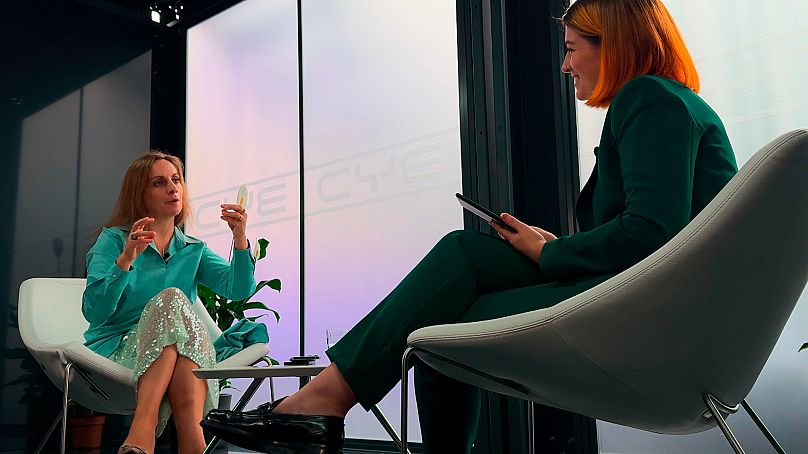
“The conversion rate from test drive to purchase is outstanding in every market,” BYD’s Maria Grazia Davino told The Big Question.
As the popularity of EVs continues to grow in Europe, so too does the strength of Chinese manufacturer BYD.
The firm's first models, the Atto 3, Han and Tang, officially hit European forecourts in late 2022, though other companies had begun importing them in the preceding years. Since then, their range has grown to offer at least 10 different vehicles.
According to data from the European Automobile Manufacturers’ Association (ACEA), BYD had a 1.1% market share of new vehicle registrations in the EU in July 2025, up from 0.4% in the same period the year before.
In the first half of 2025, unit sales increased 251.3% compared to the previous year, while EU new car registrations on the whole decreased 0.7% in that same period.
But with increased import tariffs for Chinese manufacturers making it harder to stay competitive, are European fears of a Chinese takeover unfounded
In this episode of The Big Question, Euronews reporter Hannah Brown sat down with Maria Grazia Davino, senior vice president and regional managing director at BYD Europe, to discuss the firm’s vision for its future in the bloc.
BYD takes on Europe
Davino, who joined the company earlier this year from Stellantis, spoke with a clear confidence in BYD’s vehicles. Perhaps, in part, due to her own experience.
“People sit in the car and you surprisingly see that the immediate acceptance is there—actually we exceed customers' expectations,” she explained.
“This is not only my direct experience, [it’s] what I observe, what customers tell me, what dealers tell me. The conversion rate from test drive to purchase is outstanding in every market.”
“BYD comes to Europe with a full commitment to enrich the industry,” Davino told The Big Question.
“We have superior technology and the product to play the game. There has been some narrative around it—like ‘you want to conquer’—no, it's not about conquering, we can't, we are so small compared to the others.
“I always say we are fuelled by the challenges that also humble us, and we are here to enrich the industry.”
Tougher competition for non-European companies
Right now in the EU, Chinese manufacturers pay an additional import tariff, on top of the standard 10%. SAIC, once China’s largest auto manufacturers, faces the steepest additional tariff at 35.3%. Geely, the parent company of Volvo, pays 18.8%, and BYD pays 17%.
Many vehicles made by the US firm Tesla are also manufactured in China, although the company’s additional tariff comes to just 7.8%. Despite this, BYD managed to outsell Musk’s famous EV brand in Europe for the first time in April 2025.
In addition to these tariffs, France recently announced incentives for consumers to buy EVs assembled in Europe and equipped with a European battery, a move designed to support European manufacturers.
“It just makes the competition tougher, but we are okay in competing,” Davino said.
“That's our company culture, you know. We are there to collaborate and compete, so we'll have to face it, be better, find alternatives so we will continue to compete.”
In a bid to strengthen the company’s presence in the bloc and boost competitiveness by avoiding import tariffs, BYD has established a manufacturing plant in Hungary. Production is set to begin by the end of the year.
“So the first product we will be producing there is a Dolphin Surf. And that's just a start, because at our plants, we can produce more than one car line, so that makes our productivity very flexible,” Davino told The Big Question.
“The teams at the dealers are also growing, and our brand in the market requests a certain number of qualified salespeople. So we also contribute to the [training and] qualification of these people.”
Will hybrids continue to outperform EVs?
Right now, hybrids are the most popular vehicle by power type, making up 34.8% of all new car registrations in Europe in the first half of 2025.
The key to their popularity, according to Davino, is that they’re providing a “convenient alternative”.
“You have a true electric vehicle with a 100km range. For example with the Seal 6 DM-i Touring that we have brought on the market now, just launched, you have a vehicle that does not give you any anxiety. With our vehicle, you can go up to 1,350 kilometres range,” She claimed that recent drivers were able to drive from Warsaw to Munich without needing to stop to refuel.
As technology improves and EV range increases, Davino said she can’t predict if the popularity of full electrics will surpass hybrids, emphasising that it's consumers deciding the fate of the industry.
The Big Question* is a series from Euronews Business where we sit down with industry leaders and experts to discuss some of the most important topics on today’s agenda.****
Watch the video to see the full discussion with BYD’s Maria Grazia Davino.
‘When people buy an EV, they rarely go back’: Hyundai CEO on designing for Europe
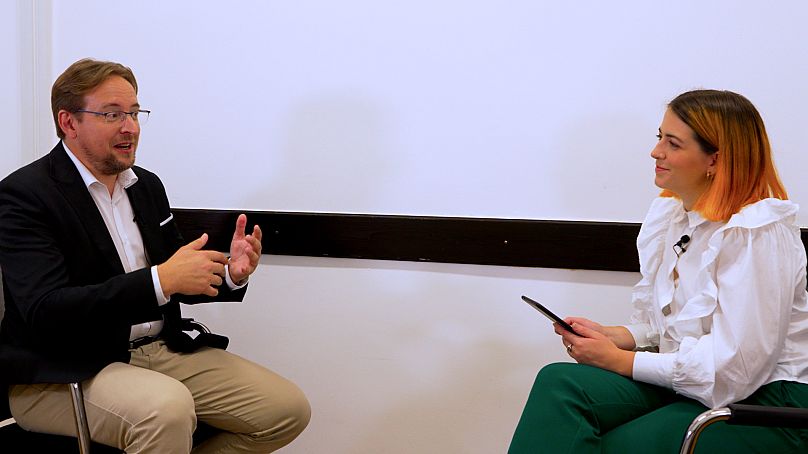
“If you're the second preferred vehicle for the customer, you're the first one they're not buying,” Xavier Martinet, President and CEO of Hyundai Motor Europe, told The Big Question.
Hyundai is probably one of South Korea’s most globally recognisable brands, with only the likes of Samsung and LG also vying for the title.
The Hyundai Motor Group, which owns Kia and Genesis, first arrived in Europe in the late 1970s. However, it was only in 1997 that they opened their first production site outside of South Korea, in Turkey.
“If you look at personal cars we're at 4% market share in Europe, we're ranked number 10 on the market,” said Xavier Martinet, President and CEO of Hyundai Motor Europe.
“When you look back in time, 10-15 years ago we were at half this market share, so Hyundai has been growing over time.”
In their 58 years of business, the company has managed to produce more than 100 million units worldwide and its factory in Ulsan, South Korea, is the largest automotive production plant in the world.
In this episode of The Big Question, Hannah Brown sat down with Xavier to discuss Hyundai’s place in the European market and how it sees the future of automotive power.
Hyundai in Europe
Aside from the production plant in Turkey, Hyundai has also been producing vehicles at a plant in Nošovice, Czech Republic, since 2008. Together, the two sites have a production capacity of 560,000 units per year.
According to Xavier, 79% of the vehicles sold by Hyundai in Europe in 2024 were produced in these two plants.
However, the greater-than-predicted success of their smallest EV to date, the INSTER, produced in South Korea, is expected to roll that number back to 70% in 2025.
While Xavier insists there’s no third plant planned in Europe just yet, he suggested that regional success for the firm’s newest releases could ignite a conversation around future investment.
A new EV from Hyundai
Hyundai recently announced the Concept 3 car, an EV in its IONIQ range that’s expected to hit the market early next year.
Positioned in the B-segment, accompanied by the likes of the Ford Fiesta, the Renault Clio and the Peugeot 208, the compact Concept 3 underlines Hyundai’s focus on offering EVs across all market segments—according to Xavier.
“What we see, for example, is that the EV mix is actually higher for fleet customers (who typically buy C- or D-segment vehicles), but retail buyers right now have a lower mix of EV. They still want to buy the old ones because either they don't find the car they want or the price is too high,” he explained.
“And this is why for us targeting this lower part of the segment with strong EV propositions was fundamental.”
He also highlighted the need to tailor vehicles specifically to the European audience.
“We need to develop products that are really taking into account European customers’ needs, lifestyles, demands—and the Concept 3 is a perfect illustration of that. When we do have global products, we need to calibrate them because you don't drive on the German Autobahn like you drive on an Interstate in the US, so we need to be able to really adjust and fine-tune the vehicle characteristics so that vehicles satisfy the customers wherever they drive,” Xavier told The Big Question.
What will power cars in the future?
Despite targets to boost EV uptake and Hyundai’s Concept 3 announcement, hybrid cars remain the most popular vehicle type for new purchases in Europe.
“Customers are usually keeping a car an average of six years in Europe. And for them to go directly from an internal combustion engine vehicle to an EV is an act of faith,” Xavier explained.
However, Hyundai isn't putting all their eggs into one metaphorical EV basket. They’re also leading innovation in the hydrogen-powered vehicle world.
“EVs are one great way to electrify the car park, but we also have some questions about access to rare earth materials and whether these tensions will really change,” Xavier said.
“So it's quite interesting to develop some kind of alternative that one day might become quite valuable as a compliment. So we're not opposing the two, we're just saying it's good to have different solutions to decarbonise the car industry.”
Right now, the hydrogen-powered vehicle market in Europe is virtually non-existent, with sales only in the hundreds. Cost and infrastructure are two of the main limitations, although Hyundai’s US branch is working on solutions.
“We're developing a car, bus, truck, and when you look at our plant in Savannah, Georgia in the US, we are also producing our own hydrogen. So, at the end of the day, you are not talking about one car, you talk about an ecosystem,” Xavier explained.
In a symbol of its commitment to diversifying power solutions, Hyundai has pledged to offer European customers an EV, hybrid, plug-in hybrid and hydrogen powered version of each of their models by 2027.
The Big Question is a series from Euronews Business where we sit down with industry leaders and experts to discuss some of the most important topics on today’s agenda.
Watch the video to see the full discussion with Hyundai’s Xavier Martinet.
No comments:
Post a Comment