Earthquake data could hold the key to predicting Mount Etna’s next eruption, study finds
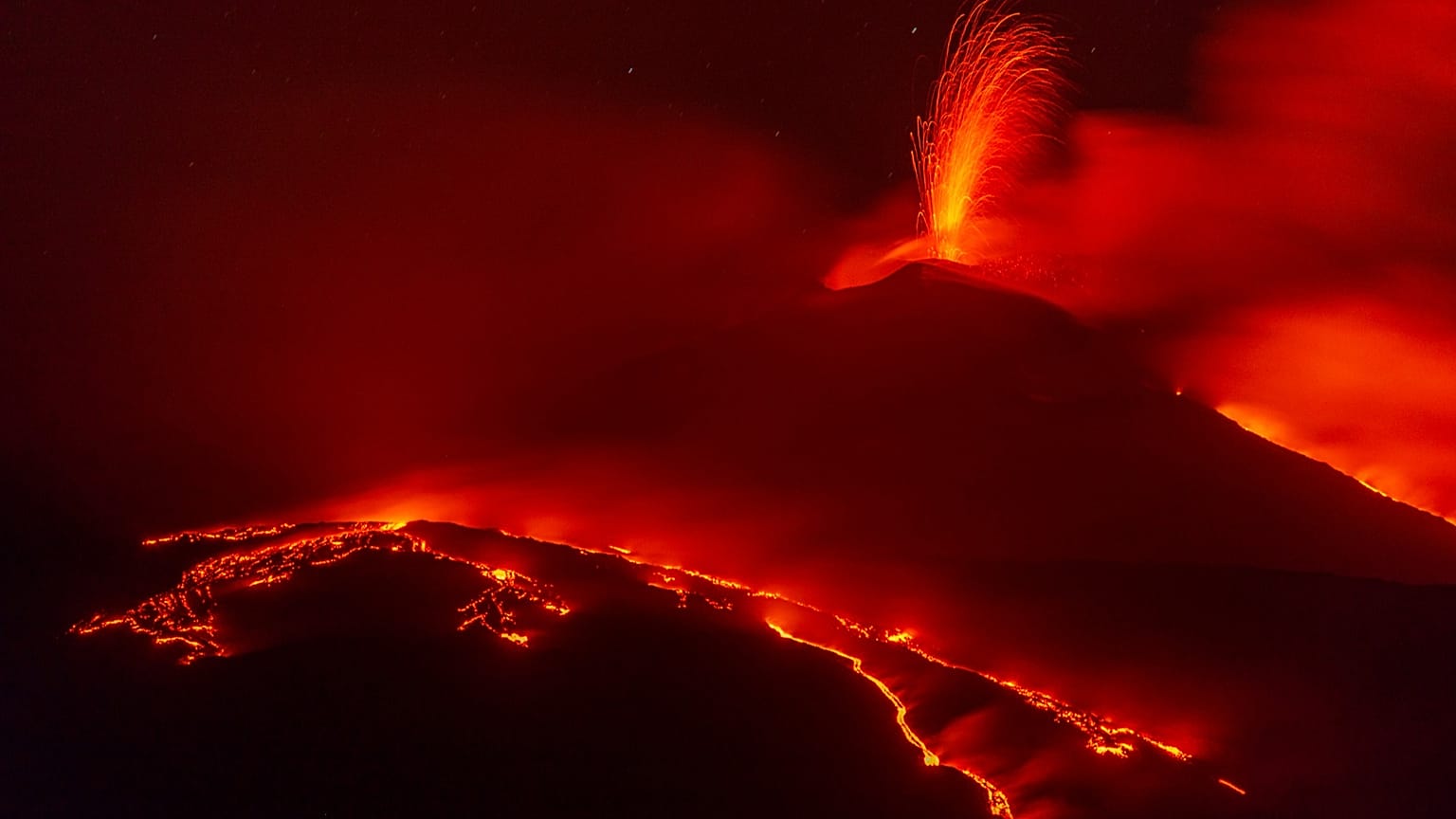
New research shows earthquake patterns can help forecast Mount Etna eruptions
Mount Etna is one of the world’s most active volcanoes. Located on the east coast of Sicily, it erupts multiple times per year - most recently in June this year.
While it is somewhat possible to predict eruptions, a new study publishedin Science Advances proposes a new prediction method that analyses earthquake patterns. It could allow for earlier and better preparedness.
How to predict volcanoes
Scientists currently monitor Mount Etna by looking at seismic, geological, geophysical, and geochemical data, especially how magma moves in the upper crust. From this, they are able to get a sense of whether the volcano will erupt shortly, as when magma erupts on the surface, it becomes lava. But oftentimes, there’s not a lot of time between an alert and aneruption.
This new study offers a different paradigm: looking at earthquakepatterns and magma movements on a deeper level.
Earthquakes and volcanoes are often interconnected. Earthquakes occur along tectonic plate boundaries, and Mt. Etna is situated right at the meeting point of the African and European tectonic plates. Small and big earthquakes affect the volcano’s magma movement, potentially influencing the eruption
A new method
The study, conducted by researchers National Institute of Geophysics and Volcanology, analysed two decades' worth of earthquake data from Mount Etna.
Researchers honed in on the “b value,” which basically assesses the proportion of small to large earthquakes. They found a correlation between volcanic activity and b value: the ratio changed as the magma rose through the crust. By plotting the “b value” over time, they could identify some early signs of volcanic eruption.
“Our results show that monitoring the b value over time offers a valuable opportunity to track magma movements from deep to shallow portions of the plumbing system and could be integrated into Etna’s multiparametric surveillance system to improve the assessment of impending eruptions,” the authors write.
Avoiding catastrophe
Earlier and more accurate prediction is crucial for the communities surrounding Etna. According toNASA, nearly one-third of Sicily’spopulation lives along the slopes of the volcano. June’s eruption saw ash plumes of 6.5 kilometres.
The authors see this new method as a way to avoid catastrophe, both at Mount Etna and other similar volcanoes.
“The b value could be used as an eruption precursor for other volcanoes where a sufficient number of earthquakes is available, ultimately leading to better management of volcanic hazard and public safety,” they write
Why earthquakes sometimes still occur in tectonically silent regions
image:
Global distribution of natural and induced seismicity. Natural earthquakes with moment magnitude higher than 5 are color-coded according to their hypocenter depth (upper right colorbar, U.S. Geological Survey (USGS) catalog, year 2021). Induced earthquakes are plotted with red markers. Injection-induced, extraction-induced, and events with unclear causes are marked by different markers (bottom right legend, Human-Induced Earthquake Database (HiQuake) catalog, till 2022, note that the catalog is not exhaustive).
view moreCredit: Utrecht University/Nature Communications
Earthquakes in the American state of Utah, the Soultz-sous-Forêts region of France or in the Dutch province of Groningen should not be able to occur even if the subsurface has been exploited for decades. This is because the shallow subsurface behaves in such a way that faults there become stronger as soon as they start moving. At least that is what geology textbooks teach us. And so, in theory, it should not be possible for earthquakes to occur. So why do they still occur in such nominally stable subsurfaces? Geosciences researchers from Utrecht University considered this question. They discovered that as a result of millions of years of inactivity, extra stress can build up on the faults which can result in a single release. This research, recently published in the journal Nature Communications, is vitally important in the search for safe locations for applications such as geothermal energy production and energy storage.
“Faults can be found almost everywhere. Faults in the shallow subsurface are usually stable, so we do not expect shock movements to occur along them”, says Dr Ylona van Dinther, who supervised the research. Nevertheless, shock movements often do occur in the stable first few kilometres of the subsurface. In such instances, we generally find a correlation with human activities. What exactly explains that paradox of shallow faults, which become stronger with movement, but then suddenly become weak and are subsequently released with a tremor?
Inactive faults heal slowly
Induced earthquakes (those caused by human activities) often take place on inactive faults that have not moved for millions of years. Although these faults do not move, we still observe a very slow growth of the surface that connects them. This sort of ‘fault healing’ gives rise to additional strength. It is this extra fault strength that can cause an acceleration once a fault has been set in motion. This acceleration is what causes earthquakes to occur in stable subsurfaces, despite textbooks telling us that this ought not to happen there.
Shallow
As such areas do not have a history of earthquakes, the people living there are more at risk as infrastructure has not been built to withstand earthquakes. “Furthermore, these earthquakes take place at a depth where human activities occur, in other words, no more than several kilometres deep. That is considerably less deep than the majority of natural earthquakes.” Therefore, they can be more hazardous and cause more ground shaking.
Lack of recurrence reduces earthquake risk
Interestingly, this potential acceleration, in the form of an earthquake, occurs only once. As soon as that extra fault strength, which has been built up over millions of years, finds a way out, the situation becomes stable again. “As a result, there is no more earthquake activity at that spot”, states Van Dinther. “This means that, although the subsurface in such areas will not settle immediately after human operations stop, the strength of the earthquakes — including the maximum expected magnitude — will gradually decrease.” If faults do indeed become stronger when they move, then these already broken pieces will quietly slip past each other, and in doing so, act as a barrier. That makes it harder for earthquakes to increase in size. This makes it possible to lower the estimated risk of an earthquake, as this risk is primarily determined by the maximum magnitude of an earthquake.
Lessons learned for future sustainable subsurface use
These findings also have important implications for the future use of the subsurface. On the one hand, earthquakes, contrary to what was previously assumed, can indeed occur on faults in more stable subsurfaces. However, these earthquakes only occur once on a single fault. Subsequently, the situation becomes safer once the fault has moved, whether through an earthquake or gradual slipping. That being the case, we need to gain a deeper understanding of the behaviour of faults (will they accelerate or slow down?), the role of fault healing, and how this translates into movements on the fault. Then we will also be able to better estimate and anticipate one-off risks, and improve how we communicate this information. Utrecht University is already taking the first steps in this direction with new calculation models.
Journal
Nature Communications
Method of Research
Computational simulation/modeling
Subject of Research
Not applicable
Article Title
Frictional healing and induced earthquakes on conventionally stable faults
No comments:
Post a Comment