Why Microgrids Are the Backbone of the Next Energy Revolution
- Microgrids provide flexible, decentralized power solutions that can operate independently from national grids, boosting access in remote and underserved areas.
- Global initiatives are using microgrids to empower communities and expand clean energy access.
- In the U.S., utilities like PG&E are deploying microgrids to reduce wildfire risks and enhance grid resilience, aided by emerging AI tools that optimize energy balance and efficiency.
Microgrids are becoming an increasingly attractive means of supplying rural areas with energy, particularly as renewable energy sources can be used to power small grids in unconventional energy-producing regions. These small grids can be developed alongside a comprehensive transmission network or in parts of the world where electricity access is limited, to boost access. A microgrid is a group of interconnected loads and distributed energy resources within clearly defined electrical boundaries that acts as a single controllable entity with respect to the grid. It can operate in connection to a broader electricity grid or independently. Microgrids vary significantly in size, from small applications, such as rooftop solar power, to wide-scale (often renewable) energy projects. Some incorporate battery storage to ensure a stable energy supply, while others may rely entirely on the energy source, such as solar panels that only work when the sun is shining.
Microgrids can be beneficial as they can operate independently from the main grid, meaning that they can be used to connect hard-to-reach areas, such as rural regions, to electricity sources. They can also be used independently in the case of a power outage on the main supply. This can make them useful to critical infrastructure, such as medical facilities and grocery stores, to ensure they do not lose power during a blackout.
More companies are now exploring the potential of developing microgrids as higher investment is being seen in renewable energy projects worldwide, signalling a new era of energy infrastructure development. In addition, many now view microgrids as useful for supplying energy in unserved or underserved areas, particularly in developing countries.
In regions of Yemen that have long experienced regular blackouts, leading them to rely on diesel-fuelled generators, the UNDP has invested in “Renewable Energy to Improve Access to Health Services and Livelihood Opportunities” (HEAL) Project across five governorates, with funding from the Kuwait Fund for Arab Economic Development. The agency has developed solar microgrids to “provide energy to low-income youth and marginalized individuals who are the primary breadwinners for their families” to encourage economic empowerment. Beneficiaries are expected to reach around 205,000 individuals.
In the Democratic Republic of Congo (DRC), most electricity comes from hydropower, and despite government efforts to expand the national grid, it has not kept pace with population growth. In 2020, around 1.6 million of the DRC’s 10 million households had access to electricity. The Multilateral Investment Guarantee Agency (MIGA), the International Finance Corporation, and the International Development Association have partnered with the private sector to develop Africa’s largest mini-grid project to accelerate access to electricity. MIGA has provided a guarantee of $50.3 million to Congo Energy Solutions Limited, which is expected to expand its operations to provide energy to up to five million people by 2025.
In the United States, some companies are developing microgrids to decrease risks associated with energy delivery. For example, the U.S. utility Pacific Gas and Electric Company (PG&E) is increasingly developing remote grids in wildfire-prone regions to reduce the risk of fire associated with main transmission lines. As the price of solar panels, batteries, and backup generators declines, microgrids are becoming more accessible. To date, the utility has installed just around a dozen systems in the Sierra Nevada high country, however this could provide the blueprint for future development in certain regions of the U.S. PG&E aims to develop over 30 remote grids by the end of 2027.
The region’s energy regulator approved the development of remote grids by the utility in 2023, which could potentially spur a new era of microgrid development. However, at present, the cost of installing and operating the solar panels and batteries and maintaining and fuelling the generators must be lower than what the firm would have spent on conventional power lines for PG&E to consider installing a microgrid.
The move follows the forced bankruptcy of the utility in 2019, after its transmission lines were linked to the starting of California’s deadliest-ever wildfire, as the state has mandated PG&E to prevent future disasters. California’s utilities have spent billions on burying key power lines, clearing trees and underbrush, and protecting overhead lines to prevent wildfires. However, this investment has forced utilities to increase consumer costs. This has led several utilities to seek out alternative ways to deliver clean, safe power to consumers, such as through the rollout of microgrids.
The new generation of technology is expected to improve microgrid efficiency. For example, artificial intelligence (AI) can help manage the balance between different energy sources, such as solar, battery storage and generators. AI can be used to analyse current and projected energy production and demand to optimise energy flows and ensure efficient energy distribution. This is expected to reduce waste and ensure a stable supply of energy. It can also be used to improve microgrid sustainability to optimise the use of renewable energy sources.
By Felicity Bradstock for Oilprice.com
Mega-Batteries Are Powering the Clean Energy Revolution
- Grid-scale energy storage, particularly mega-batteries, is essential for the global clean energy transition by balancing the variable nature of renewable energy sources like solar and wind.
- The scale of these projects is rapidly expanding due to decreasing technology costs, policy urgency, and volatile energy prices, with Europe projected to see a significant increase in utility-scale battery storage capacity by 2030.
- These advanced battery technologies not only contribute to more stable energy pricing and security but also create new lucrative opportunities for energy traders to profit from market fluctuations.
Grid-scale energy storage may not be flashy, but it’s the backbone of the global clean energy transition. As more and more of the world’s electric grids are increasingly powered by variable energy sources such as solar and wind power, energy storage becomes ever more vital to energy security. As such, these projects are ramping up in scale, with mega-batteries becoming the new normal for energy infrastructure projects around the globe.
Production rates of variable renewable energies like wind and solar fluctuate according to the weather, the time of day, and the season. This can lead to a major mismatch between energy supply and demand. When the sun is shining and solar panels are producing the most energy, for example, also happens to be when the lights are switched off and relatively few people are home using appliances. When everyone gets home and fires up their ovens, lights, and heaters in the winter, the sun is setting on those solar panels.
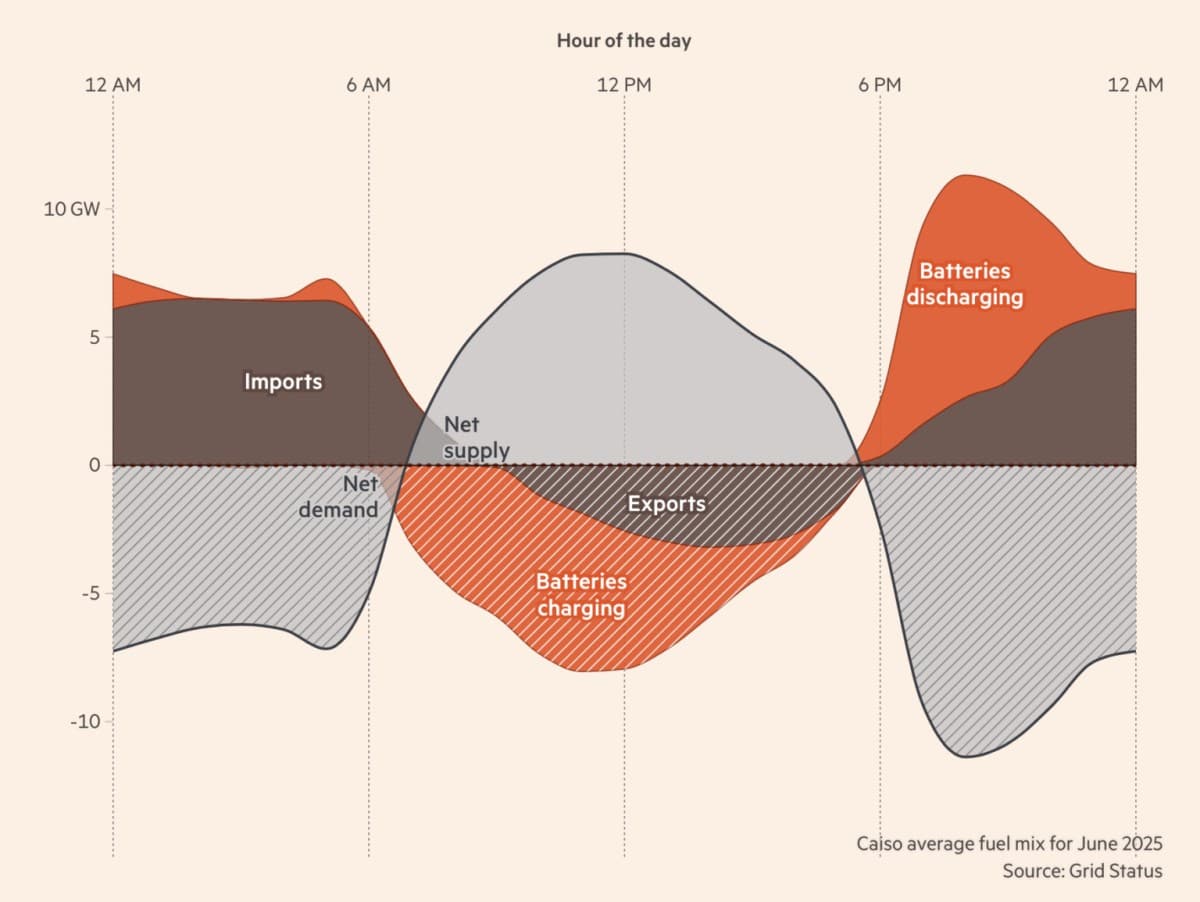
Image source: Financial Times
At peak production hours, renewable energy prices can even plunge below zero as producers essentially pay their customers to take excess energy off their hands, wreaking market havoc and disincentivizing further clean energy investing in the long run. Energy storage, therefore, plays a critical role in countering this variability and makes a 100% renewable grid a practical and economically viable possibility. Energy storage – which can take many forms – acts to balance supply and demand by capturing excess energy at peak production hours and feeding it back into the grid as needed. Without these technologies, rolling blackouts would be a cripplingly common phenomenon.
And the scale of energy storage projects is expanding exponentially as utility-scale solar and wind farms become increasingly common. “Once a niche technology, grid-scale batteries have become the hidden enablers of the energy transition,” states a recent European Business Magazine report. “For years, the economics looked impossible. But a mix of plunging technology costs, policy urgency, and volatile energy prices has tipped the balance,” the article goes on to say.
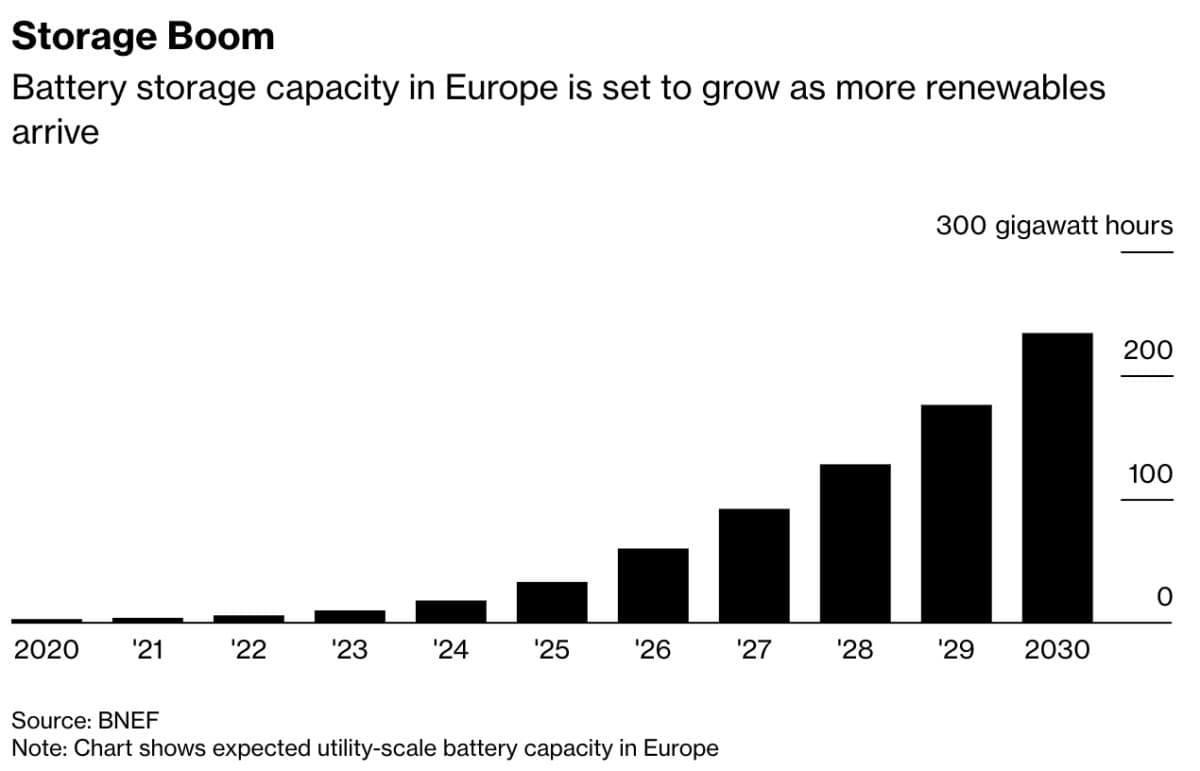
In Europe, mega-batteries are gaining serious ground as the continent’s energy grids start to tip toward majority-renewable energy sources. Analysis from Bloomberg NEF projects that Europe will have 130 gigawatt-hours (GWh) of utility-scale battery storage capacity by 2030. That marks an incredible increase from the 17 GWh installed as of today.
Tesla is vying to place itself at the technological forefront of the mega-battery boom. Just last month, the company launched a new Megablock battery, which combines four Megapack batteries and a transformer all in one package for more efficient scaling and streamlined installation processes. One Megablock can store up to 20 megawatt-hours of power for up to four hours at peak capacity. “Scaled up for a large project, 248 megawatt-hours can fit into an acre,” reports Canary Media. Perhaps even more importantly, the technology allows developers to build up energy storage capacity very, very quickly. Tesla claims that the Megablock allows users to build up 1 gigawatt-hour’s worth of storage in as little as 20 business days – no mean feat.
Not only will these and other grid-scale battery storage technologies allow for more stable energy pricing and better energy security over the course of the clean energy transition, they also offer energy traders a new way to cash in on energy market fluctuations. Traders can
“Traders can profit by simply selling stored power for more than they paid for it,” Bloomberg writes. “They can also make money in the ancillary services market, where mechanisms are used to maintain grid stability.” Indeed, battery operators are receiving a growing portion of their earnings through energy trading, completely changing the economics of the booming energy storage market through increased monetization. This development is perhaps a predictable one, as energy trading has become an increasingly central and lucrative part of the unfolding clean energy landscape.
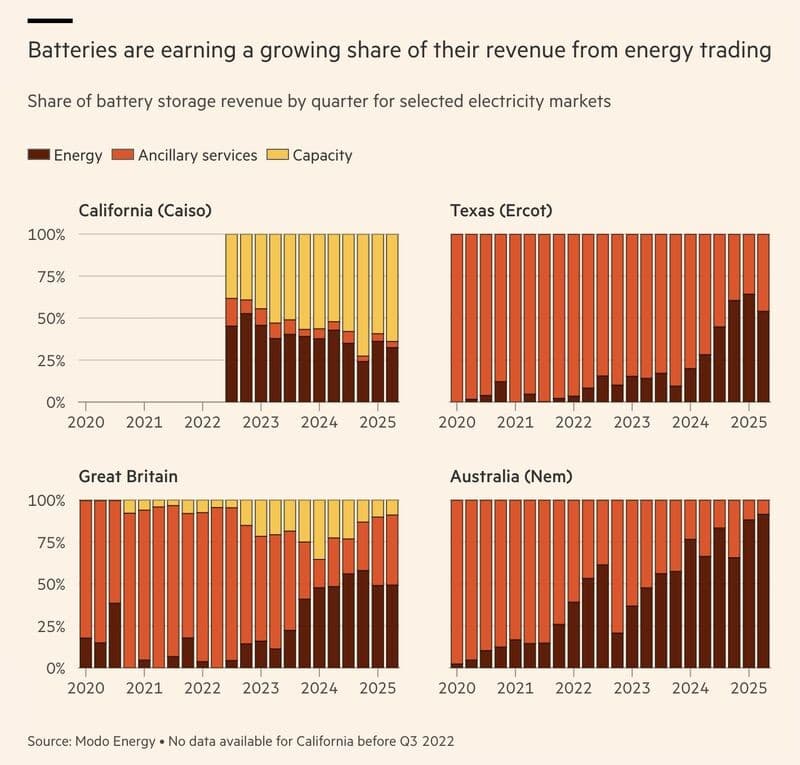
Image source: Financial Times
By Haley Zaremba for Oilprice.com
Europe’s Aging Grids Buckle Under Renewable Energy Demands
- The world's power grids require significant upgrades and expansion to meet growing electricity demands and integrate renewable energy sources effectively.
- Insufficient investment in grid modernization is already causing issues like critical congestion and blackouts in Europe, hindering the clean energy transition.
- Countries like the Netherlands are experiencing power cuts and energy consumption austerity measures due to rapid clean energy adoption without commensurate grid infrastructure development.
The world’s power grids need a major upgrade to keep pace with growing rates of electrification and the ever-increasing energy demands of big data. A cleaner energy landscape means a whole lot more electricity demand, as we switch from gas-powered vehicles and appliances to newer, cleaner models that need to plug into the grid to charge. This means that expanding grid capacity and making our aging grids smarter and more flexible will be essential to maintaining energy security for the future – but grid infrastructure remains woefully neglected, and we’re already starting to see some of the fallout.
“To achieve countries’ national energy and climate goals, the world’s electricity use needs to grow 20% faster in the next decade than it did in the previous one,” states a 2023 report from the International Energy Agency. As a result, grids need to expand at an unprecedented rate. “Reaching national goals also means adding or refurbishing a total of over 80 million kilometres of grids by 2040, the equivalent of the entire existing global grid,” the report goes on to say.
Failure to prioritize investing in grid modernization and expansion poses a major threat to the clean energy transition and to energy security as grids become increasingly reliant on renewable energy sources. Solar and wind energy are variable, meaning that their production levels wax and wane according to factors that have nothing to do with demand trends. Plus, energy production is increasingly dispersed, especially so thanks to the proliferation of residential solar panels. These factors introduce an extra level of complexity for grids that were designed with just a few major utilities in mind, and with only one direction of energy flow.
All of this is already leading to some hiccups for grid stability. In Europe, where renewable expansion and EV adoption have soared, critical grid congestion and catastrophic blackouts have become an increasing issue. At the end of April, cascading grid failures in Spain and Portugal resulted in the worst blackout in European history, and highlighted how woefully insufficient grid investment has been to date. At the time, Eurelectric reported that the “extraordinary event” in Iberia served as “a stark reminder that the grid is the backbone of our society. With electricity playing an increasingly important role in our society, we need to create all the conditions to enable a secure electricity supply.”
Unfortunately, many countries are now facing the consequences of failing to create all of those conditions. In the Netherlands, massive success with clean energy capacity installation and EV adoption without commensurate grid infrastructure expansion has resulted in a new norm of power cuts and energy consumption austerity measures. And it’s going to take a lot of money and time to fix the issue.
"They have a grid crisis because they haven't invested enough in their distribution networks, in their transmission networks, so they are facing bottlenecks everywhere, and it will take years and billions of dollars to solve this," Damien Ernst, professor of electrical engineering at Belgium's Liege University, recently told the BBC. The problem is causing ripples throughout the Netherlands economy. New housing, for example, is now facing long waiting lists in order to connect to grids that are already operating over maximum capacity.
But the issue is not limited to the Netherlands. Much of Europe has neglected to properly invest in grid infrastructure as a part of national clean energy planning. "We have an enormous amount of solar panels being installed, and they are installed at a rate that is much, much too high for the grid to be able to accommodate," Ernst went on to say.
By Haley Zaremba for Oilprice.com
No comments:
Post a Comment