Anduril Plans to Build Unmanned Warships in Seattle
In the latest sign of development from the budding U.S.-Korea shipbuilding partnership, American tech firm Anduril reports that it will work with HD Hyundai to develop unmanned vessels for the Modular Attack Surface Craft (MASC) competition, the latest U.S. Navy program for an oceangoing unmanned warship. This particular platform will be built in Seattle for low-rate production, Anduril says.
Anduril - the maker of Australia's Ghost Shark unmanned sub - says that the new "family" of USV designs will be autonomous, modular, mass production-ready, iteratively upgradeable, and capable of flexible mission payloads. Mission possibilities range from ISR to electronic warfare to strike, based on loadout. Its design philosophy is to use software for system integration, maximizing interchangeability of hardware components and minimizing vendor lock-in for parts in the sustainment phase. Similarly, Anduril and HD Hyundai picked all-steel construction for the hull, the least technically complicated, most repairable and most accessible option for smaller shipyards.
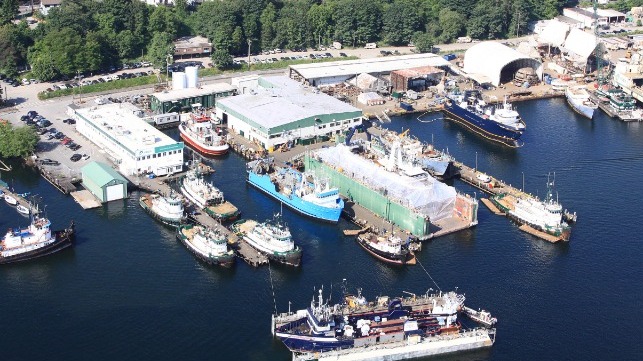
Anduril and HD Hyundai are building the first prototype in Korea using HD Hyundai's advanced capabilities. This stage will prove out the design and technology in an advanced facility and prepare the system for production in America. For the next stage, Anduril is building up capacity at the small Foss Shipyard site in Seattle. The yard is located next to traditional firms like Western Towboat and Coastal Transportation on the Lake Washington Ship Canal, and Foss shut it down in 2021. It will be revived and used as the home base for Anduril's low-rate production for integration and testing.
"The Pacific Northwest, home to the wartime legacy of Kaiser Shipyards and the original Freedom’s Forge, offers the infrastructure, supply chain depth, and skilled labor to expand U.S. shipbuilding capacity. The region provides the ideal conditions to re-energize American shipbuilding and grow the maritime workforce," said Anduril in a statement.
In addition to its human workforce, Anduril is maximizing automation during production, in partnership with robotics firm Hadrian. The work will be done with precision automation and "rapid fabrication capabilities" to build structural and mechanical components, Anduril said.
U.S. Navy Takes Delivery of Last Independence-Class Littoral Combat Ship
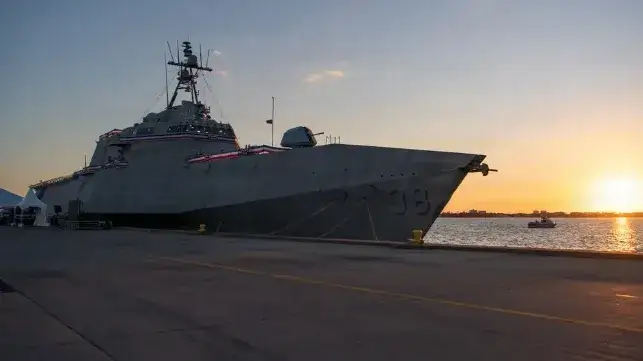
The U.S. Navy has commissioned USS Pierre, its very last Independence-class Littoral Combat Ship, bringing a challenging acquisition program one step closer to a close. Only one Freedom-class LCS is still pending delivery.
"The commissioning of USS Pierre marks an important moment for the Fleet. President Trump is committed to restoring our shipbuilding capacity because he knows that to be a superpower, one must be a seapower," said Secretary of the Navy John Phelan. "This ship represents the skill, dedication, and craftsmanship of the builders, yard workers, and industry partners who brought her from concept to keel commissioning."
The final hull has been a long time coming. Design of the Independence-class formally began in 2004, in parallel with the swappable "mission packages" that the ships were supposed to carry interchangeably. The Pentagon opted not to down-select to a single ship design and yard, so there would be two classes: Austal built its aluminum trimaran Independence-class "variant," and Fincantieri/Lockheed built their steel monohull Freedom-class design as well. The choice to build two classes was made in order to secure political support for the project, former Navy Undersecretary Robert Work told ProPublica in 2023.
From a capability standpoint, the two designs came under fire from traditional navalists for their comparatively low survivability and lethality. The hulls were designed for high speeds and shallow draft, allowing for swift operations near shore. The unusually high speed requirement meant engineering tradeoffs for armor and armament, and they were not designed to the same standard as other combatants for resistance to shock. When it came time for shock trials, the Navy performed the blasts at reduced intensity to avoid damage to the ships, and halted tests for the Freedom-class series before reaching one-third of rated force. In 2016, official concerns were raised about whether they could survive in combat.
In service, the Freedom-class quickly developed a reputation for mechanical issues, particularly a faulty gearbox design in the propulsion system. The class was assigned to tow a sonar array for antisubmarine warfare, but the sonar package failed to develop and was canceled in 2022. Even when all systems were functioning, the Freedom-class vessels were "noisy as an aircraft carrier," and that created challenges for sonar work, according to then-CNO Adm. Mike Gilday. Lacking a mission for the Freedom-class, the Navy decommissioned first-in-class LCS USS Freedom in 2021, 12 years ahead of her planned end of life. In 2022, Navy leadership tried to decommission all nine Freedom-class hulls then in service, the youngest of which had been active for less than three years; ultimately five were removed from the fleet.
The Independence-class has had fewer public issues. Beginning in 2019, structural defects resulting in hull cracking were found on at least six ships, according to Military Times - forcing low speed and sea state restrictions for at least one vessel. The issue was above the waterline only, and was fixed in later production with heavier hull plating in certain areas. Retrofits and repairs were planned for in-service vessels. At sea, the vessels have proven useful for interdictions and freedom of navigation patrols. In addition, the mine countermeasures package that the Independence-class is assigned to carry has reached initial operational capability, and deployed for the first time in 2025.
For both classes, a contractor-centric service model initially drove up operating costs near to full-sized destroyer levels, according to U.S. Navy budget data. In recent years the service has been working to shift more responsibility for repairs in-house and empower the crew to fix broken gear.
The arrival of the last Independence-class hull also marks the end of a large order series for Austal USA's aluminum construction line. The all-aluminum Spearhead-class fast transport and a medical-ship version are still in production. In the meantime, Austal has started up a large and growing business in all-steel construction, which is rapidly expanding.
Austal USA To Increase Submarine Industrial Base Capabilities Under AUKUS
[By: Austal USA]
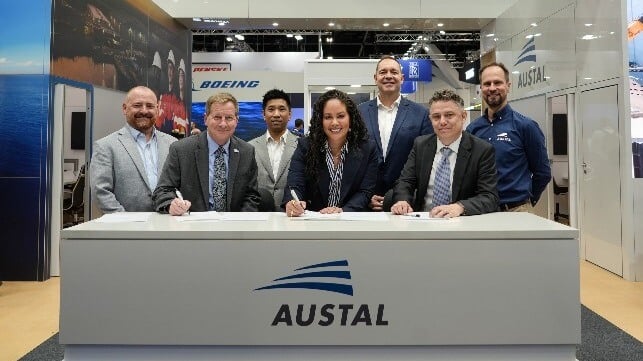
Austal USA entered a Memorandum of Understanding (MoU) with Australian Submarine Corporation (ASC) during the 2025 Indo Pacific International Maritime Exposition (INDOPAC 2025) in Sydney, Australia. This MoU marks an agreement to advance the introduction of cutting-edge 3D printing in Australian shipbuilding and submarine sustainment, strengthening the supply chain to support the Virginia-class and Australian Collins-class submarine programs.
“Austal USA is proud of the role we are playing in the international effort to fortify the submarine industrial base through innovations in additive manufacturing capabilities,” stated Austal USA President Michelle Kruger. “We recognize the importance of AUKUS and are excited to be at the forefront of this monumental collaboration of Allies partnering to defend our freedom with an impenetrable fleet of surface and subsurface naval assets.”
The MoU, signed at the Austal USA stand by Austal USA Vice President Business Development & External Affairs, Lawrence Ryder, ASC Chief Capability Officer, Danielle Bull, and Austal Australia Chief Technology Officer, Dr. Glenn Callow, is another indication of the significant role Austal USA is playing in integrating AM technologies into the maritime industrial base of not only the US but also Australia.
“This is another significant advance in our efforts to fully integrate the use of AM in the submarine and shipbuilding production and repair process,” stated Ryder. “Signing the MoU here at INDOPAC in Sydney highlights the growing achievements of AUKUS and the expanding relationship between the US and Australian industrial bases.”
Austal USA’s advanced technologies team has been at the forefront of AM adoption, operating the U.S. Navy’s Additive Manufacturing Center of Excellence (AM CoE) in Danville, Va. Austal USA is responsible for developing a national network of vendors with qualified AM machines and processes to provide critical submarine parts. Austal USA has a unique familiarity with end-to-end production pathways using AM across multiple modalities and alloys. The company is using laser powder bed fusion (LPBF), wire arc additive manufacturing (WAAM), wire laser additive manufacturing (WLAM) and exploring the use of cold spray additive manufacturing (CSAM).
One of the most significant challenges is ensuring additive manufacturing digital data smoothly integrates with existing Navy logistics, inventory, and quality management systems. Austal USA is developing a network that will ensure digital traceability – a digital thread built to Navy requirements – through the development of Digital -Secure Exchange for Additive (Digital – SEA), a purpose-built platform that will connect the Navy and component OEMs with AM suppliers and digital manufacturing information.
Austal USA also formed a strategic partnership in 2022 with General Dynamics Electric Boat, supported by the U.S. Navy, to expand the submarine industrial base (SIB) by producing modules for the Virginia and Columbia -class programs. As part of the partnership, Austal USA is constructing and outfitting Command and Control Systems Modules (CCSM) and Electronic Deck Modules (EDM) for the Virginia- and Columbia-class programs.
Austal USA has continued to expand its facilities and workforce to support the growing demand of the SIB. A new production facility, a 369,600 square foot manufacturing building, will be dedicated to submarine module manufacturing. The new building, Module Manufacturing Facility 3, will be fully operational in late 2026.
The products and services herein described in this press release are not endorsed by The Maritime Executive.
No comments:
Post a Comment