COP30 Shows How Corporate Power Is Derailing Climate Justice
While Brazil positions the summit as an “Implementation COP,” the reality is a conference dominated by the very corporations expanding fossil fuel extraction.
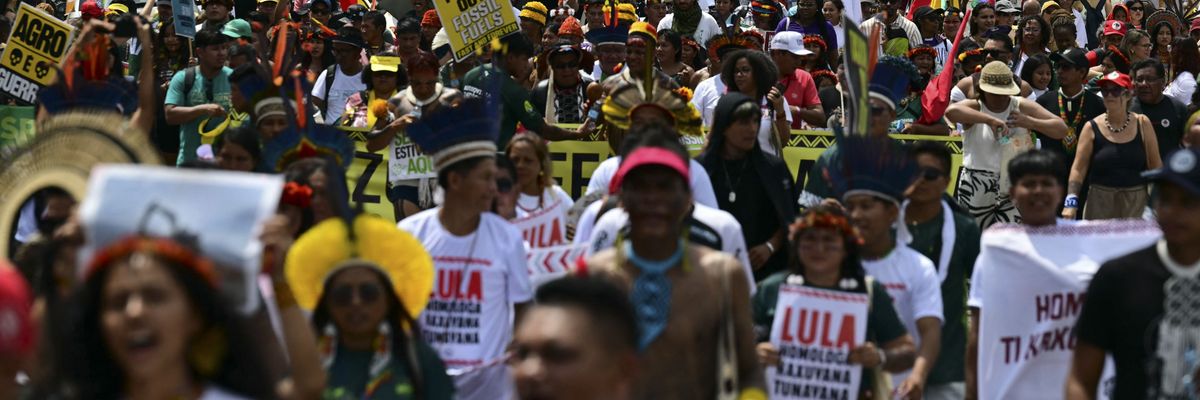
Thousands of people take part in the so-called “Great People’s March” in the sidelines of the COP30 UN Climate Change Conference in Belem, Para State, Brazil on November 15, 2025.
(Photo by Pablo Porciuncula/ AFP via Getty Images)
Jawad Khalid
Nov 20, 2025
Analysis from the Kick Big Polluters Out coalition shows more than 1,600 fossil fuel lobbyists have been granted access to COP30 in Belém, Brazil. That means 1 in every 25 participants represents the industry that is accelerating climate chaos.
Lobbyists from ExxonMobil, BP, TotalEnergies, and major trade associations roam freely while delegates from the 10 most climate-vulnerable nations combined are vastly outnumbered. Indigenous peoples and civil society activists are squeezed to the margins, sometimes literally, as protesters blockaded entrances to be heard. Meanwhile, fossil fuel executives are in the rooms where decisions or the lack thereof will shape our collective future.
Inside COP30, the contradiction is stark. While Brazil positions the summit as an “Implementation COP,” the reality is a conference dominated by the very corporations expanding fossil fuel extraction. Nearly $250 billion in new oil and gas projects have been approved since COP29, even as the world burns. Indigenous communities, guardians of the Amazon for generations, struggle to enter decision-making rooms, while fossil fuel lobbyists walk in with ease. The people on the frontlines of climate devastation are silenced; the industry that profits from it is amplified.
Protests in Belém, from Indigenous flotillas along the Amazon River to the blockade of COP entrances, are acts of survival and resistance. Indigenous leaders like Raoni Metuktire speak for the forest, the water, and the air that sustain life. Civil society groups push for mechanisms like the Belém Action Mechanism, aiming to put communities at the center of climate solutions. Yet in the halls of negotiation, these voices are often drowned out by the hum of corporate self-interest and the whir of greenwashed PR campaigns.
To expect hope or justice from a world run by billionaires is a delusion.
True climate justice requires more than aspirational statements. It requires dismantling the structures that allow wealth and power to concentrate in the hands of the few while the majority bear the consequences. It demands a serious rethink of the COP system itself: enforceable conflict-of-interest rules, accountability measures for governments and corporations, and meaningful participation for the communities on the frontlines of the crisis.
It is time for the people to call out this hypocrisy and expose this façade for what it is: a fiesta of corporate power, a spectacle of interests flexing muscles through Big Oil and fossil fuel lobbyists. COP30, like its predecessors, has become less a climate forum and more a playground for polluters.
Perhaps one can draw a strong parallel with the genocide in Gaza. I say this because the system is rigged: rigged against the people, the weak, and the vulnerable. Witnessing Gaza makes one feel powerless in front of structures built by and for the powerful, at the expense of the oppressed. And I write not just because of genocides in Gaza or Sudan, but because of the enduring sense of helplessness experienced by the poor and working classes across the globe. Systems rigged by corporate and neoliberal interests have fueled record levels of inequality, leaving ordinary people to bear the brunt of stagnant wages, spiraling living costs, and environmental devastation. This is not a problem confined to the so-called Global South. The endemic inequality extends to the West as well: The richest 1% now control more wealth than 95% of humanity.
The global cost-of-living crisis shows the same structural inequality at work. Inflation is surging worldwide, with food and energy costs pushing millions into poverty from sub-Saharan Africa to South Asia, and even in developed countries. People are skipping meals, forgoing medicine, or working multiple jobs just to survive. Governments scramble with subsidies or cash transfers, but these measures often fail to reach the most vulnerable or merely offer temporary relief, leaving structural inequities intact. The climate crisis and economic injustice are deeply intertwined, both fueled by concentrated wealth and corporate influence.
To expect hope or justice from a world run by billionaires is a delusion. Unless these entrenched systems of inequality are dismantled, unless wealth is distributed more equitably, climate justice like all other lofty promises of fairness will remain a mere pipe dream.
It is time to reset priorities and take an honest stock of COPs. If the conference cannot stay committed to its original purpose to protect people and the planet perhaps it is time to roll it back. Enough of greenwashed pledges and photo ops for polluters. The climate emergency is urgent, but these gatherings, as currently structured, serve only those who profit from the destruction, not those who suffer it.
Our work is licensed under Creative Commons (CC BY-NC-ND 3.0). Feel free to republish and share widely.
Jawad Khalid
Jawad Khalid is a climate finance specialist based in Islamabad. He works on green innovation, low-carbon investment, and climate resilience in South Asia. He writes frequently on climate justice and adaptation policy for regional and international outlets.
Full Bio >
While Brazil positions the summit as an “Implementation COP,” the reality is a conference dominated by the very corporations expanding fossil fuel extraction.
Thousands of people take part in the so-called “Great People’s March” in the sidelines of the COP30 UN Climate Change Conference in Belem, Para State, Brazil on November 15, 2025.
(Photo by Pablo Porciuncula/ AFP via Getty Images)
Jawad Khalid
Nov 20, 2025
Analysis from the Kick Big Polluters Out coalition shows more than 1,600 fossil fuel lobbyists have been granted access to COP30 in Belém, Brazil. That means 1 in every 25 participants represents the industry that is accelerating climate chaos.
Lobbyists from ExxonMobil, BP, TotalEnergies, and major trade associations roam freely while delegates from the 10 most climate-vulnerable nations combined are vastly outnumbered. Indigenous peoples and civil society activists are squeezed to the margins, sometimes literally, as protesters blockaded entrances to be heard. Meanwhile, fossil fuel executives are in the rooms where decisions or the lack thereof will shape our collective future.
Inside COP30, the contradiction is stark. While Brazil positions the summit as an “Implementation COP,” the reality is a conference dominated by the very corporations expanding fossil fuel extraction. Nearly $250 billion in new oil and gas projects have been approved since COP29, even as the world burns. Indigenous communities, guardians of the Amazon for generations, struggle to enter decision-making rooms, while fossil fuel lobbyists walk in with ease. The people on the frontlines of climate devastation are silenced; the industry that profits from it is amplified.
Protests in Belém, from Indigenous flotillas along the Amazon River to the blockade of COP entrances, are acts of survival and resistance. Indigenous leaders like Raoni Metuktire speak for the forest, the water, and the air that sustain life. Civil society groups push for mechanisms like the Belém Action Mechanism, aiming to put communities at the center of climate solutions. Yet in the halls of negotiation, these voices are often drowned out by the hum of corporate self-interest and the whir of greenwashed PR campaigns.
To expect hope or justice from a world run by billionaires is a delusion.
True climate justice requires more than aspirational statements. It requires dismantling the structures that allow wealth and power to concentrate in the hands of the few while the majority bear the consequences. It demands a serious rethink of the COP system itself: enforceable conflict-of-interest rules, accountability measures for governments and corporations, and meaningful participation for the communities on the frontlines of the crisis.
It is time for the people to call out this hypocrisy and expose this façade for what it is: a fiesta of corporate power, a spectacle of interests flexing muscles through Big Oil and fossil fuel lobbyists. COP30, like its predecessors, has become less a climate forum and more a playground for polluters.
Perhaps one can draw a strong parallel with the genocide in Gaza. I say this because the system is rigged: rigged against the people, the weak, and the vulnerable. Witnessing Gaza makes one feel powerless in front of structures built by and for the powerful, at the expense of the oppressed. And I write not just because of genocides in Gaza or Sudan, but because of the enduring sense of helplessness experienced by the poor and working classes across the globe. Systems rigged by corporate and neoliberal interests have fueled record levels of inequality, leaving ordinary people to bear the brunt of stagnant wages, spiraling living costs, and environmental devastation. This is not a problem confined to the so-called Global South. The endemic inequality extends to the West as well: The richest 1% now control more wealth than 95% of humanity.
The global cost-of-living crisis shows the same structural inequality at work. Inflation is surging worldwide, with food and energy costs pushing millions into poverty from sub-Saharan Africa to South Asia, and even in developed countries. People are skipping meals, forgoing medicine, or working multiple jobs just to survive. Governments scramble with subsidies or cash transfers, but these measures often fail to reach the most vulnerable or merely offer temporary relief, leaving structural inequities intact. The climate crisis and economic injustice are deeply intertwined, both fueled by concentrated wealth and corporate influence.
To expect hope or justice from a world run by billionaires is a delusion. Unless these entrenched systems of inequality are dismantled, unless wealth is distributed more equitably, climate justice like all other lofty promises of fairness will remain a mere pipe dream.
It is time to reset priorities and take an honest stock of COPs. If the conference cannot stay committed to its original purpose to protect people and the planet perhaps it is time to roll it back. Enough of greenwashed pledges and photo ops for polluters. The climate emergency is urgent, but these gatherings, as currently structured, serve only those who profit from the destruction, not those who suffer it.
Our work is licensed under Creative Commons (CC BY-NC-ND 3.0). Feel free to republish and share widely.
Jawad Khalid
Jawad Khalid is a climate finance specialist based in Islamabad. He works on green innovation, low-carbon investment, and climate resilience in South Asia. He writes frequently on climate justice and adaptation policy for regional and international outlets.
Full Bio >
Brazil’s planned railway to Amazon draws fire on margins of COP30
By AFP
November 19, 2025

Alessandra Korap, a leader of the Munduruku people, takes part in a protest at COP30 - Copyright AFP Pablo PORCIUNCULA
Fran BLANDY
Indigenous protesters at UN climate talks in Brazil have zeroed in on a major grievance: A planned railway that would stretch almost the distance from London to Berlin and cut through the Amazon rainforest.
To farmers, the Ferrograo — meaning Grain Railway — would be a logistical revolution.
Critics see yet another massive infrastructure project coming to threaten the Amazon, undermining President Luiz Inacio Lula da Silva’s commitment to the environment.
– What is the idea behind the Ferrograo? –
Brazil is the world’s largest exporter of soybeans and corn, much of which is produced in the central state of Mato Grosso.
Currently, this cargo travels long distances by truck to either southern seaports or northern river ports.
For over a decade, Brazilian governments have tried to advance a 933-kilometer (580-mile) railway that would link Sinop in Mato Grosso to the northern river port of Miritituba.
From there, grain can reach the Amazon River and the Atlantic Ocean.
– What do supporters of the project say? –
Elisangela Pereira Lopes, a technical advisor with the CNA, Brazil’s main farmer’s organization, told AFP the railway was “essential to guarantee the competitiveness of Brazilian agribusiness.”
She said that Mato Grosso, responsible for about 32 percent of national grain production “needs a more efficient logistics route to keep pace with the sector’s growth.”
Lopes said the railway was expected to cut the logistics cost of grain exports by up to 40 percent, while reducing road traffic and the associated CO2 emissions.
– What do the critics say? –
Mariel Nakane of the Socio-Environmental Institute (ISA) told AFP the railway will impact Indigenous lands and drive deforestation and land grabbing.
She said the switch by agribusiness in the last decade to exporting their goods more cheaply via northern river ports had already transformed the Tapajos River that the Miritituba port sits on.
“Riverside communities are being expelled… they can no longer fish in some regions because now it’s just ports and this barge traffic.
“The idea is to install the railway and have it increase the volume transported on this route by five times.”
Meanwhile, she fears a free-for-all in areas already vulnerable to deforestation.
Nakane said Brazil’s current licensing procedures were not enough to protect the rainforest and its residents.
She pointed to other controversial projects, such as oil exploration near the Amazon River — which began in October — and plans to pave the BR-319, a major highway in the rainforest.
“The government is not capable of doing this right. It’s very easy for the government to claim that it’s committed to the climate agenda, but sweep these controversial projects under the rug.”
– Why has this come up at COP climate talks? –
With the eyes of the world on Belem during the UN climate summit, Indigenous communities have sought to cast a spotlight on their grievances, such as the Ferrograo.
Protesters are also furious about a decree signed by Lula in August establishing major Amazon rivers, including the Tapajos, as priorities for cargo navigation and private port expansion.
“We will not allow it because it is our home, our river, our forest,” said Indigenous leader Alessandra Korap of the Munduruku people.
“The river is the mother of the fish.”
– What is the current status of the project? –
Brazil’s environmental agency Ibama said to AFP in a statement that “the licensing process for the Ferrograo railway is in its initial stage, with an assessment of its environmental viability.”
However, the process was suspended in 2021 by Supreme Court judge Alexandre de Moraes after a constitutional challenge to plans to alter the limits of a national park to build the railway.
Moraes allowed the case to resume in 2023, and the court began hearing it again last month.
Moraes — a powerful figure in Brazil who has personally led several major investigations — voted to allow the project to go ahead.
However, the hearing is currently paused after another judge asked for more time to analyze the case.
Australia yields to Turkey in standoff over next climate summit
By AFP
November 19, 2025

Australia and Turkey both wanted to host next year's climate summit and unless one withdrew its bid, both would have missed out. - Copyright AFP Pablo PORCIUNCULA
By AFP
November 19, 2025
Alessandra Korap, a leader of the Munduruku people, takes part in a protest at COP30 - Copyright AFP Pablo PORCIUNCULA
Fran BLANDY
Indigenous protesters at UN climate talks in Brazil have zeroed in on a major grievance: A planned railway that would stretch almost the distance from London to Berlin and cut through the Amazon rainforest.
To farmers, the Ferrograo — meaning Grain Railway — would be a logistical revolution.
Critics see yet another massive infrastructure project coming to threaten the Amazon, undermining President Luiz Inacio Lula da Silva’s commitment to the environment.
– What is the idea behind the Ferrograo? –
Brazil is the world’s largest exporter of soybeans and corn, much of which is produced in the central state of Mato Grosso.
Currently, this cargo travels long distances by truck to either southern seaports or northern river ports.
For over a decade, Brazilian governments have tried to advance a 933-kilometer (580-mile) railway that would link Sinop in Mato Grosso to the northern river port of Miritituba.
From there, grain can reach the Amazon River and the Atlantic Ocean.
– What do supporters of the project say? –
Elisangela Pereira Lopes, a technical advisor with the CNA, Brazil’s main farmer’s organization, told AFP the railway was “essential to guarantee the competitiveness of Brazilian agribusiness.”
She said that Mato Grosso, responsible for about 32 percent of national grain production “needs a more efficient logistics route to keep pace with the sector’s growth.”
Lopes said the railway was expected to cut the logistics cost of grain exports by up to 40 percent, while reducing road traffic and the associated CO2 emissions.
– What do the critics say? –
Mariel Nakane of the Socio-Environmental Institute (ISA) told AFP the railway will impact Indigenous lands and drive deforestation and land grabbing.
She said the switch by agribusiness in the last decade to exporting their goods more cheaply via northern river ports had already transformed the Tapajos River that the Miritituba port sits on.
“Riverside communities are being expelled… they can no longer fish in some regions because now it’s just ports and this barge traffic.
“The idea is to install the railway and have it increase the volume transported on this route by five times.”
Meanwhile, she fears a free-for-all in areas already vulnerable to deforestation.
Nakane said Brazil’s current licensing procedures were not enough to protect the rainforest and its residents.
She pointed to other controversial projects, such as oil exploration near the Amazon River — which began in October — and plans to pave the BR-319, a major highway in the rainforest.
“The government is not capable of doing this right. It’s very easy for the government to claim that it’s committed to the climate agenda, but sweep these controversial projects under the rug.”
– Why has this come up at COP climate talks? –
With the eyes of the world on Belem during the UN climate summit, Indigenous communities have sought to cast a spotlight on their grievances, such as the Ferrograo.
Protesters are also furious about a decree signed by Lula in August establishing major Amazon rivers, including the Tapajos, as priorities for cargo navigation and private port expansion.
“We will not allow it because it is our home, our river, our forest,” said Indigenous leader Alessandra Korap of the Munduruku people.
“The river is the mother of the fish.”
– What is the current status of the project? –
Brazil’s environmental agency Ibama said to AFP in a statement that “the licensing process for the Ferrograo railway is in its initial stage, with an assessment of its environmental viability.”
However, the process was suspended in 2021 by Supreme Court judge Alexandre de Moraes after a constitutional challenge to plans to alter the limits of a national park to build the railway.
Moraes allowed the case to resume in 2023, and the court began hearing it again last month.
Moraes — a powerful figure in Brazil who has personally led several major investigations — voted to allow the project to go ahead.
However, the hearing is currently paused after another judge asked for more time to analyze the case.
COP30 dragged into clash over gender language
By AFP
November 19, 2025

Women and girls face disproportionate impacts from climate change, the UN says, largely because they make up the majority of the world's poor and rely heavily on local natural resources for their livelihoods - Copyright AFP/File Pablo PORCIUNCULA
Issam AHMED
Conservative delegations from the Vatican to Iran are pushing to narrow the definition of “gender” at UN climate talks in Brazil — a move aimed at excluding trans and non-binary people and threatening to complicate the summit’s outcome.
The effort, which seeks to use footnotes of key texts to attach country-specific interpretations, would set a “harmful precedent” that could seep into other shared decisions taken by the UN’s climate body, opponents warn.
“When women and gender-diverse people are at the table, climate policies are more ambitious, more inclusive and more durable,” former Irish president Mary Robinson said Wednesday.
“Weakening agreed language undermines climate ambition and is completely new in this system and it’s not acceptable.”
Paraguay, Argentina, Iran, Indonesia, Malaysia as well as the Holy See have so far entered footnotes into the draft Gender Action Plan (GAP) meant to guide work for the next decade, including efforts to embed gender in the heart of climate programs.
Similar footnotes have also appeared in a text related to the “just transition” — the framework to shift to environmentally sustainable economies without leaving workers and communities behind.
“We do not agree at all with what some countries are putting in the agenda footnotes,” Alicia Barcena, Mexico’s secretary of environment, told AFP.
“We feel we are going backwards — we should never go backwards.”
The issue has become so sensitive that COP30’s Brazilian presidency has elevated it from technical negotiations to a higher political level, where ministers are now trying to hash out a compromise.
Women and girls face disproportionate impacts from climate change, the UN says, largely because they make up the majority of the world’s poor, and are less involved in decision-making.
During times of drought they walk further, work harder, and are more likely to die than men when extreme weather disasters strike.
Yet despite decades of commitments, women account for just 35 percent of delegates at COP30 in Belem, according to the Women’s Environment and Development Organization (WEDO).
The first formal GAP was adopted in 2017 and strengthened in 2019; COP30 is now hammering out its next, more ambitious iteration.
– Anti-wokeism –
The footnotes lay bare parties’ red lines around the term “gender” — some longstanding, others part of a rising right-wing tide opposed to so-called “wokeism.”
The Holy See, for example, says it understands gender as “grounded on the biological sexual identity that is male and female.”
Argentina, a majority-Catholic country led by President Javier Milei — a close ally of US President Donald Trump — has rolled back gender-equality policies and LGBT rights, and attacked the “cancer” of “wokeism.”
There is “frustration within rooms,” a source close to the matter, who requested anonymity because they were not authorized to discuss the sensitive issue, said Wednesday. “It’s become a bit ridiculous — we have six footnotes right now; should we have 90?”
The source added there was no need to reopen the definition, because parties can already interpret decisions according to their national circumstances.
“Allowing countries to attach their own interpretations to agreed language does not protect national sovereignty. It undermines multilateralism itself,” Bridget Burns, executive director of the Women’s Environment and Development Organization, told AFP.
“If every Party could footnote core terms like finance, ambition or equity, we would have no negotiation left — only fragmentation. Gender equality is an agreed principle under this Convention — it needs no qualification.”
One possible off-ramp, the source said, would be for the opposing countries to deliver statements after a decision is adopted, ensuring their positions are reflected in the official record.
By AFP
November 19, 2025
Women and girls face disproportionate impacts from climate change, the UN says, largely because they make up the majority of the world's poor and rely heavily on local natural resources for their livelihoods - Copyright AFP/File Pablo PORCIUNCULA
Issam AHMED
Conservative delegations from the Vatican to Iran are pushing to narrow the definition of “gender” at UN climate talks in Brazil — a move aimed at excluding trans and non-binary people and threatening to complicate the summit’s outcome.
The effort, which seeks to use footnotes of key texts to attach country-specific interpretations, would set a “harmful precedent” that could seep into other shared decisions taken by the UN’s climate body, opponents warn.
“When women and gender-diverse people are at the table, climate policies are more ambitious, more inclusive and more durable,” former Irish president Mary Robinson said Wednesday.
“Weakening agreed language undermines climate ambition and is completely new in this system and it’s not acceptable.”
Paraguay, Argentina, Iran, Indonesia, Malaysia as well as the Holy See have so far entered footnotes into the draft Gender Action Plan (GAP) meant to guide work for the next decade, including efforts to embed gender in the heart of climate programs.
Similar footnotes have also appeared in a text related to the “just transition” — the framework to shift to environmentally sustainable economies without leaving workers and communities behind.
“We do not agree at all with what some countries are putting in the agenda footnotes,” Alicia Barcena, Mexico’s secretary of environment, told AFP.
“We feel we are going backwards — we should never go backwards.”
The issue has become so sensitive that COP30’s Brazilian presidency has elevated it from technical negotiations to a higher political level, where ministers are now trying to hash out a compromise.
Women and girls face disproportionate impacts from climate change, the UN says, largely because they make up the majority of the world’s poor, and are less involved in decision-making.
During times of drought they walk further, work harder, and are more likely to die than men when extreme weather disasters strike.
Yet despite decades of commitments, women account for just 35 percent of delegates at COP30 in Belem, according to the Women’s Environment and Development Organization (WEDO).
The first formal GAP was adopted in 2017 and strengthened in 2019; COP30 is now hammering out its next, more ambitious iteration.
– Anti-wokeism –
The footnotes lay bare parties’ red lines around the term “gender” — some longstanding, others part of a rising right-wing tide opposed to so-called “wokeism.”
The Holy See, for example, says it understands gender as “grounded on the biological sexual identity that is male and female.”
Argentina, a majority-Catholic country led by President Javier Milei — a close ally of US President Donald Trump — has rolled back gender-equality policies and LGBT rights, and attacked the “cancer” of “wokeism.”
There is “frustration within rooms,” a source close to the matter, who requested anonymity because they were not authorized to discuss the sensitive issue, said Wednesday. “It’s become a bit ridiculous — we have six footnotes right now; should we have 90?”
The source added there was no need to reopen the definition, because parties can already interpret decisions according to their national circumstances.
“Allowing countries to attach their own interpretations to agreed language does not protect national sovereignty. It undermines multilateralism itself,” Bridget Burns, executive director of the Women’s Environment and Development Organization, told AFP.
“If every Party could footnote core terms like finance, ambition or equity, we would have no negotiation left — only fragmentation. Gender equality is an agreed principle under this Convention — it needs no qualification.”
One possible off-ramp, the source said, would be for the opposing countries to deliver statements after a decision is adopted, ensuring their positions are reflected in the official record.
Lula lands in Amazon to press for climate deal
By AFP
November 19, 2025

Brazil's President Luiz Inacio Lula da Silva held a summit in Belem before COP30 and returned Wednesday to press for a deal - Copyright AFP/File Pablo PORCIUNCULA
Brazilian President Luiz Inacio Lula da Silva arrived in Belem on Wednesday to press negotiators to reach an early deal at UN climate talks as nations remain far apart on contentious issues.
COP30 host Brazil released a draft pact on Tuesday, hoping to get nations to agree on the most contentious points as soon as Wednesday, two days before the conference is scheduled to end in the Amazonian city.
Lula flew in to bring the weight of the presidency to the talks, in a rare late-stage visit by a head of state or government at the annual gathering.
The Brazilian president has invested a lot of political capital to achieve success in what he has promised would be a “COP of truth” and a victory against climate deniers.
Lula was due to meet with representatives of emerging countries, Europe, island states, Indigenous groups and civil society.
The head of COP30, Brazilian diplomat Andre Correa do Lago, has pressed negotiators to work around the clock in an effort to bridge divisions between the world’s wealthiest nations, developing countries and oil-rich states.
The disagreements center on the impact of trade measures, language on transitioning away from fossil fuels, and demands for developed countries to provide more climate finance to poorer nations.
French ecological transition minister Monique Barbut knocked back Brazilian hopes of securing a deal as soon as Wednesday.
“No, there will not be a COP decision today. I don’t see how that could happen,” Barbut told AFP.
“However, yes, there is a little bit of movement. But we are still far from the mark because for us, it must be a comprehensive package,” Barbut said after a coordination meeting with European colleagues.
She added, however, that she was “more optimistic” than she was the day before.
– No more money –
The draft underscores the gulf between a broad coalition — led by Europe and island states — pushing for a “roadmap” on phasing out fossil fuels, and an opposing bloc led by oil-producing countries.
“Whether we’re going to call it the roadmap or we’re going to use a different wording, I think is secondary. But once again, we very much like the idea,” EU climate commissioner Wopke Hoekstra said at a news conference.
Negotiators are also at loggerheads over pressure from the developing world for developed countries to provide more finance to help vulnerable nations adapt to climate change and deploy renewable energy.
The EU, where many countries are facing economic headwinds and soaring debt, has led opposition to those demands.
“We’re not looking at any increases in adaptation finance,” Irish climate minister Darragh O’Brien said.
A new text is due to be published on Wednesday.
COP30 is due to end on Friday, but climate summits regularly run into overtime.
By AFP
November 19, 2025
Brazil's President Luiz Inacio Lula da Silva held a summit in Belem before COP30 and returned Wednesday to press for a deal - Copyright AFP/File Pablo PORCIUNCULA
Brazilian President Luiz Inacio Lula da Silva arrived in Belem on Wednesday to press negotiators to reach an early deal at UN climate talks as nations remain far apart on contentious issues.
COP30 host Brazil released a draft pact on Tuesday, hoping to get nations to agree on the most contentious points as soon as Wednesday, two days before the conference is scheduled to end in the Amazonian city.
Lula flew in to bring the weight of the presidency to the talks, in a rare late-stage visit by a head of state or government at the annual gathering.
The Brazilian president has invested a lot of political capital to achieve success in what he has promised would be a “COP of truth” and a victory against climate deniers.
Lula was due to meet with representatives of emerging countries, Europe, island states, Indigenous groups and civil society.
The head of COP30, Brazilian diplomat Andre Correa do Lago, has pressed negotiators to work around the clock in an effort to bridge divisions between the world’s wealthiest nations, developing countries and oil-rich states.
The disagreements center on the impact of trade measures, language on transitioning away from fossil fuels, and demands for developed countries to provide more climate finance to poorer nations.
French ecological transition minister Monique Barbut knocked back Brazilian hopes of securing a deal as soon as Wednesday.
“No, there will not be a COP decision today. I don’t see how that could happen,” Barbut told AFP.
“However, yes, there is a little bit of movement. But we are still far from the mark because for us, it must be a comprehensive package,” Barbut said after a coordination meeting with European colleagues.
She added, however, that she was “more optimistic” than she was the day before.
– No more money –
The draft underscores the gulf between a broad coalition — led by Europe and island states — pushing for a “roadmap” on phasing out fossil fuels, and an opposing bloc led by oil-producing countries.
“Whether we’re going to call it the roadmap or we’re going to use a different wording, I think is secondary. But once again, we very much like the idea,” EU climate commissioner Wopke Hoekstra said at a news conference.
Negotiators are also at loggerheads over pressure from the developing world for developed countries to provide more finance to help vulnerable nations adapt to climate change and deploy renewable energy.
The EU, where many countries are facing economic headwinds and soaring debt, has led opposition to those demands.
“We’re not looking at any increases in adaptation finance,” Irish climate minister Darragh O’Brien said.
A new text is due to be published on Wednesday.
COP30 is due to end on Friday, but climate summits regularly run into overtime.
Lula to return to COP30 as first draft climate deal lands
By AFP
November 18, 2025

Brazil's Vice President and Minister of Industry and Trade Geraldo Alckmin (L) and Brazil's Environment Minister Marina Silva addressed the press in Belem on Monday - Copyright AFP Pablo PORCIUNCULA
Nick PERRY and Julien MIVIELLE
COP30 host Brazil on Tuesday unveiled a first draft deal after UN climate talks stretched late into the night, seeking a compromise with nations at odds as the summit clock ticks down.
The draft landed as President Luis Inacio Lula da Silva announced he was returning to Belem, the rainforest city where the marathon negotiations are underway, in an effort to seal a deal.
The draft text offers a sweep of possible outcomes, reflecting the gulf between the nearly 200 nations at the summit in the Amazon, and the road still ahead to reach a final pact.
The nine-page text addresses the main flashpoints in Belem: trade measures, demands for greater finance for poorer nations, and the inadequacy of national carbon-cutting pledges.
“This is a mixed bag,” EU climate chief Wopke Hoekstra told AFP on Tuesday, flagging the bloc’s opposition to some proposals in the draft on climate finance and trade measures.
“We’re not going to open up the hard-fought compromise of last year in terms of financing” or be “lured into a phony conversation about trade measures”, he added in reference to China’s focus at COP30 on the EU’s flagship carbon pricing policy.
With the talks stuck, Brazil announced Monday it wanted an agreement by midweek, sending exhausted negotiators back to the bargaining table and extending work hours late into the night.
The quick turnaround of a draft indicated Brazil was confident about landing an agreement soon, observers told AFP.
“It represents a steady progression from the previous iteration and is likely one of the earliest releases of such a clean text in recent COP history,” Li Shuo, a climate analyst at the Asia Society Policy Institute, told AFP.
– Tough compromise –
Among other things, the draft underscores a stark division between a coalition pushing for a “roadmap” on a fossil fuel phaseout and an opposing bloc led by oil-producing countries.
It proposes an optional “workshop” to discuss “low carbon solutions,” or a high-level ministerial roundtable on pathways to help countries “progressively overcome their dependency on fossil fuels.”
A third option proposes no text at all.
The draft also raises the possibility of assessing national climate pledges annually, instead of every five years, to assess more frequently shortfalls in global efforts to reduce greenhouse gas emissions.
It also suggested financial assistance from wealthy countries to developing ones for adaptation to climate change should be tripled by 2030 or 2035 — a key demand from poorer nations.
“Climate finance is not charity. It is a legal and moral obligation,” Vanuatu’s climate change minister, Ralph Regenvanu, told the summit Tuesday.
Proposals to address concerns over trade — as China leads a push against “unilateral” measures and the EU’s carbon price on imports in particular — were also canvassed.
On this sensitive issue, four proposals were outlined, including the creation of a summit under the UN secretary-general on climate trade disputes.
– Presidential push –
In a surprise move, a Brazilian presidential source told AFP that Lula would return to Belem on Wednesday in what many interpreted as a tactic to push through a deal.
“It would be a way of putting pressure on delegates to move quickly to resolve issues,” David Waskow, international climate director at the World Resources Institute think tank, told AFP.
The marathon climate talks are supposed to end Friday after close to two weeks of negotiation, but previous summits have frequently run into overtime.
Brazil is eager to show that the world is still united in the fight against climate change, despite the United States skipping the summit and many other nations juggling competing priorities.
“We must show the world that multilateralism is alive,” Josephine Moote, permanent representative of the small-island state of Kiribati, told COP30 on Tuesday.
COP-and-trade? Tariffs, carbon tax weigh on climate talks
By AFP
November 18, 2025

Newly launched BYD Dolphin is displayed during the launch of the Chinese-made BYD brand in Jakarta, on January 18, 2024 - Copyright AFP/File BAY ISMOYO
By AFP
November 18, 2025
Brazil's Vice President and Minister of Industry and Trade Geraldo Alckmin (L) and Brazil's Environment Minister Marina Silva addressed the press in Belem on Monday - Copyright AFP Pablo PORCIUNCULA
Nick PERRY and Julien MIVIELLE
COP30 host Brazil on Tuesday unveiled a first draft deal after UN climate talks stretched late into the night, seeking a compromise with nations at odds as the summit clock ticks down.
The draft landed as President Luis Inacio Lula da Silva announced he was returning to Belem, the rainforest city where the marathon negotiations are underway, in an effort to seal a deal.
The draft text offers a sweep of possible outcomes, reflecting the gulf between the nearly 200 nations at the summit in the Amazon, and the road still ahead to reach a final pact.
The nine-page text addresses the main flashpoints in Belem: trade measures, demands for greater finance for poorer nations, and the inadequacy of national carbon-cutting pledges.
“This is a mixed bag,” EU climate chief Wopke Hoekstra told AFP on Tuesday, flagging the bloc’s opposition to some proposals in the draft on climate finance and trade measures.
“We’re not going to open up the hard-fought compromise of last year in terms of financing” or be “lured into a phony conversation about trade measures”, he added in reference to China’s focus at COP30 on the EU’s flagship carbon pricing policy.
With the talks stuck, Brazil announced Monday it wanted an agreement by midweek, sending exhausted negotiators back to the bargaining table and extending work hours late into the night.
The quick turnaround of a draft indicated Brazil was confident about landing an agreement soon, observers told AFP.
“It represents a steady progression from the previous iteration and is likely one of the earliest releases of such a clean text in recent COP history,” Li Shuo, a climate analyst at the Asia Society Policy Institute, told AFP.
– Tough compromise –
Among other things, the draft underscores a stark division between a coalition pushing for a “roadmap” on a fossil fuel phaseout and an opposing bloc led by oil-producing countries.
It proposes an optional “workshop” to discuss “low carbon solutions,” or a high-level ministerial roundtable on pathways to help countries “progressively overcome their dependency on fossil fuels.”
A third option proposes no text at all.
The draft also raises the possibility of assessing national climate pledges annually, instead of every five years, to assess more frequently shortfalls in global efforts to reduce greenhouse gas emissions.
It also suggested financial assistance from wealthy countries to developing ones for adaptation to climate change should be tripled by 2030 or 2035 — a key demand from poorer nations.
“Climate finance is not charity. It is a legal and moral obligation,” Vanuatu’s climate change minister, Ralph Regenvanu, told the summit Tuesday.
Proposals to address concerns over trade — as China leads a push against “unilateral” measures and the EU’s carbon price on imports in particular — were also canvassed.
On this sensitive issue, four proposals were outlined, including the creation of a summit under the UN secretary-general on climate trade disputes.
– Presidential push –
In a surprise move, a Brazilian presidential source told AFP that Lula would return to Belem on Wednesday in what many interpreted as a tactic to push through a deal.
“It would be a way of putting pressure on delegates to move quickly to resolve issues,” David Waskow, international climate director at the World Resources Institute think tank, told AFP.
The marathon climate talks are supposed to end Friday after close to two weeks of negotiation, but previous summits have frequently run into overtime.
Brazil is eager to show that the world is still united in the fight against climate change, despite the United States skipping the summit and many other nations juggling competing priorities.
“We must show the world that multilateralism is alive,” Josephine Moote, permanent representative of the small-island state of Kiribati, told COP30 on Tuesday.
By AFP
November 18, 2025
Newly launched BYD Dolphin is displayed during the launch of the Chinese-made BYD brand in Jakarta, on January 18, 2024 - Copyright AFP/File BAY ISMOYO
Issam AHMED
In Belem, the Brazilian city hosting COP30, it’s hard to miss the BYD Dolphin Mini — the Chinese hatchback that’s dominating the local electric vehicle market, even as the company races to catch up in Europe and is absent in North America.
Trade-restrictive measures loom large over this year’s UN climate summit, with China pushing for wider market access for its green technologies and major developing economies challenging Europe over its new carbon border tax on carbon-intensive imports like steel and fertilizer.
Even smaller developing countries whose exports aren’t targeted by Europe’s Carbon Border Adjustment Mechanism (CBAM) fear broader measures to come.
“Trade, at this COP, unlike previous COPs, has already been elevated,” Li Shuo, director of the China Climate Hub at the Asia Society Policy Institute, told AFP. “We can already expect that trade will form the most prominent part of the outcome.”
Traditionally, climate ambition and finance have dominated discussions — how far major emitters will curb pollution, and how much money rich nations will provide to help developing countries adapt and accelerate their transition away from fossil fuels.
Countries including China, India and Brazil have repeatedly tried to put trade on COP agendas, without success. That’s changing.
A draft text issued by the Brazilian presidency on Tuesday — seen as paving the way for the final outcome text — listed trade as the second of its four top bullet points.
– ‘Free flow of green products’ –
The tone was set earlier at a leaders’ summit in November, when Chinese Vice Premier Ding Xuexiang urged countries to “remove trade barriers and ensure the free flow of quality green products.”
The EU imposes steep tariffs on Chinese EVs — reaching up to over 45 percent depending on the company — while Canada and the United States go far higher still, exceeding 100 percent.
A Southeast Asian negotiator told AFP these realities rankle countries in Asia, which are buying up cheap Chinese green tech to accelerate their transitions, and find it “illogical” and “inconsistent” that Western nations are spurning the chance to do the same.
“We need to achieve the radical decarbonization of the global economy in the next two decades if we are to meet the Paris temperature goals,” Alden Meyer of the think tank E3G told AFP.
“To the extent trade policies are creating barriers to achieving that objective, that’s a legitimate topic.”
The European Union’s CBAM is another flashpoint.
The policy aims to level the playing field for industries covered by EU emissions rules by preventing companies from relocating to countries with weaker standards.
But major developing economies — including India and South Africa — are heavily exposed.
– CBAM and beyond –
“The Global North, having used carbon-intensive industries to develop themselves, are now throwing up the gates to the Global South,” Mohamed Adow, of think tank Power Shift Africa, told AFP.
Concerns also extend beyond the sectors CBAM covers. An African negotiator from a cocoa-exporting country said the EU’s paused deforestation regulations — requiring proof commodities don’t come from recently cleared land — were another major worry.
The EU insists CBAM is not a trade policy but a climate one.
“Pricing carbon is something that we need to pursue with as many as possible, as quickly as possible,” the bloc’s climate commissioner, Wopke Hoekstra, said Monday. “We’re not going to be lured into the suggestion that CBAM is a unilateral trade measure.”
“Some countries say one thing here in negotiations, and they say another thing when we speak to them bilaterally,” Sweden’s Climate Ambassador Mattias Frumerie told AFP, explaining that privately some nations welcome CBAM as an incentive to decarbonize.
Brussels says CBAM was designed to comply with World Trade Organization rules.
Russia has launched a complaint, but with the WTO’s dispute mechanism effectively paralyzed since 2019, opponents are seeking other venues to raise concerns, especially as the UK and Canada move forward with their own mechanisms.
David Waskow, director of the World Resources Institute’s International Climate Initiative, said even if trade appears in the COP’s final decision text, no one expects the summit to “magically” resolve these disputes. “They want to surface them, they want to poke each other,” he told AFP.
“Sometimes doing that can lead to some recalibration of policy.”
In Belem, the Brazilian city hosting COP30, it’s hard to miss the BYD Dolphin Mini — the Chinese hatchback that’s dominating the local electric vehicle market, even as the company races to catch up in Europe and is absent in North America.
Trade-restrictive measures loom large over this year’s UN climate summit, with China pushing for wider market access for its green technologies and major developing economies challenging Europe over its new carbon border tax on carbon-intensive imports like steel and fertilizer.
Even smaller developing countries whose exports aren’t targeted by Europe’s Carbon Border Adjustment Mechanism (CBAM) fear broader measures to come.
“Trade, at this COP, unlike previous COPs, has already been elevated,” Li Shuo, director of the China Climate Hub at the Asia Society Policy Institute, told AFP. “We can already expect that trade will form the most prominent part of the outcome.”
Traditionally, climate ambition and finance have dominated discussions — how far major emitters will curb pollution, and how much money rich nations will provide to help developing countries adapt and accelerate their transition away from fossil fuels.
Countries including China, India and Brazil have repeatedly tried to put trade on COP agendas, without success. That’s changing.
A draft text issued by the Brazilian presidency on Tuesday — seen as paving the way for the final outcome text — listed trade as the second of its four top bullet points.
– ‘Free flow of green products’ –
The tone was set earlier at a leaders’ summit in November, when Chinese Vice Premier Ding Xuexiang urged countries to “remove trade barriers and ensure the free flow of quality green products.”
The EU imposes steep tariffs on Chinese EVs — reaching up to over 45 percent depending on the company — while Canada and the United States go far higher still, exceeding 100 percent.
A Southeast Asian negotiator told AFP these realities rankle countries in Asia, which are buying up cheap Chinese green tech to accelerate their transitions, and find it “illogical” and “inconsistent” that Western nations are spurning the chance to do the same.
“We need to achieve the radical decarbonization of the global economy in the next two decades if we are to meet the Paris temperature goals,” Alden Meyer of the think tank E3G told AFP.
“To the extent trade policies are creating barriers to achieving that objective, that’s a legitimate topic.”
The European Union’s CBAM is another flashpoint.
The policy aims to level the playing field for industries covered by EU emissions rules by preventing companies from relocating to countries with weaker standards.
But major developing economies — including India and South Africa — are heavily exposed.
– CBAM and beyond –
“The Global North, having used carbon-intensive industries to develop themselves, are now throwing up the gates to the Global South,” Mohamed Adow, of think tank Power Shift Africa, told AFP.
Concerns also extend beyond the sectors CBAM covers. An African negotiator from a cocoa-exporting country said the EU’s paused deforestation regulations — requiring proof commodities don’t come from recently cleared land — were another major worry.
The EU insists CBAM is not a trade policy but a climate one.
“Pricing carbon is something that we need to pursue with as many as possible, as quickly as possible,” the bloc’s climate commissioner, Wopke Hoekstra, said Monday. “We’re not going to be lured into the suggestion that CBAM is a unilateral trade measure.”
“Some countries say one thing here in negotiations, and they say another thing when we speak to them bilaterally,” Sweden’s Climate Ambassador Mattias Frumerie told AFP, explaining that privately some nations welcome CBAM as an incentive to decarbonize.
Brussels says CBAM was designed to comply with World Trade Organization rules.
Russia has launched a complaint, but with the WTO’s dispute mechanism effectively paralyzed since 2019, opponents are seeking other venues to raise concerns, especially as the UK and Canada move forward with their own mechanisms.
David Waskow, director of the World Resources Institute’s International Climate Initiative, said even if trade appears in the COP’s final decision text, no one expects the summit to “magically” resolve these disputes. “They want to surface them, they want to poke each other,” he told AFP.
“Sometimes doing that can lead to some recalibration of policy.”
COP30: Mixed messages and differing actions
By Dr. Tim Sandle
SCIENCE EDITOR
Change abound
Elsewhere, melting ice, collapsing ice shelves, and disrupted ocean circulation threaten sea levels, ecosystems, and climate stability.
Our planet’s climate is undergoing change. Earth’s climate balance is not simply governed by the slow weathering of silicate rocks, which capture carbon and stabilise temperature over aeons. New research reveals that biological and oceanic feedback loops—especially involving algae, phosphorus, and oxygen—can swing the planet’s temperature far more dramatically.
Scientists have published the total amount of carbon dioxide (CO₂) safely stored underground through Carbon Capture and Storage (CCS). The first annual report by a new collaboration, the London Register of Subsurface CO₂ Storage, reveals that over 383 million tonnes of carbon dioxide have been removed from the atmosphere by CCS since 1996.
Saudi Arabia called out
Hence, COP30, which started on 10 November and ends on 21 November, is coming at a particularly precarious time for climate action. The conference has also struggled with support, with only sixty world leaders attending. U.S. President Donald Trump was an unsurprising absentee at COP30, having at the UN General Assembly last month branded climate change a “con job”.
With those leaders who have attended, things have not always been harmonious. Former U.S. vice-president Al Gore has accused the Saudi delegation at COP30 of “flexing its muscles” in discussions regarding how to move away from oil and gas. He reportedly told the Financial Times that “Saudi Arabia appears to be determined to veto the effort to solve the climate crisis, only to protect their lavish income from selling the fossil fuels that are the principal cause of the climate crisis.”
There have also been a lot of protests. Cristiane Puyanawa, an indigenous protester, told Reuters: “Our land and our forest are not commodities. Respect nature and the peoples who live in the forest.”
Nations making change
Some countries have made clear climate impacting commitments. Four examples of positive news reveal how nations can make a positive impact.
Beginning with coal giant South Korea. The country has pledged to ditch the dirtiest fossil fuel. The pledge commits to retiring 62 coal plants over the next 15 years. Forty have already confirmed closure dates.
A group called the Premium Flyers Solidarity Coalition, which is planning to tax premium air tickets and private jets, said that Djibouti, Nigeria and South Sudan were joining the effort, which already includes France, Spain, Kenya and Barbados.
The European Union’s climate chief Wopke Hoekstra told COP30 it was time to impose the broadest possible carbon pricing scheme, defending an issue several countries oppose over fears about its potential economic effects.
Finally, in an interview with the Guardian, Brazil’s environment minister, Marina Silva, has encouraged countries to create a roadmap to move away from fossil fuels but did not commit Brazil to taking part. She noted that “The map is an answer to our scientific knowledge [of the climate crisis]. It is an ethical answer.”
What’s next?
To close out the conference, Brazilian President Luiz Inácio Lula da Silva is expected to arrive to COP30 on Wednesday to rally consensus among parties at the summit ahead of Friday’s final scheduled session.
By Dr. Tim Sandle
SCIENCE EDITOR
DIGITAL JOURNAL
November 17, 2025

Demonstrators demanded forest protection and global climate responsibility during COP30 in Belem, Brazil, a UN climate conference that one nonprofit group warned featured more than 1,000 fossil fuel lobbyists and energy industry leaders
November 17, 2025
Demonstrators demanded forest protection and global climate responsibility during COP30 in Belem, Brazil, a UN climate conference that one nonprofit group warned featured more than 1,000 fossil fuel lobbyists and energy industry leaders
- Copyright AFP Pablo PORCIUNCULA
As most world leaders, or at least their governmental representatives, attend parts of COP30, the news about the changing environment is far from good. Satellite images, for example, reveal the fastest Antarctic glacier retreat ever (Hektoria Glacier’s sudden eight-kilometre collapse).
As most world leaders, or at least their governmental representatives, attend parts of COP30, the news about the changing environment is far from good. Satellite images, for example, reveal the fastest Antarctic glacier retreat ever (Hektoria Glacier’s sudden eight-kilometre collapse).
Change abound
Elsewhere, melting ice, collapsing ice shelves, and disrupted ocean circulation threaten sea levels, ecosystems, and climate stability.
Our planet’s climate is undergoing change. Earth’s climate balance is not simply governed by the slow weathering of silicate rocks, which capture carbon and stabilise temperature over aeons. New research reveals that biological and oceanic feedback loops—especially involving algae, phosphorus, and oxygen—can swing the planet’s temperature far more dramatically.
Scientists have published the total amount of carbon dioxide (CO₂) safely stored underground through Carbon Capture and Storage (CCS). The first annual report by a new collaboration, the London Register of Subsurface CO₂ Storage, reveals that over 383 million tonnes of carbon dioxide have been removed from the atmosphere by CCS since 1996.
Saudi Arabia called out
Hence, COP30, which started on 10 November and ends on 21 November, is coming at a particularly precarious time for climate action. The conference has also struggled with support, with only sixty world leaders attending. U.S. President Donald Trump was an unsurprising absentee at COP30, having at the UN General Assembly last month branded climate change a “con job”.
With those leaders who have attended, things have not always been harmonious. Former U.S. vice-president Al Gore has accused the Saudi delegation at COP30 of “flexing its muscles” in discussions regarding how to move away from oil and gas. He reportedly told the Financial Times that “Saudi Arabia appears to be determined to veto the effort to solve the climate crisis, only to protect their lavish income from selling the fossil fuels that are the principal cause of the climate crisis.”
There have also been a lot of protests. Cristiane Puyanawa, an indigenous protester, told Reuters: “Our land and our forest are not commodities. Respect nature and the peoples who live in the forest.”
Nations making change
Some countries have made clear climate impacting commitments. Four examples of positive news reveal how nations can make a positive impact.
Beginning with coal giant South Korea. The country has pledged to ditch the dirtiest fossil fuel. The pledge commits to retiring 62 coal plants over the next 15 years. Forty have already confirmed closure dates.
A group called the Premium Flyers Solidarity Coalition, which is planning to tax premium air tickets and private jets, said that Djibouti, Nigeria and South Sudan were joining the effort, which already includes France, Spain, Kenya and Barbados.
The European Union’s climate chief Wopke Hoekstra told COP30 it was time to impose the broadest possible carbon pricing scheme, defending an issue several countries oppose over fears about its potential economic effects.
Finally, in an interview with the Guardian, Brazil’s environment minister, Marina Silva, has encouraged countries to create a roadmap to move away from fossil fuels but did not commit Brazil to taking part. She noted that “The map is an answer to our scientific knowledge [of the climate crisis]. It is an ethical answer.”
What’s next?
To close out the conference, Brazilian President Luiz Inácio Lula da Silva is expected to arrive to COP30 on Wednesday to rally consensus among parties at the summit ahead of Friday’s final scheduled session.
‘That place’: Merz offends Brazil with comments about COP30 city
By AFP
November 18, 2025

Brazil's President Luiz Inacio Lula da Silva (R) and Germany's Chancellor Friedrich Merz hold a bilateral meeting at COP30 -
By AFP
November 18, 2025
Brazil's President Luiz Inacio Lula da Silva (R) and Germany's Chancellor Friedrich Merz hold a bilateral meeting at COP30 -
Copyright Brazilian Presidency/AFP Ricardo STUCKERT
German Chancellor Friedrich Merz has rubbed Brazilians the wrong way with disparaging comments about the COP30 host city of Belem.
The hot and humid Amazonian city, with limited infrastructure, is hosting tens of thousands of participants from around the world for the UN climate talks.
Brazil’s President Luiz Inacio Lula da Silva had brushed off concerns about the location and highlighted the need to put the world’s largest tropical rainforest at the center of the talks.
However, the conservative Merz, returning from a leaders’ summit, appeared less than impressed.
“We live in one of the most beautiful countries in the world. I asked journalists who accompanied me to Brazil last week: ‘Who among you would want to stay here?’ No one raised their hand,” Merz said in Berlin.
“Everyone was delighted to be back in Germany and to have left that place.”
His comments angered local authorities and some Brazilians on social media jokingly compared it to Germany’s infamous humiliation of Brazil at the 2014 World Cup — when the national team lost by seven goals to one.
Helder Barbalho, the governor of the state of Para, where Belem is located, slammed “the prejudiced” comments on the X social network.
“It’s curious to see that those who have contributed to global warming are surprised by the heat in the Amazon,” he said.
“Unfortunately, the German chancellor delivered a speech full of arrogance and prejudice, unlike his people, who are showing their fascination for our city in the streets of Belém,” city Mayor Igor Normando said on X.
On the UOL news site, a column by journalist Jamil Chade, published on Tuesday, was titled: “Merz, your xenophobia is the new Berlin Wall.”
On a Brazil forum on Reddit, one user who said he was from Para state, said Merz’s comments still didn’t hurt as much as the now-mythic football match.
Following the controversy, a spokesperson for Merz sent a statement to AFP saying that “the Chancellor expressed his regret that time constraints prevented him from better experiencing the impressive natural beauty of the Amazon region.”
He also conveyed his “great respect for the achievement of having been able to organize such an important international conference in Belem.”
On Monday, in a speech during a plenary session of COP30, German Environment Minister Carsten Schneider struck a different tone, praising the “wonderful people of Brazil” who “captivated him with their warm hospitality.”
German Chancellor Friedrich Merz has rubbed Brazilians the wrong way with disparaging comments about the COP30 host city of Belem.
The hot and humid Amazonian city, with limited infrastructure, is hosting tens of thousands of participants from around the world for the UN climate talks.
Brazil’s President Luiz Inacio Lula da Silva had brushed off concerns about the location and highlighted the need to put the world’s largest tropical rainforest at the center of the talks.
However, the conservative Merz, returning from a leaders’ summit, appeared less than impressed.
“We live in one of the most beautiful countries in the world. I asked journalists who accompanied me to Brazil last week: ‘Who among you would want to stay here?’ No one raised their hand,” Merz said in Berlin.
“Everyone was delighted to be back in Germany and to have left that place.”
His comments angered local authorities and some Brazilians on social media jokingly compared it to Germany’s infamous humiliation of Brazil at the 2014 World Cup — when the national team lost by seven goals to one.
Helder Barbalho, the governor of the state of Para, where Belem is located, slammed “the prejudiced” comments on the X social network.
“It’s curious to see that those who have contributed to global warming are surprised by the heat in the Amazon,” he said.
“Unfortunately, the German chancellor delivered a speech full of arrogance and prejudice, unlike his people, who are showing their fascination for our city in the streets of Belém,” city Mayor Igor Normando said on X.
On the UOL news site, a column by journalist Jamil Chade, published on Tuesday, was titled: “Merz, your xenophobia is the new Berlin Wall.”
On a Brazil forum on Reddit, one user who said he was from Para state, said Merz’s comments still didn’t hurt as much as the now-mythic football match.
Following the controversy, a spokesperson for Merz sent a statement to AFP saying that “the Chancellor expressed his regret that time constraints prevented him from better experiencing the impressive natural beauty of the Amazon region.”
He also conveyed his “great respect for the achievement of having been able to organize such an important international conference in Belem.”
On Monday, in a speech during a plenary session of COP30, German Environment Minister Carsten Schneider struck a different tone, praising the “wonderful people of Brazil” who “captivated him with their warm hospitality.”
Australia yields to Turkey in standoff over next climate summit
By AFP
November 19, 2025
Australia and Turkey both wanted to host next year's climate summit and unless one withdrew its bid, both would have missed out. - Copyright AFP Pablo PORCIUNCULA
Nick Perry
Australia has conceded defeat in a bruising diplomatic struggle over hosting rights to next year’s UN climate summit, with Turkey prevailing despite holding a much weaker hand.
Exactly who presides over the blockbuster global event is still in play, but Australia’s long-running campaign to bring COP31 to Adelaide is over.
“Obviously, it would be great if Australia could have it all. But we can’t have it all,” said a dejected Chris Bowen, Australia’s climate minister, in Brazil where this year’s climate talks rumble on.
Just two days earlier in the rainforest city of Belem, where the unresolved standoff with Turkey risked a spat on the world stage, Bowen declared confidently: “We’re in it to win it.”
But despite its bid enjoying overwhelming support, Australia could not get around a quirk of the UN system — that consensus is required to win hosting rights.
Turkey refused to withdraw, leading to a tug-of-war in Belem that tested Brazil’s insistence that global climate solidarity was alive and well.
Without one side backing down, or another arrangement being made, COP31 would default to Germany, which hosts the UN climate body’s offices — something many wanted to avoid, not least the Germans themselves.
A highly-unusual alternative was brokered: Turkey would host the 200-nation summit, but Australia would steer the marathon negotiations.
“I know some people will be disappointed in that outcome,” said Bowen but “significant concessions are what’s required when you try to find consensus.”
– Turkey triumph –
It is a major coup for President Recep Tayyip Erdogan, who has pursued an assertive, go-between diplomacy that positioned Turkey as a mediator in conflicts from Ukraine to Gaza and the Horn of Africa.
The summit will be held in the Mediterranean resort city of Antalya, where Turkey already hosts a major diplomatic forum every January that serves to showcase the soft power image that Ankara wants to project.
COP summits attract world leaders, business executives, and tens of thousands of visitors, and hosting the gala events has become a point of prestige.
Rival COP-hosting bids are not unprecedented, but none had ever come down to the wire like this.
Turkey insisted it had a competitive bid, despite lacking the numbers behind Australia, which had pledged to co-host with climate vulnerable Pacific Island nations.
Under COP rules, hosting duties rotate through five blocs and in 2026 that fell to the Western European and Other States — two dozen mostly European countries but also Turkey, Australia and Canada, among others.
On Thursday, at a meeting to break the impasse, Turkish diplomats stood together alone some distance from the other representatives, with both groups entering the room through different doors.
The meeting was chaired by German state secretary for the environment Jochen Flasbarth, who told AFP the co-hosting proposal was “innovative” and he did not hear opposition to it.
But it had yet to be put in writing — and only then would he reconvene the group to make a decision.
– ‘Disappointed’ –
But close observers said it was unlikely Australia could accept anything other than the COP31 presidency — and hard to imagine Turkey would not agree to the terms.
“It would seem remarkable that a country that had no supporters other than themselves in the regional group that decides would be able to both walk away with physical hosting of the COP, as well as the all-important presidency,” said a diplomatic source close to the discussions.
Simon Bradshaw from Greenpeace Australia Pacific, told AFP that “whatever the venue, whatever the arrangement, the task remains the same: phasing out fossil fuels and ending deforestation.”
But the mood was less upbeat in the Pacific Island region, where rising seas and extreme weather threatens the very survival of many small island states.
“We are all not happy. And disappointed it’s ended up like this,” Papua New Guinea’s Foreign Minister Justin Tkatchenko told AFP as the news broke.
jmi-np-fo-ia/des
Australia has conceded defeat in a bruising diplomatic struggle over hosting rights to next year’s UN climate summit, with Turkey prevailing despite holding a much weaker hand.
Exactly who presides over the blockbuster global event is still in play, but Australia’s long-running campaign to bring COP31 to Adelaide is over.
“Obviously, it would be great if Australia could have it all. But we can’t have it all,” said a dejected Chris Bowen, Australia’s climate minister, in Brazil where this year’s climate talks rumble on.
Just two days earlier in the rainforest city of Belem, where the unresolved standoff with Turkey risked a spat on the world stage, Bowen declared confidently: “We’re in it to win it.”
But despite its bid enjoying overwhelming support, Australia could not get around a quirk of the UN system — that consensus is required to win hosting rights.
Turkey refused to withdraw, leading to a tug-of-war in Belem that tested Brazil’s insistence that global climate solidarity was alive and well.
Without one side backing down, or another arrangement being made, COP31 would default to Germany, which hosts the UN climate body’s offices — something many wanted to avoid, not least the Germans themselves.
A highly-unusual alternative was brokered: Turkey would host the 200-nation summit, but Australia would steer the marathon negotiations.
“I know some people will be disappointed in that outcome,” said Bowen but “significant concessions are what’s required when you try to find consensus.”
– Turkey triumph –
It is a major coup for President Recep Tayyip Erdogan, who has pursued an assertive, go-between diplomacy that positioned Turkey as a mediator in conflicts from Ukraine to Gaza and the Horn of Africa.
The summit will be held in the Mediterranean resort city of Antalya, where Turkey already hosts a major diplomatic forum every January that serves to showcase the soft power image that Ankara wants to project.
COP summits attract world leaders, business executives, and tens of thousands of visitors, and hosting the gala events has become a point of prestige.
Rival COP-hosting bids are not unprecedented, but none had ever come down to the wire like this.
Turkey insisted it had a competitive bid, despite lacking the numbers behind Australia, which had pledged to co-host with climate vulnerable Pacific Island nations.
Under COP rules, hosting duties rotate through five blocs and in 2026 that fell to the Western European and Other States — two dozen mostly European countries but also Turkey, Australia and Canada, among others.
On Thursday, at a meeting to break the impasse, Turkish diplomats stood together alone some distance from the other representatives, with both groups entering the room through different doors.
The meeting was chaired by German state secretary for the environment Jochen Flasbarth, who told AFP the co-hosting proposal was “innovative” and he did not hear opposition to it.
But it had yet to be put in writing — and only then would he reconvene the group to make a decision.
– ‘Disappointed’ –
But close observers said it was unlikely Australia could accept anything other than the COP31 presidency — and hard to imagine Turkey would not agree to the terms.
“It would seem remarkable that a country that had no supporters other than themselves in the regional group that decides would be able to both walk away with physical hosting of the COP, as well as the all-important presidency,” said a diplomatic source close to the discussions.
Simon Bradshaw from Greenpeace Australia Pacific, told AFP that “whatever the venue, whatever the arrangement, the task remains the same: phasing out fossil fuels and ending deforestation.”
But the mood was less upbeat in the Pacific Island region, where rising seas and extreme weather threatens the very survival of many small island states.
“We are all not happy. And disappointed it’s ended up like this,” Papua New Guinea’s Foreign Minister Justin Tkatchenko told AFP as the news broke.
jmi-np-fo-ia/des
No comments:
Post a Comment