COP30
COP30 climate talks head for final showdown as draft deal drops fossil fuel transition
The COP30 climate summit was headed for a showdown on Friday after host Brazil released a draft proposal that made no mention of efforts to phase out fossil fuels. A group of around 30 countries earlier warned they would not accept a deal that failed to include a plan to transition away from oil, gas and coal.
Issued on: 21/11/2025
By: FRANCE 24

Negotiators were divided Friday on the last day of fire-delayed UN climate talks, as Europe rejected COP30 host Brazil's latest draft agreement which lacks a roadmap to phase out fossil fuels.
At stake is nothing less than proving that international cooperation can still function in a fractured world – and delivering a text that nudges the planet back toward the critical 1.5C long-term warming target, despite the absence of President Donald Trump's United States.
But after two weeks of negotiations in the Amazonian city of Belem, the draft text unveiled by Brazil on Friday had no mention of "fossil fuels" or the word "roadmap" that President Luiz Inacio Lula da Silva had himself suggested weeks ago.
"This is in no way close to the ambition we need on mitigation. We are disappointed with the text currently on the table," European Union climate commissioner Wopke Hoekstra said in a statement to AFP.
France's ecological transition minister, Monique Barbut, decried in a text message to AFP "an incomprehensible omission at a time of climate emergency".
Around 30 countries had written to the Brazilian presidency on Thursday warning they could not accept a final deal at COP30 that did not include a plan for moving away from fossil fuels.


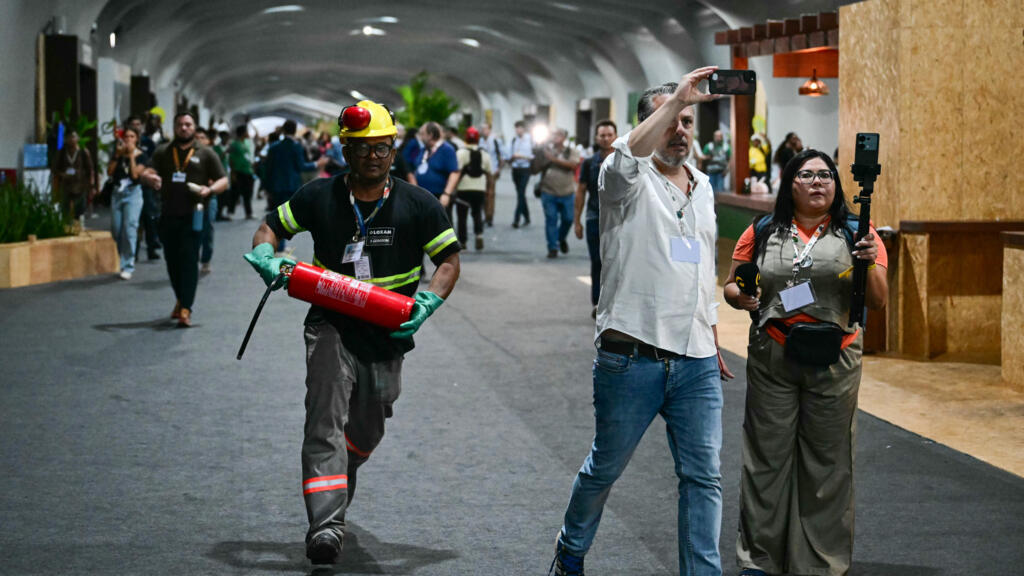
Negotiations toward a final outcome were delayed on Thursday when a fire torched a hole through the fabric ceiling of the COP30 venue, forcing a panicked evacuation.
Nineteen people were treated for smoke inhalation and two for anxiety attacks, officials said. The venue reopened later on Thursday night.
The conference is supposed to end on Friday but UN climate summits often run into overtime.
Protests
Lula has branded COP30 the "COP of truth," investing significant political capital in its success and defending his choice to hold it in Belem, despite concerns over inadequate infrastructure that have plagued the hot, humid city on the edge of the world's largest rainforest.
The COP30 climate summit was headed for a showdown on Friday after host Brazil released a draft proposal that made no mention of efforts to phase out fossil fuels. A group of around 30 countries earlier warned they would not accept a deal that failed to include a plan to transition away from oil, gas and coal.
Issued on: 21/11/2025
By: FRANCE 24
Oxfam activists wear masks representing EU Commission chief Ursula Von der Leyen, Argentina's President Javier Milei, US President Donald Trump and Britain's Keir Starmer at a protest in Belem, Brazil, on November 20, 2025. © Pablo Porciuncula, AFP
01:12
01:12
Negotiators were divided Friday on the last day of fire-delayed UN climate talks, as Europe rejected COP30 host Brazil's latest draft agreement which lacks a roadmap to phase out fossil fuels.
At stake is nothing less than proving that international cooperation can still function in a fractured world – and delivering a text that nudges the planet back toward the critical 1.5C long-term warming target, despite the absence of President Donald Trump's United States.
But after two weeks of negotiations in the Amazonian city of Belem, the draft text unveiled by Brazil on Friday had no mention of "fossil fuels" or the word "roadmap" that President Luiz Inacio Lula da Silva had himself suggested weeks ago.
"This is in no way close to the ambition we need on mitigation. We are disappointed with the text currently on the table," European Union climate commissioner Wopke Hoekstra said in a statement to AFP.
France's ecological transition minister, Monique Barbut, decried in a text message to AFP "an incomprehensible omission at a time of climate emergency".
Around 30 countries had written to the Brazilian presidency on Thursday warning they could not accept a final deal at COP30 that did not include a plan for moving away from fossil fuels.
Negotiations were delayed when a fire torched a hole through the fabric ceiling of the COP30 venue. © Jacqueline, Lisboa, AFP
The letter, drafted by Colombia, stated: "We cannot support an outcome that does not include a roadmap for implementing a just, orderly, and equitable transition away from fossil fuels."
China, India, Saudi Arabia, Nigeria and Russia have rejected the fossil fuel roadmap, according to a negotiator who wished to remain anonymous.
Consensus is needed among the nearly 200 nations at the UN climate talks to land an agreement.
NGOs also rejected the drat deal, with Greenpeace urging nations to send it back to the Brazilian chair for revisions.
"Hopes were raised by initial proposals for roadmaps both to end deforestation and fossil fuels," said Greenpeace climate politics expert Tracy Carty.
"But these roadmaps have disappeared and we're again lost without a map to 1.5C and fumbling our way in the dark while time is running out."
Money fight
Divisions remain not just over fossil fuels but trade measures and finance for poorer nations to adapt to climate change and move to a low-carbon future.
"The lack of finance from richer nations ... remains an ongoing obstacle in these final days to securing bold and fair outcomes," Rachel Cleetus, senior policy director at the Union of Concerned Scientists, told AFP.
The EU is also fighting resistance led by China and India to its "carbon tax" on imports such as steel, aluminum, cement and fertilisers – measures Britain and Canada are also preparing to adopt.
The letter, drafted by Colombia, stated: "We cannot support an outcome that does not include a roadmap for implementing a just, orderly, and equitable transition away from fossil fuels."
China, India, Saudi Arabia, Nigeria and Russia have rejected the fossil fuel roadmap, according to a negotiator who wished to remain anonymous.
Consensus is needed among the nearly 200 nations at the UN climate talks to land an agreement.
NGOs also rejected the drat deal, with Greenpeace urging nations to send it back to the Brazilian chair for revisions.
"Hopes were raised by initial proposals for roadmaps both to end deforestation and fossil fuels," said Greenpeace climate politics expert Tracy Carty.
"But these roadmaps have disappeared and we're again lost without a map to 1.5C and fumbling our way in the dark while time is running out."
Money fight
Divisions remain not just over fossil fuels but trade measures and finance for poorer nations to adapt to climate change and move to a low-carbon future.
"The lack of finance from richer nations ... remains an ongoing obstacle in these final days to securing bold and fair outcomes," Rachel Cleetus, senior policy director at the Union of Concerned Scientists, told AFP.
The EU is also fighting resistance led by China and India to its "carbon tax" on imports such as steel, aluminum, cement and fertilisers – measures Britain and Canada are also preparing to adopt.
© France 24
01:19
01:19
Negotiations toward a final outcome were delayed on Thursday when a fire torched a hole through the fabric ceiling of the COP30 venue, forcing a panicked evacuation.
Nineteen people were treated for smoke inhalation and two for anxiety attacks, officials said. The venue reopened later on Thursday night.
The conference is supposed to end on Friday but UN climate summits often run into overtime.
Protests
Lula has branded COP30 the "COP of truth," investing significant political capital in its success and defending his choice to hold it in Belem, despite concerns over inadequate infrastructure that have plagued the hot, humid city on the edge of the world's largest rainforest.
The fire was the third major incident since the summit began at the COP30 compound.
Last week, Indigenous protesters stormed the venue and blockaded the entrance days later in a peaceful demonstration.
The cause of the blaze was being investigated but may have been the result of a short circuit or other electrical malfunction, said Brazilian Tourism Minister Celso Sabino.
(FRANCE 24 with AFP)
Last week, Indigenous protesters stormed the venue and blockaded the entrance days later in a peaceful demonstration.
The cause of the blaze was being investigated but may have been the result of a short circuit or other electrical malfunction, said Brazilian Tourism Minister Celso Sabino.
(FRANCE 24 with AFP)
Fossil fuel showdown looms on UN climate summit's final day
Belém (Brazil) (AFP) – A breach, a blockade, and a blaze: tumultuous UN climate talks head into their final day Friday in the Brazilian Amazon, with countries still sharply split over fossil fuels.
Issued on: 21/11/2025 - RFI
Belém (Brazil) (AFP) – A breach, a blockade, and a blaze: tumultuous UN climate talks head into their final day Friday in the Brazilian Amazon, with countries still sharply split over fossil fuels.
Issued on: 21/11/2025 - RFI
Delegates are set to resume their negotiations after a dramatic fire on Thursday afternoon torched a hole through the fabric ceiling of the Cop30 venue, forcing a panicked evacuation. © Pablo PORCIUNCULA / AFP
At stake at Cop30 is nothing less than proving that international cooperation can still function in a fractured world – and delivering a text that nudges the planet back toward the critical 1.5C long-term warming target, despite the absence of President Donald Trump's United States.
Brazilian President Luiz Inacio Lula da Silva has branded it the "Cop of truth," investing significant political capital in its success and defending his choice to hold it in Belem, despite concerns over inadequate infrastructure that have plagued the hot, humid city on the edge of the world's largest rainforest.
Delegates are set to resume their negotiations after a dramatic fire on Thursday torched a hole through the fabric ceiling of the Cop30 venue, forcing a panicked evacuation.
It was the third major incident since the summit began at the Cop30 compound, located on the site of an old airport and made up of enormous, air-conditioned tents alongside permanent structures.
Last week, Indigenous protesters stormed the venue and blockaded the entrance days later in a peaceful demonstration.
Thursday's fire broke out around 2pm local time, quickly filling the cavernous halls with acrid smoke.
The blaze was brought under control in six minutes, organizers said. Nineteen people were treated for smoke inhalation and two for anxiety attacks, officials said. The venue reopened later on Thursday night.
Infrastructure woes
The symbolism of a fire breaking out at the UN's annual summit tasked with reining in global warming was hard to miss.
In another twist, Brazil had chosen as its Cop30 mascot a folklore guardian of the forest with flame-like hair, known as Curupira.
The cause of the blaze was being investigated but may have been the result of a short circuit or other electrical malfunction, said Brazilian Tourism Minister Celso Sabino.
Infrastructure problems have beset the summit from the start, from air-conditioning woes to leaking ceilings, and numerous participants have reported issues with electrical wiring.
At the negotiating table, countries are tasked with finding what UN chief Antonio Guterres has called an "ambitious compromise" on divisive issues.
These include phasing out fossil fuels – the main driver of human-caused warming and its escalating impacts, from record heat and severe storms to rising seas, crop failures and economic losses.
Fossil fuel fight
Lula has championed agreeing to a "roadmap" that would give countries specific targets – but in a dramatic turn, even the words "fossil fuels" were cut from the latest draft proposal put forward by the summit's Brazilian leadership and seen by AFP.
That text was slammed by more than 30 countries that co-signed a letter drafted by Colombia stating: "We cannot support an outcome that does not include a roadmap for implementing a just, orderly, and equitable transition away from fossil fuels."
China, India, Saudi Arabia, Nigeria and Russia have rejected the fossil fuel roadmap, according to a negotiator who wished to remain anonymous.
Negotiators are also at odds over pressure from the developing world for developed countries to provide more financing to help vulnerable nations adapt to climate change and deploy renewable energy.
"The lack of finance from richer nations – a critical part of the Paris Agreement – remains an ongoing obstacle in these final days to securing bold and fair outcomes," Rachel Cleetus of the Union of Concerned Scientists told AFP.
And for the first time at a Cop, trade has come to the fore.
The European Union is fighting resistance led by China and India to its "carbon tax" on imports such as steel, aluminum, cement and fertilizers – measures Britain and Canada are also preparing to adopt.
Although Cop30 is set to conclude Friday, climate summits often run into overtime – and Thursday's lost hours may make that likelier.
At stake at Cop30 is nothing less than proving that international cooperation can still function in a fractured world – and delivering a text that nudges the planet back toward the critical 1.5C long-term warming target, despite the absence of President Donald Trump's United States.
Brazilian President Luiz Inacio Lula da Silva has branded it the "Cop of truth," investing significant political capital in its success and defending his choice to hold it in Belem, despite concerns over inadequate infrastructure that have plagued the hot, humid city on the edge of the world's largest rainforest.
Delegates are set to resume their negotiations after a dramatic fire on Thursday torched a hole through the fabric ceiling of the Cop30 venue, forcing a panicked evacuation.
It was the third major incident since the summit began at the Cop30 compound, located on the site of an old airport and made up of enormous, air-conditioned tents alongside permanent structures.
Last week, Indigenous protesters stormed the venue and blockaded the entrance days later in a peaceful demonstration.
Thursday's fire broke out around 2pm local time, quickly filling the cavernous halls with acrid smoke.
The blaze was brought under control in six minutes, organizers said. Nineteen people were treated for smoke inhalation and two for anxiety attacks, officials said. The venue reopened later on Thursday night.
Infrastructure woes
The symbolism of a fire breaking out at the UN's annual summit tasked with reining in global warming was hard to miss.
In another twist, Brazil had chosen as its Cop30 mascot a folklore guardian of the forest with flame-like hair, known as Curupira.
The cause of the blaze was being investigated but may have been the result of a short circuit or other electrical malfunction, said Brazilian Tourism Minister Celso Sabino.
Infrastructure problems have beset the summit from the start, from air-conditioning woes to leaking ceilings, and numerous participants have reported issues with electrical wiring.
At the negotiating table, countries are tasked with finding what UN chief Antonio Guterres has called an "ambitious compromise" on divisive issues.
These include phasing out fossil fuels – the main driver of human-caused warming and its escalating impacts, from record heat and severe storms to rising seas, crop failures and economic losses.
Fossil fuel fight
Lula has championed agreeing to a "roadmap" that would give countries specific targets – but in a dramatic turn, even the words "fossil fuels" were cut from the latest draft proposal put forward by the summit's Brazilian leadership and seen by AFP.
That text was slammed by more than 30 countries that co-signed a letter drafted by Colombia stating: "We cannot support an outcome that does not include a roadmap for implementing a just, orderly, and equitable transition away from fossil fuels."
China, India, Saudi Arabia, Nigeria and Russia have rejected the fossil fuel roadmap, according to a negotiator who wished to remain anonymous.
Negotiators are also at odds over pressure from the developing world for developed countries to provide more financing to help vulnerable nations adapt to climate change and deploy renewable energy.
"The lack of finance from richer nations – a critical part of the Paris Agreement – remains an ongoing obstacle in these final days to securing bold and fair outcomes," Rachel Cleetus of the Union of Concerned Scientists told AFP.
And for the first time at a Cop, trade has come to the fore.
The European Union is fighting resistance led by China and India to its "carbon tax" on imports such as steel, aluminum, cement and fertilizers – measures Britain and Canada are also preparing to adopt.
Although Cop30 is set to conclude Friday, climate summits often run into overtime – and Thursday's lost hours may make that likelier.

COP30 Summit in Brazil. Photo
Credit: BRUNO PERES/AGÊNCIA BRASIL
November 18, 2025
By ABr
By Luciano Nascimento
COP30 is entering its final week with the arrival of high-level representatives and growing expectations for fast-paced climate negotiations. Around 160 ministers and other officials from various countries are meeting in a high-level plenary session this Monday (Nov. 17) to further talks on how to tackle climate change.

The gathering aims to find consensus on sensitive issues such as financing for climate action, adaptation parameters, and ways to implement and monitor targets for reducing greenhouse gas emissions.
The session was opened by Brazil’s vice-President and Minister of Development, Industry, Trade, and Services Geraldo Alckmin. This week’s discussions are taking place at the political level with high-level representatives – like environment ministers – who can outline the agreements to be reached at the conference.
“The time for promises is over. Every extra fraction of a degree in global warming means lives at risk, more inequality, and more losses for those who contributed least to the problem,” Alckmin said at the opening of the plenary session.
“This COP should mark the beginning of a decade of acceleration and delivery – the moment when discourse turns into concrete action, when we stop debating goals and all of us start to fulfill them,” he added.
Negotiators report they have made significant progress on several points of the 145-item agenda already agreed upon.
“As negotiations move from the technical to the political level, discussions intensify on adaptation, just transition, climate finance, and other issues that require consensus by the end of the week,” the COP organization’s bulletin reads.
This second and final week begins with a unifying focus – bringing nature to the center of climate action. This means strengthening commitments to protect forests, guaranteeing the rights of indigenous peoples and local communities, and expanding nature-based solutions as essential pillars of global progress.
The agenda for discussions includes expectations for the definition of climate adaptation indicators. A final list of up to 100 indicators – covering national, thematic, and means of implementation dimensions, such as financing, capacity building, and technology – is on the negotiating table.
Also to be debated are the rights and leadership of indigenous peoples and Afro-descendants and how indigenous governance can strengthen emerging climate finance mechanisms.
Furthermore, two topics that were not on the agenda for discussion because they had not reached consensus have managed to move forward – the development of roadmaps for the phasing out of fossil fuels and the one for zero deforestation.
Financing
The definition of climate finance sources remains one of the critical issues. Several debates are planned in an attempt to reach consensus on financing sources.
One of the critical issues is the implementation of Article 9.1 of the 2015 Paris Agreement. It states that developed countries must provide financial resources to assist developing countries in reducing greenhouse gas emissions and adapting to climate change.
At COP29 in Baku, climate finance was set at USD 300 billion per year, which is considered far too insufficient. The presidents of COP30 and COP29 went so far as to draw up a proposal to mobilize resources of up to USD 1.3 trillion per year, but it is not certain that commitments on this scale will move forward at this edition of the conference. Developing countries consider this amount necessary to implement an agenda to mitigate the climate crisis.
Agência Brasil (ABr) is the national public news agency, run by the Brazilian government. It is a part of the public media corporation Empresa Brasil de Comunicação (EBC), created in 2007 to unite two government media enterprises Radiobrás and TVE (Televisão Educativa).
November 18, 2025
By ABr
By Luciano Nascimento
COP30 is entering its final week with the arrival of high-level representatives and growing expectations for fast-paced climate negotiations. Around 160 ministers and other officials from various countries are meeting in a high-level plenary session this Monday (Nov. 17) to further talks on how to tackle climate change.
The gathering aims to find consensus on sensitive issues such as financing for climate action, adaptation parameters, and ways to implement and monitor targets for reducing greenhouse gas emissions.
The session was opened by Brazil’s vice-President and Minister of Development, Industry, Trade, and Services Geraldo Alckmin. This week’s discussions are taking place at the political level with high-level representatives – like environment ministers – who can outline the agreements to be reached at the conference.
“The time for promises is over. Every extra fraction of a degree in global warming means lives at risk, more inequality, and more losses for those who contributed least to the problem,” Alckmin said at the opening of the plenary session.
“This COP should mark the beginning of a decade of acceleration and delivery – the moment when discourse turns into concrete action, when we stop debating goals and all of us start to fulfill them,” he added.
Negotiators report they have made significant progress on several points of the 145-item agenda already agreed upon.
“As negotiations move from the technical to the political level, discussions intensify on adaptation, just transition, climate finance, and other issues that require consensus by the end of the week,” the COP organization’s bulletin reads.
This second and final week begins with a unifying focus – bringing nature to the center of climate action. This means strengthening commitments to protect forests, guaranteeing the rights of indigenous peoples and local communities, and expanding nature-based solutions as essential pillars of global progress.
The agenda for discussions includes expectations for the definition of climate adaptation indicators. A final list of up to 100 indicators – covering national, thematic, and means of implementation dimensions, such as financing, capacity building, and technology – is on the negotiating table.
Also to be debated are the rights and leadership of indigenous peoples and Afro-descendants and how indigenous governance can strengthen emerging climate finance mechanisms.
Furthermore, two topics that were not on the agenda for discussion because they had not reached consensus have managed to move forward – the development of roadmaps for the phasing out of fossil fuels and the one for zero deforestation.
Financing
The definition of climate finance sources remains one of the critical issues. Several debates are planned in an attempt to reach consensus on financing sources.
One of the critical issues is the implementation of Article 9.1 of the 2015 Paris Agreement. It states that developed countries must provide financial resources to assist developing countries in reducing greenhouse gas emissions and adapting to climate change.
At COP29 in Baku, climate finance was set at USD 300 billion per year, which is considered far too insufficient. The presidents of COP30 and COP29 went so far as to draw up a proposal to mobilize resources of up to USD 1.3 trillion per year, but it is not certain that commitments on this scale will move forward at this edition of the conference. Developing countries consider this amount necessary to implement an agenda to mitigate the climate crisis.
Agência Brasil (ABr) is the national public news agency, run by the Brazilian government. It is a part of the public media corporation Empresa Brasil de Comunicação (EBC), created in 2007 to unite two government media enterprises Radiobrás and TVE (Televisão Educativa).
No, Amazon rainforest trees were not cut down for COP30
Issued on: 17/11/2025 - FRANCE24
04:41 min

As the COP30 summit proceeds, Donald Trump and others continue to share the claim that 100,000 trees in the Amazon rainforest were chopped down to make way for a highway to the UN climate conference's host city, Belem. But the claim is misleading, as we explain in this edition of Truth or Fake.
BY: Emerald MAXWELL
Issued on: 17/11/2025 - FRANCE24
04:41 min
As the COP30 summit proceeds, Donald Trump and others continue to share the claim that 100,000 trees in the Amazon rainforest were chopped down to make way for a highway to the UN climate conference's host city, Belem. But the claim is misleading, as we explain in this edition of Truth or Fake.
BY: Emerald MAXWELL
No comments:
Post a Comment