FREE OUR COUSINS
Plans to expand one of France’s primate research centres are facing resistance from animal rights groups and growing national debate over Europe’s animal testing future.
Issued on: 23/11/2025 - RFI
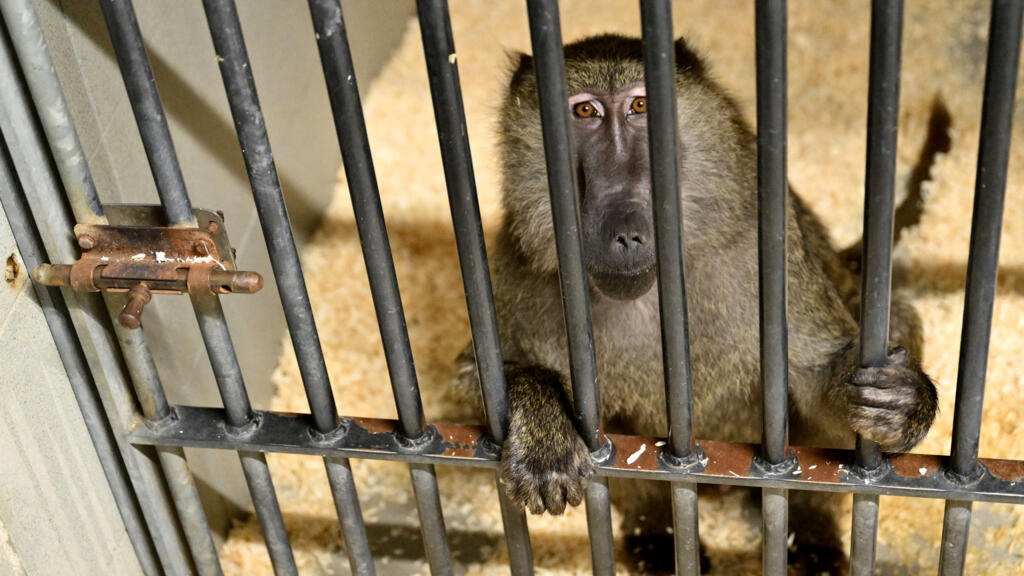
An Anubis baboon at the CNRS primatology centre in Rousset, where various monkey species are raised for the French scientific community, 6 November, 2025.
AFP - CHRISTOPHE SIMON
The National Centre for Scientific Research (CNRS) site at Rousset in Provence – which has spent decades breeding primates for scientific experiments – aims to triple its population to 1,800 animals by 2029.
Rights groups have criticised the move, warning it runs counter to the European Union's push to phase out animal testing.
The CNRS, backed by the French government, insists the expansion is necessary to reduce reliance on costly imports and improve welfare.
When Covid-19 disrupted animal shipments from China and Africa, the cost of a single lab-bred primate soared to between €15,000 and €20,000 – a price public research institutions struggled to meet.
The CNRS has framed the project as a matter of “France’s research sovereignty”.
The National Centre for Scientific Research (CNRS) site at Rousset in Provence – which has spent decades breeding primates for scientific experiments – aims to triple its population to 1,800 animals by 2029.
Rights groups have criticised the move, warning it runs counter to the European Union's push to phase out animal testing.
The CNRS, backed by the French government, insists the expansion is necessary to reduce reliance on costly imports and improve welfare.
When Covid-19 disrupted animal shipments from China and Africa, the cost of a single lab-bred primate soared to between €15,000 and €20,000 – a price public research institutions struggled to meet.
The CNRS has framed the project as a matter of “France’s research sovereignty”.
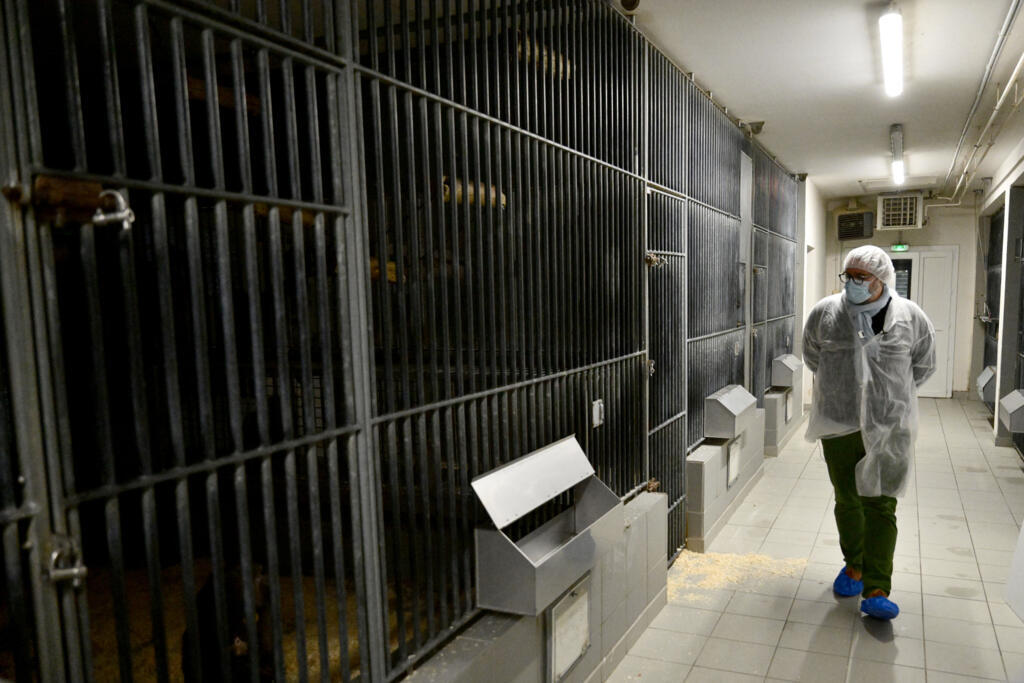
A vet pictured at the CNRS primatology centre in Rousset, south-eastern France.
AFP - CHRISTOPHE SIMON
However, One Voice, a prominent French animal rights group, says the plan goes “against the course of history”.
Although the EU has pledged to gradually move away from animal testing – and banned the practice for cosmetics in 2013 – it has not set firm deadlines.
The debate in France has intensified such that the Rousset centre opened its doors this month to allow a rare visit by journalists.
Behind barbed wire and discreet signage, enclosures spread across seven hectares of pine forest house 300 Anubis baboons, 60 Guinea baboons, 130 rhesus macaques and 120 marmosets, all born in captivity.
However, One Voice, a prominent French animal rights group, says the plan goes “against the course of history”.
Although the EU has pledged to gradually move away from animal testing – and banned the practice for cosmetics in 2013 – it has not set firm deadlines.
The debate in France has intensified such that the Rousset centre opened its doors this month to allow a rare visit by journalists.
Behind barbed wire and discreet signage, enclosures spread across seven hectares of pine forest house 300 Anubis baboons, 60 Guinea baboons, 130 rhesus macaques and 120 marmosets, all born in captivity.
Academic research
The site – soon to be renamed the National Primate Centre (CNP) – has been allocated €31 million in public funds to support its expansion.
Claire Duliere, who leads One Voice’s anti-testing campaign, argues the project is ultimately about “profitability, because it will be necessary to justify this use of public funds”.
But Ivan Balansard, head of ethics and animal research models at CNRS, counters that the plan is “anything but profit-driven: it is the public funding the public”.
Keeping the facility in France, he says, ensures better monitoring of living conditions and animal welfare. Each primate is expected to have 1.49 square metres of space on average – above EU requirements.
Founded in 1978, the centre is one of three public facilities in France breeding monkeys for research. Its primates are used only in academic work, Balansard says, including projects at Inserm and the Pasteur Institute, with only limited private sector involvement.
In 2023, around 3,500 monkeys were used for scientific research purposes in France, mostly in the fields of neuroscience and immunology. Most were ultimately euthanised to prevent prolonged suffering.
It is unclear how many came from Rousset, but the centre hopes to eventually supply 30 percent of the primates used in French research.
In comparison, the United States uses around 60,000 monkeys a year for testing, while China used 240,000 in 2021, bred across 57 centres, according to CNRS figures.
The site – soon to be renamed the National Primate Centre (CNP) – has been allocated €31 million in public funds to support its expansion.
Claire Duliere, who leads One Voice’s anti-testing campaign, argues the project is ultimately about “profitability, because it will be necessary to justify this use of public funds”.
But Ivan Balansard, head of ethics and animal research models at CNRS, counters that the plan is “anything but profit-driven: it is the public funding the public”.
Keeping the facility in France, he says, ensures better monitoring of living conditions and animal welfare. Each primate is expected to have 1.49 square metres of space on average – above EU requirements.
Founded in 1978, the centre is one of three public facilities in France breeding monkeys for research. Its primates are used only in academic work, Balansard says, including projects at Inserm and the Pasteur Institute, with only limited private sector involvement.
In 2023, around 3,500 monkeys were used for scientific research purposes in France, mostly in the fields of neuroscience and immunology. Most were ultimately euthanised to prevent prolonged suffering.
It is unclear how many came from Rousset, but the centre hopes to eventually supply 30 percent of the primates used in French research.
In comparison, the United States uses around 60,000 monkeys a year for testing, while China used 240,000 in 2021, bred across 57 centres, according to CNRS figures.
Developing alternatives
Public opinion in France appears to be hardening against animal experimentation. A 2023 Ipsos poll commissioned by One Voice found that 74 percent of people opposed it.
Technological advances – including new modelling tools and artificial intelligence – contributed to a 3.8 percent drop in the number of animals used in French research between 2022 and 2023, bringing the total to around 2 million – mostly mice.
But for now, the technology falls short of offering a complete solution.
Substitution models “cannot encapsulate the complexity of a living organism” for certain fields, particularly oncology, the national academies of medicine, sciences, pharmacy and veterinary sciences warned in 2021.
Monkeys have played a key role in the development of vaccines and treatments for diseases including polio, Ebola, HIV and Parkinson’s – a scientific legacy that continues to fuel the debate over Rousset’s future.
(with AFP)
No comments:
Post a Comment