
By Florian Misch, Ben Park, Carlo Pizzinelli and Galen Sher
Can artificial intelligence provide a much-needed boost to Europe’s economic productivity? Use of AI is spreading much faster than earlier technologies, such as the personal computer and the internet. And AI promises significant productivity jumps by automating many tasks and enhancing human capabilities.
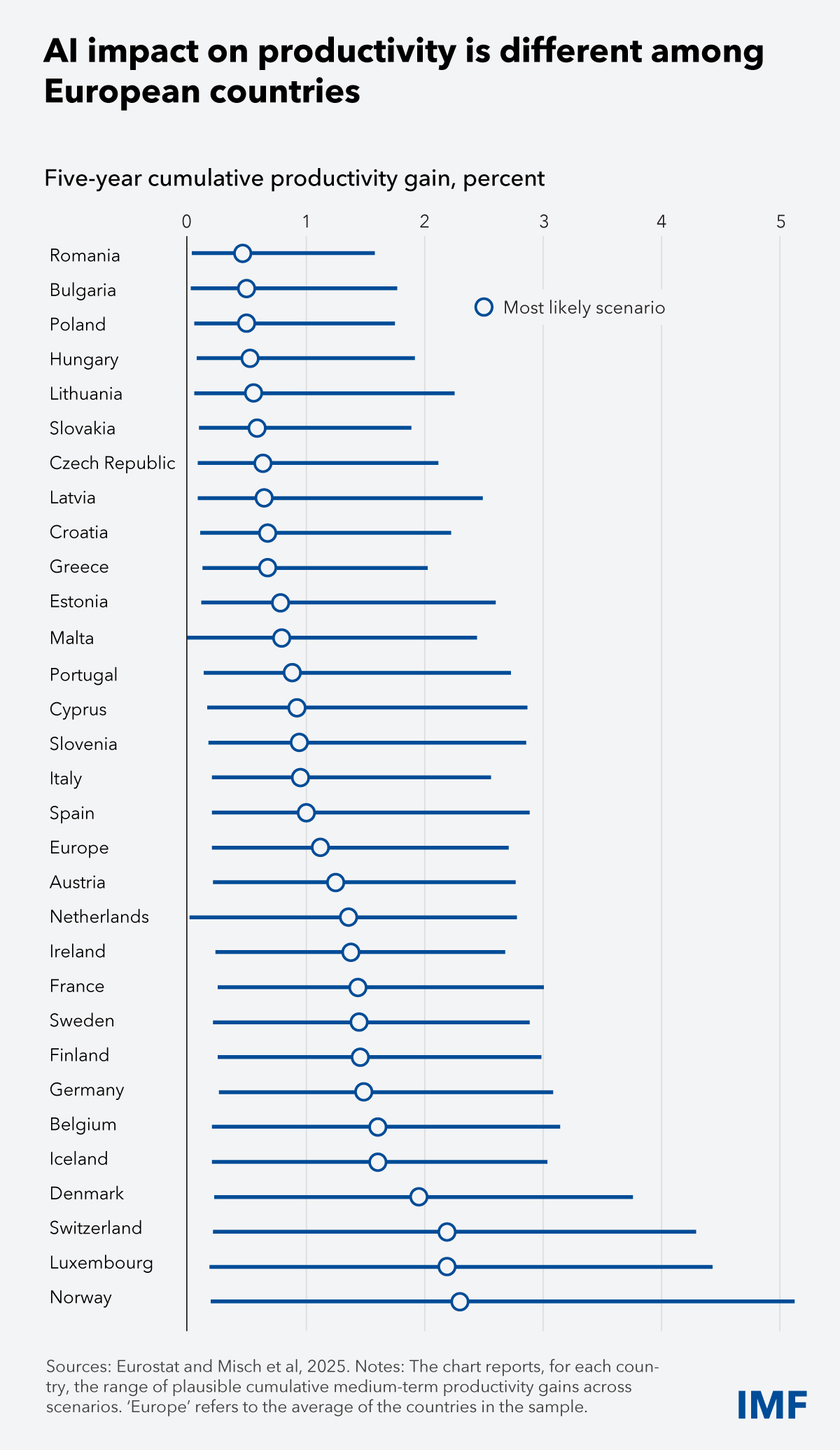
However, achieving large gains will hinge on European countries’ commitment to growth-enhancing reforms and willingness to being flexible on regulation, to help the new technology to flourish. Absent reforms, our research shows that the medium-term gain in productivity from the AI alone would vary considerably across countries, and for Europe as a whole would be rather modest: about 1.1 percent cumulatively over five years. With pro-growth reforms, though, much bigger gains are possible over the longer run.
Can artificial intelligence provide a much-needed boost to Europe’s economic productivity? Use of AI is spreading much faster than earlier technologies, such as the personal computer and the internet. And AI promises significant productivity jumps by automating many tasks and enhancing human capabilities.
However, achieving large gains will hinge on European countries’ commitment to growth-enhancing reforms and willingness to being flexible on regulation, to help the new technology to flourish. Absent reforms, our research shows that the medium-term gain in productivity from the AI alone would vary considerably across countries, and for Europe as a whole would be rather modest: about 1.1 percent cumulatively over five years. With pro-growth reforms, though, much bigger gains are possible over the longer run.
How AI helps productivity now
Three factors drive the economy-wide and one-off productivity effects of AI adoption:Exposure to AI of different sectors and occupations—the degree to which AI can automate or augment tasks;
Companies’ incentives to adopt AI, particularly potential savings in labor costs;
Average productivity gains across occupations. Contrary to past automation technologies, AI exposure is especially large in professional, managerial, or administrative work that is non-manual and often knowledge-based, like finance or software development.
European countries would benefit to different degrees. Higher-income countries typically gain more because they have more white-collar services, leaving them more exposed to AI. They also have higher wage levels which increase incentives to adopt labor-saving technologies. For example, Norway could gain as much as 5 percent in the most optimistic scenario.
Gains for lower-income economies will likely be more limited, which means that AI could temporarily widen productivity disparities within Europe. For instance, Romania could add just below 2 percent even in an optimistic scenario. Productivity gains could be larger in all countries if the cost of AI systems falls more quickly.
Strong upsides over longer term
The improving capabilities of AI models (as evidenced by various tests) suggest that gains could be much larger over a longer time horizon. AI could have more transformational effects by creating new industries and value chains. It could also boost productivity growth more permanently through accelerating research and development (referred to in literature as Invention in the method of inventing). For example, there is already evidencethat AI accelerates and enhances pharmaceutical drug development.
Recent work estimates the long-run annual labor productivity growth impact when considering that AI is not only used to produce goods and services but also to create new commercial knowledge. In the United States, annual productivity growth could be boosted by 1 percent annually, while for Europe the gains could also be substantial but not as high. The analysis points to longer lasting effects which imply dramatically larger gains than the short-term effects we estimated. These predicted long-term benefits could even be conservative: When estimating the impact of technology, expectations are often too optimistic about the immediate effects and too pessimistic about lasting contributions (Amara’s Law).
The improving capabilities of AI models (as evidenced by various tests) suggest that gains could be much larger over a longer time horizon. AI could have more transformational effects by creating new industries and value chains. It could also boost productivity growth more permanently through accelerating research and development (referred to in literature as Invention in the method of inventing). For example, there is already evidencethat AI accelerates and enhances pharmaceutical drug development.
Recent work estimates the long-run annual labor productivity growth impact when considering that AI is not only used to produce goods and services but also to create new commercial knowledge. In the United States, annual productivity growth could be boosted by 1 percent annually, while for Europe the gains could also be substantial but not as high. The analysis points to longer lasting effects which imply dramatically larger gains than the short-term effects we estimated. These predicted long-term benefits could even be conservative: When estimating the impact of technology, expectations are often too optimistic about the immediate effects and too pessimistic about lasting contributions (Amara’s Law).
How Europe should respond
To take full advantage of AI’s potential, Europe must focus on removing the barriers that limit diffusion of skills and technology and the growth of companies. The recent Regional Economic Outlook for Europe highlights several policy priorities.
Deepening the European Union single market will be critical to counter fragmentation along national borders. The goal must be to make it easier for innovative firms in the field of AI to access a broader, EU-wide customer base. This requires removing barriers to cross-border services, opening up protected sectors, and harmonizing standards – all of which can help reduce the cost of developing and adopting AI tools.
Funding the risky investments that underpin AI development (often based on intangible assets like software and intellectual property) requires stronger and more integrated financial markets. A well-functioning Capital Markets Union can increase the availability of venture capital by channeling more savings to early-stage, risky technological ventures in AI. Improving the recognition and valuation of intangibles assets such as intellectual property related to AI in financial statements and resolution regimes would also help mobilize private financing for innovation.
Flexible labor markets and portable social protection are vital to help workers transition toward sectors and firms that are expanding thanks to AI. For instance, simplifying degree recognition, enhancing housing affordability, and ensuring pension portability can facilitate movement to where opportunities from AI arise.
Creating a more efficient energy market is another key ingredient. Affordable and reliable electricity will support data centers that power AI systems. Securing competitive and low-carbon energy supplies through better market integration will support both AI infrastructure and Europe’s broader green transition.
Finally, regulation needs to remain flexible. While addressing important data protection, ethical, and safety concerns related to AI, regulation will need to be dynamically calibrated to navigate the trade-offs between addressing risks and enabling growth through AI adoption. Otherwise, even some of the moderate productivity dividends from AI adoption over the next few years could be lost.
Reaping the full potential of AI depends on policy choices that Europe makes today. Even moderate AI productivity gains in the coming years would be significant relative to Europe’s anemic economic growth prospects. Capturing larger, longer-term benefits—and keeping up with the United States—will hinge above all on Europe’s ability to move fast in building a more dynamic and integrated single market.
About the authors:
Florian Misch is a Senior Economist in France team of the European Department at the IMF. He is also working on issues related to Artificial Intelligence and has been part of the Norway, Romania, and Sweden teams, interrupted by a stint at the European Stability Mechanism. Prior to joining the European Department, Florian worked in the IMF’s Fiscal Affairs Department, as a freelance economic policy consultant for organizations such as the New Zealand Treasury and the World Bank, and as researcher at the Centre for European Economic Research.
Ben Park is a Research Officer in the IMF’s European Department. He holds a M.Sc. in Mathematics and Statistics from Georgetown University and obtained his B.A. in International Affairs and Economics from the George Washington University.
Carlo Pizzinelli is an economist in the European Department of the International Monetary Fund. His research focuses on labor markets and structural transformation issues. His works on these topics have been featured in academic journals and IMF publications.
Galen Sher is a Senior Economist working on global fiscal policy topics at the IMF’s Fiscal Affairs Department, where he has led the Fiscal Monitor report. Previously, he was Senior Economist for Germany in the IMF’s European Department where he developed advice on a range of topics from macroprudential policy to productivity.
Florian Misch is a Senior Economist in France team of the European Department at the IMF. He is also working on issues related to Artificial Intelligence and has been part of the Norway, Romania, and Sweden teams, interrupted by a stint at the European Stability Mechanism. Prior to joining the European Department, Florian worked in the IMF’s Fiscal Affairs Department, as a freelance economic policy consultant for organizations such as the New Zealand Treasury and the World Bank, and as researcher at the Centre for European Economic Researc
No comments:
Post a Comment