Conservative media war pits pro-Trump networks against each other
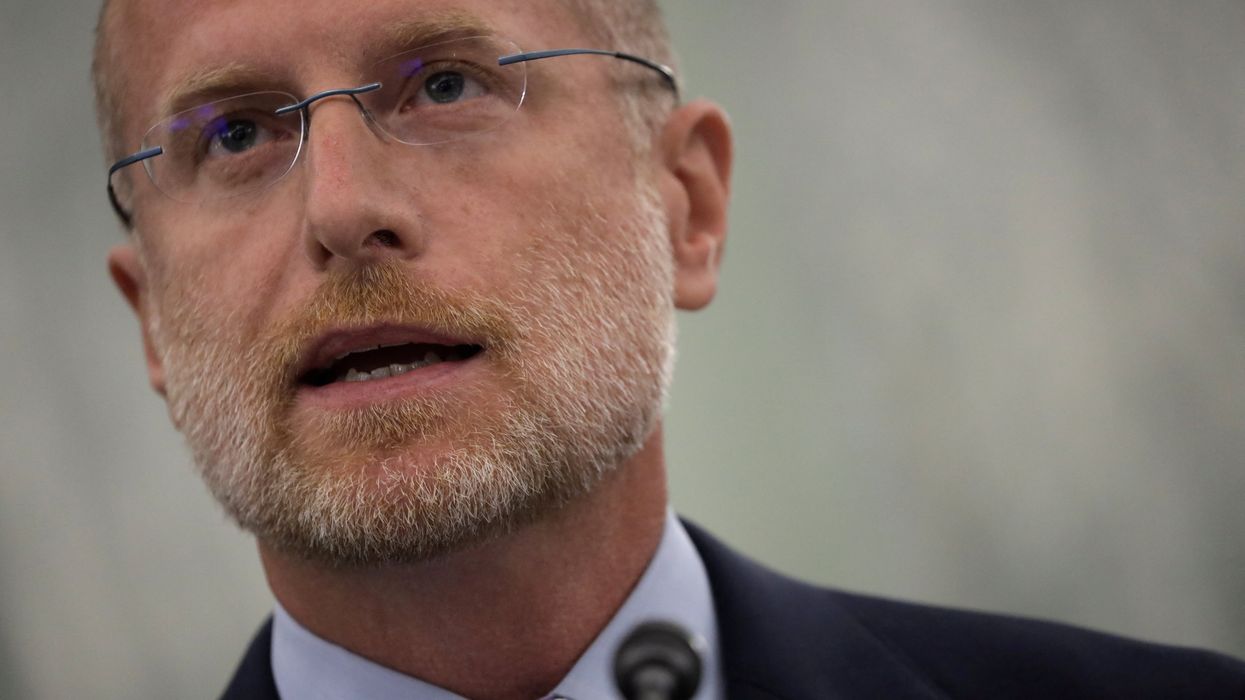
Commissioner of Federal Communications Commission Brendan Carr testifies during an oversight hearing held by the U.S. Senate Commerce, Science, and Transportation Committee to examine the Federal Communications Commission (FCC), in Washington, U.S. June 24, 2020. Alex Wong/Pool via REUTERS/File Photo
Two powerful groups of media executives very friendly to President Donald Trump are currently embroiled in a fight that puts FCC chair Brendan Carr in an awkward position, reports Politico's John Hendel.
"The nation’s largest TV station owners want Carr’s Federal Communications Commission to loosen the rules that limit how many stations a single company can operate, a goal that many conservatives have been pressing for years," Hendel writes.
These owners, however, have a "formidable opponent in Trump confidant Chris Ruddy, the majority owner of Newsmax Media, who wants to keep the rules in place and now appears to be making headway with the president," he explains.
Trump took to Truth Social Sunday to demonstrate that headway, Hendel notes.
"NO EXPANSION OF THE FAKE NEWS NETWORKS,” Trump wrote, "echoing Ruddy’s argument that removing the ownership cap would hurt conservatives," Hendel explains.
“If anything, make them SMALLER!” Trump added.
Carr, Hendel writes, "has shown a knack for disruptive, MAGA-pleasing culture-war moves, like his public upbraiding of comedian Jimmy Kimmel and accusing '60 Minutes' of being unfriendly to conservatives," but now he's conflicted.
"Carr has signaled he may want to change the 21-year-old limit on TV station ownership, which was intended to prevent any one broadcaster from too much power over what Americans see on television," Hendel explains. "Loosening the ownership rule would allow right-leaning companies like Sinclair Broadcast Group to expand."
Large TV station owners are hitting a growth limit, Hendel writes, so "a larger cap would give more power to station owners — seen by many conservatives as an ideological counterweight to the mainstream national networks that control TV programming."
Newsmax's Ruddy, however, is standing in the way, Hendel says.
"Ruddy is trying to block any change, arguing that the cap — which limits a broadcaster’s reach to 39 percent of U.S. households — preserves the right market balance between TV broadcasters and cable outlets, and allows a greater mix of voices," he writes.
“It’s not going to work,” Ruddy tells Politico. "The president doesn’t want this, and so I have no doubt that he will not support the FCC going to extraordinary but potentially illegal lengths.”
Joining Ruddy is Charles Herring, president of the pro-Trump One America News Network (OANN) cable channel, who, Hendel writes, "shares a marketplace wariness of TV station owners gobbling up too much power."
“Independent [and] diverse voices will disappear,” wrote Herring in an X post.
Under Trump, this has turned "into a political tug-of-war and an influence battle between big names on the right," Hendel says.
Former Trump press secretary Sean Spicer recently wrote an op-ed in right-wing outlet The Daily Caller in which he argued that Carr should lift the cap.
“Conservatives who believe in free enterprise should not be vocally encouraging Big Brother to continue barring broadcast TV companies like Sinclair and Nexstar from competing in the free market,” argued Spicer, a contributor to Nexstar’s cable network NewsNation.
Nexstar, Hendel notes, is "trying to usher through a $6.2 billion deal to buy rival station owner Tegna, a merger that would only be possible if Carr relaxes the cap. The new company would operate 265 TV stations, reaching more than half the country."
Ruddy, however, says "that the FCC is working to go against the interests of the president and his supporters — and really against most consumers.”
“We have a history of big companies going in and giving conservative think tanks money to do reports and stand on issues,” Ruddy adds “And it’s not working.”
Through all this, Trump "is being pulled in both directions on an issue he cares a great deal about: what’s on television," he writes.
“If this would also allow the Radical Left Networks to ‘enlarge,’ I would not be happy,” Trump wrote.
"That will likely give broadcasters and their conservative allies room to try to counter Ruddy’s narrative — and some are already casting the issue accordingly," Hendel explains.
On Monday, Nexstar said that "Americans want more access to local news and a variety of voices without the filter of the coastal elites."
For now, the person truly stuck in the middle is Carr.
"Carr’s path to lifting the cap is uncertain, and his own staff say they’re likely to end up in court over the issue. Detractors don’t even believe the agency has the authority to unleash this consolidation at all, saying it’s a matter for Congress," Hendel says.
"We haven’t made a final decision there yet,” Carr told Politico on Nov. 18. “I continue to be very open minded.”
Commissioner of Federal Communications Commission Brendan Carr testifies during an oversight hearing held by the U.S. Senate Commerce, Science, and Transportation Committee to examine the Federal Communications Commission (FCC), in Washington, U.S. June 24, 2020. Alex Wong/Pool via REUTERS/File Photo
November 28, 2025
ALTERNET
Two powerful groups of media executives very friendly to President Donald Trump are currently embroiled in a fight that puts FCC chair Brendan Carr in an awkward position, reports Politico's John Hendel.
"The nation’s largest TV station owners want Carr’s Federal Communications Commission to loosen the rules that limit how many stations a single company can operate, a goal that many conservatives have been pressing for years," Hendel writes.
These owners, however, have a "formidable opponent in Trump confidant Chris Ruddy, the majority owner of Newsmax Media, who wants to keep the rules in place and now appears to be making headway with the president," he explains.
Trump took to Truth Social Sunday to demonstrate that headway, Hendel notes.
"NO EXPANSION OF THE FAKE NEWS NETWORKS,” Trump wrote, "echoing Ruddy’s argument that removing the ownership cap would hurt conservatives," Hendel explains.
“If anything, make them SMALLER!” Trump added.
Carr, Hendel writes, "has shown a knack for disruptive, MAGA-pleasing culture-war moves, like his public upbraiding of comedian Jimmy Kimmel and accusing '60 Minutes' of being unfriendly to conservatives," but now he's conflicted.
"Carr has signaled he may want to change the 21-year-old limit on TV station ownership, which was intended to prevent any one broadcaster from too much power over what Americans see on television," Hendel explains. "Loosening the ownership rule would allow right-leaning companies like Sinclair Broadcast Group to expand."
Large TV station owners are hitting a growth limit, Hendel writes, so "a larger cap would give more power to station owners — seen by many conservatives as an ideological counterweight to the mainstream national networks that control TV programming."
Newsmax's Ruddy, however, is standing in the way, Hendel says.
"Ruddy is trying to block any change, arguing that the cap — which limits a broadcaster’s reach to 39 percent of U.S. households — preserves the right market balance between TV broadcasters and cable outlets, and allows a greater mix of voices," he writes.
“It’s not going to work,” Ruddy tells Politico. "The president doesn’t want this, and so I have no doubt that he will not support the FCC going to extraordinary but potentially illegal lengths.”
Joining Ruddy is Charles Herring, president of the pro-Trump One America News Network (OANN) cable channel, who, Hendel writes, "shares a marketplace wariness of TV station owners gobbling up too much power."
“Independent [and] diverse voices will disappear,” wrote Herring in an X post.
Under Trump, this has turned "into a political tug-of-war and an influence battle between big names on the right," Hendel says.
Former Trump press secretary Sean Spicer recently wrote an op-ed in right-wing outlet The Daily Caller in which he argued that Carr should lift the cap.
“Conservatives who believe in free enterprise should not be vocally encouraging Big Brother to continue barring broadcast TV companies like Sinclair and Nexstar from competing in the free market,” argued Spicer, a contributor to Nexstar’s cable network NewsNation.
Nexstar, Hendel notes, is "trying to usher through a $6.2 billion deal to buy rival station owner Tegna, a merger that would only be possible if Carr relaxes the cap. The new company would operate 265 TV stations, reaching more than half the country."
Ruddy, however, says "that the FCC is working to go against the interests of the president and his supporters — and really against most consumers.”
“We have a history of big companies going in and giving conservative think tanks money to do reports and stand on issues,” Ruddy adds “And it’s not working.”
Through all this, Trump "is being pulled in both directions on an issue he cares a great deal about: what’s on television," he writes.
“If this would also allow the Radical Left Networks to ‘enlarge,’ I would not be happy,” Trump wrote.
"That will likely give broadcasters and their conservative allies room to try to counter Ruddy’s narrative — and some are already casting the issue accordingly," Hendel explains.
On Monday, Nexstar said that "Americans want more access to local news and a variety of voices without the filter of the coastal elites."
For now, the person truly stuck in the middle is Carr.
"Carr’s path to lifting the cap is uncertain, and his own staff say they’re likely to end up in court over the issue. Detractors don’t even believe the agency has the authority to unleash this consolidation at all, saying it’s a matter for Congress," Hendel says.
"We haven’t made a final decision there yet,” Carr told Politico on Nov. 18. “I continue to be very open minded.”
Conservative 'confusion' after MAGA revealed as 'propaganda coup': constitutional scholar
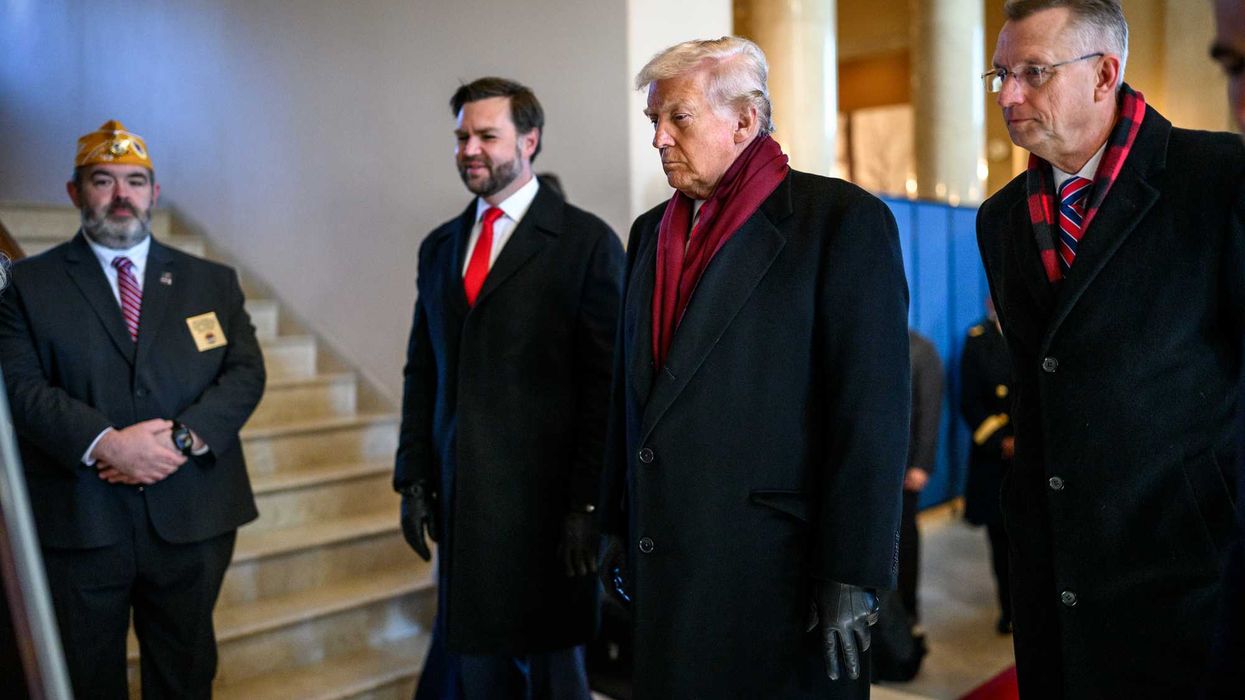
President Donald Trump, Vice President JD Vance, and Secretary of Veterans Affairs Doug Collins walk towards the stage during Veterans Day ceremonies at Arlington National Cemetery in Arlington, Virginia, Tuesday, November 11, 2025. (Official White House Photo by Daniel Torok)
On Newsweek’s new video podcast "The 1600," constitutional scholar and lifelong conservative Justin Stapley warns that the MAGA movement’s problems run far deeper than any single election cycle.
Stapley, host of The Conservative Underground podcast, argues that the "GOP’s outward strength under President Donald Trump masks a party increasingly defined by internal division, ideological drift, and the growing influence of populism and online-driven extremism," Newsweek says.
"Speaking with Newsweek's Carlo Versano, Stapley warns that Trump’s personal dominance has masked the extent to which traditional conservatism has been sidelined, leaving Republicans unprepared for what comes after Trump," they write.
In response to Versano saying "Republicans got smoked" in the November elections, Stapley, who is also the state director of the Utah Reagan Caucus, says the problem runs deeper than just one election cycle.
"What we’ve discovered is that the last 10 years haven’t been a direct ideological shift so much as a propaganda coup," he says.
"People will walk up with a swagger, red MAGA hat, angry look, and say, 'Oh, we've got a zombie Reaganite over here.' And then everyone else will stop and say, 'Wait, I thought we liked Reagan.' There’s confusion among ordinary Republicans," he adds.
Those "ordinary Republicans," he explains, are not part of the MAGA movement and are still steeped in Reaganism.
"Ordinary Republicans still embrace Reaganism and traditional conservatism because they understand the country is built on deep philosophical roots," he says. If people want to abandon all that because it's 'holding us back,' that’s not what many Republicans signed up for."
Stapley is no Trump fan, saying, that while we've had some bad presidents before, "he’s worse because we’ve gutted the checks and balances that used to exist."
"Congress has become almost an empty branch of government — even though it was meant to be the 'first among equals.' The modern presidency has grown and grown. Congress has become the president’s foot soldiers," he says.
Stapley also explains that there is a crack in the MAGA base because Trump "can't please everyone," and he sees MAGA morphing into something entirely different that what it is currently.
"We may soon see 'America First' meaning something very different from MAGA," he says.
"Trump still holds the MAGA brand, but you have people like Marjorie Taylor Greene, Nick Fuentes, Tucker Carlson, Matt Walsh saying 'I’m America First, and I’m America Only.'"
Without Trump on the ballot in 2028, Stapley says Republicans have work to do.
"Republicans need to figure out their identity. People say they’ve remade themselves into a blue-collar populist party with a bigger coalition. But that coalition doesn’t show up without Trump," he says.
They also need to realize the truth about Trump.
"Even with Trump, we’ve overestimated his strength. He’s run in three consecutive presidential elections and never broken 50 percent," he says. "He has a 47 percent ceiling unless he’s running against a candidate who’s mentally not there or one who didn’t go through a Democratic selection process."
President Donald Trump, Vice President JD Vance, and Secretary of Veterans Affairs Doug Collins walk towards the stage during Veterans Day ceremonies at Arlington National Cemetery in Arlington, Virginia, Tuesday, November 11, 2025. (Official White House Photo by Daniel Torok)
November 26, 2025
ALTERNET
On Newsweek’s new video podcast "The 1600," constitutional scholar and lifelong conservative Justin Stapley warns that the MAGA movement’s problems run far deeper than any single election cycle.
Stapley, host of The Conservative Underground podcast, argues that the "GOP’s outward strength under President Donald Trump masks a party increasingly defined by internal division, ideological drift, and the growing influence of populism and online-driven extremism," Newsweek says.
"Speaking with Newsweek's Carlo Versano, Stapley warns that Trump’s personal dominance has masked the extent to which traditional conservatism has been sidelined, leaving Republicans unprepared for what comes after Trump," they write.
In response to Versano saying "Republicans got smoked" in the November elections, Stapley, who is also the state director of the Utah Reagan Caucus, says the problem runs deeper than just one election cycle.
"What we’ve discovered is that the last 10 years haven’t been a direct ideological shift so much as a propaganda coup," he says.
"People will walk up with a swagger, red MAGA hat, angry look, and say, 'Oh, we've got a zombie Reaganite over here.' And then everyone else will stop and say, 'Wait, I thought we liked Reagan.' There’s confusion among ordinary Republicans," he adds.
Those "ordinary Republicans," he explains, are not part of the MAGA movement and are still steeped in Reaganism.
"Ordinary Republicans still embrace Reaganism and traditional conservatism because they understand the country is built on deep philosophical roots," he says. If people want to abandon all that because it's 'holding us back,' that’s not what many Republicans signed up for."
Stapley is no Trump fan, saying, that while we've had some bad presidents before, "he’s worse because we’ve gutted the checks and balances that used to exist."
"Congress has become almost an empty branch of government — even though it was meant to be the 'first among equals.' The modern presidency has grown and grown. Congress has become the president’s foot soldiers," he says.
Stapley also explains that there is a crack in the MAGA base because Trump "can't please everyone," and he sees MAGA morphing into something entirely different that what it is currently.
"We may soon see 'America First' meaning something very different from MAGA," he says.
"Trump still holds the MAGA brand, but you have people like Marjorie Taylor Greene, Nick Fuentes, Tucker Carlson, Matt Walsh saying 'I’m America First, and I’m America Only.'"
Without Trump on the ballot in 2028, Stapley says Republicans have work to do.
"Republicans need to figure out their identity. People say they’ve remade themselves into a blue-collar populist party with a bigger coalition. But that coalition doesn’t show up without Trump," he says.
They also need to realize the truth about Trump.
"Even with Trump, we’ve overestimated his strength. He’s run in three consecutive presidential elections and never broken 50 percent," he says. "He has a 47 percent ceiling unless he’s running against a candidate who’s mentally not there or one who didn’t go through a Democratic selection process."
No comments:
Post a Comment