AUSTRALIA
AGL Strikes 15-Year Deal to Buy Clean Power From WA Wind Project

AGL Energy Ltd. (ASX: AGL) has signed a 15-year Power Purchase Agreement (PPA) with Tilt Renewables for 100% of the expected 105 MW of generation from the Waddi Wind Farm, located in Western Australia’s Shire of Dandaragan.
Under the deal, AGL Perth Energy will offtake all electricity generated by the Waddi Wind Farm once operational, beginning in the second half of 2028. The agreement marks AGL’s first long-term wind PPA in the state, expanding its renewable portfolio and supporting its decarbonisation goals.
The Waddi Wind Farm is strategically aligned with the Western Australian Government’s Clean Energy Link North transmission expansion, part of the SWIS Transmission Plan, which aims to unlock renewable generation capacity across the state. The project is being developed by Tilt Renewables, one of Australia’s leading renewable energy developers, and will play a key role in expanding AGL Perth Energy’s offering to Western Australian businesses.
AGL Perth Energy, which has been operating in WA since 1999, currently supplies electricity and gas to SMEs and large commercial and industrial clients. According to AGL Chief Commercial Officer David Moretto, the agreement will diversify AGL’s renewable portfolio and strengthen its WA market position.
AGL General Manager Giles Redmile added that the deal represents a “milestone” for AGL Perth Energy, enabling it to offer renewable-linked products to a broader range of customers as demand for clean energy solutions continues to grow across Western Australia.
By entering into renewable PPAs such as this one, AGL helps underwrite new clean energy generation while securing long-term price stability for both itself and its customers. The agreement also demonstrates AGL’s ongoing shift toward a lower-emissions portfolio as part of its broader energy transition strategy.
By Charles Kennedy for Oilprice.com
Dutch Not Surprised as Offshore Wind Farm Auction Gets No Bids
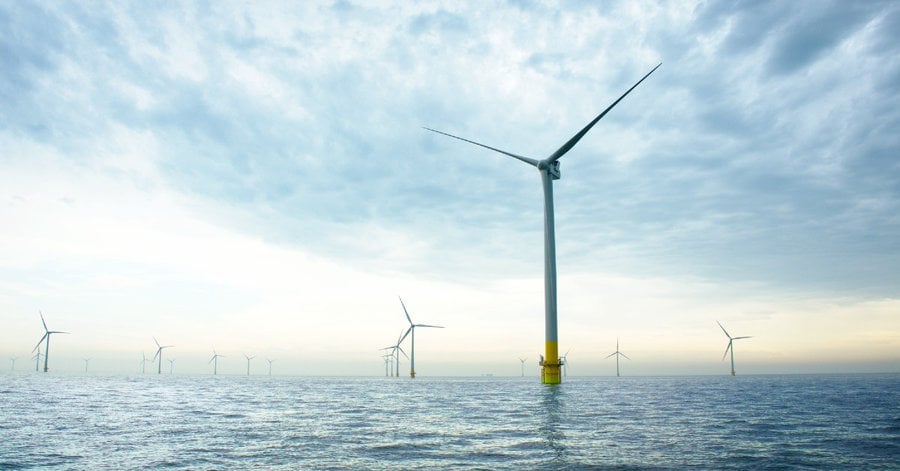
The Netherlands Enterprise Agency (RVO) confirmed that it had not received any bids in the latest offshore wind farm auction for the North Sea. While the government was disappointed, they noted that it was not a surprise due to the changing conditions in the industry.
The Netherlands was offering a new site approximately 60 miles off the coast near Texel in the northwest of the country. The site had originally been proposed with a capacity of 2 GW, but the auction was later amended to a 1 GW capacity. The government said the change had been taken to lower the investment risk for developers and to attract more bids. However, the auction, which was proposed without a government subsidy, failed to attract any applications for the construction and operations at the Nederwiek I-A site.
RVO cited rising costs and less demand for electricity than previously expected as factors in the lack of bids. It said that while the market for offshore wind energy has grown rapidly in recent years, the market has recently changed rapidly and significantly. They noted that auctions in Germany, Denmark, the United Kingdom, and Belgium have also failed to obtain bids or were postponed due to limited interest.
“The sustainability of Dutch industry, among others, is lagging behind,” writes RVO. “This has made it more difficult for wind farm developers to conclude long-term electricity contracts before the construction of a wind farm starts. This has reduced their willingness to invest.”
The government highlights that it had already begun planning, noting that the Ministry of Climate Policy and Green Growth had warned the auction might not receive any applications. In September, the Ministry released its plan for the next phase of the offshore wind energy sector.
In 2026, the government wants to issue permits for 2 GW of offshore wind energy capacity. The new plan calls for a subsidy scheme to be introduced, with officials noting that €948 million (US$1.1 billion) has already been reserved for the program in 2026. The next round will also be based on a Contracts for Difference (CFD) process, which will guarantee a minimum price for the generated electricity. When the market price falls below the guarantee, the government makes up the difference in subsidies, and when it exceeds it, the profits go to the country or consumers.
The Netherlands’ government is currently reviewing the sites to be offered in 2026. They plan to release the details of the next round by January, and they believe the new approach will stimulate more interest in the market.
Wind Turbine Installation Vessel Charybis
Dominion Energy Confirms Commissioning Delays on WTIV Charybdis
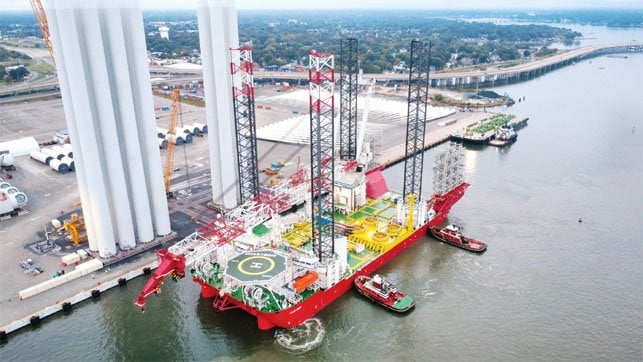
As part of its quarterly earnings report to the investment community, Dominion Energy gave a detailed update on commissioning delays with its wind turbine installation vessel Charybis while also emphasizing that the Coastal Virginia offshore wind project remains on schedule and is making good progress. CEO Robert Blue discussed the challenges with the vessel and the overall progress on the project, which he still expects will deliver first power to customers late in the first quarter of 2026.
Calling Charybdis, which is the first American-made Jones Act-compliant WTIV, a “challenge,” Blue went on to tell the investment community, “I am extremely disappointed that Charybdis has again not met expectations… we failed to deliver regarding Charybdis.” He, however, told the audience that he was confident that they would complete commissioning and that the first wind turbine installations would occur late next month (November).
He highlights the uniqueness of the vessel, which he says was built to global best practices but has inherent risk in being the first Jones Act-compliant vessel of its kind built and regulated in the United States.
The vessel, which is 472 feet long and is 27,000 gross tons, was built at Seatrium AmFELS yard in Brownsville, Texas. In its jack-up position, there is a 40-meter (131-foot) air gap under the hull, and its crane has a 2,200-ton capacity. The vessel completed sea trials, received sign-offs, and arrived in Portsmouth, Virginia, in September. Since its arrival, Siemens Gamesa completed necessary modifications for turbine handling and installation, and the vessel underwent new-to-zone inspections in Portsmouth.
Blue said two primary areas of concern were identified during the inspection. First was the material condition of certain components, primarily in the ship’s electrical system. Second was the need for documentation that confirmed that the systems meet US-approved codes and standards. About 200 items were identified that needed to be addressed,
Dominion reports there are about 200 crewmembers and marine electricians working on the ship and doing the additional surveys. To date, they said over 4,000 inspections have been done across 69 electrical systems, including 1,400 cable inspections. Of the 200 items identified on the punch list, about 120 have now been closed out.
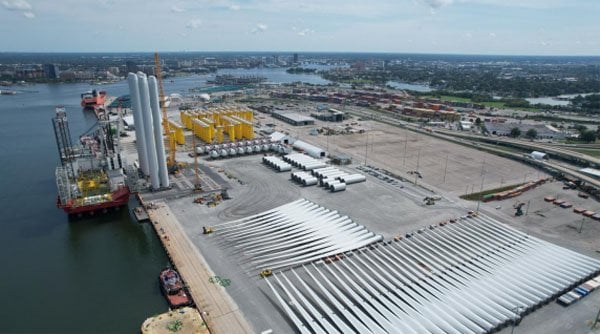
Charybdis on dock with the material staged for the offshore wind farm in Portsmouth, Virginia (Dominion Energy)
Dominion says it decided to build the ship, with a cost it now sets at $715 million, because it represented a strategic advantage. They said having their own vessel provided enhanced schedule certainty, which translated to cost certainty for the project. Blue said Dominion continues to believe in the advantages of the vessel.
Through September, they report a total investment of $8.2 billion in the Coastal Virginia project, with remaining project costs attributable to Dominion expected at $1.5 billion.
At this point, 100 percent of the monopiles have been installed, completed one month before the end of the installation season. In addition, 63 transition pieces have been installed, and all 176 are now fabricated. The second substation jacket recently went in, and the topside will be installed shortly. The third offshore substation will be installed in the first quarter of 2026.
First power remains on schedule for about five months from now, and they still expect completion of the project by the end of 2026. However, the delays with Charybdis have meant the company has significantly reduced the schedule for weather and vessel maintenance contingency. Blue said it might result in the final few turbines not being installed until early 2027.
IX Renewables & Asia Cement Corporation Sign Agreement for "Rui Li 1"

[By: IX Renewables]
During the 2025 Energy Taiwan, IX Renewables and Asia Cement Corporation (ACC) signed a cooperation agreement for the “Rui Li 1” floating offshore wind project. The partnership marks a major milestone in Taiwan’s renewable energy journey – combining international offshore expertise with strong local industrial capabilities. It adds new momentum into a sector that has until recently been slowing, as the country works to advance its energy transition and net-zero ambitions.
Located deep waters off Hsinchu, the Rui Li 1 floating wind farm will have a planned installed capacity of 180MW, in water depths ranging from 70 to 95 meters. The project is led by IX Renewables in collaboration with international partners - GF Corporation (Japan) Hexicon (Sweden/Korea) and SNOW BV (Netherlands/France). The participation of Asia Cement Corporation as s sponsor represents a meaningful step in Taiwan’s domestic industry and fostering a pragmatic and locally rooted approach to floating wind development.
Eric Kamphues, CEO of IX Renewables, stated “We warmly welcome Asia Cement Corporation’s participation in Rui Li 1. This cooperation represents our shared confidence in the continued growth of Taiwan’s offshore wind industry. By combining Taiwan’s strong industrial foundation with IX’s international offshore wind experience, we can jointly bring floating wind technology from vision to reality. Together, we aim to contribute to Taiwan’s 2035 goal of achieving 21 GW of offshore wind capacity and advancing toward a net-zero future.”
Peter Hsu, the Board Director of Asia Cement Corporation added “We value the opportunity to collaborate with IX Renewables, a company with solid technical expertise and a proven track record in Taiwan’s offshore wind sector. This cooperation reflects our shared commitment to advancing Taiwan’s renewable energy industry through pragmatic and locally integrated development. Together, we aim to contribute to Taiwan’s energy transition and demonstrate the strength of partnership between international know-how and domestic industry.”
Eric further noted “Since Taiwan’s first offshore wind demonstration project began commercial operation in 2017 — a project in which IX Renewables was closely involved — the country’s total installed capacity has surpassed 3 GW. To reach the 2035 target of 21 GW of offshore wind, floating wind farms will be the essential next step. IX regards Rui Li Phase 1 not just as a demonstration, but as the beginning of Taiwan’s next chapter in offshore wind.
IX Renewables and Asia Cement Corporation look forward to leveraging international experience and local industry capabilities to bring floating wind technology in practice in Taiwan, making a lasting contribution to the country’s energy transition and net-zero future.
The products and services herein described in this press release are not endorsed by The Maritime Executive.

No comments:
Post a Comment