European and African leaders are meeting in Angola for a summit focused on trade and renewing the relationship between African and European countries that have been tested by growing influence of Russia, China and the United States.
Issued on: 24/11/2025 - RFI
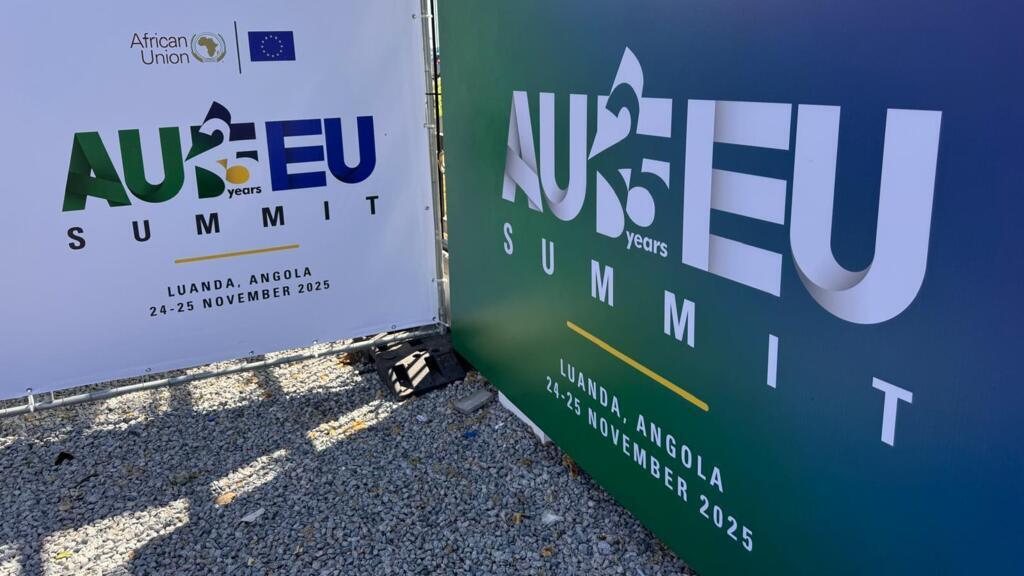
The AU-EU summit is being held in Luanda, Angola, 24-25 November 2025.
© Paulina Zidi/RFI
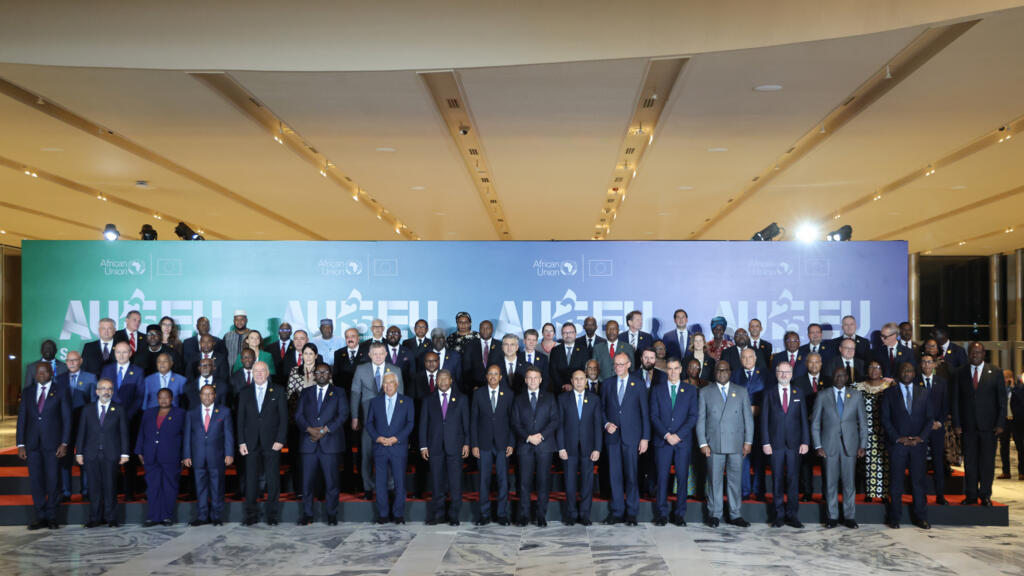
Continuing his African tour, French President Emmanuel Macron is in Luanda to join nearly 80 EU and African leaders at a two-day summit that marks 25 years of EU-African Union relations, which are fraying.
The EU is the leading supplier of direct foreign investment to Africa and its leading trading partner.
Yet China, the US and Russia are gaining influence, as some African countries turn away from their former colonial rulers, notably France.
"Relations between Africa and Europe need to be revisited," Pascal Saint-Amans, a professor at the University of Lausanne in Switzerland who in Luanda, told RFI.
"Economic exchanges for a long time happened in a colonial relationship, but I believe that with the overall shift in global geopolitics, we now have a relationship that is more on an equal footing, less paternalistic, which is a very good thing."
The seventh EU-African Union gathering comes on the heels of a G20 meeting in South Africa where a US boycott underscored geopolitical fractures.
"The challenges we face today – climate change, digital transformation, irregular migration, conflicts and insecurity – know no borders. The response to this multipolar world must be multipolar cooperation," EU chiefs Ursula von der Leyen and Antonio Costa said in a joint statement Monday.
"Together, Africa and Europe can lead the way," they said, adding the two blocs aimed to shape "a fairer, greener, and more secure world based on shared values and mutual respect".
Focus on trade
Tackling illegal migration to Europe and security cooperation are on the summit agenda, as is a push to grant Africa more of a voice in global governance bodies.
But boosting trade is likely the top priority, as the EU seeks to secure critical minerals needed for its green transition and to reduce its dependency on China for minerals used in electronic goods.
In 2021, the EU launched a massive infrastructure project, the Global Gateway, intended to counter China’s growing influence, with half of the €300 billion invested in Africa by 2027.
A key part of the strategy is the Lobito corridor, a railway project in partnership with the US, that passes through Angola, connecting mineral-rich areas of the Democratic Republic of Congo and Zambia to the Atlantic coast.
The EU is the leading supplier of foreign direct investment to the continent and its top commercial counterpart. Trade in goods and services hit €467 billion in 2023, according to Brussels.
Continuing his African tour, French President Emmanuel Macron is in Luanda to join nearly 80 EU and African leaders at a two-day summit that marks 25 years of EU-African Union relations, which are fraying.
The EU is the leading supplier of direct foreign investment to Africa and its leading trading partner.
Yet China, the US and Russia are gaining influence, as some African countries turn away from their former colonial rulers, notably France.
"Relations between Africa and Europe need to be revisited," Pascal Saint-Amans, a professor at the University of Lausanne in Switzerland who in Luanda, told RFI.
"Economic exchanges for a long time happened in a colonial relationship, but I believe that with the overall shift in global geopolitics, we now have a relationship that is more on an equal footing, less paternalistic, which is a very good thing."
The seventh EU-African Union gathering comes on the heels of a G20 meeting in South Africa where a US boycott underscored geopolitical fractures.
"The challenges we face today – climate change, digital transformation, irregular migration, conflicts and insecurity – know no borders. The response to this multipolar world must be multipolar cooperation," EU chiefs Ursula von der Leyen and Antonio Costa said in a joint statement Monday.
"Together, Africa and Europe can lead the way," they said, adding the two blocs aimed to shape "a fairer, greener, and more secure world based on shared values and mutual respect".
Focus on trade
Tackling illegal migration to Europe and security cooperation are on the summit agenda, as is a push to grant Africa more of a voice in global governance bodies.
But boosting trade is likely the top priority, as the EU seeks to secure critical minerals needed for its green transition and to reduce its dependency on China for minerals used in electronic goods.
In 2021, the EU launched a massive infrastructure project, the Global Gateway, intended to counter China’s growing influence, with half of the €300 billion invested in Africa by 2027.
A key part of the strategy is the Lobito corridor, a railway project in partnership with the US, that passes through Angola, connecting mineral-rich areas of the Democratic Republic of Congo and Zambia to the Atlantic coast.
The EU is the leading supplier of foreign direct investment to the continent and its top commercial counterpart. Trade in goods and services hit €467 billion in 2023, according to Brussels.
Humanitarian aid
Another part of redefining the relationship is the EU’s humanitarian role in conflicts on the African continent.
The EU has sometimes become the main donor, after aid cuts by the US.
“We feel that the EU is also putting more emphasis on economic and security questions, rather than on democracy and human rights,” Danny Singoma, a member of the national consultation framework of Congolese civil society, told RFI.
“When you challenge the EU, they say ‘No, we do not interfere in internal affairs; We only help on the economic and humanitarian level.’ And that is what we want to change.”
Shift to Ukraine
EU leaders may be distracted from African issues by Ukraine and US President Donald Trump's draft plan to stop Russia’s war, that the EU sees as tilted in favour of Moscow.
Some EU leaders will meet to discuss Ukraine on the sidelines of the Luanda summit on Monday, with others dialling in via video conference.
Europeans said they were not involved in crafting the original plan and released a counter-poposal that would ease some of the proposed territorial concessions and include a NATO-style security guarantee from the US for Ukraine if it is attacked.
(with newswires)
EU, Africa leaders talk trade and minerals in Angola summit
Luanda (Angola) (AFP) – European and African leaders gathered in Angola Monday for a summit to deepen economic and security ties that also presented the chance for emergency talks on Ukraine.
Issued on: 24/11/2025 - RFI
'Implementable commitments'
The summit marks 25 years of EU-African Union relations -- ties that analysts say need revamping if Europe wants to hold on to its role as the continent's top partner.
"Our prosperity is more connected than ever. We both need to build the industries of tomorrow. We both need to make the most of our talent and resources and get rid of dangerous dependencies," European Commission President Ursula von der Leyen said in opening remarks.
Minerals and credibility
Boosting trade is a top priority as US tariffs buffet both continents.
The EU is expected to offer expertise to help build up intra-African trade, which currently accounts for a paltry 15 percent of the global total, diplomats said.
Luanda (Angola) (AFP) – European and African leaders gathered in Angola Monday for a summit to deepen economic and security ties that also presented the chance for emergency talks on Ukraine.
Issued on: 24/11/2025 - RFI
© Ludovic MARIN / AFP
European Union chief Antonio Costa chaired an impromptu EU summit at a Luanda hotel in the morning, as Europe and Kyiv push to review a US proposal to end the Ukraine war seen as heavily favouring Moscow.
"While work remains to be done, there is now a solid basis for moving forward," European Commission President Ursula von der Leyen said after the meeting, which followed Sunday talks between US, Ukrainian and European officials in Geneva.
EU leaders including Germany's Friedrich Merz and Poland's Donald Tusk then headed to a conference centre near the waterfront of the Angolan capital for a summit with their African counterparts.
South Africa's Cyril Ramaphosa and Felix Tshisekedi of the Democratic Republic of Congo were among a stream of heads of state and government welcomed by host Joao Lourenco of Angola.
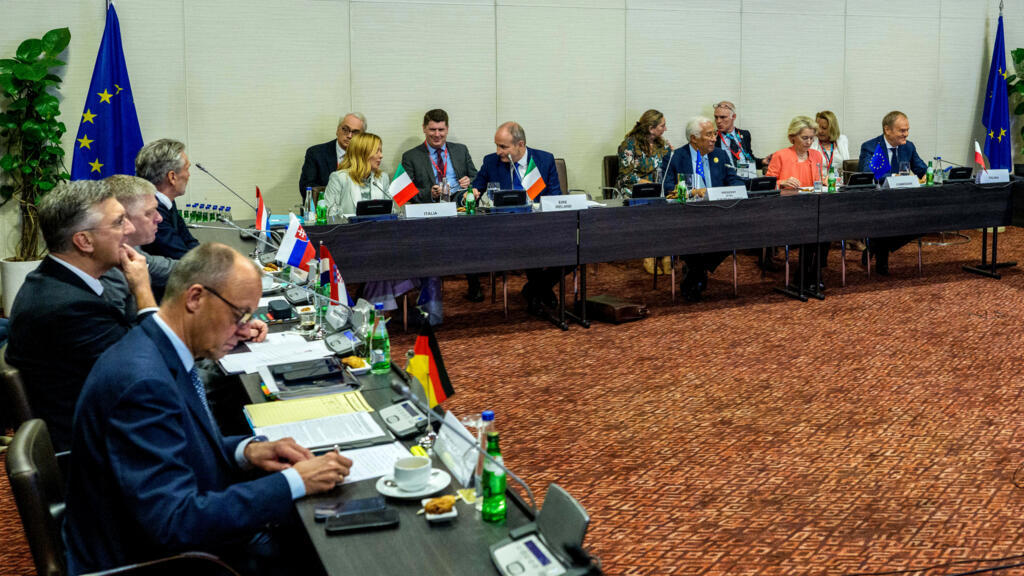
European Union chief Antonio Costa chaired an impromptu EU summit at a Luanda hotel in the morning, as Europe and Kyiv push to review a US proposal to end the Ukraine war seen as heavily favouring Moscow.
"While work remains to be done, there is now a solid basis for moving forward," European Commission President Ursula von der Leyen said after the meeting, which followed Sunday talks between US, Ukrainian and European officials in Geneva.
EU leaders including Germany's Friedrich Merz and Poland's Donald Tusk then headed to a conference centre near the waterfront of the Angolan capital for a summit with their African counterparts.
South Africa's Cyril Ramaphosa and Felix Tshisekedi of the Democratic Republic of Congo were among a stream of heads of state and government welcomed by host Joao Lourenco of Angola.
European leaders at the summit also met separately to discuss the US draft plan to end Russia's war in Ukraine © Michael Kappeler / POOL/AFP
"The Europe-Africa axis must increasingly become the central axis of the international community," said UN chief Antonio Guterres.
Addressing the gathering, which came on the heels of a G20 meeting in South Africa where a US boycott underscored geopolitical fractures, Lourenco decried "deteriorating" global security, citing conflicts in Europe, Africa and the Middle East.
"It is urgent that multilateralism be rescued," he said.
"The Europe-Africa axis must increasingly become the central axis of the international community," said UN chief Antonio Guterres.
Addressing the gathering, which came on the heels of a G20 meeting in South Africa where a US boycott underscored geopolitical fractures, Lourenco decried "deteriorating" global security, citing conflicts in Europe, Africa and the Middle East.
"It is urgent that multilateralism be rescued," he said.
'Implementable commitments'
The summit marks 25 years of EU-African Union relations -- ties that analysts say need revamping if Europe wants to hold on to its role as the continent's top partner.
"Our prosperity is more connected than ever. We both need to build the industries of tomorrow. We both need to make the most of our talent and resources and get rid of dangerous dependencies," European Commission President Ursula von der Leyen said in opening remarks.
The EU is the leading supplier of foreign direct investment to Africa and its leading trade partner © EDUARDO SOTERAS / AFP
Africa has emerged as a battleground for its critical minerals and energy potential, with China, the United States and Russia also seeking to foster stronger ties.
The EU is the leading supplier of foreign direct investment to the continent and its top commercial counterpart. Trade in goods and services hit 467 billion euros ($538 billion) in 2023, according to Brussels.
The Gulf states and Turkey have also made significant inroads, granting African nations bargaining power with the EU, said Geert Laporte of ECDPM, a European think tank.
"We don't have that situation anymore where Europe was the only partner," he said.
Observers say Europe needs to invest in infrastructure, energy and job-creating industrial projects in Africa, and a move away from lofty statements of support.
"Africa is looking not for new declarations but for credible, implementable commitments," said AU spokesman Nuur Mohamud Sheekh.
Africa has emerged as a battleground for its critical minerals and energy potential, with China, the United States and Russia also seeking to foster stronger ties.
The EU is the leading supplier of foreign direct investment to the continent and its top commercial counterpart. Trade in goods and services hit 467 billion euros ($538 billion) in 2023, according to Brussels.
The Gulf states and Turkey have also made significant inroads, granting African nations bargaining power with the EU, said Geert Laporte of ECDPM, a European think tank.
"We don't have that situation anymore where Europe was the only partner," he said.
Observers say Europe needs to invest in infrastructure, energy and job-creating industrial projects in Africa, and a move away from lofty statements of support.
"Africa is looking not for new declarations but for credible, implementable commitments," said AU spokesman Nuur Mohamud Sheekh.
Minerals and credibility
Boosting trade is a top priority as US tariffs buffet both continents.
The EU is expected to offer expertise to help build up intra-African trade, which currently accounts for a paltry 15 percent of the global total, diplomats said.
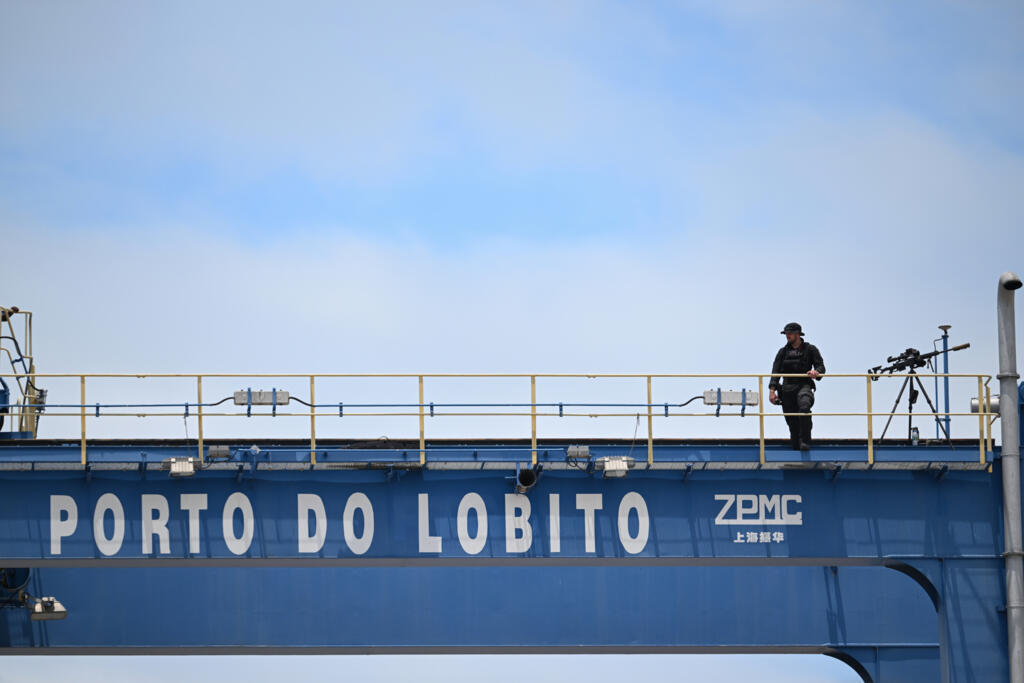
The Lobito corridor is a major project to connect mineral rich areas of the Democratic Republic of Congo and Zambia to the Atlantic coast © ANDREW CABALLERO-REYNOLDS / AFP
It will also seek to secure critical minerals needed for its green transition and ease dependency on China for rare earths, essential for tech and electronic goods.
"Europe has the know-how and technology; Africa has the fundamental raw materials for the world's industries," said Lourenco.
The 27-nation bloc will likely showcase new investments under the Global Gateway -- a massive infrastructure plan that Brussels hopes can counter China's growing influence.
Summit host Angola is home to one of the EU's signature undertakings: the Lobito corridor, a railway project funded in partnership with the United States to connect mineral-rich areas of the Democratic Republic of Congo and Zambia to the Atlantic coast.
"Europe's credibility now depends on whether it can support the delivery of projects that create value in Africa, not just visibility for Brussels," said Ikemesit Effiong of the Nigeria-based consultancy SBM Intelligence.
The summit is to continue on Tuesday, although some leaders including Merz, France's Emmanuel Macron and Italy's Giorgia Meloni are expected to leave Monday night.
© 2025 AFP
It will also seek to secure critical minerals needed for its green transition and ease dependency on China for rare earths, essential for tech and electronic goods.
"Europe has the know-how and technology; Africa has the fundamental raw materials for the world's industries," said Lourenco.
The 27-nation bloc will likely showcase new investments under the Global Gateway -- a massive infrastructure plan that Brussels hopes can counter China's growing influence.
Summit host Angola is home to one of the EU's signature undertakings: the Lobito corridor, a railway project funded in partnership with the United States to connect mineral-rich areas of the Democratic Republic of Congo and Zambia to the Atlantic coast.
"Europe's credibility now depends on whether it can support the delivery of projects that create value in Africa, not just visibility for Brussels," said Ikemesit Effiong of the Nigeria-based consultancy SBM Intelligence.
The summit is to continue on Tuesday, although some leaders including Merz, France's Emmanuel Macron and Italy's Giorgia Meloni are expected to leave Monday night.
© 2025 AFP
No comments:
Post a Comment