No to a US war on Venezuela!
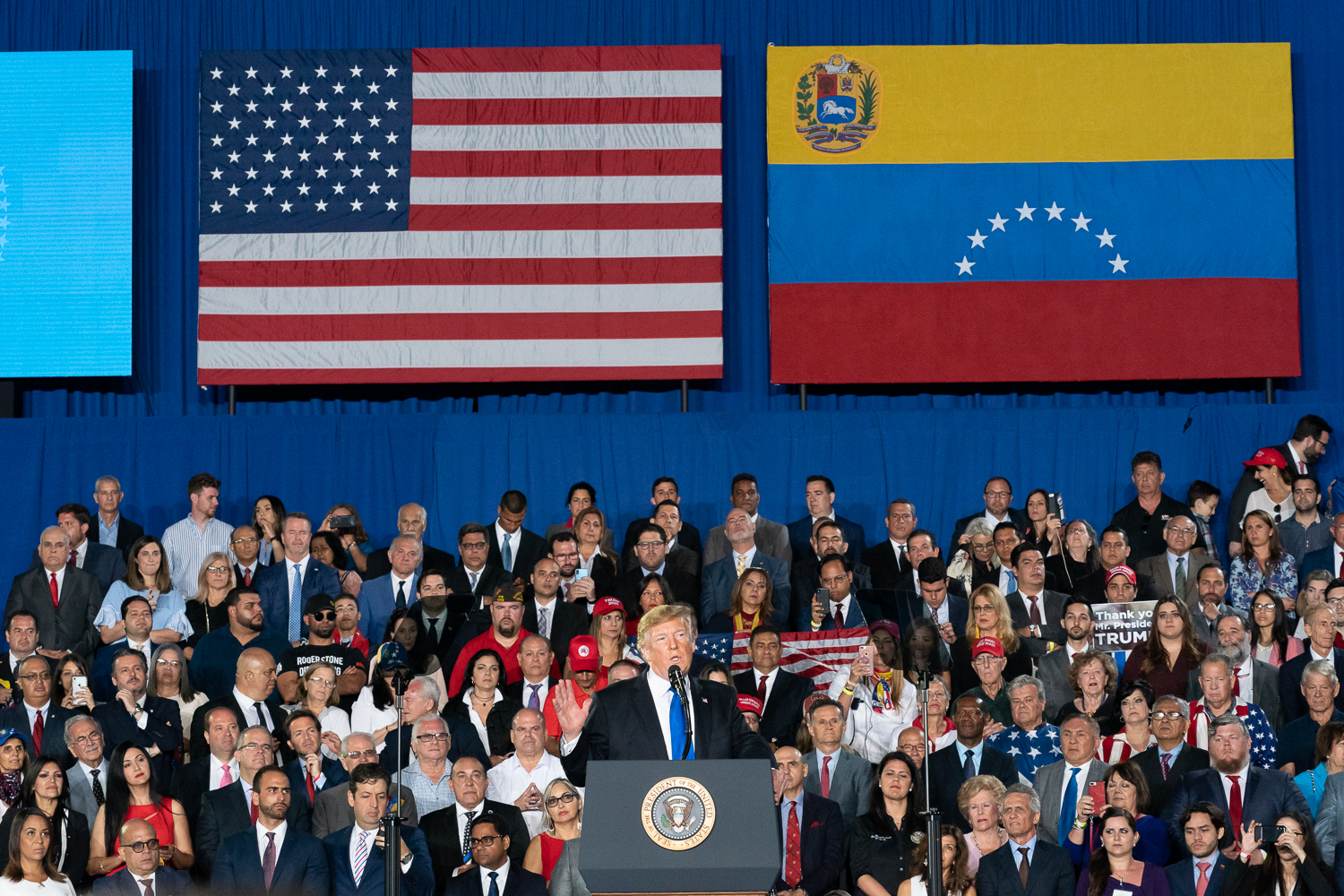
For the past few weeks the Trump administration has intensified its long-standing aggression against Venezuela by deploying warships (including a nuclear submarine) in the Caribbean Sea in a purported anti-narcotics operation. US forces have carried out at least five incidents of strikes on boats in Venezuelan waters to date, killing 37 people. Trump’s latest move has been to authorise the CIA to conduct covert operations inside Venezuela.
President Nicolas Maduro, as Venezuela’s current leader, has been a focus of this ‘war on drugs’ narrative, justifying the US’s illegal actions by demonising him as a ‘narco-terrorist’ engaged in drug trafficking, despite UN evidence to the contrary. The US also portrays him as being an illegitimate leader, offering a bounty of $50 million for his capture.
But overthrowing the Bolivarian Revolution has been a project of US imperialism ever since Huge Chávez became President in 1999 and set about transforming the country through a series of far-reaching measures including healthcare, education, land redistribution and anti-poverty programmes.
Key to these revolutionary changes was, and still is, the massive wealth in oil reserves that Venezuela has – the largest in the world – and the revenues generated from them. Chávez’s massive programme of wealth redistribution redirected these oil revenues to collective social purposes rather than funding the opulent lifestyle of Venezuela’s elites.
Additionally, to help realise his vision that “another world is possible”, not just for Venezuela, Chávez also envisaged (and ultimately helped create) key regional organisations to unite Latin American voices and provide progressive economic alternatives to neo-liberalism.
Aghast at what this represented, both politically and economically, the US has ever since then, in concert with the extreme right-wing elites in Venezuela, sought to destabilise the country and effect ‘regime change’.
In 2002, a US-backed military coup temporarily ousted Chávez before a spontaneous popular uprising restored him to the presidency. Other US tactics to destabilise the country have included massive funding of opposition groups to try –unsuccessfully – to win elections, coupled with disinformation campaigns to isolate the country, campaigns of violence on the streets, further coup attempts and domestic sabotage.
But the most powerful US weapon against Venezuela has been an increasingly severe set of economic sanctions, illegal under international law, designed to destroy the economy and bring the country to its knees.
The US sanctions, first introduced by Obama in 2015 and ramped up by Trump in his first presidency into a crippling economic, trade and financial blockade, led to a 99% fall in oil revenues and well over a hundred thousand unnecessary deaths.
Complementing this, Trump has at various times threatened military action against Venezuela. He also backed minor politician Juan Guaidό’s attempt to bring about ‘regime change’ by declaring himself ’interim president’ in 2019. But despite lavish bankrolling of his activities, including insurrectionary adventures, with confiscated Venezuelan assets, this attempt at ‘regime change’ fizzled out when the right-wing Venezuelan opposition ditched Guaidó in December 2022.
Throughout and to this day, the British government has supported the US’s policy, even levying its own sanctions and withholding 31 tons of Venezuelan gold worth roughly $2 billion lodged in the Bank of England’s vaults.
Despite all this, the Venezuelan economy has survived – even growing by between 5 to 6% in 2024 – though at the cost of great hardship for millions of ordinary Venezuelans.
But the political and economic dynamics motivating this drive by US imperialism to secure ‘regime change’ have not lessened.
Politically, Venezuela’s commitment to Latin American independence and resistance to neo-liberalism are anathema to the US’s historic and continuing commitment to the Monroe Doctrine. Recent progressive left electoral successes in Mexico, Colombia, Honduras, Brazil and Uruguay, for example, are seen by the US government as a challenge to its dominance.
Economically, Venezuela is a rich country with vast mineral reserves, but the prize is its oil. In 2023 Trump himself publicly admitted that he wanted to overthrow Maduro to secure control over Venezuela’s oil, mirroring the way he boasted in 2020 that he was militarily occupying Syria’s crude oil-rich regions in order to “take the oil”.
The overthrow of the Bolivarian Revolution would enable the US to control Venezuela’s oil and help sustain the US’s faltering economy, as well as shore up the rhetoric of Trump’s ‘America First’ agenda.
But Trump is being challenged domestically, in the media and Congress. Although Congressional Democrats have long supported sanctions against Venezuela, their Senate resolution requiring Trump to seek Congressional authorisation before any further military strikes purportedly aimed at drug cartels was defeated 48-51 (with two Republicans in favour and one Democrat against).
Opposition in Latin America and the Caribbean is much more forthright. The region is clear about the enormous implications if the US were to be successful in securing ‘regime change’, especially for the future of blockaded Cuba, which has been in US Secretary of State Marco Rubio’s sights for longer than Venezuela, and for heavily-sanctioned Nicaragua. Trump has also been making very similar threats against President Petro’s government in Colombia, calling openly for ‘regime change’.
Encapsulating these concerns, the ALBA bloc of countries issued a statement strongly condemning the US’s actions: “These manoeuvres not only constitute a direct attack on the independence of Venezuela, but also a threat to the stability and self-determination of all the peoples of Latin America and the Caribbean (…) We categorically reject the orders from the United States government to deploy military forces under false pretexts, with the clear intention of imposing illegal, interventionist policies that are contrary to the constitutional order of the States of Latin America and the Caribbean.”
The Venezuela Solidarity Campaign (VSC) has launched a petition urging governments and political actors internationally to join in opposing military intervention and all threats to peace in the region.
The British government has disgracefully failed to join the criticism being voiced in Latin America and the US of Trump’s illegal actions, committing only to “fighting the scourge of drugs…accordance with the fundamental principles of the UN Charter”.
A linked letter to Keir Starmer and Yvette Cooper is therefore urging them to join the international effort against military intervention and in support of peace.
VSC will be joining with forces across the British labour, peace and solidarity movements to express maximum opposition to US military aggression in the weeks and months ahead.
The United States Prepares for War on Venezuela
Monday 27 October 2025, by Dan La Botz
The United States is preparing for war against Venezuela. While President Donald Trump has asserted that the country’s goal is to stop shipments of Venezuelan drugs to the United States, in private conversations U.S. officials have made it clear that Secretary of State Marco Rubio plans to remove Venezuelan President Nicolás Maduro. This forms part of Trump’s goal of reasserting U.S. domination in Latin America such as it exercised in the nineteenth century by gunboats and in the twentieth century by installing friendly governments.
The preparations for the war have involved attacks on small boats that began in early September. Trump claims the boats were carrying drugs, though no proof has been provided. Altogether as of this time (Oct. 26), the United States forces have destroyed ten boats and killed 43 people in international waters in the Caribbean and the Pacific Ocean. The Trump administration claims that the United States is engaged in national self-defense because drugs like fentanyl kill tens of thousands of Americans, though Venezuela is not a significant producer or trafficker of fentanyl nor is it a major source of cocaine. Many legal experts have stated that these extra-judicial killings are simply murder on the high seas,
On October 2, 2025, the Trump administration designated several Latin American cartels as “foreign terrorist organizations” and “unlawful combatants,” and said that the cartel actions constitute an "armed attack against the United States.” The U.S. government claims that Maduro controls el Cartel de los Soles, the criminal organization responsible for drug trafficking. “Just as al-Qaida waged war on our homeland, these cartels are waging war on our border and our people,” said Secretary of Defense Pete Hegseth. Democrats and some Republicans have criticized the operation. Senator Jack Reed of Rhode Island has argued that the military is not “empowered to hunt down suspected criminals and kill them without trial.” Others have suggested that if he is serious, Trump should ask for a declaration of war, but he says he will not do so.
The Real Goal: A Coup against Maduro
The real goal of the United States is the removal of Maduro. The drive to eliminate the Maduro government comes from Marco Rubio, a Cuban-American Miami and former Florida Senator. On August 7, the U.S. offered a bounty of $50 million for information leading to the arrest and/or conviction of Venezuelan President Nicolás Maduro, a measure clearly intended to foment a coup. In mid-October Trump authorized the CIA to conduct covert actions in Venezuela while about the same time, turning up the pressure, B-52 bombers began to fly along the Venezuelan coast.
The United States has about 10,000 troops and many military aircraft in the Caribbean. And for years it has also had several warships in the region, including destroyers with guided middles. Now Trump is sending the Gerald Ford aircraft carrier, the world’s largest warship, to Venezuela, accompanied by five destroyers, a cruiser, and a submarine. The Ford carries about 75 fighter jets and a crew of 4,500. Clearly such enormous military power is not about drug interdiction but is rather preparation for an attack on Venezuela.
It is unlikely that U.S. troops will fight on the ground; rather Trump will take a page from Russian dictator Vladimir Putin’s playbook and use artillery and bombs to destroy military bases and to terrorize and demoralize the population. All of this to bring about a coup.
Trump ran for president as an opponent of foreign wars and regime change, but now the “peace president,” as he calls himself, will wage war. It looks like American imperialism in Latin America is back-with a vengeance.
26 October 2025
Attached documentsthe-united-states-prepares-for-war-on-venezuela_a9236.pdf (PDF - 905.1 KiB)
Extraction PDF [->article9236]
Venezuela
Venezuela’s authoritarian turn and the repression of its Left
Against Campism, for International Working-Class Solidarity
The permanent instability of a system in crisis
The pro-Maduro left abandons the workers and people of Venezuela
“Everyone knows what happened”
Dan La Botz was a founding member of Teamsters for a Democratic Union (TDU). He is the author of Rank-and-File Rebellion: Teamsters for a Democratic Union (1991). He is also a co-editor of New Politics and editor of Mexican Labor News and Analysis.
International Viewpoint is published under the responsibility of the Bureau of the Fourth International. Signed articles do not necessarily reflect editorial policy. Articles can be reprinted with acknowledgement, and a live link if possible.
LIBERTARIAN ANTI IMPERIALISM
Norwegian Peace Council Rejects Peace Prize Winner
Norway’s largest peace organization, the Norwegian Peace Council, has announced that it would forego its traditional torchlight procession for the Nobel Peace Prize winner this year after widespread dissatisfaction with the Nobel Committee’s selection of Venezuelan politician María Corina Machado as this year’s laureate.
Eline H. Lorentzen, Chairwoman of the Peace Council, explained that:
We have great respect for the Nobel Committee and the Peace Prize as an institution, but as an organization we must also be true to our own principles and the broad peace movement we represent. We look forward to celebrating the Peace Prize again in the coming years.
The Norwegian Nobel Committee shocked the global pro-peace community with its selection of Machado as this year’s Prize winner, as the Venezuelan has over decades openly appealed to the US, Israel, and other countries to use military force to overthrow the sitting Venezuelan president and install her into power.
Not only has Machado urged the overthrow of the sitting Venezuelan president, Nicolas Maduro, who the US Central Intelligence Agency has been given the green light by President Trump to hunt down, but she also openly called for the overthrow of Maduro’s predecessor, the late President Hugo Chavez.
While the solid majority worldwide across the political spectrum has reacted with horror at Israel’s ongoing genocide in Gaza, “Peace Prize” winner Machado sent a letter to Israeli prime minister Netanyahu telling him that she “greatly appreciates his decisions and decisive actions in the war.”
In December, 2018, Machado sent a letter to Netanyahu requesting Israeli aid in overthrowing the Venezuelan government by force, an action that would undoubtedly result in many thousands of deaths and injuries.
The timing of the Nobel Committee selecting Machado, just as the United States is attacking boats off the coast of Venezuela and openly threatening to launch ground operations against Venezuela, has likewise raised more than a few eyebrows.
Ron Paul Institute chairman Ron Paul recently wrote:
Is the Nobel Peace Prize just another deep state, soft-power tool intended to boost the US global military empire? The timing of the award going to the relatively unknown Machado is suspicious. President Trump has parked an armada of warships off the Venezuelan coast as his aides openly talk about ‘decapitation’ strikes on the Venezuelan government. After the extrajudicial killing of some 20 civilians in his attacks on at least four boats off the Venezuelan coast, President Trump is openly bragging that no one dares launch a boat in the area.
As with its selection of US President Barack “drone strike” Obama and European “protester-savaging” Union as previous laureates, the Nobel Committee continues to embarrass itself and discredit the originl intent of the Prize.
The Norwegian Peace Council deserves credit for sticking up for its principles in the face of powerful opposition. The Nobel Committee? Not so much
Daniel McAdams is director of the The Ron Paul Institute for Peace & Prosperity.
US Officials Disagree With Trump on Venezuela
by Ted Snider | Oct 28, 2025 |
In the waters of the Caribbean, a surprisingly large U.S. fleet sits with Venezuela in its sights. It includes over 10,000 troops, Aegis guided-missile destroyers, a nuclear-powered fast attack submarine, F-35B jet fighters, MQ-9 Reaper drones, P-8 Poseidon spy planes, assault ships and a secretive special-operations ship.
The fleet is built for war on Venezuela or its drug cartels, but it is engineered to put enough pressure on Venezuela’s President Nicolás Maduro to push him from power. The justification for the war is stopping the flow of drugs into the U.S. by Venezuelan drug cartels; the justification for the coup is that Maduro is the head of those cartels.
But U.S. officials – often those in the best place to know – have disagreed with all three aspects of the military action: the significance of Venezuela’s drug cartels in the flow of drugs, and especially fentanyl, into United States; the role of Maduro in those cartels; and the use of the military to fight them. For their disagreement, many of those officials have left or been forced from their jobs.
U.S. President Donald Trump has insisted that military force is necessary to stop “narco-terrorists” who are smuggling a “deadly weapon poisoning Americans. He has claimed that “every boat,” the U.S. military strikes off the coast of Venezuela is “stacked up with bags of white powder that’s mostly fentanyl” and “kills 25,000 on average – some people say more.”
But current and former U.S. officials disagree. While most of the boats the U.S. military has sunk have been in the passageway between Venezuela and Trinidad and Tobago, U.S. officials say that that passage is neither used to transport fentanyl nor is it used to transport drugs to the United States. 80% of the drugs that flow through that passage is marijuana, and most of the rest is cocaine. And those drugs are headed, not to the U.S., but to West Africa and Europe. Most of the fentanyl that finds its way into the U.S. comes from Mexico.
The military strikes on Venezuelan boats cannot be justified by the war on drugs and “are unlikely… to cut overdose deaths in the United States,” according to officials. “When I saw [an internal document on the strikes],” a senior U.S. national security official said, “I immediately thought, ‘This isn’t about terrorists. This is about Venezuela and regime change’.”
According to U.S. Drug Enforcement Administration, 90% of the cocaine that transits into the U.S. enters through Mexico, not Venezuela. And Venezuela is not a source of fentanyl. The dissenting American officials are in agreement with international bodies. The 2025 UNODC World Drug Report assesses that Venezuela “has consolidated its status as a territory free from the cultivation of coca leaves, cannabis and similar crops.” The report says that “[o]nly 5% of Colombian drugs transit through Venezuela.” The EU’s European Drug Report 2025 corroborates the UN report: it “does not mention Venezuela even once as a corridor for the international drug trade.”
U.S. intelligence also disagrees on the Trump administration’s claim that Maduro is at the head of the Venezuelan drug cartels. The Trump administration has insisted that “Maduro is the leader of the designated narco-terrorist organization Cartel de Los Soles.”
Again, though, U.S. officials disagree. A “sense of the community” memorandum dated April 7, 2025 that puts together the findings of the 18 agencies in the U.S. intelligence community released by the Office of the Director of National Intelligence directly contradicts the Trump administration’s claim that Maduro is the leader of Tren de Aragua (TDA) drug cartel.
The memorandum clearly states that “the Maduro regime probably does not have a policy of cooperating with TDA and is not directing TDA movement to and operations in the United States.” It states that the intelligence community “has not observed the regime directing TDA.”
Making the American case against the Maduro government even less credible, the memorandum finds that “Venezuelan intelligence, military, and police services view TDA as a security threat and operate against it in ways that make it highly unlikely the two sides would cooperate in a strategic or consistent way.” The Venezuelan National Guard has arrested TDA members and “Venezuelan security forces have periodically engaged in armed confrontations with TDA.”
The contradiction was seen as a problem. Days after the memorandum’s release, Joe Kent, the acting chief of staff for Tulsi Gabbard, the director of national intelligence, told a senior intelligence analyst to do a “rethink” of the analysis and offer a new assessment. “We need to do some rewriting so this document is not used against the DNI [Director of National Intelligence] or POTUS [President of the United States],” Kent told intelligence officers.
The rewritten memo still contradicted the Trump administration’s claims about Maduro. One week later, Michael Collins, the acting chair of the National Intelligence Council, and, Maria Langan-Riekhof, his deputy, were fired by Gabbard. Gabbard claims the firings were part of a campaign to stop leaks by “deep-state criminals” who are politicizing the intelligence community.
U.S. officials have objected not just to the White House’s claims about Venezuela as a narco-state and about Maduro’s role as head of the cartels, but also to the White House’s militarized answer to the problem. And the objection has come from the highest level of the U.S. military.
On October 16, Admiral Alvin Holsey, head of the U.S. Southern Command, the group that oversees all operations in Central and South America, including the current and any future military actions taken against Venezuela, announced that he was stepping down. The New York Times has reported that there were “real policy tensions concerning Venezuela” between the Admiral and Pete Hegseth, the Secretary of War. Current and former U.S. officials say that Holsey “had raised concerns about the mission and the attacks on the alleged drug boats.”
But there are also reports that there were questions about whether Holsey would be fired in the days before he announced his resignation. “Hegseth did not believe Holsey was moving quickly or aggressively enough to combat drug traffickers in the Caribbean.” The Washington Post reports that “Hegseth had grown disenchanted with Holsey and wanted him to step aside.” The disenchantment, according to “people familiar with the matter,” started “around the time that the Trump administration began ordering deadly strikes on alleged drug boats off the coast of Venezuela.”
At every level, Venezuela as a significant source of drug deaths in America, Maduro’s role as leader of Venezuela’s drug cartels, and the United States’ militarized solution to the problem, U.S. officials have disagreed with the Trump administration. Some of those officials have paid for doing their jobs with their jobs.
If you liked this article, please support Antiwar.com.
We are 100% reader-supported.
Ted Snider is a regular columnist on U.S. foreign policy and history at Antiwar.com and The Libertarian Institute. He is also a frequent contributor to Responsible Statecraft and The American Conservative as well as other outlets. To support his work or for media or virtual presentation requests, contact him at tedsnider@bell.net
The Neocons Have Finally Found a Way Into MAGA Hearts
“Neocon” may have become a dirty word, but after a few years, their agenda is back in play.
And no doubt many of their players, too.
After being banished to the wilderness for plunging the nation into a 20-year war, the neocons fell flat with the Trump base in Ukraine and lost the thread with MAGA in Israel. Venezuela and the Western Hemisphere are another matter. The neocons have evolved, and regime change is back on the menu.
How? Rather than pushing “democracy” and “freedom” like George W. Bush’s famous second inaugural speech at the height of the Iraq War, neoconservatives have adopted the prevailing MAGA/New Right language of “America First” to inject regime change back into fashion.
If you don’t think so, just listen to what Marco Rubio – once a reliable foot soldier for neoconservative foreign policy on Capitol Hill since his election to the Senate in 2011 – has to say about Nicolas Maduro today. He insists that Maduro is “not the President of Venezuela and his regime is not the legitimate government,” but a “corrupt, criminal and illegitimate (regime)” that undermines “America’s national security interests.”
Meanwhile, he calls Maduro an “enemy of humanity” who “has strangled democracy and grasped at power in Venezuela” and announced a $50 million bounty on his head. Since then, there has been a massive military buildup in the region and talk of bringing the lead narco terrorist to justice.
This hasn’t been lost on observers, even in conventional Right circles. “You thought I was joking when I said Trump was the greatest neoconservative president we’ve had in ages,” National Review’s Jim Geraghty exclaimed in a recent column.
Supporters of Trump say the president is still allergic to “regime change wars” and that the administration is only interested in short, sharp actions against drug cartels and Maduro. Yet Trump hasn’t fully denied that aspiration either. In fact, he teases a little about it every day. The President has even confirmed that he gave the CIA – who know a thing or two about assassinations and toppling governments – the authority to conduct covert operations in and around Venezuela.
If it walks like a duck, quacks like a duck, it’s a duck.
So what is different about today? Trump’s populist base elected him because he espoused a nationalism that promised a foreign policy focused on American interests and our own backyard: cracking down on illegal immigration and drugs being top priorities. Going after cartels fits neatly into a “return of the Monroe Doctrine” and “pivot back to the Western Hemisphere.”
“Both inside and out of the administration there are many MAGA-aligned thinkers who want a more regionalized strategy in place of a globalist or imperial American foreign policy. They tend to be for less engagement with the Middle East and Europe and more attention to the Western Hemisphere,” noted Modern Age editor Daniel McCarthy.
“Where that outlook intersects with neoconservatism is that the neocons have, of course, long wanted regime change and the promotion of liberal democracy in Latin America. Since there’s a fight on to define what the Monroe Doctrine means in the 21st century, the neocons have an advantage in that they already have a plan for Latin America and for Venezuela in particular.”
McCarthy points to neoconservative Elliott Abrams, who has probably set the record for Washington comebacks since his conviction in the Iran-Contra Affair. Abrams was in the thick of Reagan’s destabilizing attempts to overthrow communists in Latin America in the 80s. He has shown up in both Republican and Democratic administrations, always promoting regime change as a way to advance American interests in the region. He now runs the neoconservative Vandenberg Coalition and drove Trump’s failed policy to overturn Maduro during his first administration (Rubio was in on that too). Abrams is not on the inside today, but has been all over mainstream media for his quick takes on recent anti-narco military operations.
“There was less emphasis on the Monroe Doctrine in the first term, but now the neocons interested in Latin America are adapting their ideas for a Monroe Doctrine framework, and since there isn’t a fully articulated alternative on the non-neocon MAGA right, the neocons are in a position to influence the agenda,” charged McCarthy.
One may wonder who “they” are when the most visible neocons of the early 21st Century are now Never Trumpers who seemingly spend most of their time tweeting about “No Kings” and the total collapse of American democracy. Bill Kristol, David Frum, Elliot Cohen, Jen Rubin – they are part of a domestic commentariat who, even if they supported what Trump was doing in the Caribbean, wouldn’t say so publicly (except for maybe on Gaza).
The folks at the reliable neoconservative Hudson Institute, however, are railing against the realists (they call “isolationists”) in Trumpworld on Ukraine and Israel, and are now dipping their toe into the Americas. They hosted regime change advocates in a recent forum, where CSIS’s Eric Farnsworth trotted out the new language in support of regime change:
“I think in the biggest sense, to have Venezuela free and prosperous and return to democracy that is absolutely in the U.S. interest, to say nothing of, if I can say, the interests of Colombia and Brazil and Peru and Ecuador and Trinidad and Tobago and the Caribbean countries and the countries, frankly, in Europe where, like Spain, where Venezuela has intervened in elections and things like that.”
Carrie Filipetti, the executive director of the Vandenberg Coalition and a former Trump official, channeled the president’s Venezuela policy. They assert the “rise” of the Venezuelan Tren de Aragua gang and Maduro’s rejection of Trump’s diplomatic overtures have forced the White House to take more kinetic action. Secretary Rubio has designated TdA as a foreign terrorist organization.
“The United States has made it very clear that we are not afraid to use precision strikes on entities that we think are a direct threat to American security,” said Filipetti. “I would argue that the Maduro regime and its narco trafficking is much more of a direct immediate threat to the United States, even than the Iranian nuclear program, though I do very much support that we use the strikes on that program as well.”
By conflating the threat of drugs to the homeland with Maduro and his “illegitimate” regime, neoconservatives have found a wedge to push between the populist America Firsters and the realists/restrainers who had much success in throwing cold water on aggressive status quo policies in both Ukraine and Gaza.
One could say that they started seeding this ground in embracing “national conservatism” in the early days of the Trump Administration. In fact, at the recent 2025 “NatCon,” speakers like Daniel Horowitz played up this idea of renewed “Peace through Strength” and acknowledged conservatives were “traumatized” by the long wars wrought by the Bush II crowd in the early aughts.
“Because of this trauma, we (think) that we are going to get more Baghdads and Kabul, we’re going to get sucked in and we are going to die… What Trump demonstrated (in Iran), he eschewed this false dichotomy. We don’t want war” he said. “The way you break this trepidation and fear…. you break their stuff and you leave.”
“That is what America First means – you break it and you leave.”
Of course, young Horowitz, who was likely in grade school during the wars, misses the glaring holes in his eloquent treatise. “A military intervention in the region is likely to have the opposite effect as intended – it could spur a massive refugee crisis, elevate anarchic narco groups, and tempt China to quietly intervene to make Washington waste its time,” The American Conservative’s editor Curt Mills tells Antiwar.com. And that’s just the attacks on the boats and prospective “targeted strikes” on Venezuela. Fantasies of “just arming” or fomenting the opposition inside to get what Washington wants is equality stupid, say critics.
Seems like reasonable advice, but it runs up against a powerful and wealthy constituency that includes the Venezuelan and Cuban exile communities in South Florida and the U.S. Capitol. And the opposition itself, led by Maria Machado, knows the way to Trump’s heart. Right now, regime change is through a drug war, and the opposition is in “constant communication” with Trump’s people on drug movements out of Venezuela, according to POLITICO.
“If you had Pablo Escobar as the president of Colombia, going after Pablo will be the same thing as making political change possible,” said Leopoldo López, who POLITICO describes as a Venezuelan opposition activist.
McCarthy is right, there is no “fully articulated alternative on the non-neocon MAGA right.” But there needs to be one. No one thinks Maduro is a good guy or that drugs and gangs aren’t a problem. But the base seems to be dazzled by bombs when just yesterday they were ecstatic for a reinforced crackdown on the border, which is one of the best ways to keep drugs and gangs out. While it might not be as sexy, the U.S. Coast Guard is trained in maritime drug interdiction; it could use more resources, too. The military as drug cops? Not their job.
Most effective in the meantime is just calling the neoconservative agenda for what it is and reminding MAGA why they hated it in the first place. One shouldn’t get away with slapping lipstick on a pig and calling it a new, beautiful thing. And that includes the regime change shenanigans going on in Latin America today.
The Rubio Doctrine: Neocons Are Back!
According to several recent news reports, the two major Trump foreign policy shifts last week are the handiwork of Marco Rubio, the President’s Secretary of State and (acting) National Security Advisor. As with all neocon plans, they will be big on promises and small on delivery.
First up, according to Bloomberg it was Rubio who finally convinced President Trump to take “ownership” of the US proxy war on Russia, and for the first time place sanctions on Russia. Up to this point President Trump chose to portray himself as a mediator between Ukraine and Russia. But with this move against Russia’s oil sector he can no longer credibly claim that this is “Joe Biden’s war.”
The Trump move followed a confusing few weeks since the Trump/Putin Alaska summit in August. After that meeting Trump dropped the neocon position that a ceasefire in the Russia/Ukraine war must occur before any peace negotiations. It was a sign that Trump was looking more realistically at the war. He also said he did not think Ukraine would win, which is pretty obvious.
A surprise call to Putin the day before Ukrainian president Zelensky was to arrive in town just over a week ago reinforced that position and Zelensky left Washington empty-handed. He was seeking Tomahawk missiles that could strike deep into Russian territory.
Then out of the blue President Trump last week announced through his Treasury Secretary Scott Bessent that the US would be sanctioning Russia’s two largest oil companies until Russia declares a ceasefire in the war before negotiations. That won’t happen, but what it does mean is that Rubio and the neocons have successfully gotten Trump to step on the escalation escalator. That is what they always do. It will be much harder to back down now.
At the same time the US Administration was jumping deeper into the Russia/Ukraine war, a long-time neocon dream was suddenly back in play. Although in Trump’s first term a “regime change” operation was attempted against Venezuela, it failed spectacularly. But the neocons have long dreamed of overthrowing the Venezuelan government – they almost got their way back in 2002 – and suddenly after several weeks of extrajudicial murder on the high seas in the name of fighting the drug war, President Trump announced that land strikes on Venezuela would begin soon.
He did mention that he might brief Congress on his plans for war on Venezuela, not that Congress can be bothered to care much one way or the other.
The neocon old guard that still dominates Washington foreign policy is taking a victory lap. South Carolina Senator Lindsey Graham was on the Sunday shows beaming over the conversion of “no regime-change wars” President Trump to “regime change wars” President Trump.
The Saddam Hussein WMD factories of 2002 have become the Nicolas Maduro cocaine and fentanyl factories of 2025 and once again the neocon war lies are amplified by the US mainstream media and transmitted to the American people. A new disaster is in the making. The “global war on terror” has been rebranded the “hemispheric war on narco-terror” and the US military industrial complex is rubbing its hands in anticipation of a windfall.
After John Bolton’s disastrous stint in the first Trump Administration, promises were made that the second Trump Administration would be neocon-free. Instead, the neocons are back. Unless President Trump wakes up soon, the neocons will destroy his second term… and maybe the country
No comments:
Post a Comment