Director Kaouther Ben Hania on five-year-old Hind Rajab's tragic cry for help from Gaza
Issued on: 25/11/2025
Play (12:14 min)

Hind Rajab's phone call to the Palestinian Red Crescent in January 2024 was, for director Kaouther Ben Hania, the "tipping point" in the ongoing Israeli attacks on the Gaza Strip. As the Franco-Tunisian filmmaker releases her latest film "The Voice of Hind Rajab", she tells us about re-creating the story of the five-year-old girl who was killed by the Israeli army following a lengthy phone call with Red Crescent staff who were working tirelessly to arrange her rescue.
Ben Hania tells us about the importance of using the original audio in this hybrid feature which draws on both documentary and fiction, the emotional toll the shoot took on her cast and crew, and the power of cinema to bring meaning to news reports that fail to capture the humanity and complexity of the stories they tell.
BY: Olivia SALAZAR-WINSPEAR
Laura DI BIASIO
Magali FAURE
Marion CHAVAL
Solène CLAUSSE
Palestinian Christians issue 'Kairos II,' a cry of hope in a time of darkness
(RNS) — Updating a document issued in 2009, Kairos Palestine II demands international protection, accountability and reparations.
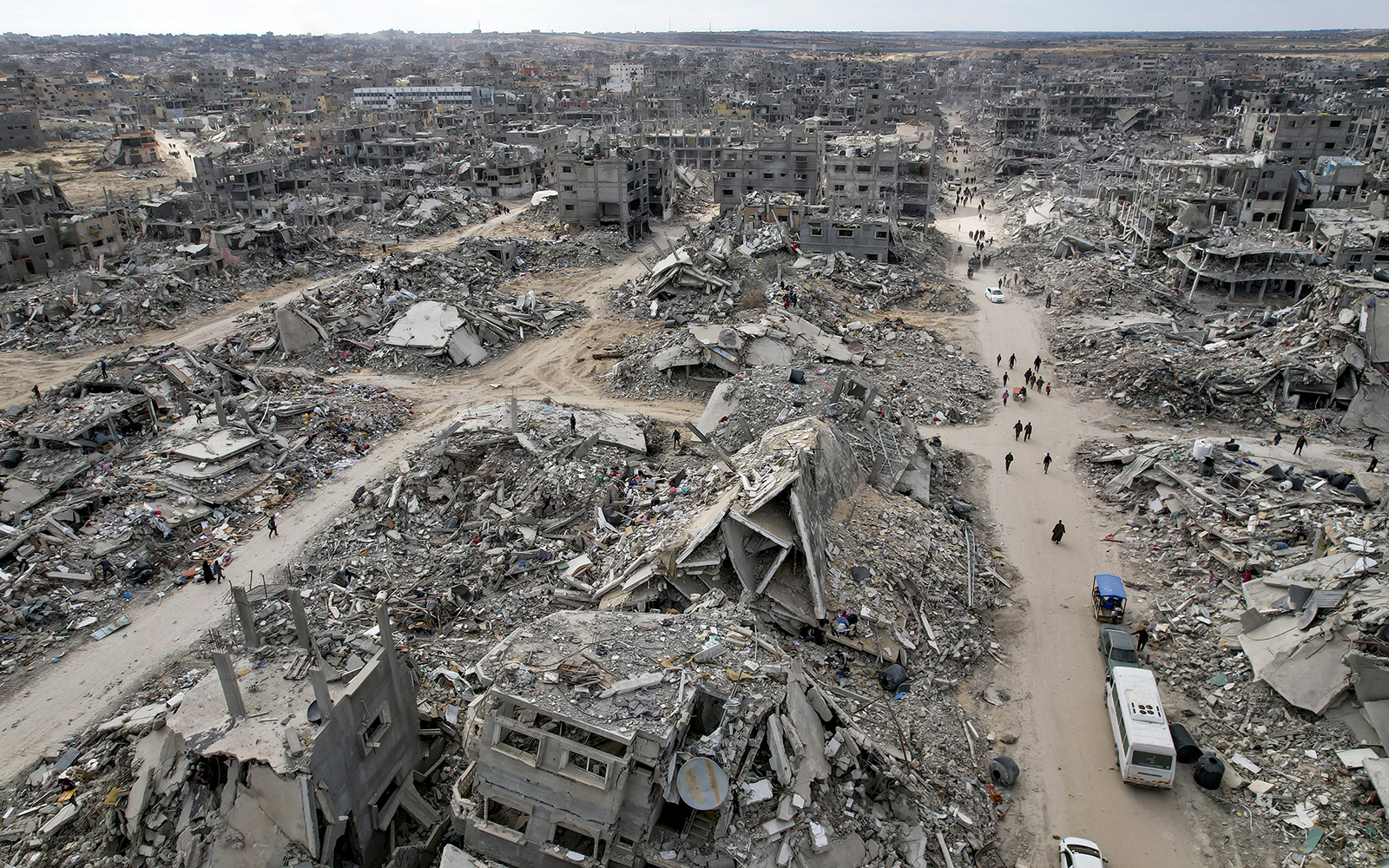
FILE - Displaced Palestinians return to Rafah, Gaza Strip, Jan. 20, 2025, a day after a ceasefire deal between Israel and Hamas went into effect.
(AP Photo/Jehad Alshrafi, File)
Daoud Kuttab
November 21, 2025
RNS
(RNS) — In December 2009, a group of Palestinian Christian leaders issued the Kairos Palestine Document, a cry from a people living under occupation and apartheid. Named for the Greek biblical term kairos, meaning a critical, decisive moment in history demanding a faithful response, Kairos Palestine spoke first to Palestinians and then to the global church, urging Christians everywhere to reject “injustice and apartheid, and to work courageously for a just and lasting peace.”
Sixteen years later, Palestinian Christians say the world has changed so dramatically that a new moment of truth has arrived. Hence, the release of Kairos II this week. The updated document states plainly that “we live now in a time of genocide, ethnic cleansing and forced displacement unfolding before the eyes of the world.” That recognition, its authors argue, marks a fundamental shift.
RELATED: Global evangelical Christianity is shifting eastward, says Palestinian minister
Kairos II emerges “from the heart of the assault on Gaza — mass displacement, starvation, the destruction of every sector of life, and the burial of families under rubble.” It speaks, the authors write, as “a cry of hope in a time of genocide,” insisting that faith, hope and love can and must be renewed even in the darkest hour.
Lamma Mansour, a policy researcher in Jerusalem, said that Kairos Palestine II is a necessary update to the 2009 document “at a critical time for Palestinians and especially for Palestinian Christians.”
The Rev. Munther Isaac, pastor of the Lutheran Evangelical Church in Ramallah and a member of the Kairos Palestine board, said that the document is also a call to action. “Kairos II,” he said, “is not an attempt at the beautification of suffering, it is a call to persevere” in the wake of a brutal war. The document uses “clear, unambiguous language that calls for naming things,” Isaac said, calling Zionism and Christian Zionism “racist, exclusionary, and colonial ideologies.”
Any political solution, he insisted, “must begin with the truth. Settler colonialism and the apartheid system based on Jewish supremacy must be dismantled … We reject any state with conditions and diminished sovereignty. We demand international protection, accountability and reparations.”
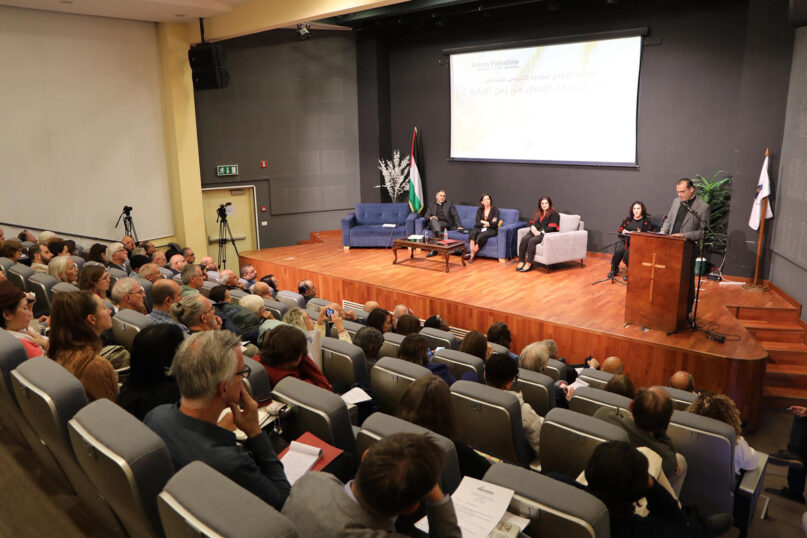
The Rev. Munther Isaac, right, speaks during the release of Kairos II at Bethlehem Bible College, Nov. 14, 2025, in Bethlehem, West Bank. (Photo by Daoud Kuttab)
The document was presented Nov. 14 at Bethlehem Bible College before an audience representing the full spectrum of the Palestinian Christian community: Catholics, Orthodox Christians and Protestants. Among those present were former Latin Patriarch Michel Sabbah, Orthodox Bishop Atallah Hanna, Lutheran Bishop Sani Ibrahim Azar, and the Rev. Jack Sara, secretary general of the World Evangelical Alliance’s Middle East and North Africa region.
Isaac said the new text “comes within a new context and expresses theology and faith in a time of genocide — and what it means to be a church in a time of genocide.” But, he added, “it is also an embodiment of the theology of resilience and hope.”
The Rev. Hanna Katnasho, academic dean of Nazareth Evangelical College, said the document represents “the thoughts of a group of Palestinians who are suffering immense pain and facing the killing of children and injustice.” It is, he said, an effort “to bring this context into God’s presence — to understand his will and spread a message of peace and love in light of justice.”
Katnasho added that Kairos II places genocide at the center of the crisis and articulates a Christian message in the face of a global moral collapse that is diametrically opposed to Christ’s teachings of love, mercy and peace.
The Rev. Jack Sara, president of Bethlehem Bible College, called the new document “a new beginning for a very important initiative.” Kairos II, he said, “calls on Christians around the world to seriously consider the Palestinian issue and defines what is required from a Palestinian Christian perspective.”
The original Kairos document was hailed as a unique ecumenical voice of Palestinian Christians. Kairos II has been seen as a much more courageous document, calling the Israeli actions in Gaza genocide and addressing what they considered as the sins of Christian Zionists for their attempts at justifying Israeli war crimes against Palestinians, especially women and children in Gaza, including dozens of Palestinian Christians and churches that were also victims of the Israeli aggression.
Salim J. Munayer, a founder of Musalaha: A Vision of Reconciliation, an organization that works toward reconciliation between Israelis and Palestinians, called the past two years “one of the most painful situations any people have endured,” and praised Palestinian Christians for having “the mental and spiritual depth to produce such a powerful document” as Kairos II.
“The challenge now,” Munayer added, “is to ensure that Kairos II is widely shared and heard, breaking through the longstanding silence and complicity of much of the Western Church. The realities faced by the Palestinian people over the last century will not fade away — nor should the prophetic witness contained in this document.”
(Daoud Kuttab is the publisher of Milhilard.org, a Christian news site dedicated to communities in Jordan and Palestine, and the author of “State of Palestine NOW.” Follow him on X @daoudkuttab. The views expressed in this commentary do not necessarily reflect those of Religion News Service.)
No comments:
Post a Comment