Sustainable Manure Management Boosts Soil Health And Slashes Greenhouse Gas Emissions
November 2, 2025
By Eurasia Review
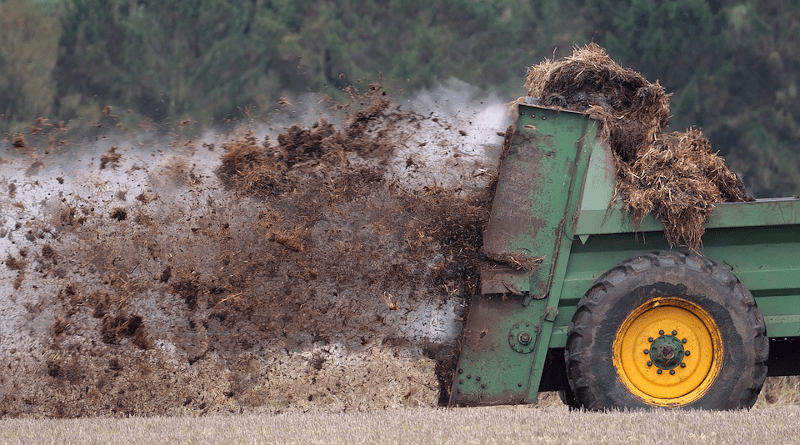
A new long-term field study demonstrates that combining organic manure with synthetic fertilizer can enhance soil quality, maintain high crop yields, and dramatically reduce harmful nitrous oxide emissions—one of the most potent greenhouse gases contributing to climate change.
Researchers at Hainan University, the Chinese Academy of Sciences, and their partners have revealed how different soil management strategies impact the soil microbiome and the ecological processes that control the nitrogen cycle. Their findings show that when manure is integrated with synthetic nitrogen fertilizer, both soil organic carbon and total nitrogen are significantly increased. This synergy leads to better soil fertility and improved crop performance without the environmental burden commonly associated with traditional fertilizers.
The experiment, conducted in the North China Plain, compared four fertilizer treatments: no fertilizer, conventional synthetic fertilization, an optimal synthetic fertilizer rate, and a balanced combination of manure and synthetic fertilizer. Plots treated with the manure-plus-synthetic blend registered the highest soil quality scores and maintained yields comparable to those managed with high synthetic input alone.
Crucially, the integrated manure approach produced much lower nitrous oxide emissions than conventional synthetic fertilization. Nitrous oxide, also known as N2O, is roughly 300 times more potent than carbon dioxide as a greenhouse gas. The key to this reduction lies in the soil microbes responsible for nitrogen cycling. Manure-amended plots had a much larger population of microbes carrying the nosZ gene, which enables the final step of denitrification—the conversion of N2O to benign nitrogen gas.
By using advanced molecular approaches, such as high-throughput gene sequencing and new ecological modeling, the researchers traced how fertilizer strategies select for different groups of nitrogen-cycling microbes. Conventional fertilization was shown to favor microbes that produce more N2O, whereas integrated manure management stimulates those that can break N2O down.
The study also highlights the roles of both deterministic and random (stochastic) forces in shaping microbial communities under various fertilizer treatments. Notably, key microbes for nitrification and denitrification are largely steered by environmental selection, which means that fertilizer choices can predictably drive soil microbiome function toward either higher or lower emissions.
The authors point out that their results offer a practical roadmap for sustainable agriculture: farmers can maintain, or even increase, yields while helping to meet climate targets by fine-tuning fertilizer applications. The team believes that such ecological engineering of soil microbiomes may be the next frontier for reducing greenhouse gases from agriculture.
Future research should investigate how these findings apply to different agroecosystems and explore the economic and logistical factors needed for wide-scale adoption of integrated manure management.
Agricultural practices play a decisive role in the preservation or degradation of protected areas
image:
Cattle grazing in a protected area in Camargue © J.Jalbert-TourduValat
view moreCredit: © J.Jalbert-TourduValat
New research shows that modern agriculture is impacting biodiversity inside protected areas in Europe, while some traditional agricultural practices may help preserve it. The Natura 2000 is the largest network of protected areas in the world, established to conserve the most valuables habitats and species in the European Union (EU). Researchers conducted a large-scale survey among Natura 2000 protected area managers across all Europe focusing on management practices, funding and threats to biodiversity facing the Natura 2000 network.
The findings are quite clear: "The main threat to biodiversity conservation inside protected areas in Europe comes from the intensification of agricultural practices, like the use of pesticides, overgrazing and hedgerow removal. It was alarming to learn how managers of protected areas feel that biodiversity is not safe from these harmful practices,” says doctoral researcher Giorgio Zavattoni from the University of Turku, Finland.
Indeed, 80% of habitats of community interest in the European Union are in an unfavorable state of conservation, with national reports suggesting that the main driver for habitat degradation is intensive agriculture, a process characterized by increased use of inorganic fertilizers, pesticides, and new crop types including winter crops. The findings of this study reveal that these agricultural pressures pose in fact significant challenges for protected area managers, who often cannot address them fully. This highlights how the simple designation of a protected area does not itself ensure the effective conservation of its habitats and species, because stakeholder involvement and active management is often essential.
Are protected area managers against agriculture inside protected areas? The answer is no. In fact, some of the most common measures implemented by Natura 2000 managers to improve the state of biodiversity coincide with some traditional low-intensity farming methods. Practices such as sustainable grazing and mowing play a key role in preserving important habitats vital for many endangered species.
“Grasslands and marshes are among the most biodiversity-rich ecosystems in Europe, and protected area managers may use extensive grazing to ensure the conservation of these habitats” explains Elie Gaget, researcher at the Tour du Valat, research institute for the conservation of Mediterranean wetlands (France), and co-author of the study. Unfortunately, with the intensification of agriculture, these traditional practices are disappearing in the European Union.
Funding available to manage Natura 2000 protected areas often relies on the European Union’s Common Agricultural Policy (CAP), which Member States apply through their own national programme. The same instrument also provides subsidies, among other things, to intensive agricultural practices even inside protected areas.
Professor Jon Brommer, co-author of the study based at the University of Turku (Finland), explains: “The Natura 2000 network aims at protecting biodiversity without excluding human activities. However, it is confusing to use public money to support two very different approaches, with mixed effects on biodiversity.”
Overall, the study highlights the urgent need to strengthen agricultural regulations inside protected areas if the European Union is to achieve its biodiversity conservation goals. Many of the biodiversity-friendly measures that were included in the initial proposals of the European Green Deal were removed after spring 2024.
The study highlights how low-intensity agricultural practices, both within and around natural sites, are necessary for the conservation of European biodiversity.
Reference:
Giorgio Zavattoni, Elie Gaget, Ineta Kačergytė, Tomas Pärt, Thomas Sattler, Tyler Hallman, Diego Pavón-Jordán & Jon E. Brommer. Threats and management of Natura 2000 protected areas in relation to current agricultural practices. Conservation Biology. 2025. DOI: 10.1111/cobi.70172
Journal
Conservation Biology
Method of Research
Data/statistical analysis
Subject of Research
Not applicable
Article Title
Threats and management of Natura 2000 protected areas in relation to current agricultural practices
Article Publication Date
3-Nov-2025
No comments:
Post a Comment