
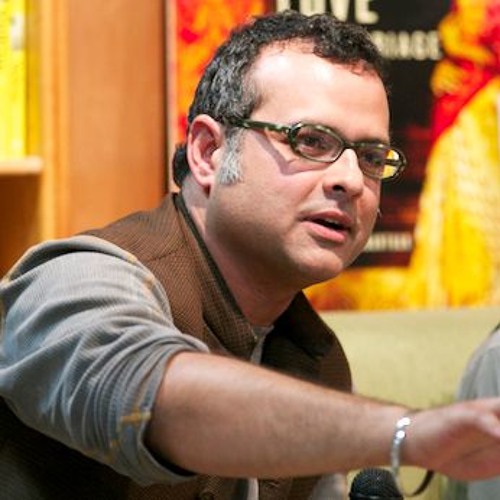
The threat of another US invasion of Venezuela is on the agenda under the fascist Trump government and this panel looks at that as well as the history of the AFL-CIO and US labor in supporting US imperialist interests in controlling the country’s wealth for US profits. The panel was hosted by Alex Wise and was sponsored by the Labor Education Project On AFL-CIO operations. Panel members included: Steve Ellner, historian and Professor Emeritus Universidad Oriente, Puerto La Cruz; James Jordan, Alliance For Global Justice; and Ricardo Ortiz, labor researcher and Puerto Rican internationalist.

Trump says Venezuela airspace should be considered closed 'in its entirety'
President Donald Trump on Saturday warned that the airspace above and around Venezuela should be considered closed, escalating tensions with Venezuelan President Nicolas Maduro as Washington steps up a major military deployment in the Caribbean and strikes on alleged drug-smuggling vessels.
Issued on: 29/11/2025
By: FRANCE 24
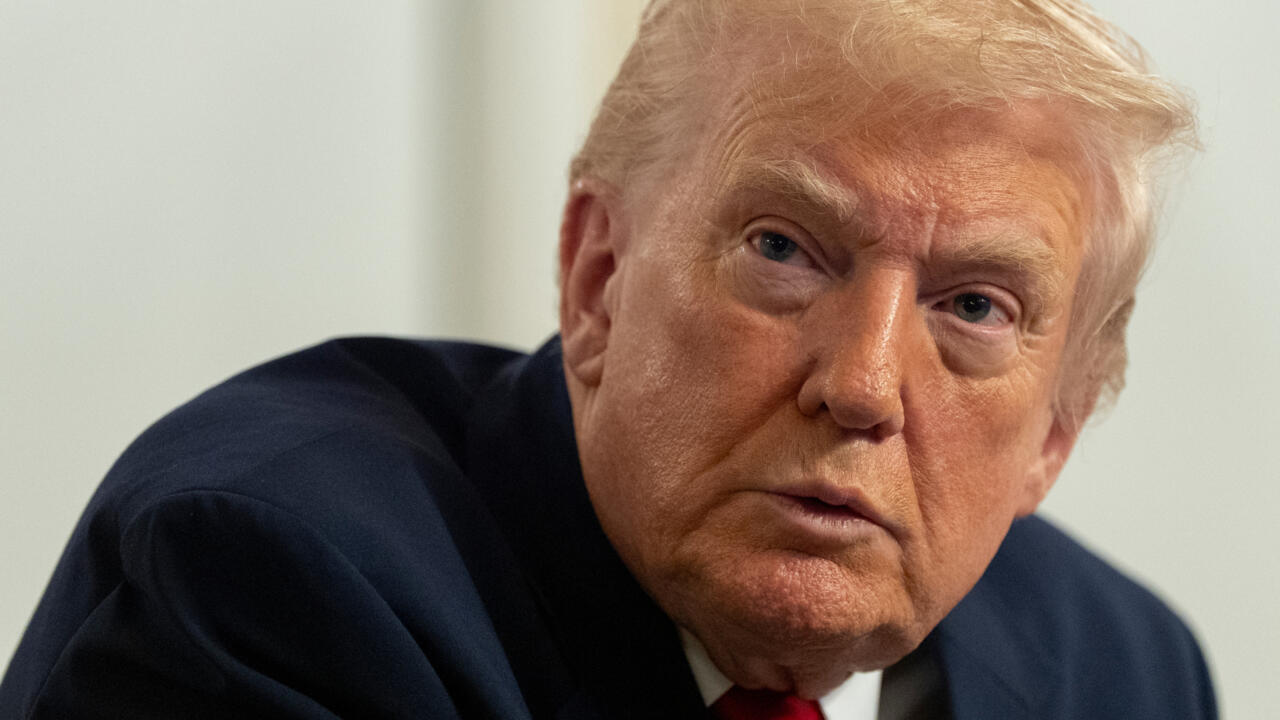 President Donald Trump speaks to reporters from his Mar-a-Lago estate on Thanksgiving, November 27, 2025. © Alex Brandon, AP
US President Donald Trump warned on Saturday that the airspace above and near Venezuela should be considered closed, the latest escalation in a standoff with leftist leader Nicolas Maduro.
"To all Airlines, Pilots, Drug Dealers, and Human Traffickers," Trump wrote on his Truth Social network, "please consider THE AIRSPACE ABOVE AND SURROUNDING VENEZUELA TO BE CLOSED IN ITS ENTIRETY."
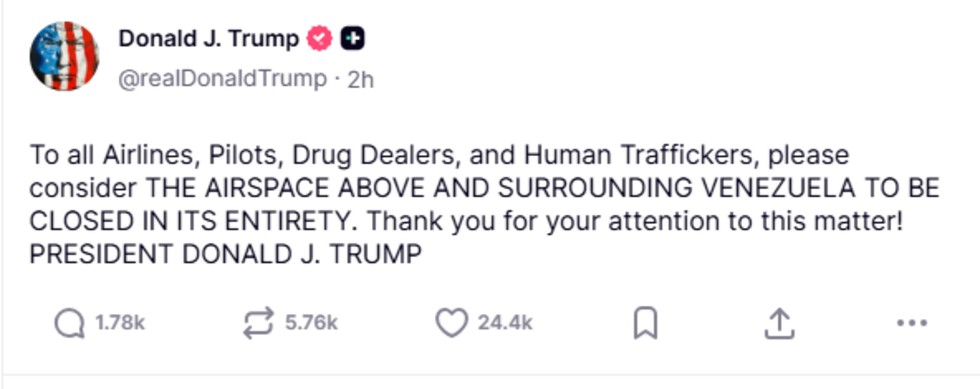 Screenshot of Donald Trump's Truth social account on November 29. © France 24
The US president did not elaborate.
Trump's administration is piling pressure on Venezuela, with a major military deployment in the Caribbean that includes the world's largest aircraft carrier.
Washington says the aim is to curb drug trafficking, but Caracas insists regime change is the ultimate goal.
US forces have carried out strikes against more than 20 alleged Venezuelan drug-smuggling vessels in the Caribbean Sea and eastern Pacific Ocean since early September, killing more than 80 people.
Washington has yet to release evidence that the vessels it targeted were used to smuggle drugs or posed a threat to the United States.
A Trump-Maduro phone call
Regional tensions have flared as a result of the campaign and the accompanying military buildup.
US aviation authorities last week urged civilian aircraft operating in Venezuelan airspace to "exercise caution" due to the "worsening security situation and heightened military activity in or around Venezuela."
That warning prompted six airlines that account for much of the travel in South America to suspend flights to Venezuela.
The move infuriated Caracas and led it to ban the companies – Spain's Iberia, Portugal's TAP, Colombia's Avianca, Chile and Brazil's LATAM, Brazil's GOL and Turkish Airlines – for "joining the actions of state terrorism promoted by the United States government."
The New York Times reported on Friday that Trump and Maduro had spoken by phone last week and discussed a possible meeting in the United States.
The report about the Trump-Maduro call came a day after the US president said efforts to halt Venezuelan drug trafficking by land were imminent, further ratcheting up tensions with Caracas.
(FRANCE 24 with AFP)
US President Donald Trump warned on Saturday that the airspace above and near Venezuela should be considered closed, the latest escalation in a standoff with leftist leader Nicolas Maduro.
"To all Airlines, Pilots, Drug Dealers, and Human Traffickers," Trump wrote on his Truth Social network, "please consider THE AIRSPACE ABOVE AND SURROUNDING VENEZUELA TO BE CLOSED IN ITS ENTIRETY."
The US president did not elaborate.
Trump's administration is piling pressure on Venezuela, with a major military deployment in the Caribbean that includes the world's largest aircraft carrier.
Washington says the aim is to curb drug trafficking, but Caracas insists regime change is the ultimate goal.
US forces have carried out strikes against more than 20 alleged Venezuelan drug-smuggling vessels in the Caribbean Sea and eastern Pacific Ocean since early September, killing more than 80 people.
Washington has yet to release evidence that the vessels it targeted were used to smuggle drugs or posed a threat to the United States.
A Trump-Maduro phone call
Regional tensions have flared as a result of the campaign and the accompanying military buildup.
US aviation authorities last week urged civilian aircraft operating in Venezuelan airspace to "exercise caution" due to the "worsening security situation and heightened military activity in or around Venezuela."
That warning prompted six airlines that account for much of the travel in South America to suspend flights to Venezuela.
The move infuriated Caracas and led it to ban the companies – Spain's Iberia, Portugal's TAP, Colombia's Avianca, Chile and Brazil's LATAM, Brazil's GOL and Turkish Airlines – for "joining the actions of state terrorism promoted by the United States government."
The New York Times reported on Friday that Trump and Maduro had spoken by phone last week and discussed a possible meeting in the United States.
The report about the Trump-Maduro call came a day after the US president said efforts to halt Venezuelan drug trafficking by land were imminent, further ratcheting up tensions with Caracas.
(FRANCE 24 with AFP)
Venezuela Isn’t the Global Threat, Trump and Rubio Are

U.S. warships and aircraft have gathered in the Caribbean as part of Washington’s latest military buildup in a renewed effort to combat narcotics trafficking. Many analysts see a familiar mix of political posturing and regime-change ambitions rather than a serious security operation.
In this exclusive interview for FPIF, sociologist and Venezuela specialist David Smilde talks about how the current show of force fits into a pattern of U.S. intervention in the region. Smilde examines the Trump administration’s motives, the outsized role of Secretary of State Marco Rubio in driving Venezuela policy, and the consequences of casting Nicolás Maduro as a “narco-terrorist” threat. He also looks at how both Washington and Caracas deploy “performance as strategy” and what remains for diplomacy and regional mediation amid deepening hostilities.
David Smilde is the Charles A. and Leo M. Favrot Professor of Human Relations and Senior Associate at the Center for Inter-American Policy and Research at Tulane University. He has researched Venezuela for three decades and lived there for 16 years.
Daniel Falcone: With the U.S. military buildup in the Caribbean and justifications of force as a counter-narcotics campaign, how is this not a genuine security initiative and more of a politically motivated show of force?
David Smilde: As many people have pointed out, Venezuela is not a leading source of cocaine coming to the United States and the most recent Drug Enforcement Agency numbers suggest less than 10 percent moves through Venezuela. Most of it originates in Colombia and moves through the Pacific route and through Mexico. In any case, most overdose deaths in the United States come from fentanyl, and none of that comes from Venezuela or elsewhere in South America. This is, first and foremost, political theater for Trump’s base. He campaigned on the idea that he would use the U.S. military against drug cartels, and these bombings of purported drug boats play well with his base.
There is no Cartel de los Soles in Venezuela or anywhere else. That is a tongue-in-cheek name created by some journalists 30 years ago to refer to the fact that there are military officers involved in drug trafficking. It became a real “thing” when it was the basis of a 2020 indictment of Maduro in the context of the maximum pressure campaign against him during Juan Guaido’s interim government.
Of course, the names of these cartels are usually created not by cartel members themselves but from the outside. But the term “cartel” actually has a meaning. It refers to situations in which various drug traffickers get together in one organization to coordinate and distribute providers, routes and markets, and follow a strategic plan to maximize prices and profits. That has not happened in Venezuela. There is no drug cartel for Maduro or anyone else to lead. Instead, there is the more typical ecosystem of various small scale drug networks going about their business, often with tacit agreements between them over territory, but without any kind of overall coordination or strategy as you would get with a cartel.
Furthermore, the idea of an invasion by the Tren de Aragua criminal gang is entirely bogus. The Tren de Aragua really does exist but focuses more on local drug trafficking and extortion rings in Venezuela, Colombia, Peru and Chile, and now apparently in Spain. They are not known to engage in maritime or even cross-national drug trafficking. The idea of a Tren de Aragua invasion of the United States has been promoted by Marco Rubio and members of the Venezuelan opposition precisely to frame what is happening in Venezuela as a threat to U.S. national security, requiring a military response.
Another important element behind this is the desire for regime change. The first Trump administration tried but failed to push Maduro out. Now, after the July 2024 electoral fraud, Maduro is an international pariah, widely seen as illegitimate inside and outside of Venezuela. At the same time, Marco Rubio is secretary of state and national security advisor, the two most powerful positions in foreign policy in the U.S. government. He has long been committed to regime change in Venezuela, in part because he thinks it would lead to regime change in Cuba and Nicaragua as well.
Trump, of course, is a long-time critic of regime-change operations, but Rubio has been able to repackage this as a battle against “narco-terrorism.” Every opportunity he gets, Rubio repeats the idea that Maduro is not president of Venezuela, he is the leader of a drug cartel. This could potentially be the justification for an air strike against Maduro, just like Trump did against Iranian general Qassem Soleimani in 2020, or some type of seizure and extraction.
Such an operation would likely just lead to a reorganization of the current government into an even more repressive version. But Trump could say “I did my part, now the Venezuelan opposition can do theirs.” And the truth is, they have been continually telling the Trump administration that the Maduro government is weak and they are ready to fill in the gap.
DF: Maduro mobilized millions of militia personnel and presented the crisis as a defense of national sovereignty. How much of this is political versus genuine self-defense?
DS: In this case, performance is self-defense. Maduro wants to try to demonstrate that, in the case of an invasion, the population would not be easily controlled nor easily turned against the government. Or at least it wants to show that any U.S. military action would end up having significant “collateral damage” in the civilian population. Maduro’s public appearances in recent months have been among crowds of people or in hotels, probably with this logic in mind, i.e. increasing the costs of any air strike against him. We can expect this to continue as Maduro has shown time and again that the continuation of his government is more important to him than the well-being of the population.
DF: Do you see any place for civil society organizations to help in the mediation process? U.S.-Venezuela relations look to be at an all-time low.
DS: At the current moment, the situation seems to outstrip the potential agency of civil society organizations, and diplomacy and negotiations will be at the state-to-state level. If there is military action against Venezuela, regional leaders will need to speak out loudly and clearly against it and try to seek a peaceful way forward. Both Presidents Lula da Silva in Brazil and Claudia Sheinbaum in Mexico have expressed interest in mediating.
And that’s good, because one big reason for the current situation is the lack of effective regional diplomacy in 2024. While there were important statements from Colombia, Brazil, and Mexico, and none of them recognized Maduro’s claim to victory, they were never able to work together in a unified diplomatic effort to get Venezuela back on track. This left the field wide open for Rubio and Trump to fill this space in pursuit of their own political goals. Many Venezuelans feel that the world has forgotten them and moved on, only Donald Trump has taken up their cause. It’s an important lesson that progressive forces in the hemisphere need to reflect upon and address.
However, if Trump decides to just pack up and, say, go to the Pacific or focus on Mexico, there is likely to be a wave of repression within Venezuela against civil society and what opposition is left in the country, as Maduro seeks retribution. If that is the case, international organizations will be key to making sure this does not happen in the dark and trying to raise the costs for the Maduro government.
DF: Based on years of U.S. human rights abuses and illiberal and immoral sanctions, what path do you see toward rebuilding any semblance of a functional relationship between D.C. and Caracas?
DS: U.S. actions should be criticized for the damage they have done and are doing in Venezuela. But that cannot overshadow the history of Chavismo’s aggressive erosion of democracy and widespread human rights violations. This is a left project that has gone wrong, that has betrayed its people and continues to oppress them.
Right now, it is hard to imagine any kind of positive relationship developing between the United States and Venezuela, but things can change fast. An old adage says, “in international politics, there are no permanent friends or permanent enemies, only permanent interests.” The United States has one of the world’s largest economies and Venezuela has the largest proven reserves of oil in the world, as well as a population with high human development indices. You can add in the fact that there are now hundreds of thousands of Venezuelans living in the United States. Everything points towards the potential for a mutually beneficial relationship, and one can easily imagine that happening, post-Maduro and post-Trump.
And you really do not even need to go that far back. During the first six months of the Trump administration, there were two competing theories of how to deal with Venezuela, the one we are currently seeing from Marco Rubio and the one that pointed towards negotiation and normalization with Ric Grenell. For a few months it seemed like Grenell was winning. Now it seems Rubio has the upper hand. But it is entirely possible that Trump could get tired of pushing for Maduro’s ouster and seek to come up with some sort of agreement for access to Venezuelan resources that would make Trump appear like the great dealmaker.
There are also signs that this is part of a broader reorientation of U.S. policies in Latin America, becoming a version of “separate spheres.” As U.S. global hegemony wanes, the Trump administration could be deciding that the Americas is the space in which the U.S. is preeminent. On the one hand, we have seen bombings off the Colombian coast and verbal sparring and retribution against Colombian president Gustavo Petro. And there are suggestions that Mexico could be next for U.S. attacks against supposed drug cartels. On the other hand, Trump recently provided Argentinian President Javier Milei with a $20 billion bailout, shortly before Argentinian regional elections.
This is what some are calling the “Donroe Doctrine,” a new stage of the Monroe Doctrine where the United States seeks to focus on Latin America and attempt to diminish the influence of China and Russia. So far, Trump has been able to keep Latin American leaders atomized with the threat of tariffs. But that could change over time as Trump loses support, and the region starts to see common cause in the emerging geopolitical context.
DF: What do you make of Trump’s recent suggestion that he could send in ground troops?
DS: In the past couple of days, President Trump has sent mixed messages, probably intentionally. On the one hand, he said “we’re going to talk to Maduro, he wants to talk,” suggesting there could be negotiations instead of a military strike. On the other hand, he told reporters he would not rule out troops on the ground. Parallel to Trump’s statements, Marco Rubio has announced that they would be seeking to name the “Cartel of the Suns” as a Foreign Terrorist Organization, but that this would not happen for another week, the grace period during which Congress can voice objections. Once they do that, it will be even easier for them to target Nicolás Maduro. This comes as polls have shown that the idea of military action in Venezuela is very unpopular among the U.S. public. This, at the same time that Trump’s candidates lost across the board in elections two weeks ago and Trump’s own ratings have reached new lows, putting him 13 points under water.
The current idea seems to be to strike up conversations with Nicolás Maduro with the sword of Damocles over his head, wresting whatever concessions they can. Just what U.S. demands will be is not clear. Rubio clearly will be pushing for regime change. Trump seems more motivated by geopolitics and Venezuela’s natural resources. If he could gain exclusive U.S. access to Venezuelan oil and mineral wealth, he could declare victory while satisfying his “America First” base and not getting involved in an unpopular regime change operation.
This is not about stopping the flow of dangerous drugs, it is about actually increasing the flow of the dangerous drug some pushers want to keep us all hooked on.
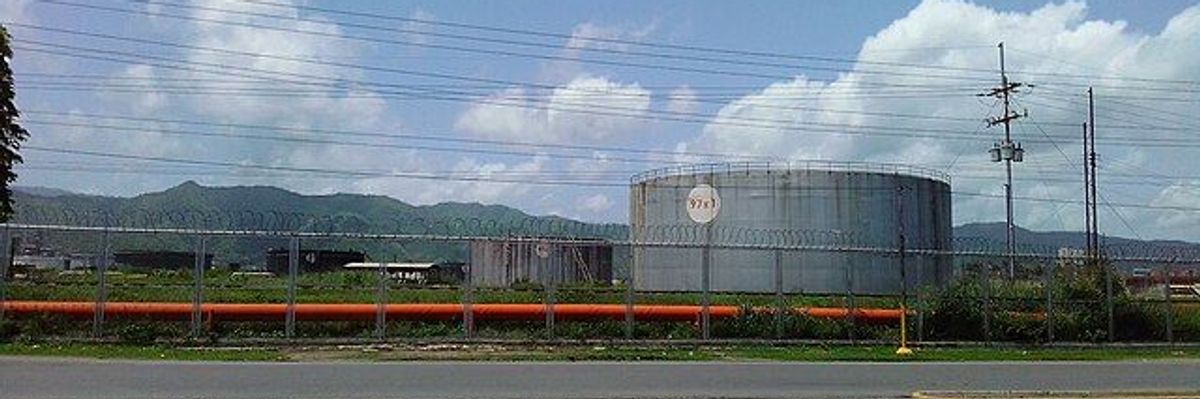
An oil refinery is seen in Puerto La Cruz, Venezuela.
(Photo by Guaiquerí/Wikipedia/CC BY-SA 4.0)
Richard Steiner
Nov 28, 2025
President Donald Trump’s saber-rattling about potential military action in Venezuela is indeed about drugs, but not cocaine. It is about a far more dangerous drug that former President George W. Bush admitted (in his 2006 State of the Union address) the US is addicted to—oil.
Venezuela has the largest proven oil reserves in the world—300 billion barrels—even larger than reserves in Saudi Arabia. Mr. Trump and his oil industry friends may imagine that by deposing President Nicolas Maduro and installing a friendly government there, the US would have unlimited access to this huge oil reserve, which is five times larger than the proven reserves in the US. Never mind the fact that for any hope of future climate stability, most of this oil needs to stay right where it is, in the ground.

Colombian President Petro Says Venezuela Oil ‘At Heart’ of Trump Aggression
‘Venezuela, for the American Oil Companies, Will Be a Field Day,’ Says US Lawmaker Pushing Invasion
We’ve seen this tragic play before. The Bush administration justified its disastrous 2003 invasion of Iraq with the pretext that Iraq had weapons of mass destruction which, as it turned out, it didn’t. And as US Central Command commander General John Abizaid admitted about the Iraq war at the time: “Of course it’s about oil, it’s very much about oil, and we can’t really deny that.” The invasion killed tens of thousands of people, mostly civilians, and destabilized the broader Middle East region for years.
And now here we go again. A similar pretext—this time “drug interdiction”—is being used to justify a potential US invasion and regime change in Venezuela. But this is not about stopping the flow of dangerous drugs, it is about actually increasing the flow of the dangerous drug some pushers want to keep us all hooked on—oil. As Colombian President Gustavo Petro recently stated on the US-Venezuela threat: “Oil is at the heart of the matter.”
Instead of admitting their addiction, the damage it causes, and committing to recovery, hard core junkies are always desperate for more supply. It seems Mr. Trump and his oil industry friends are the most dangerous narco-traffickers we need to worry about.
Our work is licensed under Creative Commons (CC BY-NC-ND 3.0). Feel free to republish and share widely.
Richard Steiner
Richard Steiner was a marine professor with the University of Alaska from 1980 to 2010, stationed in the Arctic and Prince William Sound. He advises on oil and environment through Oasis Earth.
Full Bio >

US President Donald Trump has authorised the USS Gerald R. Ford to enter the Caribbean. It now floats north of Puerto Rico, joining the USS Iwo Jima and other US navy assets to threaten Venezuela with an attack. Tensions are high in the Caribbean, with various theories floating about regarding the possibility of what seems to be an inevitable assault by the US and regarding the social catastrophe that such an attack will occasion. CARICOM, the regional body of the Caribbean countries, released a statement affirming its view that the region must be a “zone of peace” and that disputes must be resolved peacefully. Ten former heads of government from Caribbean states published a letter demanding that “our region must never become a pawn in the rivalries of others”.
Former Trinidad and Tobago Prime Minister Stuart Young said on 21 August, “CARICOM and our region is a recognised zone of peace, and it is critical that this be maintained”. Trinidad and Tobago, he said, has “respected and upheld the principles of non-intervention and non-interference in the internal affairs of other countries and for good reason”. On the surface, it appears as if no one in the Caribbean wants the United States to attack Venezuela.
However, the current Prime Minister of Trinidad and Tobago, Kamla Persad-Bissessar (known by her initials as KPB), has openly said that she supports the US actions in the Caribbean. This includes the illegal murder of eighty-three people in twenty-one strikes since 2 September 2025. In fact, when CARICOM released its declaration on the region being a zone of peace, Trinidad and Tobago withdrew from the statement. Why has the Prime Minister of Trinidad and Tobago gone against the entire CARICOM leadership and supported the Trump administration’s military adventure in the Caribbean?
Backyard
Since the Monroe Doctrine (1823), the United States has treated all Latin America and the Caribbean as its “backyard”. The United States has intervened in at least thirty of the thirty-three countries in Latin America and the Caribbean (90 percent of the countries, in other words) —from the US attack on Argentina’s Malvinas Islands (1831-32) to the current threats against Venezuela.
The idea of the “zone of peace” emerged in 1971 when the UN General Assembly voted for the Indian Ocean to be a “zone of peace”. In the next two decades, when CARICOM debated this concept for the Caribbean, the United States intervened in, at least, the Dominican Republic (after 1965), Jamaica (1972-1976), Guyana (1974-1976), Barbados (1976-1978), Grenada (1979-1983), Nicaragua (1981-1988), Suriname (1982-1988), and Haiti (1986).
In 1986, at the CARICOM summit in Guyana, the Prime Minister of Barbados, Errol Barrow, said “My position remains clear that the Caribbean must be recognised and respected as a zone of peace… I have said, and I repeat, that while I am prime minister of Barbados, our territory will not be used to intimidate any of our neighbours be that neighbour Cuba or the USA.” Since Barrow made that comment, Caribbean leaders have punctually affirmed, against the United States, that they are nobody’s backyard and that their waters are a zone of peace. In 2014, in Havana, all members of the Community of Latin American and Caribbean States (CELAC) approved a “zone of peace” proclamation with the aim “of uprooting forever threat or use of force” in the region.
Persad-Bissessar or KPB has rejected this important consensus across political traditions in the Caribbean. Why is this so?
Betrayals
In 1989, trade union leader Basdeo Panday formed the United National Congress (UNC), a centre-left formation (whose former name was the Caucus for Love, Unity, and Brotherhood). KPB joined Panday’s party and has remained in the UNC since then. Throughout her career till recently, KPB stayed at the centre of the UNC, arguing for social democratic and pro-welfare policies whether as opposition leader or in her first term as Prime Minister (2010-2015). But even in her first term, KPB showed that she would not remain within the bounds of the centre-left but would tack Far-Right on one issue: crime.
In 2011, KPB declared a State of Emergency for a “war on crime”. At her home in Phillipine, San Fernando, KPB told the press, “The nation must not be held to ransom by groups of thugs bent on creating havoc in our society”, “We have to take very strong action”, she said, “very decisive action”. The government arrested seven thousand people, most of them released for lack of evidence against them, and the government’s Anti-Gang Law could not be passed: this was a policy that mimicked the anti-poor campaigns in the Global North. Already, in this State of Emergency, KPB betrayed the legacy of the UNC, which she dragged further to the Right.
When KPB returned to power in 2025, she began to mimic Trump with “Trinidad and Tobago First” rhetoric and with even harsher language against suspected drug dealers. After the first US strike on a small boat, KPB made a strong statement in support of it: “I have no sympathy for traffickers, the US military should kill them all violently”. Pennelope Beckles, who is the opposition leader in Trinidad and Tobago, said that while her party (the People’s National Movement) supports strong action against drug trafficking, such action must be “lawful” and that KPB’s “reckless statement” must be retracted. Instead, KPB has furthered her support of the US militarisation of the Caribbean.
Problems
Certainly, Trinidad and Tobago faces a tight knot of economic vulnerability (oil and gas dependence, foreign exchange shortages, slow diversification) and social crises (crime, inequality, migration, youth exclusion). All of this is compounded by the weakness of State institutions to help overcome these challenges. The weakness of regionalism further isolates small countries such as Trinidad and Tobago, which are vulnerable to pressure from powerful countries. But KPB is not only acting due to pressure from Trump; she has made a political decision to use US force to try and solve her country’s problems.
What could be her strategy? First, get the United States to bomb small boats that are perhaps involved in the centuries-old Caribbean smuggling operations. If the US bombs enough of these little boats, then the small smugglers would rethink their transit of drugs, weapons, and basic consumer commodities. Second, use the goodwill generated with Trump to encourage investment into Trinidad and Tobago’s essential but stagnant oil industry. There might be short-term gain for KPB. Trinidad and Tobago requires at least $300 million if not $700 million a year for maintenance and for upgrading its petrochemical and Liquified Natural Gas plants (and then it needs $5 billion for offshore field development and building new infrastructure). ExxonMobil’s massive investment in Guyana (rumoured to be over $10 billion) has attracted attention across the Caribbean, where other countries would like to bring in this kind of money. Would companies such as ExxonMobil invest in Trinidad and Tobago? If Trump wanted to reward KPB for her unctuousness, he would tell ExxonMobil CEO Darren Woods to expand on the deepwater blocks investment his company has already made in Trinidad and Tobago. Perhaps KPB’s calculation to set aside the zone of peace ideas will get her some more money from the oil giants.
But what does this betrayal break? It certainly disrupts further any attempt to build Caribbean unity, and it isolates Trinidad and Tobago from the broader Caribbean sensibility against the use of the waters for US military confrontations. There are real problems in Trinidad and Tobago: rising gun-related violence, transnational trafficking, and irregular migration across the Gulf of Paria. These problems require real solutions, not the fantasies of US military intervention. US military interventions do not resolve problems, but deepen dependency, escalate tensions, and erode every country’s sovereignty. An attack on Venezuela is not going to solve Trinidad and Tobago’s problems but might indeed amplify them.
The Caribbean has a choice between two futures. One path leads toward deeper militarisation, dependency, and incorporation into the US security apparatus. The other leads toward the revitalisation of regional autonomy, South-South cooperation, and the anti-imperialist traditions that have long sustained the Caribbean’s political imagination.
No comments:
Post a Comment