It’s possible that I shall make an ass of myself. But in that case one can always get out of it with a little dialectic. I have, of course, so worded my proposition as to be right either way (K.Marx, Letter to F.Engels on the Indian Mutiny)
Wednesday, November 19, 2025
UK Government’s asylum proposals ‘cross a dangerous line’, warn campaigners and MPs
"This is headline chasing, not problem solving - a Government bowing to anti-immigrant, anti-rights politics."
Charities and MPs have condemned Shabana Mahmood’s hardline plans to make it harder for asylum seekers and refugees to settle in the UK.
The proposals Mahmood set out yesterday include reviewing people’s refugee status every 30 months and forcing refugees to return to their home country if it becomes safe. The changes would mean those with asylum status would have to wait 20 years, rather than five, to become UK citizens.
Mahmood also said she would amend laws that guarantee housing and financial support to asylum seekers facing destitution.
The government also plans to make asylum seekers contribute to accommodation costs if they own a large number of “high-value” belongings.
In addition, the government will attempt to change how the European Convention on Human Rights (ECHR) is interpreted to stop asylum seekers using their rights to family life to avoid deportation.
Reform MP Danny Kruger invited Mahmood to join Reform UK, and far-right activist Tommy Robinson backed Mahmood’s reforms, sparking concerns among Labour backbenchers.
Amnesty International said that the proposals represent “a historic weakening of refugee protection” and warned that ministers are undermining the European Convention on Human Rights (ECHR) while claiming they want to remain within it.
Steve Valdez-Symonds, Amnesty International UK’s Refugee and Migrant Rights Director, called the Home Secretary’s plans “cruel, divisive and fundamentally out of step with basic decency”.
He added: “This is headline chasing, not problem solving – a Government bowing to anti-immigrant, anti-rights politics instead of standing up for the basic principles that protect us all.
“The moment a Government decides that fundamental rights can be switched off for certain people, it crosses a dangerous line that should never be crossed. This is how universal protections begin to rot. Once you strip rights from one group, you hand the licence to whoever comes next to strip them from others.
“This headline-chasing cruelty will not fix the immigration system. It will only fuel fear, worsen instability and give legitimacy to the most divisive politics. Anyone who cares about universal human rights needs to act now, because if rights aren’t upheld for everyone – especially those who lack public sympathy – then they are not rights at all, but mere concessions that those in power may permit or withhold as they please.”
Andrea Vukovic, Co-Director of Women for Refugee Women, said: “The Home Secretary stated that ‘illegal migration is tearing the UK apart’. The only thing tearing the UK apart is a politics devoid of humanity, compassion and dignity. These plans – borrowed from hostile systems around the world – represent more cruelty, more uncertainty and more hostility for people seeking safety here. It tells those with refugee status in the UK – who have fled war, persecution, and violence – that their protection is temporary and that they will never be welcome here. This is a dangerous step in the wrong direction.”
A Refugee Action spokesperson, said: “Politicians are tearing Britain apart. Instead of fixing our NHS, making housing affordable and reducing wealth inequality they are rolling out the red carpet for the far right.
“This racist package of hostility against people seeking safety will further divide our communities and create a two-tier society divided into people who are told they belong, and those who are told they don’t.”
The spokesperson added: “Deterrence policies like these may be a great distraction for a government worried about next week’s budget and wracked by political infighting, but they won’t stop Channel crossings nor build inclusive, thriving communities.”
The spokesperson also noted that in the UK, fifty families hold more wealth than half the population, warning that the government should focus on fair taxation and tackling inequality “instead of tormenting people who have done nothing to cause these problems”.
Former Labour leader Jeremy Corbyn said that Mahmood was “trying to appease the most ghastly right-wing forces all across Europe in undermining and walking away from the European Convention on Human Rights.”
Naomi Smith, chief executive of Best for Britain, said: “The fact that these proposals are being cheered by far-right extremists should give the government pause – but beyond being a clear moral failure, the data shows it is also a profound misjudgment of political strategy.”
Smith also highlighted that studies by election analysts show that “ramping up ever-harsher rhetoric on immigration and asylum never wins over Reform-curious voters, but does drive Labour voters toward the Lib Dems and Greens in England, and the SNP and Plaid in Scotland and Wales”.
“The government would be wiser to make the case for the international institutions and protections we all depend on.”
Green Party MP, Carla Denyer, called the plans “a new low”, saying the government was “plumbing the depths of performative cruelty, in hopes that the public won’t notice they have no answers to the real issues facing communities across this country”.
“Confiscating the belongings of people fleeing war and violence, and trapping refugees in perpetual limbo, where even those who have been granted asylum would have the constant threat of deportation hanging over their heads, undermining integration and making it impossible to put down roots. These are extreme, inhumane proposals from a desperate and failing government.
“The only way to prevent people making dangerous crossings by small boats is to open safe and managed routes for people to claim asylum in the UK. There are hints Mahmood could introduce such schemes – a sensible government would focus on this workable policy rather than divisive gimmicks.”
Olivia Barber is a reporter at Left Foot Forward
‘This is not triangulation, it is capitulation’
Olivia Blake 19th November, 2025
This week, the Home Secretary announced a programme of migration and asylum reforms, taking inspiration from Denmark’s immigration system.
That the centre left is also tipped to lose Copenhagen for the first time in the city’s electoral history should be a flashing warning sign for Labour. In Denmark, years of tightening immigration rules and ceding rhetorical ground to the far right did not neutralise the issue – it normalised it. In the process, it hollowed out the moral core of social democracy and left voters questioning what the centre left was for. Labour now risks repeating the same mistake.
When a Labour government begins to sound indistinguishable from the hard right on immigration, when its spokespeople parrot phrases like “golden ticket” and boast about making life harder for refugees – this is not triangulation, it is capitulation, and it represents a profound betrayal of Labour values. More dangerously sti
The fixation on so-called ‘pull factors’ is one of the most persistent myths in the migration debate. The idea that refugees risk their lives crossing seas because Britain’s asylum system is too generous has been repeatedly disproven by researchers, refugee agencies, and even the Government’s own evidence. People flee because of the push factors of war, persecution, famine, state collapse – not because of marginal differences in welfare entitlements or processing rules. No parent puts their child in a dinghy because of a generous British welfare system. For those escaping the Taliban, Assad, or Russian bombardment, the “choice” is not between hardship abroad and comfort in the UK; it is between danger and survival. The pull-factor narrative is not only false, it is a convenient distraction used to justify ever-harsher policies that do nothing to reduce crossings, succeeding only in dehumanising the people it affects. This is why so-called ‘deterrent’ policies always fail.
The UK has seen an increase in asylum applications in recent years compared to our EU neighbours, but it is worth considering this in context. Germany (250,550), Spain (166,145), Italy (158,605) and France (157,460) all received more applications than the UK (108,138) in 2024. Adjusted per capita, the UK still trends behind other EU nations, ranking 14th among the EU27 plus UK.
A humane system is possible: one built on safe routes that prevent dangerous crossings; on integration rather than exclusion; on tackling the backlog; where asylum seekers have the right to work and can contribute through taxation.
To build this system requires moral courage. It is about saying that the far-right don’t have the answers, but we on the left do. Above all, it requires honesty about the real source of deprivation in our communities: those who spent 14 years stripping public services to the bone while profiting from division, not people seeking safety.
Olivia Blake
Olivia Blake is the Labour MP for Sheffield Hallam.@_OliviaBlake
Asylum debate: Labour divisions laid bare as Mahmood stands her ground
James Moules 18th November, 2025
RogerMechan/Shutterstock.com
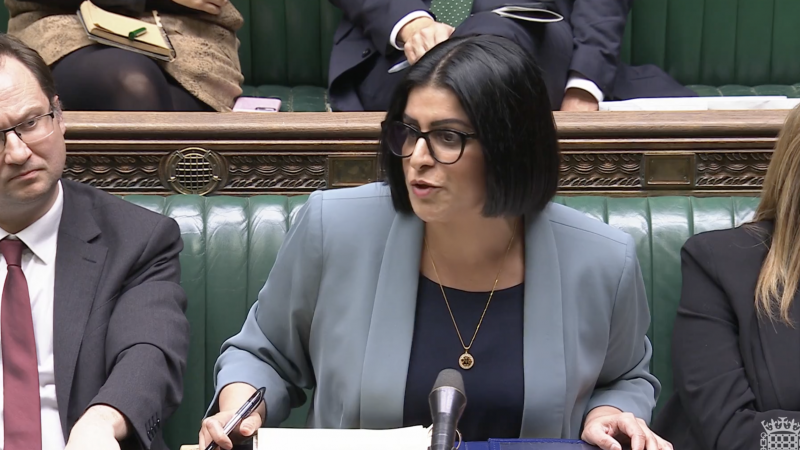
Shabana Mahmood came out fighting in the House of Commons yesterday after more than a dozen Labour MPs made their displeasure at the government’s asylum reforms known.
The Home Secretary told MPs: “If we fail to deal with this crisis, we will draw more people down a path that starts with anger and ends in hatred.”
But her new asylum measures have proved divisive on the Labour backbenches. Some MPs have voiced their support for the controversial proposals, but there has been no shortage of those expressing their visceral discomfort too.
Around 20 Labour MPs so far have gone public with their opposition to Mahmood’s plans, with many condemning the reforms in the strongest of terms.
York Central MP Rachael Maskell told Times Radio: “The dehumanisation of people in desperation is the antithesis of what the Labour Party is about.
Stroud MP Simon Opher said that “we should push back on the racist agenda of Reform rather than echo it.”
Allies of the government argue these measures are an essential tool to get a grip on a crisis that they claim is driving more and more voters into the arms of Farage and Reform.
Mahmood spoke of how the issue had been raised in her constituency, saying: “What unites all Britons, regardless of their background, is a desire for fairness and for a good system in which people can have confidence.”
But critics argue that many of the proposed reforms stretch the bounds of decency, and will only see more Labour voters abandon the party for the Liberal Democrats, Greens and Your Party.
Some left wing and soft left figures have argued the government should be placing greater focus on improving the cost of living and healthcare instead of leaning to the right on immigration.
Divisions deepen
However, Mahmood still has plenty of vocal backers in the PLP, with Hartlepool MP Jonathan Brash and Peterborough MP Andrew Pakes being among those to speak out in favour.
Could we see another rebellion? Possibly. It’s likely more Labour MPs will publicly express discomfort as the row rumbles on. But the Home Secretary has made it clear she’s up for the fight.
During the debate, Mahmood brought up her own experience of racism in Britain. “I wish I had the privilege of walking around this country and not seeing the division that the issue of migration and the asylum system is creating across this country,” she said.
The controversial plans include fast-tracked deportations, changes to the appeals process, and new rules to return those granted asylum to their home countries once those places are deemed safe.
It will also quadruple the length of time to achieve permanent status – from five years to 20.
Nottingham East MP Nadia Whittome said much of the reform programme “flies in the face of decency and compassion”.
The wider debate
The government’s proposals haven’t just sparked backlash within the PLP, with many left wing groups and humanitarian campaigners voicing concerns about the measures.
Dr Dora-Olivia Vicol, CEO of the Work Rights Centre said: “These changes will force refugees – people fleeing war, torture, persecution – into a state of permanent precarity for two decades.
“It is very difficult for people with time-limited leave to secure good work, as most employers look for certainty. Shutting refugees out of sustainable, secure work only pushes them closer to precarious roles where they can be exploited for profit.”
But at the same time, think tank More in Common polled several “Danish model” asylum policies ahead of the announcement and found strong public support for many measures – including pushing asylum seekers to return to their home countries once these places become safe.
A spokesperson for the union BFAWU said: “The BFAWU Executive Council is alarmed by the Home Secretary’s announcement yesterday, and by the direction it signals for the UK’s asylum system.
“The government’s statement that refugee status will become temporary, that the pathway to settlement will be significantly lengthened, and that support for people seeking safety may be withdrawn raises profound concerns about fairness, human rights, and the functioning of our economy.”
Government asylum reforms greeted with outrage within Labour
NOVEMBER 18, 2025
“The Home Secretary sounds like a Reform supporter,” said Nigel Farage. “Well done patriots,” said Tommy Roboinson. Shabana Mahmood’s proposed reforms to Britain’s immigration rules have drawn fulsome support from some obnoxious quarters – and outrage from Labour MPs and progressives.
There is so much wrong with the new regime proposed for refugees that it is difficult to know where to begin. Let’s start with motive.
“The new asylum proposals outlined by the Home Secretary are not driven by humanity, fairness or even economics,” writes Labour’s former Director of Policy Andrew Fisher. “They are driven by political cowardice.”
With reports of a new 20-year wait to secure indefinite leave to remain for those claiming asylum and populist gimmicks like seizing jewellery and assets from small boat migrants to help pay for accommodation, Keir Starmer’s 2020 pledge to have “an immigration system based on compassion and dignity” is well and truly dead.
If the aim of the changes is to halt the rise of Reform, they are likely to fail on this front. Manchester University Politics Professor Rob Ford points out: “Labour can never be the party of those who reject the asylum principle. Hardline immigration conservatism is owned by the right. Low-trust radical right voters will never believe an approach like this because they know it runs against the grain of the Party’s core electorate and history – so will fail.”
He concludes: “Labour seem to now come up with a new kamikaze nosedive operation to alienate social liberals while failing to attract Reform-curious voters every month.” He adds that, like Labour’s fiscal policy, it reinforces a belief among naturally Labour- leaning progressives that under Keir Starmer’s leadership, Labour “is a hostile environment to their values. But it substitutes nothing else.”
Labour MPs speak out
As well as accelerating the drift of Labour voters to the Greens, Lib Dems and others, Shabana Mahmood’s proposals are likely to provoke more internal division within the Party. Even moderate Labour MPs are incensed. Stella Creasy MP described the reform as “not just performatively cruel, it’s economically misjudged,” adding that “if you can’t stabilise your status, you will always struggle to get a job, a bank account or a mortgage, making it more likely you will be dependent on state or charity support.” She warned that “ICE-style raids on Britain’s streets” would be the only achievement of the Government’s “brutal” reforms.
Another usually loyal MP,Tony Vaughan, said the Government was taking a wrong turning: “The idea that recognised refugees need to be deported is wrong.” He added: “The rhetoric around these reforms encourages the same culture of divisiveness that sees racism and abuse growing in our communities.”
John McDonnell MP pointed out that Vaughan was “certainly not what the media would call a ‘usual suspect’. I suspect he is reflecting here what many in the PLP feel.”
Apsana Begum MP tweeted: “Policies to punish asylum seekers and refugees are a defeatist attempt to outdo Reform. There’s no dignity nor compassion in treating people fleeing persecution with appalling hostility and suspicion. It’s morally, politically and economically wrong and will only pave the way for a far-right government.”
Nadia Whittome MP agreed: “The government should be ashamed that its migration policies are being cheered on by Tommy Robinson and Reform. Instead of standing up to anti-migrant hate, this is laying the foundations for the far-right.”
Richard Burgon MP agreed, saying: “This approach isn’t just morally wrong; it’s politically disastrous.” He concluded: “This failing Labour leadership is choosing to fight on terrain set by Farage. In doing so, it is paving the way for the first far-right government in our history.”
Sarah Owen MP argued it was possible to take tough stance on illegal immigration, while having a “compassionate, fair and legal path for those seeking refuge.”
She added: “Taking jewellery from refugees is akin to painting over murals for refugee children. These repugnant ‘deterrents’ did not work for the Tories, and they won’t work for us.”
Stroud MP Simon Opher said Labour should “stop the scapegoating of immigrants because it’s wrong and cruel,” adding: “We should push back on the racist agenda of Reform rather than echo it.”
Alloa and Grangemouth MP Brian Leishman, who only recently had the Labour whip restored after being suspended for voting against the two-child benefit cap, also spoke out, as did Stourbridge MP Cat Eccles who said: “I’m massively disappointed and angry about what the Home Secretary is saying.”
MP for York Central Rachael Maskell said: “The dehumanisation of people in desperation is the antithesis of what the Labour Party is about,” and Middlesborough and Thornaby East MP Andy McDonald called the proposals “cruel, unfair and unworkable”.
Poole MPNeil Duncan-Jordan, who also recently got the Labour whip restored, said trying to steal votes from Reform was an “electoral dead end,” adding: “Kicking out recognised asylum seekers doesn’t speak to any of our values.”
Montgomeryshire and Glyndwr MP Steve Witherden said: “The problems the country faces won’t be solved by demonising asylum seekers.”Ian Byrne MP agreed, calling the reforms “morally bankrupt and politically disastrous.”
Diane Abbott MP was excoriating: “Draconian, unworkable and potentially illegal anti-asylum policies only feed Reform’s support. The government has learnt nothing from the period since the general election.”
Bell Ribeiro-Addy agreed: “The government’s latest asylum proposals seem calculated to do nothing but inflict more misery and uncertainty on people seeking safety in this country. This is not opposing the politics of hatred and division, this is holding the door open for them.”
In a detailed statement, Kim Johnson MP called the proposals “contemptible”. She added: “the government is choosing to attack the wrong 1%. Instead of taking from the most vulnerable, they’d do far better to focus on the billionaires who are really tearing this country apart.”
Paul Nowak, General Secretary of the Trades Union Congress, also added his voice. Speaking to Byline Times in advance of the Government’s latest plans, he said: “I’ve been very clear in terms of Labour: I don’t think you can out-Farage Farage.”
What is to be done?
A sensible debate about asylum would look at why record numbers of people are fleeing their home countries. AsAndrew Fisher points out, “Our far-from-ethical foreign policy sees British weapons currently brutalising innocents from Sudan to Palestine. We have a responsibility to stop funding conflict, but instead we are cutting international aid and continuing arms exports and political support for dictatorships and warmongers.”
“We need to do more to integrate asylum seekers quickly – that means allowing them to work, if they’re able, to support themselves – and providing language and health support for those who currently cannot,” says Fisher. But the last Tory Government cut free English lessons for those whose first language isn’t English and Labour has not restored them. Such an approach would not just be more ethical: it could save the Government money on asylum costs and provide extra tax revenues for the Treasury.
Olivia Blake MP agrees: “We often claim that the UK is welcoming, but these reforms undermine that narrative. Punishing people who have already fled danger, and stripping recognised refugees of stability, does not strengthen the system.”
She adds: “If we want an asylum system that works, the answer is simple: safe routes, faster decisions, the right to work for asylum seekers, and meaningful support for integration.”
Take action
Speaking this morning, Lord Alf Dubs described the proposals as “shabby” and called for more compassion in politics. Momentum agreed, adding: “Labour adopting anti-refugee rhetoric risks emboldening Reform to promote even more racist and radical measures against migrant communities.”
A draft motion for Constituency Labour Parties on the issue is being circulated.
UK Labour to Let Authorities Take Jewelry From Asylum-Seekers as Part of Sweeping New Immigration Crackdown “Labour won’t redistribute wealth from billionaires,” said former party Leader Jeremy Corbyn. “But they will seize belongings from those fleeing war and persecution.”
Protesters hold their banners, placards, and flags while they block the road during an anti-fascist counterprotest against a far-right anti-immigration protest on October 5, 2025, outside the Acacia Court in Faversham, UK. (Photo by Krisztian Elek/SOPA Images/LightRocket via Getty Images)
A new asylum policy announced Monday by the UK Labour Party will allow authorities to confiscate the jewelry and other belongings of asylum-seekers in order to pay for their claims to be processed.
The policy, which some critics said was “reminiscent of the Nazi era,” was just one part of the Labour Party’s total overhaul of the nation’s asylum system, which it says must be made much more restrictive in order to fend off rising support for the far-right.
In a policy paper released Monday, the government announced that it would seek to make the status of many refugees temporary and gave the government new powers to deport refugees if it determines it to be safe. It also revoked policies requiring the government to provide housing and legal support to those fleeing persecution, while extending the amount of time they need to wait for permanent residency to 20 years, up from just five, for those who arrive illegally.
The UK government also said it will attempt to change the way judges interpret human rights law to more seamlessly carry out deportations, including stopping immigrants from using their rights to family life under the European Convention on Human Rights (ECHR) to avoid deportation.
In an article for the Guardian published Sunday, UK Home Secretary Shabana Mahmood called the reforms “the most significant and comprehensive changes to our asylum system in a generation.” She said they were necessary because the increase in migration to the UK had stirred up “dark forces” in the country that are “seeking to turn that anger into hate.”
Nigel Farage, the leader of the far-right Reform UK Party, is leading national polls on the back of a viciously anti-immigrant campaign that has included calls to abolish the UK’s main pathway for immigrants to become permanent residents, known as “leave to remain.”
Meanwhile, in September, over 100,000 people gathered in London for an anti-immigrant rally led by Tommy Robinson, a notorious far-right figure who founded the anti-Muslim English Defence League (EDL). The event saw at least 26 police officers injured by protesters.
Last summer, riots swept the UK after false claims—spread by Robinson, Farage, and other far-right figures—that the perpetrator of the fatal stabbing of two young girls and their caretaker had been a Muslim asylum-seeker. A hotel housing asylum-seekers was set on fire, mosques were vandalised and destroyed, and several immigrants and other racial minorities werebrutallybeaten.
Mahmood said that if changes are not made to the asylum system, “we risk losing popular consent for having an asylum system at all.”
But as critics were quick to point out, the far-right merely took Labour’s crackdown as a sign that it is winning the war for hearts and minds.
Robinson gloated to his followers that “the Overton window has been obliterated, well done patriots!” while Farage chortled that Mahmood “sounds like a Reform supporter.”
Many members of the Labour coalition expressed outrage at their ostensibly Liberal Party’s bending to the far-right.
“The government should be ashamed that its migration policies are being cheered on by Tommy Robinson and Reform,” said Nadia Whittome, the Labour MP for Nottingham East. “Instead of standing up to anti-migrant hate, this is laying the foundations for the far-right.”
In a speech in Parliament, she chided the home secretary’s policy overhaul, calling it “dystopian.”
“It’s shameful that a Labour government is ripping up the rights and protections of people who have endured unimaginable trauma,” she said. “Is this how we’d want to be treated if we were fleeing for our lives? Of course not.”
The UK has signed treaties, including the ECHR, obligating it to process the claims of those who claim asylum because they face persecution in their home countries based on race, religion, nationality, group membership, or political opinion. According to data from the Home Office, over 111,000 people claimed asylum in the year from June 2024-25, more than double the number who did in 2019.
The spike came as the number of people displaced worldwide reached an all-time high of over 123.2 million at the end of 2024, according to the Norwegian Refugee Council, with desperate people seeking safety from escalating conflicts in Sudan, Ukraine, Myanmar, the Democratic Republic of Congo, and across the Middle East.
In her op-ed, Mahmood lamented that “the burden borne by taxpayers has been unfair.” However, as progressive commentator Owen Jones pointed out, the UKtakes in far fewer asylum-seekers than its peers: “Last year, Germany took over twice as many asylum-seekers as the UK. France, Italy, and Spain took 1.5 times as many. Per capita, we take fewer than most EU countries. Poorer countries such as Greece take proportionately more than we do.”
The Labour government, led by Prime Minister Keir Starmer, alread boasts that it has deported more than 50,000 people in the UK illegally since it came to power in 2024, but it has predictably done little to satiate the far-right, which has only continued to gain momentum in polls despite the crackdown.
Under the new rules, it is expected that the government will be able to fast-track many more deportations, particularly of families with children.
The jewelry rule, meanwhile, has become a potent symbol of how the Labour Party has shifted away from its promises of economic egalitarianism toward austerity and punishment of the most vulnerable.
“Labour won’t redistribute wealth from billionaires,” said former party leader Jeremy Corbyn, who is now an independent MP. “But they will seize belongings from those fleeing war and persecution.”
What changes to the UK asylum system are the Labour Government proposing?
Amid the threat posed by Farage and Reform’s rise in the polls, the government recognises that unless it can assert control and grip over the problem, there is a real risk it could lose to Reform.
With concern over immigration growing, and the issue now ranked by the public as one of the most important facing the country, the Labour government has made tackling illegal immigration a major priority.
Amid the threat posed by Farage and Reform’s rise in the polls, the government recognises that unless it can assert control and grip over the problem, there is a real risk it could lose to Reform.
Home Secretary Shabana Mahmood’s changes to the asylum system, billed as the most radical since the second world war, have caused a stir even among her own backbenchers. So, what are the major changes being set out?
1. Temporary settlement
Those granted asylum will have to wait 20 years to apply to settle permanently. Previously, they could begin this process after five years. Some have criticised this move, saying in the end the lack of clarity on status will prove more costly to the state.
In another major change, asylum status will only be granted on a temporary basis and subject to regular review every two-and-a-half years, meaning people could be returned to their home nation if it is deemed safe.
2. Changes to Right to family life
Amid growing frustration that human rights laws were being used to block deportations, the government is also looking to overhaul how human rights legislation is applied to migration court cases. Mahmood will bring forward a Bill to change how article 8 of the European Convention on Human Rights (ECHR), the right to family life, is applied in migration court cases.
3.Fewer appeals
Under the proposed changes fewer appeals will be allowed, with asylum seekers restricted to a single appeal, which, if fails, will see them deported.
4.New legal routes to the UK to be introduced
While the government is determined to tackle the pull factors on illegal immigration, it also says that it will introduce new legal routes for asylum seekers to the UK as a way to reduce the number of dangerous journeys in small boats.
The routes will be capped and are designed to give communities a greater say about the presence of refugees.
5. Visa bans
The government has also threatened to stop granting visas to people from three African countries – Angola, Namibia and the Democratic Republic of Congo – if their governments do not improve co-operation on removals of illegal migrants.
6. Asylum seekers with assets to contribute to cost of accommodation
The home secretary is also expected to announce that asylum seekers who have assets will be expected to contribute to the cost of their accommodation.




No comments:
Post a Comment