
Venezuela, Project 2025 and Big Oil’s Trump
Investment
If you think Trump’s threat to invade Venezuela is about stopping the influx of drugs into the United States, you need to take a closer look at Project 2025. That document advocates American hegemony over the Western Hemisphere. But Trump does not read documents or strategy papers. He wants to bully the hemisphere and control its vast natural resources. His “Gulf of America” apparently includes the vast oil reserves of Venezuela. The socialist nation has the world’s largest proven reserves. Still, with its politics chaotic and its military weak, and its close relationships with China, Russia, and Iran, it is an obvious launching point for Trump’s Napoleonic march through the Americas. Besides, handing over Venezuela’s oil fields to American Big Oil is the least he can do for the oil and gas executives who ponied up about $450 million – at least according to public records – to get their shill back into the White House.
His crowning gift to Big Oil may be the lucrative long-term investment opportunities they’ll have after his naval armada, which includes the world’s largest aircraft carrier, seizes Venezuela’s abundant fields. But there’s more. Trump got Congress to slash the industry’s taxes by another $18 billion, even though it already enjoyed billions in tax breaks. Additionally, he’s rolled back dozens and dozens of environmental regulations, opened public lands and waters for drilling, dismissed climate change as a hoax, and put fossil fuel executives in charge of public agencies.
It’s not that Big Oil needs big new reserves. The world is awash in oil, and the US is the world’s leading producer. In fact, when both Biden and Trump put Alaskan oil fields up for bid, there were no serious takers. Yet Trump’s functionally irrational “Drill Baby Drill” energy policies call for even more production. Although oil corporations historically control prices through policies of planned scarcity, U.S. producers opened their spigots to consolidate a monopoly by glutting the market. This strategy not only drives out small independent producers. It even puts OPEC over a barrel. Yes, in the short term, this strategy has marginally cut into Big Oil’s profits, but the current small decline is an investment in long-term market control.
Trump justifies military action and regime change in Venezuela by claiming that President Maduro heads the Cartel de Los Soles, which, he says, is a terrorist drug cartel. The U.S. Justice Department has even offered a $50-million reward for information leading to Maduro’s arrest. Once the U.S. declares it a terrorist organization, Trump will have an excuse to invade Venezuela. No: he can’t legally use military force without congressional authorization. The facts, however, fail to back Trump’s accusations. As Charlie Savage explains in a recent New York Times piece, this so-called cartel does not exist. The phrase is a decades-old figure of speech mocking the Venezuelan military, who take drug money. More importantly, according to the United Nations Office on Drugs and Crime, Venezuela is not a cocaine producing country, and most Colombian cocaine comes through the Pacific coast. The U.S. Drug Enforcement Administration corroborates this by noting that 84% of seized cocaine in the United States comes from Colombia. This is not to suggest that drug trafficking doesn’t exist in Venezuela. It does, but the government does not appear to participate in it as Trump claims. In fact, one observer in a CNN interview maintained that Maduro has seized hundreds of aircraft and almost a hundred vessels in his attempt to stop the drug trade. As for the deadly fentanyl epidemic that he’s always talking about, the major suppliers are Mexico and China. Why isn’t Trump sending his armada to those places?
The charge that drug trafficking is a military-like threat to the United States is how Trump justifies regime change through military force. Ignoring Congress and defying the Constitution, Trump’s Department of War has already killed as many as 83 people in the Caribbean without showing a stick of evidence of criminal activity. Just as important, narco-trafficking is a legal matter, not a military one. His Caribbean murders and saber-rattling against Venezuela are shot through with illegality. A Congress with any teeth would impeach Trump for a third time. But then, presidents since Harry Truman have made a habit of using military power as if it were their exclusive property. And Congress pretends not to see. Just since the 1950s, U.S. presidents from Truman and Eisenhower through Obama and Trump have all used covert as well as overt military power with utter indifference to the Constitution, Congress, or public opinion. American presidents don’t take well to small nations that get in their way. Think Lumumba, the Bay of Pigs, Allende, and Saddam Hussein. Add oil to the mix, and you get the Eisenhower-directed CIA coup of a democratically elected government in Iran in 1953. That brilliant stroke of coercive diplomacy eventually led to the 1979 Islamic Revolution, the ouster of the US’s puppet Shah, a hostage crisis, an oil embargo, and Iran’s ongoing efforts to get the big bomb. Recall, too, the Suez Canal crisis of 1956 that almost triggered a war with the Soviet Union; and of course, the Gulf oil wars of 1991 and 2003 to 2011. As Robert Engler observed many years ago in his seminal work, The Politics of Oil, the oil industry is a powerful private government that transcends national boundaries in its quest to control the world’s petroleum resources. To illustrate, he recounts the story of Standard Oil’s partnership with the German I.G. Farben company at the beginning of World War II, a partnership based on the premise that countries come and go, but Standard Oil is forever. For the time being, Trump’s dream of being crowned King of the World and Big Oil’s pursuit of world domination happily align.
Venezuela Under Siege: A Hundred Deaths at Sea – Hundreds of Thousands by Sanctions
Washington is targeting the Venezuelan people in an escalating regime-change offensive, combining open military violence with an economic siege that has quietly claimed far more lives
Most of the world looks on in disbelief at the now-routine murders on the high seas off Venezuela’s coast – serial killings that the newly minted War Department calls Operation Southern Spear.
On October 31, UN High Commissioner for Human Rights Volker Türk condemned the attacks, saying that the “mounting human costs are unacceptable.” The People’s Social Summit in Colombia (November 8-9) excoriated Washington. Four days later in Caracas, a meeting of jurists from 35 countries denounced the “homicidal rampage.” The Military Law Task Force of the National Lawyers Guild charged “egregious war crimes and violations of international human rights, maritime, and military law.”
Even The New York Times, an outlet that is not squeamish about US atrocities, described Washington’s flimsy drug-interdiction rationale as being “at odds with reality.”
The notion that the US – the world’s leading consumer of illegal narcotics, the major launderer of trafficking profits, and the cartels’ favored gun runner – is concerned about the drug plague is ludicrous.
In reality, Venezuela is essentially free of drug production and processing – no coca, no marijuana, and certainly no fentanyl – according to the authoritative United Nations World Drug Report 2025. The European Union’s assessment of global drug sources does not even mention Venezuela.
Most inconveniently for Mr. Trump, the US Drug Enforcement Agency (DEA) 2025 National Drug Threat Assessment does not list Venezuela as a cocaine producer and only as a very minor transit country. Nor is Venezuelan President Nicolás Maduro cited as a drug trafficker.
The State Department is designating the so-called Cartel de los Soles, allegedly headed by Maduro, as a Foreign Terrorist Organization (FTO). However, the entity is nowhere to be found in the DEA assessment for the simple reason that it does not exist.
Meanwhile, the body count from the killing spree is nearing one hundred, yet not an ounce of narcotics has been found. In contrast, the Venezuelan government has seized 64 tons. Clearly, Washington’s intent is not drug interdiction but regime change.
Sanctions kill
As horrific as the slaughter by direct US military violence against Venezuela may be, a far greater contributor to excess deaths has received scant media attention. The toll from sanctions is well over a hundredfold larger.
Sanctions are not an alternative to war but a way of waging war with a less overt means of violence – but deadly, nonetheless.
Sanctions, more properly called illegal unilateral coercive measures, are as lethal as the missiles Washington rains down on small boats in the southern Caribbean and the Pacific from Ecuador to Mexico.
Economists Mark Weisbrot and Jeffrey Sachs demonstrated that US sanctions imposed in 2017-2018 drastically worsened Venezuela’s economic crisis and directly contributed to an estimated 40,000 excess deaths.
By 2020, former UN Special Rapporteur Alfred de Zayas estimated a death toll of over 100,000. An expert in international law, de Zayas argues that sanctions function as collective punishment, harming civilians rather than government officials.
Washington is now escalating its regime-change offensive – while maintaining the sanctions – precisely because Venezuelans have successfully resisted the punitive measures.
Sanctions disproportionately kill children
A peer-reviewed scientific report in The Lancet reveals that a disproportionate number of the sanction’s victims globally are children under the age of five. In fact, the study finds that more human life is extinguished by sanctions than by open warfare.
The SanctionsKill! Campaign describes itself as an activist project to expose the human cost of sanctions and what can be done to end them. They are inviting health workers to sign a letter to the US Congress and the executive branch to end these child-killing sanctions.
Drawing from The Lancet study, the health workers’ letter details how sanctions are particularly deadly for small children by:
- Provoking increases in water-borne illnesses and diarrheal diseases
- Causing low birth weight
- Exacerbating hunger and malnutrition
- Denying lifesaving cancer care and organ transplants
- Obstructing access to and the import of antibiotics and other common medicines
- Hindering sanctioned countries from receiving assistance during natural disasters
Among the signatories are Margaret Flowers, MD, a pediatrician and long-time health reform advocate; professor emeritus Amy Hagopian, PhD, at the University of Washington and former chair, International Health Section, American Public Health Association; internist Nidal Jboor, co-founder of Doctors Against Genocide; and pediatrician Ana Malinow, National Single Payer leader.
Others include health policy professor Claudia Chaufan, MD and PhD, York University; child and adolescent psychiatrist Claire M. Cohen, MD, National Single Payer, PNHP; and Kate Sugarman, MD, Georgetown Law School and George Washington School of Medicine.
Their letter concludes that there is a clear consensus in the literature that broad unilateral economic sanctions have devastating health and humanitarian consequences for civilian populations: “This is a global public health crisis caused by US government policy. We implore you to fulfill your inescapable obligation to end it…Imposing such collective punishment on the innocent is morally reprehensible.”
Sanctions and slaughter
Blogger Caitlin Johnstone quips: “civilized nations kill with sanctions.” That the US kills by both sanctions and open military force does not prove her wrong. Rather, it demonstrates that today’s US empire is not civilized.
Because open warfare is more dramatic than unilateral coercive measures, there is a danger that child-killing sanctions are becoming normalized.
Indeed, this form of hybrid warfare by the US impacts roughly one-quarter of humanity. History shows – as in the case of the 1961 John F. Kennedy sanctions against Cuba – that once imposed, sanction regimes are politically difficult to end.
The campaign against unilateral coercive measures is as central to the struggle for peace as opposition to overt military aggression. Sanctions are not a benign substitute for war; they are an additional mechanism of lethal collective punishment.
PS: The health-workers’ letter will not be submitted until early 2026, so health professionals of all disciplines still have time to sign on.
“We condemn in the strongest terms the military escalation against Venezuela,” said progressive leaders from countries including the United Kingdom, Spain, and Greece.
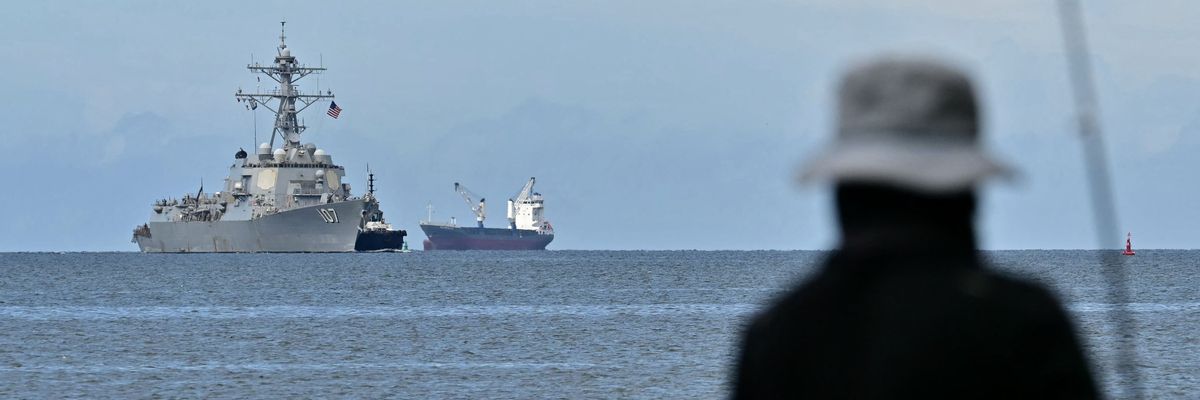
The USS Gravely warship is seen at a distance off the coast of Port of Spain, Trinidad and Tobago on October 26, 2025, as a fisherman looks on.
(Photo by Martin Bernetti/AFP via Getty Images)
Julia Conley
Nov 21, 2025
COMMON DREAMS
The administration’s “show of force has already proved lethal,” said the leaders, with more than 80 people—including fishermen and an out-of-work bus driver—having been killed in the US military’s strikes on more than 20 boats, which the administration has insisted were trafficking drugs to the US. The White House has publicized no evidence of the claims.
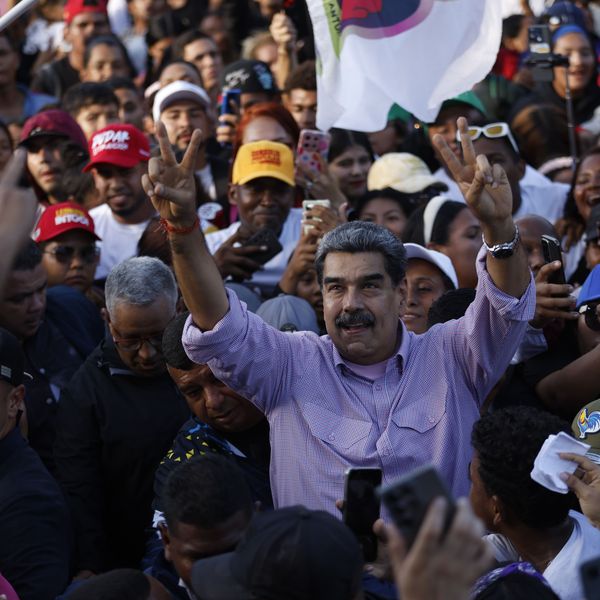
‘No More Endless Wars,’ Maduro Says to American People, Calling for ‘Peace’ in Face of Trump Threats
President Donald Trump has not taken further military action against Venezuela since he was presented with “options” for potential strikes last week by officials including Defense Secretary Pete Hegseth, nor has he followed through with threats he’s made against Mexico and Colombia.
But the European leaders—including British Members of Parliament Zarah Sultana and Jeremy Corbyn, former Greek Finance Minister Yanis Varoufakis, and Spanish Member of European Parliament Irene Montero Gil—noted that Trump “severed diplomatic channels with Caracas and approved covert [Central Intelligence Agency] operations in Venezuela” as the military buildup continues in the region.
The Trump administration has insisted it is engaged in a legal “armed conflict” with drug cartels in Venezuela, which it has accused of trafficking fentanyl to the US—though experts say drug boats originating in Venezuela are “are mainly moving cocaine from South America to Europe,” and analysis by both the United Nations and US intelligence agencies have shown the South American country plays virtually no role in the production or transit of fentanyl.
The US Congress has not authorized any military action against drug cartels or Venezuela’s government, and lawmakers from both sides of the aisle have attempted to pass war powers resolutions blocking the US from striking more boats or targets on land in Venezuela, only to have the resolutions voted down.
In his second term, Trump has sought to tie Venezuelan President Nicolás Maduro to drug cartels—despite a declassified US intelligence memo showing officials rejected the claim—and designated Cartel de los Soles a foreign terrorist organization last week, giving the White House what Hegseth called “new options” to go after the group.
But the escalation that Trump claims is the latest battle in the “War on Drugs” comes two years after he explicitly announced his desire to take control of Venezuela’s oil, and following years of condemnation of Maduro’s socialist government from Secretary of State Marco Rubio.
The European leaders said the administration’s narrative about the threat Venezuela poses to the US and the escalation is simply the “latest attempt to threaten and undermine the sovereignty of Latin America and the Caribbean nations.”
“Declassified documents have confirmed the CIA’s hand in overthrowing democratically elected governments in Latin America, such as Salvador Allende’s Chile in 1973, João Goulart’s Brazil in 1964, and Jacobo Árbenz’s Guatemala in 1954. The human cost of these regime change operations was catastrophic, and their political legacy endures,” reads the letter, which was organized by Progressive International.
A military intervention by the US in Venezuela “would mark the first interstate war by the United States in South America,” the leaders said, yet “the pretext for intervention is as tired as it is familiar.”
“Under the banner of combating the ‘narco-terrorists,’ Trump celebrates lethal strikes against peaceful fishermen arbitrarily labeled as carrying drugs,” the leaders said.
As in the past, they added, moving the War on Drugs to Venezuela would deliver “not security but a torrent of bloodshed, dispossession, and destabilization.”
“Therefore, we condemn in the strongest terms the military escalation against Venezuela,” they said. “Our demand is clear and our resolve is firm: No war on Venezuela.”
As Peoples Dispatch reported Thursday, many European leaders have “subordinated” themselves to Trump and have avoided speaking out against the US escalation with Venezuela, but left-wing political parties have led the way in denouncing the US deployment of soldiers and warships to the region.
The Workers’ Party of Belgium said recently that the world is “witnessing an unprecedented military escalation in 20 years, a multifaceted aggression that threatens not only Venezuela, but any project of sovereignty and social justice in Latin America.”
Between Trump’s imperialist offensive and Maduro’s repression
Friday 21 November 2025, by Y.B. and F.G.
Since August, at least 70 people have been killed by strikes by the U.S. armed forces on boats mainly from the Venezuelan coast, in the Caribbean Sea, under the pretext of the fight against narcoterrorism.
This imperialist offensive, which does little to hide the United States’ desire to bring about regime change in Venezuela, is also instrumentalized by the authoritarian government of president Nicolás Maduro in that country.
Imperialist advance
With the arrival of Donald Trump in power, and in particular Marco Rubio, representative of the Florida neoconservatives as Secretary of State, US imperialism is returning to its “natural zone of influence” with the aim of regaining control over Latin America. The installation of more than ten thousand troops in the region, in addition to six warships and an aircraft carrier, is an unwavering demonstration of US imperialism’s willingness to impose its political and economic agenda by force. This is particularly the case in Venezuela, a country declared an “exceptional threat” to the security of the United States since the Obama administration, a policy that was subsequently deepened by the first Trump administration, which in 2019 imposed economic sanctions on the state and on the Venezuelan state-owned oil company PDVSA, heavily aggravating the consequences of a catastrophic economic crisis already underway since the years 2014-2015.
A policy legitimized by the conservative opposition, including María Corina Machado, recent Nobel Peace Prize laureate, who openly supports Trump’s warmongering policies, as well as the expulsion of Venezuelan migrants sent to Bukele jails in El Salvador, under the pretext of belonging to “criminal gangs.”
Social and political repression
On the ground, the Maduro government, under pressure, excels in social and political repression. The disappearances or arrests of journalists, human rights activists, trade unionists, researchers, intellectuals and artists are part of everyday life. The president himself is calling on the population to use applications on phones to make denunciations without risk.
Finally, recently, it is environmental researchers and activists who have been targeted by the executive, accused of promoting a false left-wing discourse while working in the service of foreign interests. The instruction is simple, as the hashtag now present on all government communications says: dudar es traición (to doubt is to betray). In return, the critical left rejects the government’s façade of anti-imperialism and a furiously extractivist economic policy, in the service of a new ruling caste.
Internationalist solidarity
As internationalists, we denounce the new manoeuvres of the United States against the sovereignty of Venezuela, which could — moreover — destabilize the entire region, against a backdrop of fierce competition with China for control of the subcontinent. In this context, diplomatic initiatives and international mobilizations that could help make Trump back down in his warlike desires will be welcome.
Our solidarity goes to the Venezuelan people, who are the only ones capable of resolving the political and geopolitical conflict that afflicts them and that has caused the departure of more than eight million people, or a third of the country’s population.
In the face of Maduro’s imperialist attacks and authoritarianism, we call for support for the comrades and social movements that are mobilizing, in a difficult context, to promote struggles for emancipation from below, without giving in to the sirens of the far right.
Translated by International Viewpoint from l’Anticapitaliste.
Attached documentsbetween-trump-s-imperialist-offensive-and-maduro-s_a9266.pdf (PDF - 905.7 KiB)
Extraction PDF [->article9266]
Y.B. and F.G. write for l’Anticapitaliste in France.
International Viewpoint is published under the responsibility of the Bureau of the Fourth International. Signed articles do not necessarily reflect editorial policy. Articles can be reprinted with acknowledgement, and a live link if possible.
No comments:
Post a Comment