Hungary's Orban defies EU by promising to go on buying Russian oil
Hungarian Prime Minister Viktor Orban defied Brussels on Friday by promising Russia's President Vladimir Putin he would keep buying Russian oil, despite the EU's push to isolate Moscow over its invasion of Ukraine.
Issued on: 28/11/2025 - RFI
 Russian President Vladimir Putin shakes hands with Hungarian Prime Minister Viktor Orban during a meeting in Moscow, Russia, on 28 November 2025. © Alexander Nemenov / Reuters
By: Jan van der Made
Orban met Putin at the Kremlin in the midst of a diplomatic push to end the war in Ukraine, his fourth meeting with the Russian president since the 2022 invasion.
In power since 2010, Orban has maintained ties with the Kremlin throughout the conflict, while also criticising Hungary's neighbour Ukraine.
His position is out of step with Brussels, which has called on EU members to end their dependence on Russian energy and is trying to make its voice heard in peace negotiations.
"We have not given up cooperation [with Russia] in any area, regardless of any external pressure," Orban told Putin.
"I would like to reiterate that energy supplies from Russia form the basis of Hungary's energy supply now and will remain so in the future."
Partners in pragmatism
Earlier this month, Orban said he would take the EU to court over a decision to phase out remaining Russian gas imports to the bloc.
Budapest is heavily reliant on Russian energy. "We greatly appreciate the reliability and predictability of these supplies," Orban said.
Putin called Russia's energy cooperation with Hungary "a cornerstone" of the partnership between the two countries, according to a transcript of the meeting on the Kremlin website.
Putin thanked the Hungarian leader for what he called Hungary's "balanced position" on Ukraine and for maintaining ties with Russia "despite all the difficulties".
He said Budapest-Moscow ties were based on "pragmatism".
Orban – who is facing re-election in April next year – said ahead of his trip that he was going to Moscow to "ensure Hungary's energy supply is secured for the winter and the following year at an affordable price".
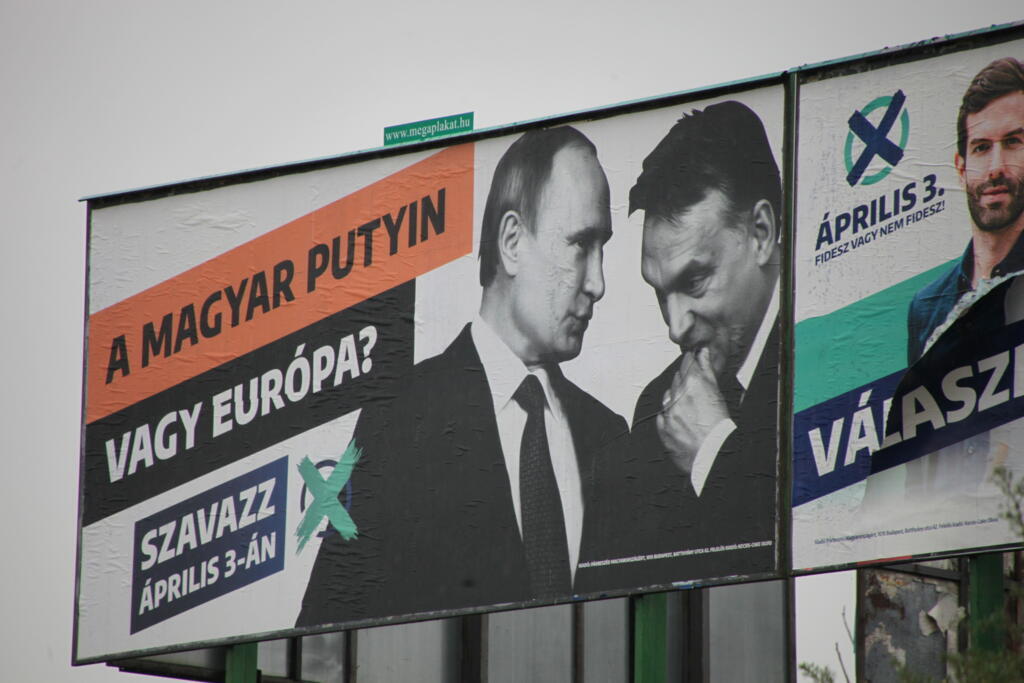 "A Hungarian Putin – or Europe? Vote on 3 April," reads an election poster overlooking a highway outside Budapest, ahead of Hungary's last general election in April 2022. © RFI/Jan van der Made
Brussels not informed
Budapest did not notify Brussels of Orban's visit to Moscow, according to reports.
"No one – at least not Hungary's NATO or EU partners, according to several diplomatic sources – had been informed of the visit. It seems it wasn't coordinated with Washington either," said investigative journalist Szabolcs Panyi, writing for independent Hungarian outlet VSquare.
Orban also visited Moscow in July last year, when Hungary was heading the rotating presidency of the European Council.
Brussels reacted angrily to that trip, saying that Orban had not received any mandate from the EU Council to visit Moscow and that the EU position on Russia’s war of aggression "excludes official contacts between the EU and President Putin".
"The Hungarian Prime Minister is thus not representing the EU in any form," EU foreign policy chief Josep Borrell said in a statement at the time.
From Washington to Warsaw: how MAGA influence is reshaping Europe’s far right
Peace talks
Orban has presented himself as a potential mediator on the Ukraine war and reiterated at his latest meeting with Putin that Hungary was "ready to serve as a venue for peace negotiations".
A summit between Putin and US President Donald Trump was meant to take place in Budapest in October, but never happened. According to Russia's Tass news agency, Putin told Orban that the idea of meeting in Budapest was suggested by Trump.
Orban seeks Trump’s support over reliance on Russian energy amid US sanctions
Orban has criticised Western support for Kyiv and said Ukraine has no chance of winning against Russia. He told Putin on Friday that the almost four-year war is harming Europe's economy and that he hopes the latest diplomatic proposals "will lead to a ceasefire and peace".
Putin has not dropped his demands that Ukraine cede even more land than Russia currently occupies.
Trump's envoy Steve Witkoff is due in Moscow next week to discuss an updated US plan to end the Ukraine war with Putin. The draft plan was initially seen as heeding to most of Putin's demands, but has been reworked by Washington after talks with Kyiv.
(with newswires)
By: Jan van der Made
Orban met Putin at the Kremlin in the midst of a diplomatic push to end the war in Ukraine, his fourth meeting with the Russian president since the 2022 invasion.
In power since 2010, Orban has maintained ties with the Kremlin throughout the conflict, while also criticising Hungary's neighbour Ukraine.
His position is out of step with Brussels, which has called on EU members to end their dependence on Russian energy and is trying to make its voice heard in peace negotiations.
"We have not given up cooperation [with Russia] in any area, regardless of any external pressure," Orban told Putin.
"I would like to reiterate that energy supplies from Russia form the basis of Hungary's energy supply now and will remain so in the future."
Partners in pragmatism
Earlier this month, Orban said he would take the EU to court over a decision to phase out remaining Russian gas imports to the bloc.
Budapest is heavily reliant on Russian energy. "We greatly appreciate the reliability and predictability of these supplies," Orban said.
Putin called Russia's energy cooperation with Hungary "a cornerstone" of the partnership between the two countries, according to a transcript of the meeting on the Kremlin website.
Putin thanked the Hungarian leader for what he called Hungary's "balanced position" on Ukraine and for maintaining ties with Russia "despite all the difficulties".
He said Budapest-Moscow ties were based on "pragmatism".
Orban – who is facing re-election in April next year – said ahead of his trip that he was going to Moscow to "ensure Hungary's energy supply is secured for the winter and the following year at an affordable price".
"Brussels not informed
Budapest did not notify Brussels of Orban's visit to Moscow, according to reports.
"No one – at least not Hungary's NATO or EU partners, according to several diplomatic sources – had been informed of the visit. It seems it wasn't coordinated with Washington either," said investigative journalist Szabolcs Panyi, writing for independent Hungarian outlet VSquare.
Orban also visited Moscow in July last year, when Hungary was heading the rotating presidency of the European Council.
Brussels reacted angrily to that trip, saying that Orban had not received any mandate from the EU Council to visit Moscow and that the EU position on Russia’s war of aggression "excludes official contacts between the EU and President Putin".
"The Hungarian Prime Minister is thus not representing the EU in any form," EU foreign policy chief Josep Borrell said in a statement at the time.
From Washington to Warsaw: how MAGA influence is reshaping Europe’s far right
Peace talks
Orban has presented himself as a potential mediator on the Ukraine war and reiterated at his latest meeting with Putin that Hungary was "ready to serve as a venue for peace negotiations".
A summit between Putin and US President Donald Trump was meant to take place in Budapest in October, but never happened. According to Russia's Tass news agency, Putin told Orban that the idea of meeting in Budapest was suggested by Trump.
Orban seeks Trump’s support over reliance on Russian energy amid US sanctions
Orban has criticised Western support for Kyiv and said Ukraine has no chance of winning against Russia. He told Putin on Friday that the almost four-year war is harming Europe's economy and that he hopes the latest diplomatic proposals "will lead to a ceasefire and peace".
Putin has not dropped his demands that Ukraine cede even more land than Russia currently occupies.
Trump's envoy Steve Witkoff is due in Moscow next week to discuss an updated US plan to end the Ukraine war with Putin. The draft plan was initially seen as heeding to most of Putin's demands, but has been reworked by Washington after talks with Kyiv.
(with newswires)
Viktor Orban heads to Moscow to secure energy supplies for Hungary

Hungarian Prime Minister Viktor Orban flew to Moscow in the early hours of November 28 to meet Russian President Vladimir Putin, aiming to guarantee Hungary’s energy supply for the winter and the coming year at affordable prices.
Posting on social media, Orban said Hungary relies on Russian gas and oil delivered via pipeline and that energy prices remain the lowest in Europe, thanks to access to relatively cheap Russian sources.
"Off to Moscow!" the prime minister wrote on Facebook. "Energy security, and affordable, low energy prices in the winter in Hungary - that's why we went to Washington, and that's why I'm going to Moscow now too."
Recent US sanctions on Russian energy firms had required diplomatic efforts in Washington to secure exemptions for Hungary.
When asked whether peace issues would arise in the discussions, Orban said they could not be avoided, online business outlet VG reported.
Foreign Minister Peter Szijjarto stressed that maintaining this energy cooperation is a national priority, noting that without it, household energy bills could triple. Hungary has imported 8.5mn tonnes of crude oil and over 7bcm of gas. Long-term security is also supported by new nuclear blocks at the Paks plant, which has received an exemption from US sanctions, he added
Analysts contend that Hungary could cut its dependence on Russian oil without compromising energy security or state revenues, but maintaining existing contracts remains financially simpler and politically expedient, G7.hu wrote.
The meeting between the Hungarian and Russian leaders underscores that, despite external pressure to diversify away from Russian fossil fuels, Hungary prioritises supply stability amid global market volatility.
Currently, Russian crude makes up over 90% of Hungary’s oil imports. Both the government and MOL have benefited from lower Russian crude prices, with the state imposing a 98% windfall tax on MOL’s profits from the Ural-Brent price spread. However, motorists have seen little benefit from that, as domestic fuel prices now exceed regional averages, even before taxes are factored in.

.jpg)
No comments:
Post a Comment